I spent most of Friday watching games I didn't much care about, with the exception of Arkansas/LSU, about which I had mixed feelings. LSU is a team I like, and generally root for whenever they're not playing the Gators. This goes back to the days of Billy Cannon and three-platoon football, featuring the Chinese Bandits. Today, I still find much to admire aesthetically about LSU's game, featuring compact, agile players who execute a well-balanced offense and a quick, swarming defense. The Bayou Bengals occupy the same space for me in college football that the Cardinals do in my baseball universe.
Be that as it may, I had reason to want Arkansas to win. The Hogs are already slated to play Florida in the SEC championship game next week, and a win over a once defeated (and still theoretical title contender) team would do the Gators more good in the BCS standings than one over a twice defeated team. So I watched the game with my amygdala shouting "Geaux Tigers!" while my cerebrum whispered "Soo-ee-ee."
It was my amygdala that got to celebrate. Meanwhile, my cerebrum is forced, once again, to recalculate Florida's chances in the SEC showdown. I'm now backing off my previous waver, and am sticking with my original prediction of an upset by Arkansas. Losing to LSU will make the Hogs hungrier and more focused.
Today we were on the road, so I missed the Florida/Florida State game. The outcome, a 21-14 Gator victory over a Seminole team having a miserable season, will not do Florida's cause in the BCS any good. That, coupled with the fact that beating a twice-defeated Arkansas won't do them as much good as if the Razorbacks had beaten LSU, means the Gators' prospects of a shot at the national championship look to be pretty much obliterated. On top of that, we have the news from L.A. (Once again, I was rooting for the Irish, despite earlier animosity.)
Once again, consolation is provided by my alma mater showing, for the second consecutive year, their ability to upset a team ranked in the top ten. Their appearance in some minor bowl now seems assured. Ignore the hype about this meaning Rutgers still has a shot at the BCS. The Scarlet Knights beat an even worse than usual Syracuse team yesterday, and the Mountaineers aren't about to let themselves be upset twice in a row in Morgantown.
Saturday, November 25, 2006

Tuesday, November 21, 2006
I break holiday radio silence briefly ...
... to note that Mickey Kaus has attempted to explain something that has long puzzled me (indeed, I've posted about it here, but am too lazy to look up the post), which is: how can an exception prove a rule? (Scroll down to his November 20 discussion of the "incumbent rule" and Menendez's victory in New Jersey, following this link.)
According to Kaus, an exception can "prove" a rule if the "exception" can be shown to be in some basic way distinguishable from other possible exceptions. Specifically, Kaus posits the "incumbent rule" in predicting election results, which holds that if the incumbent has less than 50% in the final pre-election poll, he or she will lose, because undecideds always break against the incumbent. He then says Menendez is "the exception that proves the rule .. because ... he had only been in office a few months, having been appointed in January, 2006 to the seat vacated by now-Gov. Corzine."
Well, as the nerds in my law school classes always said when the professor called on them, it seems to me that Menendez doesn't prove the "incumbent rule", he simply provides a basis for narrowing it to exclude those whose incumbency has been brief, or possibly all those whose incumbecy is a result of appointment not election. More importantly, it seems that the incumbent rule isn't a "rule" that can be proven (in the sense that a Euclidean theorem can be proven), but rather a theory that can be supported, though never "proved", by empirical means, and can be falsified by contrary evidence. What Kaus is really saying is that Menendez doesn't falsify the incumbency rule if "incumbency" is defined in a strict way. Of course, the "rule" would be falsified if, in a future election, someone who has less than 50% in the last pre-election poll and has held office for a full term or more, still manages to win.
So, I'm still looking for an exception that proves a rule. Anyone who can give me a satisfactory one may have my mid 1960s vintage edition of Copi & Gould's Introduction to Logic (provided I can find it).
Update: Keifus, helpful as always, suggests that an exception "proves" a rule in the sense that it tests it, rather as a new kind of car is put on a test track to prove its driving characteristics. So, what Kaus is saying is that Menendez's re-election "proves" the incumbency rule in this sense, which differs from my more formal definition of proof.
I think this is kind of like saying, "What doesn't kill you makes you stronger", no?
Monday, November 20, 2006
A joyous Thanksgiving to all.
I'm taking a break from blogging for the next few days, in order to prepare for and enjoy the holiday (we'll be visiting friends in Maine). I'll leave you with this autumnal scene, taken the weekend before last, of an encampment of Civil War re-enactors on the lawn of Plymouth Church of the Pilgrims, here in Brooklyn Heights. The statue in the background is of Henry Ward Beecher, the fiery abolitionsist preacher who made Plymouth Church a center of opposition to slavery in the years preceding the Civil War.

The unit these re-enactors have recreated is the 14th Regiment, a New York militia unit formed in Brooklyn. Their colorful zouave uniforms, and their courage in battle, got them nicknamed the "Red Legged Devils". You can read more about the unit's history here.
Below is a closer view of the encampment.

Saturday, November 18, 2006
College football yuck!
Everything turns out as I feared it might; i.e. Rutgers falls to Cincinatti and my USF Bulls get roughed up by Louisville.
All I can hope for now is that the Gators (1) don't get upset by FSU next week (that seems reasonably safe), (2) manage to beat Arkansas in the SEC championship game (I've already predicted they won't, but I'm beginning to waver), and (3) beat the Buckeyes in the BCS championship. I know, dream on ...
Meanwhile, I'm going to my room to sulk.
Update: It now appers that, before the Gators can get a shot at the Buckeyes, not only do they have to beat FSU and Arkansas, but bad things must also happen to both Michigan (getting beaten by Ohio State once wasn't enough) and USC.
Time to focus on the Hot Stove League. The Mets are making some interesting moves.
Friday, November 17, 2006
Another loss for the dismal science.
The year 2006 has seen the passing of two towering figures in economics, one, John Kenneth Galbraith, literally so, the other, Milton Friedman, who died yesterday, having an effect on the discipline far in excess of his height. As they differed in stature, so did their views on most issues.
My friend Amity Shlaes has this appreciation of Friedman in today's Sun.
Update: In this Slate article, Michael Kinsley says Friedman was wrong, and Galbraith right, about the ability of free capital markets to price correctly publicly traded equity.
Update squared: Fray friend Rundeep has an answer for Kinsley.
Didn't get the memo?

Walking through Battery Park, at the southern tip of Manhattan, this morning, I spotted this bird calmly watching passers-by on the footpath, and evidently unaware of the impending holiday.
OK, you don't believe this is a real, live bird? Here it is a minute before the previous shot.

Update: Rundeep points out that wild turkeys are once again common in the eastern states. I know this is true, because whenever we've made a wintertime visit to my in-laws, who moved to Massena, New York a couple of years ago, we've seen a flock of turkeys traversing their back yard, heading next door to where their neighbor puts out food for them.
Several things struck me as odd about this bird. First, although it was on a bit of parkland, it was in the most densely urbanized place in North America. Second, it was alone, while wild turkeys are usually seen in flocks. Third, it displayed no wariness of the people walking by on a path only thirty or so feet away. Finally, while it had the coloration of a wild bird rather than the white plumage of most farm-raised ones, it looked very well fed.
The dark side of the Force.
A couple of years ago, NASA was ready to give up on the Hubble Space Telescope, apparently content to allow it to go dark. Now, there are plans to repair it so it can keep doing what it does so well. Its value has just been made more evident by the images it has captured of supernovae in galaxies so distant that their light has taken half the estimated age of the universe to reach earth. As related in this article, the red-shifting of the light from these supernovae shows that the expansion of the universe has been accelerating over time. This can be explained by positing the existence of a contra-gravitational force called "dark energy". Einstein, in his theoretical work, once concluded that there is such a force, but later called this his "greatest blunder". It appears now that he was right the first time.
Here is a Hubble image of a supernova remnant, the Crab Nebula, in our own galaxy.
Here is a Hubble image of a supernova remnant, the Crab Nebula, in our own galaxy.
Thursday, November 16, 2006
The Irish Hunger Memorial
The Irish Hunger Memorial is in Battery Park City, on the west side of lower Manhattan. Approaching it from the southeast, one gets the impression of a sod and boulder covered spaceship having crashed to earth there.

Supporting the slab that holds the stone and earth above are walls of black stone striated with white bands on which are quotations about the Irish famine and other instances of starvation or mass death caused or exacerbated by government policy.
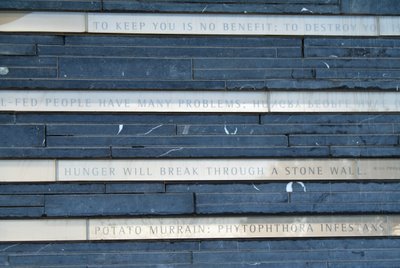
The entrance is through a tunnel lined by the same striated walls bearing more quotations. The effect is supposed to be like entering one of the ancient Irish barrow graves; having visited Newgrange, I can attest to its success.
 On entering the tunnel, one hears part of a continuous taped program that includes voices reading commentary about the famine, poetry, singers performing ballads a capella and mournful tunes played on keening tin whistle.
At the far end of the tunnel, one emerges into the roofless ruin of a typical Irish farmer's cottage of the time of the famine. This is the actual ruin of the Slack family cottage, which was taken apart, shipped to New York and reassembled.
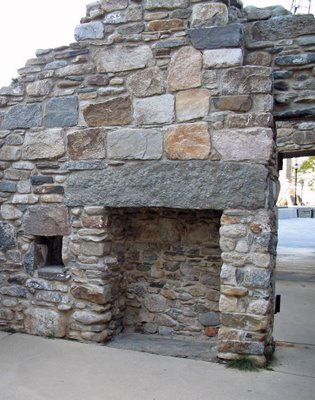
On leaving the cottage, one steps onto a path that follows a reverse "S" shaped course to the top of the Memorial. The ground through which the path wends is covered with plants native to Ireland, grown from seeds brought from there. Strewn among the plants are large stones, each inscribed with the name of its county of origin.

Rounding the first curve of the "S", one comes to face a standing stone engraved with the cross of St. Brendan.
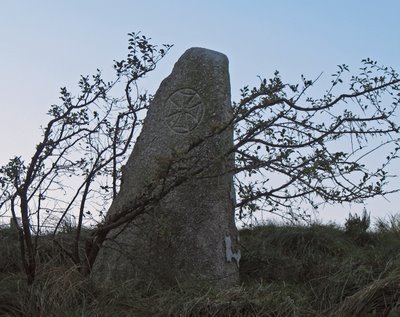
Brendan was a sixth century Irish monk who, according to tradition, set out on a seven year sea voyage with several other monks in a currach, a frail vessel made of oxhide stretched over a framework of sticks. Legend has it that Brendan and his companions reached a distant island, which some now believe to have been in the Canaries and others think was Newfoundland. In 1976, an adventurer named Tim Severin set out from Ireland in a currach built to the same specifications as those made in the sixth century, and did manage to reach Newfoundland in June of 1977. An account of his voyage is here.
If Brendan did land in the New World, he was four centuries ahead of Lief Ericsson, and odds on the first European to make the voyage. Perhaps more significantly, he pioneered the route taken centuries later by many thousands of his compatriots, the largest number of which left their native land because of the Great Hunger of the late 1840s, which, through starvation and emigration, reduced Ireland's poplation by one fourth, and which increased the population of New York City by an appreciable amount.

Supporting the slab that holds the stone and earth above are walls of black stone striated with white bands on which are quotations about the Irish famine and other instances of starvation or mass death caused or exacerbated by government policy.

The entrance is through a tunnel lined by the same striated walls bearing more quotations. The effect is supposed to be like entering one of the ancient Irish barrow graves; having visited Newgrange, I can attest to its success.
 On entering the tunnel, one hears part of a continuous taped program that includes voices reading commentary about the famine, poetry, singers performing ballads a capella and mournful tunes played on keening tin whistle.
At the far end of the tunnel, one emerges into the roofless ruin of a typical Irish farmer's cottage of the time of the famine. This is the actual ruin of the Slack family cottage, which was taken apart, shipped to New York and reassembled.

On leaving the cottage, one steps onto a path that follows a reverse "S" shaped course to the top of the Memorial. The ground through which the path wends is covered with plants native to Ireland, grown from seeds brought from there. Strewn among the plants are large stones, each inscribed with the name of its county of origin.

Rounding the first curve of the "S", one comes to face a standing stone engraved with the cross of St. Brendan.

Brendan was a sixth century Irish monk who, according to tradition, set out on a seven year sea voyage with several other monks in a currach, a frail vessel made of oxhide stretched over a framework of sticks. Legend has it that Brendan and his companions reached a distant island, which some now believe to have been in the Canaries and others think was Newfoundland. In 1976, an adventurer named Tim Severin set out from Ireland in a currach built to the same specifications as those made in the sixth century, and did manage to reach Newfoundland in June of 1977. An account of his voyage is here.
If Brendan did land in the New World, he was four centuries ahead of Lief Ericsson, and odds on the first European to make the voyage. Perhaps more significantly, he pioneered the route taken centuries later by many thousands of his compatriots, the largest number of which left their native land because of the Great Hunger of the late 1840s, which, through starvation and emigration, reduced Ireland's poplation by one fourth, and which increased the population of New York City by an appreciable amount.
Tuesday, November 14, 2006
Go West, by God!
Every once in a while I find a blog that's worth special mention, and the latest is The Goat Rope. El Cabrero serves up an irresistable combination: intelligent socio-economic-political commentary accompanied by heartwarming animal pictures.
Besides, he's from West Virginia. I'm not, but I was born in central Pennsylvania, not very far away, geographically or metaphysically. Montani semper liberi!
Update: It looks like E.C. and I might lock horns on some trade issues (see my comments on "economic nationalism" below), but I still suspect we're in agreement on more things than not.
Thursday, November 09, 2006
Exit Nine divine! Rutgers a BCS contender?
Read it and believe.
Well, the Scarlet Knights had tradition on their side. It's been 137 years and three days since they won the first college football game ever played.
Update: Downside, for me, is that Louisville's next game is against my alma mater, South Florida, which, you may recall, beat the Cardinals last year when Louisville was undefeated and ranked number nine. So, the Cards will be doubly primed for revenge. It could be really ugly for the Bulls.
Next week, Rutgers faces Cincinnatti. The Bearcats (who play west Virginia tomorrow, and therefore will be coming off either a great upset or an expected defeat) are a prime upset suspect, i.e. a team it's easy to underestimate. If the Knights survive that encounter undefeated, they next must beat Syracuse, which is having a bad season, but is an inconsistent team capable in any given game of puling off a surprise. It will be the Orangemen's final game of the year, which may motivate them to play above their usual level. Rutgers' final test, on December 2, is against West Virginia, in Morgantown. Even if the Knights are still undefeated going into this one, they're likely to be considered underdogs.
I'm not going to attempt an answer to the question in the caption of this post. I will predict that, if they make it to the BCS championship game, they'll lose. Cinderella teams always do.
Extra update: The Gators won, but Urban Meyer may still have lost some weight in the cliffhanger with Spurrier's Gamecocks. USF pummeled 'Cuse, thereby strengthening their case for another minor bowl bid, and the "Dump Bowden" crowd in Tallahassee got a big boost from the Demon Deacons.
Wednesday, November 08, 2006
Mandatory post-election comments.
The Bush press conference just ended. He handled it better than I expected. The cockiness and the smirk were gone, though the customary jocularity broke through a few times. He seemed contrite, but not by any means abject.
He was best at handling attempts to embarrass him by citing campaign rhetoric, both Democratic and his own, and asking him how he could work with the new legislative leadership based on what had been said. He was also deft in handling questions arising from his assertion to three reporters, a few days before the election, that Rumsfeld would stay at Defense.
He did artfully dodge one question, which was about disillusion on the part of religious conservatives with his administration. He pretended not to know what the questioner meant, then mumbled something about his continued commitment to "faith-based initiatives" relating to social services. He wasn't about to be drawn into a discussion about abortion, stem-cell research and gay marriage.
About the last mentioned, Glenn Reynolds and I find our libertarian instincts in agreement.
This year, it's Virginia's turn in the barrel. I hope the Old Dominion handles it better than my old home Sunshine State did in 2000.
No surprises here in New York, except maybe Hevesi's margin of victory despite his ethical lapse, which I think many viewed as simply business as usual in Albany. I was surprised, however, on scanning the voting machine, to find that an old friend I had lost touch with several years back was the Green Party candidate for Attorney General (on a ticket headed by the founder of the Bells of Hell).
Update: Jacob Weisberg, in Slate, finds a dark lining on the silver cloud: many newly-elected Democrats are economic nationalists.
Counterpoint: Kausfiles, in a critique of Weisberg's article, links to an excellent post on Real Clear Politics by former Oklahoma Democratic Congressman Brad Carson. Carson's argument is that illegal immigration (Kaus's fave hobby horse for the past several months) is greatly amplifying the negative effects of globalization on America's large body of unskilled and semi-skilled labor market participants, and making us liberals' preferred palliatives (short-term adjustment grants, minimum wage increases and, most importantly, increased funding for education and retraining) both less effective and more expensive. An unstated conclusion is that this is likely to lead to increased pressure for protectionism in markets for goods and non-labor services.
Monday, November 06, 2006
Color guard for a parade that wasn't.

This powerful Army Corps of Engineers tug, flying a plus-sized flag, was meant to lead the WW II veteran aircraft carrier Intrepid as she was towed from her berth on the West Side of Manhattan to Bayonne, New Jersey, where she is to undergo extensive repairs. Unfortunately, despite an unusually high tide in the Hudson estuary this morning, Intrepid's propellors dug into the mud that has built up around her berth over the years, and the move had to be postponed. There will be another attempt in December. (Photo taken from the Irish Hunger Memorial, about which I'll be posting in the near future.)
Sunday, November 05, 2006
QM 2 again, The Bridge again, autumn flowers and kayaks on the East River.

Queen Mary 2 was back at the Brooklyn Cruise Terminal today. The late afternoon sun highlighted her British Merchant Navy "red duster", fluttering from the staff at her stern, quite nicely.

Another view of Brooklyn Bridge, from further up Old Fulton Street. The white building in the foreground, One Front Street, once was a bank. In recent years it has been home to several restaurants and night clubs. The legendary Patsy Grimaldi's pizzaria is further down Old Fulton; the entrance is, in the photo, just below the traffic light.

These flowers were blooming in the small strip of parkland that borders the Brooklyn Heights Promenade on the inland side.

The East River (actually a strait linking Upper New York Bay to Long Island Sound) used to be regarded as unfit to travel in anything smaller than a Circle Line boat; the only bodies that came in contact with it were Brooklyn Bridge jumpers and those wearing cement overshoes. Nowadays, it's becoming a popular site for kayaking, as seen in this photo.
Saturday, November 04, 2006
College football quickie.
Florida gets by Vandy (I was cautionary about this), and wins SEC East with help from former victim LSU. My out-on-a-limb prediction is that if Arkansas wins the West, the Gators will fall to the Razorbacks in the championship game. If it turns out to be a rematch against Auburn, my crystal ball is clouded.
Seminoles, looking more like Roundheads, vent their spleen on Cavaliers.
USF beats Pitt. Been there, done that before. Can they beat Syracuse next week?
Rutgers has a bye before Louisville. Scarlet Knights' glory run likely to end Thursday night.
Nos. 1 and 2 both win narrowly against lightly-regarded opponents.
Joe Paterno literally, and Penn State figuratively, take a fall. Does this make Joe's retirement more or less likely to happen soon?
Friday, November 03, 2006
Skidmore, Owings & Merrill retrospective.
Another Slate link well worth pursuing takes you to this slide show, compiled by Witold Rybczynski, which documents SOM's contributions to architecture over the past sixty years. The show also includes pictures of buildings (including a tear-inducing interior shot of the original Penn Station) by SOM's predecessor as America's pre-eminent architectural firm, McKim, Mead & White.
Thursday, November 02, 2006
The best cut is the cheapest.
Slate has a piece by Mark Schatzker on the searing question for us carnivores: what makes for a good steak?
There are several variables considered: breed of cattle, hormones or not, wet vs. dry aging of meat, and, perhaps most important, what the cattle are fed. Schatzker and others (he writes, "We sampled ...", and notes that, except for him, because "Someone had to keep track of things", the tasting was blind) tried five rib eye steaks from four producers (two were a wet and a dry aged cut from the same producer, who "finishes" cattle in a feedlot; these were rated fifth and fourth, respectively, in the taste test) and ranked them.
And the winner was ... grass-fed (i.e. "free range"), hormone-free, mixed-breed (mostly Red Angus), presumably (Schatzker doesn't say) dry-aged beef from the Alderspring Ranch in Idaho. Surprisingly, this was the least expensive of the five, at $21.50 per pound. By contrast, the feedlot finished dry aged beef that placed fourth costs $35 per pound.
Placing second is the second least expensive beef, at $26.70 per pound: "humanely" feedlot finished by Niman Ranch. Unlike "industrial" feedlots, Niman's are less crowded and have shade and showers. The cattle are fed a mixture of grains, instead of the pure corn (maize for readers who use the Queen's English) diet that prevails in the big lots. Moreover, the cattle are given an extra year to enjoy their comfy surroundings, as Bill Niman thinks more aging on the hoof improves the meat.
My surmise is that the relative cheapness of the grass-fed and humane feedlot beef is a temporary anomaly, reflecting consumer ignorance and reliance on USDA grades, which are based solely on the fat content, or "marbling", of the meat. The grass-fed steaks rated highest in Schlatzky's test had the least marbling. The Niman steaks rated second had the most, but Bill Niman won't put a USDA grade on his beef because he "doesn't believe in the direct correlation between marbling and eating quality." (The outcome of Schlatzky's test supports this hypothesis.)
In the long run, however, if consumers discover the superiority of grass-fed beef, its price will go up. This will be not only because of increased demand, but also because of the resulting pressure on the supply of pasture land. This will also affect the price of beef finished on larger, more humane feedlots. Perhaps the best hope for us carnivores who worry about such things is the prospect of meat grown in vitro. I suspect it will be many a year before this can approach the quality of beef raised on the hoof.
Wednesday, November 01, 2006
The Merchant Marine Memorial.

This memorial, by the sculptor Marisol, is positioned just off the northern end of the pedestrian promenade that extends around the seaward side of Battery Park, at the southern tip of Manhattan. It depicts three members of the crew of an American merchant vessel that has fallen victim to a German U-Boat, aboard what appears to be a partly sunken lifeboat, with one of them extending a hand to a shipmate who has fallen into the water.
Some 9,300 U.S. merchant mariners are believed to have died in action in World War Two, a higher per capita death rate than for any of the uniformed services.
Tuesday, October 31, 2006
Monday, October 30, 2006
A good day to fly a kite.

The heavy winds that have been battering the Northeast abated some today, but there was still enough of a stout breeze this morning to keep this kite aloft in Battery Park City.
Urban daytime astronomy.
Sounds impossible? Look at today's astronomy picture for a daylight shot of a crescent moon about to eclipse a crescent Venus, taken in Budapest.
Saturday, October 28, 2006
College football bash.
Thank you, MSNBC, for defying authorities academic and municipal by continuing to call the Florida-Georgia game by its proper name, the World's Largest Outdoor Cocktail Party. The Gators came back from their defeat by Auburn, and with two weeks' rest, to continue their recent dominance of the Dawgs. They did this despite an offesnse that keeps sputtering, and a placement kicker who's now in Coach Meyer's doghouse. Next week's opponent is Vandy, which upset Georgia a couple of weeks ago. Florida needs to avoid their usual letdown after a big win (any win over Georgia is big for them), or they may find their top ten ranking scuttled by the Commodores.
FSU, which saw its ranking go a-glimmering long ago, got edged by the Terps to stay in the cellar of its division of the ACC. Mike Celizic is calling for Bobby Bowden's head. He lists several possible replacements, including USF's Jim Leavitt. Speaking of which, the Bulls have a week off to regroup from their disheartening, error-blighted loss to Cincinnatti. Next saturday, they face Pitt.
Still undefeated Rutgers puts its record and ranking at risk against Connecticut tomorrow. John Tamanaha thinks they're safe.
Beavers engulf Trojans. (Sorry, couldn't resist. Oh, and the USC QB is named Booty.)
Update: Exit nine lookin' fine. Rutgers over UConn 24-13 (very close to Tamanaha's predicted 26-14).
Friday, October 27, 2006
Real baseball wins!
The Cardinals of the RBL (Real Baseball League) defeated the Tigers of the DHL (Designated Hitter League), four games to one.
Eat crow, all you pundits who've been touting junior league supremacy.
Update: Twiff avers that crow can be "mighty palatable" so long as its served "with the right sauce". (I wonder if he means the "authorative" sauce they used to serve at Hoboken's late, lamented Clam Broth House?) He also advances the theory that "sweeping the LCS dooms you in the Series".
Tuesday, October 24, 2006
The na-a-a-me game!
I'd have guessed that, since my father's death, I was the last Claude Scales left on earth, much less the U.S. Thanks to a site called "How Many of Me?", I know there are likely to be six in this country. Try it and find out how many Americans probably share your name.
(I thought I got this link off Instapundit, but now I can't find it there. If, as my wife says, it's a case of its being right in front of me and my not being able to see it, my apologies, Glenn.)
(I thought I got this link off Instapundit, but now I can't find it there. If, as my wife says, it's a case of its being right in front of me and my not being able to see it, my apologies, Glenn.)
Monday, October 23, 2006
Another rousing cheer for Stephenie Hollyman
I'm very impressed by this slide show of McAllister tugs, and their crews, docking ships in the Port of New York/New Jersey.
The ship named Patagonian Mystic, seen in the slide show, brings to mind a comment by a friend who grew up in Detroit and used to watch ships sailing by on the river there. He observed that a typical name for a Greek-owned, Liberian-registered "salty" (an oceangoing ship that sails into the Great Lakes through the St. Lawrence Seaway) might be Unicorn Slaughterhouse. (Come to think of it, I've seen Beluga Indication among the names of vessels in transit on the Seaway's vessel transit map.)
Does anyone have any other amusing or interesting ship names to offer?
Sunday, October 22, 2006
The walk home from the parking lot.
We park our car in a lot nestled next to the abutment of the Brooklyn Bridge. Yesterday I took a few pictures walking home from the lot, going a slightly roundabout way via Old Fulton Street and the Brooklyn Heights Promenade.
The Bridge

Great God, the only bridge of power, life and joy, the bridge that was a span, a cry, an ecstasy - that was America.
- Thomas Wolfe, Of Time and the River.
(Quote courtesy of Stephenie Hollyman's magnificent blog, Crossing Media. Groucho Marx observed of Lydia, the tattooed lady, You can loin a lot from Lydia. Just so, I think I'll probably learn much from Stephenie's blog. God bless the electronic frontier.)
Squibb Hill Dog Park

A rare urban free range for canines. The cantilevered Brooklyn-Queens Expressway is in the background.
Autumn comes to Brooklyn
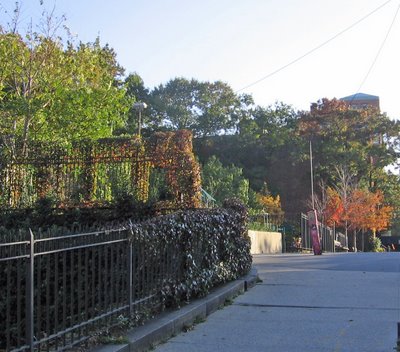
It comes here late, and without the spectacle of New England or Upstate. Still, it has a subtle beauty, as seen in this view along Columbia Heights, looking toward the Harry Chapin Playground.
A harbor workhorse
 Small tankers like this are common in New York Harbor, mostly carrying bunker fuel to ocean-going ships docked here. One of them, the Q Boys, was featured in the original version of Madonna's "True Blue" video (impossible to find on line now, as it's been completely supplanted by a later version). This one was headed up the East River fully loaded, probably delivering fuel from New Jersey to a ship docked somewhere upriver or on Long Island Sound, or perhaps carrying heating oil to a supplier in that direction.
The Bridge
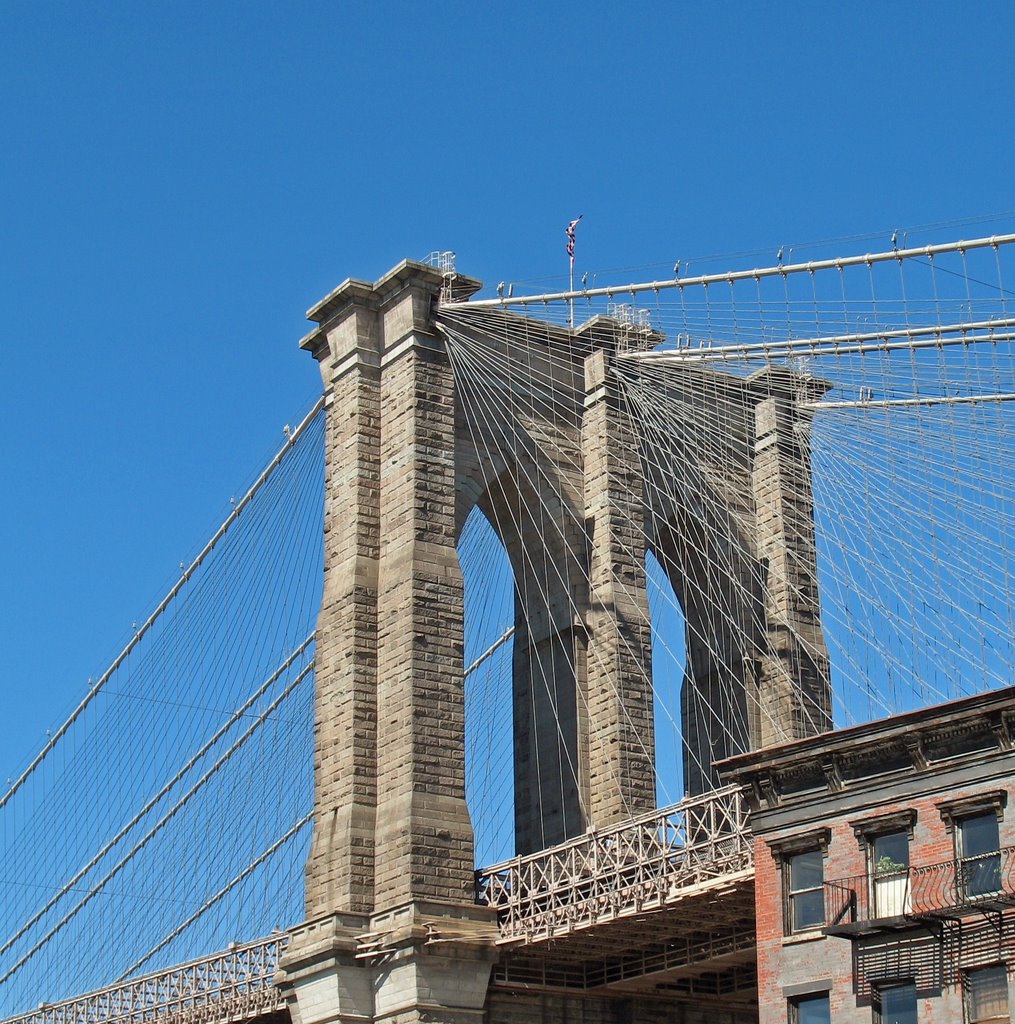
Great God, the only bridge of power, life and joy, the bridge that was a span, a cry, an ecstasy - that was America.
- Thomas Wolfe, Of Time and the River.
(Quote courtesy of Stephenie Hollyman's magnificent blog, Crossing Media. Groucho Marx observed of Lydia, the tattooed lady, You can loin a lot from Lydia. Just so, I think I'll probably learn much from Stephenie's blog. God bless the electronic frontier.)
Squibb Hill Dog Park

A rare urban free range for canines. The cantilevered Brooklyn-Queens Expressway is in the background.
Autumn comes to Brooklyn
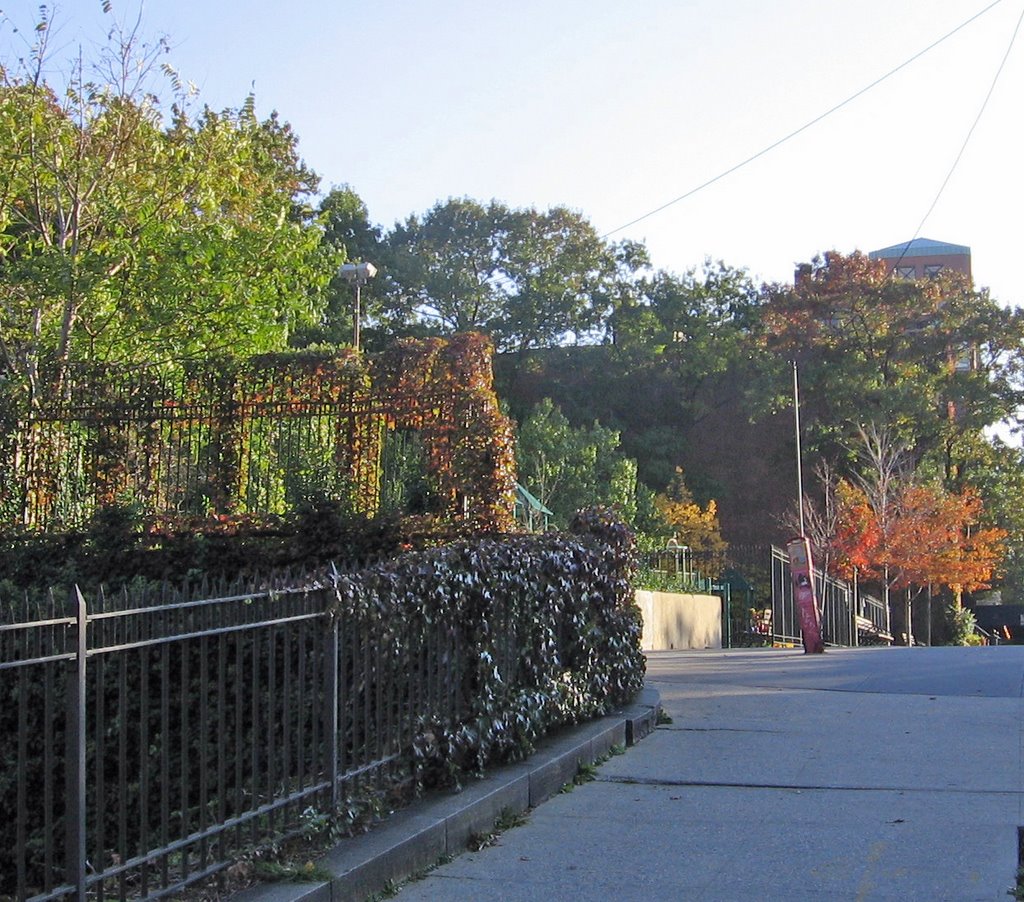
It comes here late, and without the spectacle of New England or Upstate. Still, it has a subtle beauty, as seen in this view along Columbia Heights, looking toward the Harry Chapin Playground.
A harbor workhorse
 Small tankers like this are common in New York Harbor, mostly carrying bunker fuel to ocean-going ships docked here. One of them, the Q Boys, was featured in the original version of Madonna's "True Blue" video (impossible to find on line now, as it's been completely supplanted by a later version). This one was headed up the East River fully loaded, probably delivering fuel from New Jersey to a ship docked somewhere upriver or on Long Island Sound, or perhaps carrying heating oil to a supplier in that direction.
How baseball history was made on my street.
Brooklyn Heights Blog ran a piece a few days ago on Jackie Robinson's signing with the Brooklyn Dodgers in 1945 at what was then Dodger headquarters, 215 Montague Street (four blocks from where I live).
I was amused by the look on Branch Rickey's face in the photograph, but then read in this bio that The Mahatma, like Tony LaRussa, was a law school grad. He's obviously taking the opportunity to give Mr. Robinson a bit of free legal advice.
I was amused by the look on Branch Rickey's face in the photograph, but then read in this bio that The Mahatma, like Tony LaRussa, was a law school grad. He's obviously taking the opportunity to give Mr. Robinson a bit of free legal advice.
Friday, October 20, 2006
"The Catch"
Endy Chavez's spectacular, leaping catch in the final NLCS game, doomed to be a footnote because of the Mets' loss, is compared in this Slate article to Willie Mays' magnificent running, reaching and pivoting catch in game one of the 1954 World Series.
I must have watched the '54 Series. My parents and I had just returned from England, where my dad had been stationed in the Air Force, and I was in third grade at Eglin Air Force Base Elementary School, where, during the World Series, we were excused from class to go to the "cafetorium" where a TV was set up (all Series games were played in the afternoon, then). However, I don't remember anything about it. I was just learning about baseball, while unlearning cricket and rounders. Neither the Giants nor the Indians captured my fancy.
The first Series I remember came the following year. By then I knew that the Yankees were the big, bad bullies, and the Dodgers the scrappy underdogs the Yanks had always slapped down. Besides, Brooklyn was the first place I'd touched U.S. soil after our return. So, I rooted for the Dodgers, and was rewarded. For me, "The Catch" will always be the one Sandy Amoros made in game seven of the '55 Series. (I love the Bob Gibson quote that starts the article.) The poet and Brooklynite Marianne Moore gave it a prominent mention in her celebratory "Hometown Piece for Messrs. Alston and Reese."
As a Mets fan - I consider them the Brooklyn Dodgers continued by other means - I am saddened that Molina's homer erased the prospect of Endy's catch becoming as iconic (if not as artful) as Sandy's.
Go Cardinals!
Not that I have anything against Detroit. It's just that they're in the league that plays a debased version of the game; one in which strategy has been sacrificed to short attention spans.
Update: The Cards got off to a good start last night, which was particularly important because they started a rookie pitcher with a questionable record, but who happened to have the only fully rested arm available.
Fray colleague JMB weighs in on my side in the DH rule contoversy, but backs the Tigers because he's Detroit born and raised. Fair enough. I give my wife a pass to support an AL team because she's from Massachusetts.
Update-update: Unfortunately, there are bad precedents concerning winning the first and losing the second game of a series in this post-season. Just ask Joe Torre and Willie Randolph. I hope Tony LaRussa's law degree will help him distinguish the Cards' case.
As for Twiff's (scroll down) arguments in favor of the DH, I have these replies: (1) it makes the game more interesting; and (2) there's something wrong with a low ERA?
Update-update-update: Twiff (scroll down s'more) comes right back at me. OK, I'll freely admit that the AL game is, as a general proposition, tougher on pitchers than the NL version. By the same token, though, it's got to be easier on batters. I haven't seen a comparison of batting averages of players who switch leagues, but I'd be willing to wager that those going American to National see their averages decline more often than not. As anecdotal evidence, I can think of Roberto Alomar, who batted in the high .200s his first three years at San Diego, then, after moving to the AL, batted .300 or better for nine of eleven seasons (the other two he batted .295 and .282), but whose average plummeted to .266 when he returned to the NL in 2001. Then there's Eddie Murray, whose average bounced around the .300 mark over his twelve years in Baltimore, then plunged to .247 his first year with the Dodgers. (He did bounce back and have a career high average of .330 his second year in LA; I guess the sunshine did him good. But the following year he was back down to .260.)
When all is said and done, I guess it comes down to whether you prefer a game with lots of hitting and scoring or one with lots of subtleties and strategy. I'm in that camp that enjoys "little ball"; for example, seeing a pitcher lay down a perfect bunt with one out (there are many pitchers who can do it), or seeing a manager having to decide whether to pinch hit for a pitcher who's been throwing well with a tie game in the sixth or seventh. I even enjoy seeing a pitcher surprise everyone by hitting a home run, as Bronson Arroyo, new to the NL, showed he could do twice this year.
Subscribe to:
Posts (Atom)