Rob Reiner (1947-2025) will, for me, always be the maker of three of my favorite movies: This is Spinal Tap, in which he played the narrator of a "mockumentary" about the U.S. tour of "Britain's loudest band"; When Harry Met Sally, which his wife, Michele, who died with him, convinced him to give an upbeat ending, and in which his mom, in a cameo, gave an unforgettable line at the end of the Katz's Deli scene; and The Princess Bride, with its wedding scene that rivals the one in another of my favorites, Alan Arkin's and Jules Feiffer's Little Murders. I haven't seen A Few Good Men, but it's on my list because, as Alissa Wilkinson notes in her Reiner "appraisal" in today's New York Times,
it’s really in movies like “A Few Good Men” that you can see his notion of what makes for real goodness shine through: not getting everything perfect, or fixing the world, but more simply standing up to powerful people who hurt the weak.
Robert Reich reminds me of something I'd forgotten, or more likely never focused on, which is that early in Reiner's acting career he played Michael Stivic, Archie Bunker's "Meathead" son-in-law, in "All in the Family". In the video clip above, courtesy of Reich, I see that Arch (Carroll O'Connor) and I had something in common: at least a mild form of OCD.
Jimmy Cliff, born James Chambers in 1944during a hurricane that destroyed his mother's house in St. James, Jamaica, died today at age 81. His first recorded song, when he was 14, appropriately was about a hurricane. After that he tried various musical styles, including covers of pop and rock hits and some original songs, with some success. After living in London for several years he returned to Jamaica. Thanks in part to his longstanding relationship with record producer Leslie Kong he began making music that appealed to Jamaican audiences.
In 1972 he became a movie star, playing Ivanhoe "Ivan" Martin, a young man like Cliff who came from poverty and tried to make it in music, but unlike Cliff, was cheated by crooked agents and producers and so turned to dealing drugs. The movie, The Harder They Come, produced by Perry Henzell, had a spectacular soundtrack that was released as an album in 1973. It includes cuts by Cliff as well as other reggae stars, including Desmond Dekker and Toots and the Maytals.
The songs best remembered from the soundtrack are the uptempo, optimistic ones, the title track and "You Can Get It If You Really Want". But Cliff's music also reflects the difficulties he faced growing up, and knew he continued to face even after achieving success. For example, there's "Many Rivers to Cross," the song in the video at the top of this post.
Kris Kristofferson, songwriter, singer, and actor, died yesterday at 88. I put "songwriter" before "singer" because that's how he had his greatest success in music. In the clip above he sings my favorite of his songs, "Sunday Morning Coming Down," in a memorial concert for Johnny Cash, his friend and mentor, who had a hit with it in 1972. He also wrote "Me and Bobby McGee," a posthumous hit for Janis Joplin in 1971. My friend Marshall Chapman mentions another of his songs in what I consider her signature song, "Why Can't I Be Like Other Girls?" She recalls trying to make it as a singer and songwriter in Nashville. One night she's performing at "the Doubleknit Bar" (very '70s) when some lout calls out, "Hey, little miss, sing one by Kris/ I'll help you make it through the night/ But I had written the song/ And when he couldn't sing along/ I knew I had it coming all right."
Kristofferson had a prolific second career as an actor, appearing in over fifty movies. A favorite of mine is Alice Doesn't Live Here Anymore (1974), in which he plays a rancher who has a stormy but ultimately successful relationship with the widowed mother Alice, played by Ellen Burstyn, who wants to make it as a singer. In the 1976 version of A Star Is Born he played opposite Barbra Streisand, and sings this lovely duet with her:
Alan Arkin, who died last Thursday at 89, was blessed with many talents. Before his career as an actor began in earnest he played guitar and sang as part of a folk group called the Tarriers, who were formed from a group of musicians who would gather in Washington Square Park in the mid 1950s to play and to share songs. You can read more about the Tarriers and about my encounter with Erik Darling, who had been a member of the group, here
A big break came for the Tarriers when Art D'Lugoff, music promoter and owner of the Village Gate cabaret, asked them to back Vince Martin on "Cindy, Oh Cindy." (You can read about my duet with Vince, which came courtesy of Rick Danko, here.) The song was co-written by Robert Nemiroff and D'Lugoff's brother, Burt, under the pseudonyms Robert Barron and Burt Long. The record was released in 1956 and reached the top ten in the pop chart that year. It was quickly covered by Eddie Fisher, whose version also charted. In my memory, I associate the song with Boy Scout camp in the summer of 1957. Here's the Martin/Tarriers version, with Arkin on guitar and harmony vocals:
The Tarriers followed "Cindy" on their own in early 1957 with "The Banana Boat Song" which made it to number four on the pop chart. Almost contemporaneously, Harry Belafonte released "Day-O (Banana Boat Song)" which charted at number five, but is better remembered than the Tarriers' version today. Here's the Tarriers' version:
Note that the record label lists the authors of the song as "Arkin-Carey-Darling." Bob Carey, who along with Arkin and Darling made up the Tarriers, was Black. I had assumed that he was the lead vocalist on "Banana Boat," but in this interview he said it was Arkin.
Carey also said that the Tarriers, with the lineup of himself, Arkin, and Darling, did a version of "Tom Dooley" that predated the hit version by the Kingston Trio. On this, Carey had the lead vocal
Alan Arkin left the Tarriers in 1958 to pursue his acting career. I have little to add to all that has been written about that, other than to mention that I especially enjoyed his portrayal of the anti-hero Yossarian in Catch-22 (1970), directed by Mike Nichols.and based on the 1961 novel by Joseph Heller.
Arkin excelled as a director as well as as an actor. He directed another "dark comedy," Little Murders, by Jules Feiffer, first as an award winning off Broadway stage production, then as a 1971 movie in which he also played a role as an hysterical policeman. I used Little Murders as the opening theme in my 2008 attempt to answer the question, "What is Art?"
Alan Arkin brought his keen mind and artistic sense to whatever he did. He will be sorely missed.
As I noted twelve years ago, and gave the reason there, actors, artists, and musicians I have loved over the years are dying with frequency. The latest is Tina Turner, a two time Rock and Roll Hall of Fame inductee.The first was in 1991, as Ike and Tina Turner, with her ex-husband, Ike, who got her career started in 1958, and gave her the name Tina (she was born Anna Mae Bullock, and took the name Turner when she married Ike). The second induction was in 2021 as a solo artist.
I'm not sure when I first heard Ike and Tina Turner. It may have been 1960, when "A Fool in Love" made it to number two on the pop chart, and I could have heard it on WDAE in Tampa. I know I heard "River Deep, Mountain High", probably on Boston's WRKO during my first year of law school. She was not a bel canto singer; her voice had a rasp that conveyed struggle and the grit to overcome. "River Deep" gave her more melodic structure and a chance to broaden her vocal ability.
After she separated from and divorced Ike, she went through several years of struggle. Her big break came in 1984, with the release of her album Private Dancer, which includes "What's Love Got to Do with It?" (clip above), her first song to go to number one on the pop chart. Although the song was co-written by Graham Lyle and Terry Britten, it seems almost autobiographical. Much recording and touring success followed Private Dancer, She also appeared in two movies, including a leading role as Aunty Entity in Mad Max Beyond Thunderdome.
She died on Wednesday, May 24 at her and her second husband, Erwin Bach's, home in Küsnacht, Switzerland. She has received many tributes from fellow musicians. My favorite is from Beyoncé, as quoted in the Daily News
“My beloved queen,” Beyoncé's post reads. “I love you endlessly. I’m so grateful for your inspiration, and all the ways you have paved the way. You are strength and resilience. You are the epitome of power and passion. We are all so fortunate to have witnessed your kindness and beautiful spirit that will remain forever.”
Well, first celebrity crush. Sometime in my earlier, polymorphously perverse years, there was a redhead named Irene from whom I, in my first of many displays of male emotional fuckwittage (to borrow a term from Bridget Jones), surreptitiously pocketed and took home a toy airplane, on the belief that a girl had no business owning such a thing. After my father spotted it and couldn't recall buying it, I surreptitiously returned it.
When I was seven, my father took me to the local cinema (we were living in England at the time) to see Calamity Jane, starring Doris Day in the title role (photo) and Howard Keel as her love interest, Wild Bill Hickok. From the opening scene, I knew I was in love:
To me, at age seven, there seemed something compellingly attractive about a woman who could do what were considered guy things but still be very much a woman.
Later in life, when my love interests became more complicated, there were times when I couldn't listen to "Secret Love," also from Calamity Jane, without my eyes misting over:
So, rest in peace, Doris Mary Anne Kappelhoff from Cincinnati. You meant a lot to me, and to millions of others, both men and women. You also meant a lot to animals, whose welfare you championed. An admirable person in all respects.
This TBT goes back to four years before I was born. The heading on the YouTube clip says "first version 1942" but the song is older than that. Its origins may be traced back to an Irish song, "The Old Rose Tree", and variants were common in the U.S. during the nineteenth century. It is reported to have been one of the tunes played by Titanic's orchestra as the ship was sinking.
As for the Schnickelfritz Band, they called themselves "America's Most Unsophisticated Band" and appeared in Busby Berkeley's Gold Diggers in Paris (1938), starring Rudy Vallee, whose agent discovered the band while visiting their hometown, St. Paul, Minnesota.
Thanks to John Lee, who was part of the superb technical crew that worked on the movie, I've learned that "Toxic Zombies," a.k.a. "Bloodeaters," a.k.a. "Forest of Fear," a.k.a. Il ritorno degli zombi, in which I play a small part, is one of 2,700 movies on VHS tape acquired by Yale's Sterling Memorial Library, according to this Yale Daily News story. The story mentions "Toxic Zombies" at the outset, evidently because of its gory title--also mentioned are "Silent Night, Deadly Night" and "Buried Alive"--but without mention (until my comment below the story) that its writer, producer, director, and star was a Yale Law School alumnus, my late friend (he was in his office on the 100th floor of One World Trade Center on the morning of September 11, 2001) Charlie McCrann. You can read more about the making of "Toxic Zombies," and find links to a trailer and some reviews, here.
The sad news keeps coming. Lauren Bacall, née Betty Joan Perske, a salesman's daughter who became one of the pre-eminent women of Hollywood in the middle to late twentieth century, died today of a massive stroke at the age of 89. As a boy and young man, I was entranced by her combination of toughness and tenderness, which she shared with another favorite of mine, Katherine Hepburn.
The video above shows her displaying both qualities, playing opposite her frequent film partner and later husband, Humphrey Bogart, in To Have and Have Not (Howard Hawks, 1944), based on a novel by Ernest Hemingway. She was nineteen years old when she was cast for this part.
As most, if not all, of you know by now, Robin Williams died today. The photo at left, by Photographer's Mate Airman Milosz Reterski (Navy NewsStand) [Public domain], via Wikimedia Commons, was taken while he was "entertain[ing] the crew of USS Enterprise (CVN 65) during a holiday special hosted by the United Service Organization (USO)." His shirt says "I [heart] New York" in Arabic.
I'm late on this sad news, but my friend, fellow Brooklynite, fellow Episcopalian, and fellow blogger John Wirenius has a very good post, with two superb videos. You can read it here.
Addendum: my friend and erstwhile LeBoeuf, Lamb colleague Richard Cole kindly sent me his personal reminiscence of Robin Williams, originally written for his siblings, which he has generously allowed me to share:
In the late '70s or so, Mom came down to NYC, where Doug and I took her to the Improv comedy club on her birthday, December 28. After a few comics, a sudden roar greeted the surprise appearance of Robin Williams, and I believe that during his hilarious set while riffing on birthdays, I pointed to Mom and he acknowledged it.
During the last few years, I had numerous private as well as small group discussions and laughs with Robin, mostly at/near 142 Throckmorton Theatre in Mill Valley, where he often did sets and improv for fun, allowing and encouraging others to shine too. He often sat in back, spurring younger stand ups with his barking laugh. On one such occasion, a couple shyly interrupted our conversation near backstage for a joint photo on their wedding night. Happy to oblige, he told them each: "Pretend to be surprised tonight!". Only a few months ago, Robin and I walked yakking alone for two blocks to a restaurant after the Tuesday Night comedy show, discussing his Broadway show, NYC apartment and so forth. He headed the table of comics and others, and asked me to sit down next to him. For 45 minutes or an hour, we had coffee, a bite to eat and conversation. He had grown up and lived nearby, and had struggled with everything from heart surgery, depression, substance abuse and domestic challenges, usually working frenetically while remaining accessible and friendly. I saw him do a very edgy, riotous set recently and a couple of generous improv sets with rookies; when asked how he would like to be greeted in heaven, he said he hoped that he would have a front row seat and God would say "Two Jews walk into a bar . . .". Etc., etc. Many if not most comics seem to have depressive personalities, from which paradoxically the humor explodes -- think of Jewish comics in the shadow of the Holocaust. He always leapt easily among standup, improv, comic and dramatic, serious acting, with some great movies that were not meant to evoke any mirth. It may be silly to reminisce through my little lens when he knew thousands of more important people better (everybody knew him and vice versa) but he knew my name and always said hello, and it is a good indication of the manner in which Robin affected so many.
The Dead, based on James Joyce's concluding story in his anthology of early writings, Dubliners, was John Huston's last film. Huston's son, Tony, adapted it for the screen with advice from his father. The clip below shows the film's conclusion. Gabriel Conroy (Donal McCann) and his wife Gretta (Anjelica Huston) have returned from a party at which Gabriel learned that Gretta had a lover, Michael Furey, who died before Gabriel met her. The scene takes place in their bedroom. Gretta has collapsed on the bed, and sobs. When she falls asleep, Gabriel looks out the window as snow begins falling and muses on mortality; both Furey's and his.
What reminded me of the film The Dead, which I saw many years ago, was an e-mail from Patricia Harty responding to Dermot McEvoy's earlier e-mail that inspired my previous post. She provided a link to a piece from Irish America that includes an interview with Huston during the making of the film in 1987. Ms Harty also provided a link to a sound recording of Fionnula Flanagan reading "Counterparts," another story from Dubliners. Hear it here.
Like Anglocat, I've found May, so far, to be a slow month for posting on my blog. My difficulties haven't been caused, like his, by the imminent publication of a novel (I wish!) but rather by press of family business as well as by my duties to Brooklyn Heights Blog. I'm taking from him the YouTube clip above, of Vanessa Redgrave from the 1967 movie version of Camelot, as a way of amusing, and perhaps inspiring, you in the meantime. I will be back soon; like Mr. Dylan in "Maggie's Farm", "I have a head full of ideas that are driving me insane."
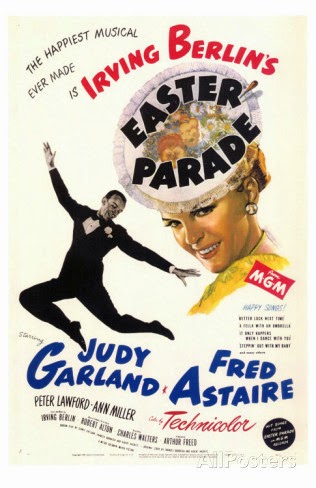
I never saw the movie Easter Parade, which was made two years after I was born, but I've always imagined this Irving Berlin song being sung by a man to a woman. The original version was the reverse, it's Judy singing to Fred about his top hat with a fancy pink ribbon for the band.
"On the Avenue, Fifth Avenue, the photographers will snap us, and you'll find that you're in the rotogravure." So, what is "the rotogravure"? It's a process developed in the nineteenth century that allowed newspapers to print color photographs and artwork on cheap newsprint paper, using rotary cylinders.
Fred Astaire intended to retire before Easter Parade was made, but agreed to take the male lead when Gene Kelly became unavailable.
WHY, WHEN THE CREEDENCE CLEARWTER PUT OUT WITH THEIR "TRAVELIN' BAND" EVERYBODY SAY WHEEE-OO BUT I KNOW IT CAUSE THEY ONLY DOING "LONG TALL SALLY" JUST LIKE THE BEATLES ANDTHESTONESANDTOMJONESANDELVIS....
--Little Richard, on the Dick Cavett show, sometime in the early 1970s, quoted in Greil Marcus, Mystery Train (5th Ed., Plume, 2008).
Today is the King's birthday. In the video above, taken from the movie King Creole (1958), he does his version of "Long Tall Sally."
A little weekend silliness. Some of us can remember when a visit to the movie theater began with a newsreel and an animated cartoon, along with previews of coming attractions, before the feature film. The cartoons I remember were mostly from Walt Disney (e.g. Donald Duck and Mickey Mouse) or Warner Brothers (e.g. Bugs Bunny and Porky Pig), but there was another studio, Terrytoons, that gave us some lesser known but interesting characters like Heckle and Jeckle, and a few that became TV staples like Mighty Mouse and Deputy Dawg. I don't know the name (if he had one) of the cat in the toon shown above. He bears some resemblance to Warner's Sylvester, and he has as much trouble with the mice as Sylvester does with Tweety. His adventures in this episode can only be described (despite its 1940 date) as psychedelic.
In the second installment of my Dewey & LeBoeuf saga, I told how my late friend Charlie McCrann wrote a feature length horror movie script as an NYU class project, then later produced, directed, and starred in that film, in which I played a minor role. The movie has been released in various places and formats under various titles: Forest of Fear, Charlie's working title, in Asia; Bloodeaters, by which it was known at movie houses and drive-ins coast-to-coast in 1980-81; Blood Butchers I'm not sure where; and Toxic Zombies, under which it was packaged as a VHS tape, later DVD, and played on the USA Cable network.
Now I've learned that it's been revived in Italy and dubbed in Italian under the title Il ritorno degli zombi. Here is a link to a YouTube video of what is obviously a very negative -- at least I know what "merda" means -- of the movie. The part of the video that starts at 10:51 shows me unwisely asking a zombie who is crouching in the road if he wants a ride to town, then the zombie swinging his hatchet, then stage blood falling on my boots. The first line in my five or so minutes of screen glory, not shown in the video, was "What the Sam Hill happened to you?" I wonder how that came out in Italian? Whoever dubbed me made me sound better than I do in English, though.
This was the winner of "the first ever cat video film festival". Unlike the star of this show, my cats don't seem to suffer existential angst. It's more like, "Hey! It's ten minutes since you last fed me, and the food in the dish is stale."
Congratulations to Will Braden, who made the video, and thanks to Geoff Abrams for bringing it to my attention.
A year ago this past February, I posted about the S.S. United States getting at least a temporary reprieve from the threat of going for scrap. Since then, the S.S. United States Conservancy has been busy publicizing the efforts to save the ship and raising funds for her preservation. You can contribute on the Conservancy's website.
The video above is of a movie newsreel (if you're my age you probably can remember these; they were shown at movie theaters, along with previews of coming attractions and cartoon shorts, before the featured film) announcing the "Big U's" setting of a new transatlantic speed record, which entitled her to the Blue Riband, an award that retired with her. The broom seen in the foreground in the still above is to be attached to her mainmast for the next voyage as an acknowledgement of her record setting run.
Thanks to Carl R. Weber for the link to the video.
This is a continuation of the story that begins here.
When I returned to LeBoeuf in 1973 from my Army stint, the firm had grown modestly, to about 45 lawyers. While I had spent most of my first year working on public utility matters, I now found myself called on to work in different areas of practice. The firm was not departmentalized, so an associate like me could be assigned tasks in various fields. One of these, to my delight as a ship buff, was maritime law. I had to learn the intricacies of charter parties, which is what contracts to charter ships are called, including such concepts as demurrage and laytime, and, when the client decided to build its own fleet of tankers, I worked on drafting and negotiating the shipyard construction contract and the operating contract with an experienced ship owner that would supply officers and crews.
I also began to get assignments in what had become the firm's second major practice area: insurance. Our clients were London based insurers whose operations in the U.S. were mostly in what's called the excess or surplus lines market, in which unlicensed insurers could write business--typically large or unusual risks--that couldn't be placed with licensed carriers, and in reinsurance. My mentor in this area was Donald J. Greene, then a rising younger partner but later to become the firm's chairman and a "name" partner. Early on, I got an assignment from Don and wrote a memo, which I gave to his secretary. The next day she called: "Mr. Greene wants to see you in his office." "Close the door," he said as I entered. My memo was prominently centered on his desktop, which typically looked like the flight deck of an aircraft carrier after all the planes had gone on a mission. The memo had prominent red marks. "Sit down." He then told me how, in the course of his Jesuit education, he had asked whether a Buddhist, Hindu, Taoist or such who lived an exemplary life was still condemned to hell for not being Christian. The answer he was given was "No," provided that person was completely unaware of Christian teaching. This, he said, was called the Doctrine of Invincible Ignorance, and my memo demonstrated it.
Despite this, Don evidently saw some redeeming virtue in my work, as I became a recipient of his "fun, travel, and adventure" talk.
Claude, I'd like for you to do more work for our [insurance clients]. This work will be challenging, and will involve a great deal of travel, some of it on short notice. You're a bachelor, right?...Good. Please make sure your passport is up-to-date and keep it handy.
Over the next several years I did a fair amount of traveling, none of which required a passport. I was assigned to keep track of legislative and regulatory developments in the Southwest Zone of the National Association of Insurance Commissioners, which involved trips to Austin, Cheyenne, Dallas, Houston, Oklahoma City, and Omaha. On one occasion, the associate assigned to the Northeast Zone had a schedule conflict and I was sent to an NAIC meeting in Baltimore. After one day, the junior partner who accompanied me said, "I can't take this any longer; give me a report when you come back Wednesday." That evening, sitting at the Hilton's bar, I got into conversation with Fred, the CEO of a Miami based insurance company. A man about my age came up to him and said, "Fred, the desk won't let the girls in without escorts." Fred looked at me and, in his best CEO voice, said "Come!" I went. Outside the door were three women with teased hair, wearing scanty tops, tight fitting pants, and stiletto heels, shivering slightly in the evening chill. We each took one by the arm, and walked them through the lobby, past the glowering desk clerk and concierge, to the elevators. We rode up to the top floor, where Fred had a deluxe suite. Inside were two state insurance commissioners, one accompanied by his wife, several other state insurance department officials, and some of Fred's junior execs. One of the commissioners asked me who I was. "I'm Claude Smith; I'm with Allstate," I answered. He said, "I have a real problem with that." Fred paid one of the women fifty dollars to remove her top and bra. He later paid another one hundred to undress completely; this prompted the commissioner with wife to bid goodnight. The naked woman then went around the room, perching on each man's lap in turn. Afterward, she gave her opinion of each of us. My diagnosis: "This one's scared of pussy." I finished my drink, thanked Fred for his hospitality, and went to my room, alone.
The partner in charge of the insurance practice was Keith Brown, a portly man with carefully coiffed silver hair, who cultivated something of an air of mystery. He occasionally drove his secretary, Mildred, to tears. When this happened, he would excuse himself, then return a few minutes later with a small bottle of perfume which he would put on her desk with a curt "Here!" One day in the spring of 1975, I was walking past Keith's office and heard "Claude, please come in." As I entered, "Close the door." ("Oh, shit," I thought.) "What are you doing tomorrow?" "Nothing, " I said. I had work to do, but no meetings or deadlines. "Good," he said. He told me to take the noon shuttle to Washington, get a cab to the river entrance to the Pentagon, go to the reception desk, identify myself and who I represented, and say I had an appointment with a certain lawyer in the Department of the Air Force. A guard would be assigned to escort me to this lawyer's office. Once there, I was to ask the lawyer to tell me everything he could about the contingency plans for the evacuation of Saigon and, in particular, whether the Civil Reserve Air Fleet would be mobilized, which meant that many civilian airliners would be commandeered by the military and taken into a war zone. This was of great concern to some of our insurance clients, who had written war risk coverage on these airliners. I figured I had just been sent on the biggest wild goose chase in the history of the firm. (Pentagon photo: en.wikipedia.org)
The following day everything went as planned until I got to the Pentagon reception desk. After I had identified myself, my firm, and our clients, no guard was summoned. I was told, "Go down the corridor with the entrance to your right until you get to the third ring, then turn left, and it's the fourth door on your right." Once I got there, I was greeted cordially by the Air Force lawyer. "Any plans to use the CRAF?" I asked. "No, it's going to be all military." I thanked him, flew back to New York, and drafted a Telex (how we sent instantaneous written communications in those days, though fax was beginning to catch on) to London. The Telex, no doubt, was intercepted and read by both the CIA and the KGB.
Around that time the firm moved from One Chase across Nassau Street to 140 Broadway (photo LoopNet), now the Brown Brothers Harriman Building. (Shortly after we moved, a senior executive of our biggest client asked a receptionist for directions to the men's room. Her answer: "I don't know; I never use it." Her redemption was marriage to an associate who later became a partner.) My office mate in our new quarters was Charlie McCrann. Charlie and I had been friends for two years. We were bachelor neighbors in Greenwich Village and often met in the evening for beers at neighborhood bars. We had different backgrounds. I had been a military brat who moved around a lot during my childhood, and went to a public high school and a state university before Harvard Law. Charlie grew up in Montclair, New Jersey, the son of a stockbroker, prepped at Lawrenceville, then went to Princeton and Yale Law. He looked like Warren Beatty. I didn't. I yearned for WASP princesses. Charlie could have, and had had, his fill of such, so he longed for secretaries with outer borough accents. (He would later marry a beautiful Haitian woman.)
One particular in which we were very different was this: Charlie was determined to keep his work life and his social life separate. I was, along with a few other associates, a rare exception he allowed to this rule. Several times when Charlie and I were out drinking together, I spotted someone else from the firm entering the bar. His reaction was always, "We've got to get out of here, now!" I was the opposite. I loved to mix people from different parts of my life together. I threw parties in my Village apartment to which I'd invite friends from the firm, law school classmates, and various characters I'd met at the Bells of Hell or the Lion's Head. At one of these, I looked across the room and saw a LeBoeuf partner sharing a joint with the members of a punk rock band.
Charlie was a movie buff. He had been president of the Yale Law School Film Society. While we worked at LeBoeuf, he took evening film classes at New York University (I was sworn to secrecy about this). We both left the firm at about the same time (late 1977), I to a utility company client in the suburbs (I reverse commuted from the Village) and Charlie to be legislative counsel to the chairman of the New York State Assembly's Insurance Committee. His job allowed him about six months off each year when the legislature wasn't in session, during which time in 1978 he took a feature length horror film script he had written as an NYU class project, in which almost all of the characters have the names of LeBoeuf lawyers, and turned it into a real movie. The plot was based on the paraquat scare of a few years previous. A group of hippies growing marijuana in a remote clearing in a national forest kill two federal agents who try to bust them. The feds then hire a cropduster to dump an as yet untested, highly toxic herbicide, Dromax, on their crop. The plane arrives just as the hippies are frantically harvesting, they get covered with Dromax, and are transformed into blood craving zombies who go on a murderous rampage.
Most of the cast and crew were recruited through ads in the Village Voice, though a few parts were given to Bells of Hell denizens, including me. Charlie pulled off a coup in getting John Amplas, who had played the title role in Pittsburgh goremeister George Romero's 1978 hemophagic thriller Martin, to play a federal agent (not one of those who get offed at the beginning). Aided by a New York State arts grant (the application described the project as a film about the dangers of herbicides), Charlie was able to hire top notch camera, sound, and special effects people, and to commission appropriately eerie music by Ted Shapiro. Most of the film was shot at locations close to the country house of a couple who were Bells regulars. It was in the wilds of north central Pennsylvania; to get there, you passed a sign that read "Welcome to Potter County, God's Country".
Charlie's working title was Forest of Fear. The distributor he convinced to handle the movie in the domestic market thought that sounded too much like an arty Japanese film, and changed it to Bloodeaters--Butchers of the Damned. Under that title, it played drive-ins and movie houses across the nation. Another distributor later acquired the rights to make it into a VHS tape (and later DVD) with the title Toxic Zombies; in the 1980s it played under that title on the USA Cable network. Charlie and I, and several other cast members (Charlie played the lead role, a forest ranger, as well as producing and directing) went to the East Coast premiere of Bloodeaters at the Twin Pine Drive-In on the outskirts of Waterbury, Connecticut. After the movie we went to the concession stand and were mobbed by local teens asking for our autographs (I can say this has happened once in my life). We were then feted at a party at what may have been Waterbury's classiest discotheque.
Here is the trailer for Bloodeaters:
Here's a favorable (!) review of the movie. Charlie's photo is next to the first paragraph; the photo on the wall is of Beverly Shapiro, who played his wife, Polly. During the scene from which this still was taken, Charlie opens a pressboard binder enclosing a thick sheaf of paper, supposedly weather statistics. It's actually the LeBoeuf fifty state excess and surplus lines law survey. The photo next to the third paragraph shows an especially clever bit of special effects gore involving a barbecue glove, a pig's foot, a wristwatch, a turkey baster, and stage blood (clear Karo syrup with red food coloring).
There will be a part three to the LeBoeuf saga. Can you stand it?



.jpg)

