Showing posts with label England. Show all posts

Tuesday, June 18, 2024

Willie Mays, 1931-2024

In the summer of 1954 I was eight years old, and my parents and I returned from a three year sojourn in England, where my father, a U.S. Air Force officer, had been stationed. I had been the only American in an English school, so I had been thoroughly Anglicized. I knew of cricket, of what my schoolmates had called "football" but we call soccer, and of something called "rounders," which I later realized had some vague resemblance to baseball. Of baseball itself, though, I knew nothing. Neither of my parents were fans, so it hadn't been part of my acculturation. 

On September 29, 1954 my third grade classmates at the Eglin Air Force Base Elementary School and I were excused from our classrooms early in the afternoon to go to the "cafetorium," where a big black-and-white TV was set up on the stage for us to watch the opening game of the World Series, pitting the New York Giants against the Cleveland Indians. I don't recall having any rooting interest, though I may have favored the Giants since I had been to New York but never to Cleveland (I still haven't, unless you count the airport). One thing remains engraved on my memory from that game: Willie Mays of the Giants making "The Catch" (video above). That was enough to convince me that baseball was something worth watching, and knowing. Thank you, Mr. Mays. 

Willie Mays, considered by many the greatest all-around baseball player ever, died today at 93. I can't help adding that he ended his playing career with the Mets, and that his last hit was a run scoring single in game 3 of the 1973 World Series. Joan Whitney Payson, then the Mets' principal owner, had promised that his number would be retired, but she died in 1975 and her promise remained unfulfilled until Old Timers' Day in August of 2022.

Sunday, June 02, 2024

Peter Myers, Octogenarian


The photo above is of three stalwarts of the Bells of Hell, a Greenwich Village pub that served as my second home from the summer of 1977 until it closed in the fall of '79. On the left is Barry Murphy, who tended bar and provided lively conversation. In the center is Pierce Turner, who, along with Larry Kirwan, as Turner and Kirwan of Wexford (their Irish hometown), were the house band at the Bells during much of my tenure there. On the right is Peter Myers, half owner of the Bells from the time he and Tony Heyes bought it from its founder, Malachy McCourt until the late weekend afternoon in '79- I was present at the time - when Peter and Tony got into a physical scuffle, started by Tony and Gary Sellers, the first person I met after first crossing the Bells' threshold in '77, and which resulted in Peter making Tony the sole owner while he went on to found Myers of Keswick, Keswick being Peter's English hometown. 

The occasion of the photo was a party to celebrate Peter's 80th birthday, given at Myers of Keswick. It was a grand affair, bringing together a sizeable collection of surviving Bells alumni. Specialties of the house, including Cornish pasties, Scotch eggs, and sausage rolls, were in profusion, as were beer and wine. I was able to catch up with some old friends I hadn't seen in some years. The store is now managed by Peter's daughter, Jennifer Myers Pulidore, whom I remembered as a kindergartener. By all appearances she's doing an excellent job. I also had some pleasant conversation with Peter's wife, Irene, whom I hadn't seen since the Bells days. 

The photo was taken as the party was ending, and Pierce was singing "The Parting Glass."

The clip above is of an exquisite rendition of this beautiful song by Celtic Woman.

As I was leaving the party, I saw Peter and a friend sitting on a bench outside the store. I stopped for a bit of last minute chat. Peter reminded me that, after his unfortunate encounter with Tony, I had offered my opinion that Tony's words, "It's your f---ing bar!" were not sufficient to transfer ownership, especially given Tony's state of intoxication at the time.  Peter was happy with this advice. 

I then recounted an anecdote I'd read some years ago, about an anthropologist who visited one of the remotest of the Scottish Western Isles and sought someone who would have a long memory and knowledge of the island's lore. He was directed to an old man who, when asked his age, said seventy-something. The anthropologist asked if there were any octogenarians on the island. The old man said, "Octogenarians ... oh, yes, there were two. But my brother shot the one, and the other flew away." I suggested that Peter should avoid the Western Isles. "I go there all the time," he said. Good luck, Peter.

Sunday, October 22, 2023

Queen Claude and Anne Boleyn


In my post about the global art market I noted that my given name, Claude, is gender neutral in French. Today, thanks to Tina Brown's review of Hunting the Falcon: Henry VIII, Anne Boleyn and the Marriage that Shook Europe, by John Guy and Julia Fox, I know there was a Queen Claude of France  (image above: School of Jean Clouet, Public domain, via Wikimedia Commons). She was consort of King François I from 1515 until her death in 1524. During their nine years of marriage, she and the King had seven children. One of them succeeded his father as King Henri II.

The connection between Queen Claude and Anne Boleyn is, as Ms. Brown notes, that Anne served as the Queen's "teenage demoiselle" following her service as "maid of honor" to Margaret of Austria. About these youthful exposures to women in Continental courts, Ms. Brown quotes Mr, Guy and Ms. Fox, "Anne found herself in a world in which women could exercise power in strikingly different ways." This was, according to Ms. Brown, in contrast to "the dour, dutiful sewing circle serving Katherine of Aragon at the British court," to which Anne returned. She found Henry still in his unhappy marriage to Katherine, and Anne's younger sister Margaret as his favorite mistress. During and after the divorce from Katherine, he turned his attention to Anne. What ensued is well known. Ms. Brown notes that a special executioner "had been summoned from France" and that "the only remnant of Anne's Francophile influence was her executioner's axe."

The supreme irony is that, although a reason for Anne's execution was her failure to produce a male heir, her daughter, Elizabeth, eventually succeeded to the crown and became one of Britain's most revered monarchs.

Saturday, May 06, 2023

Some thoughts on English and Portuguese history, an admirable woman, and two boroughs of New York City

Today King Charles III was crowned. This led me to think of the last British monarch to bear his name, Charles II (portrait by Philippe de Champaigne, public domain, via Wikimedia Commons). He was more fortunate than his father, Charles I, whose reign ended with his beheading. The young Charles was sent into exile in France. He returned to England and was crowned in 1660; his reign lasted until his death in 1685

While he has been called the "Merry Monarch" his reign was far from untroubled. In 1665 a terrible plague struck England, and the following year saw the Great Fire of London. What caused tension throughout his reign was his sympathy for Catholicism, inherited from his father and undoubtedly strengthened during his French exile. 

In 1670 Charles entered into the Secret Treaty of Dover, in which he pledged to support France in its war against the Dutch Republic and to convert to Catholicism at an unspecified time (he did so, on his deathbed). This led to the Third Anglo-Dutch War, concluded in 1674 by the Treaty of Westminster, under which, among other things, the Dutch returned their colony of New Netherland to the English, who renamed it New York. 

New York City's Borough of Brooklyn, where I have lived for the past forty years, is co-extensive with the County of Kings, so named in honor of Charles II. Our neighboring County, and Borough, of Queens is named for his consort, Catherine of Braganza (portrait by Peter Lely, public domain, via Wikimedia Commons). She was a Portuguese infanta, or princess, whose marriage to Charles at the age of 21 was, like almost all European royal marriages, diplomatically arranged. Her dowry included Bombay, now Mumbai, thereby helping to establish the British foothold in India. The marriage didn't get off to a good start. She developed a nosebleed and fainted when told that Charles had made his favorite mistress, Barbara Palmer, her Lady of the Bedchamber, or personal attendant. 

Despite this and many other discourtesies, Catherine remained faithful to Charles until his death. To his credit, Charles resisted entreaties to divorce her when she suffered three miscarriages and failed to produce a legitimate heir to the throne. After Charles died she remained in England through the short, unhappy reign of her brother in law, James II, and  the "Glorious Revolution" of 1688, which sent James into French exile and gave the crown to his daughter, Mary, and her husband, William of Orange, whose marriage had been arranged by Charles to placate Protestants and secure realtions with the Dutch. Under William and Mary, Protestant power was solidified by Parliament, which passed an "Exclusionary Act" barring Catholics from the throne. Catherine returned to Portugal in 1692, where she spent her later years active in affairs of state, serving on two occasions as regent for her brother, Peter II, and helping to secure a treaty between Portugal and England. She died in 1705 and is buried at the monastery of São Vicente de Fora.

As a Brooklynite I hate to say this, but, Queens, you got the better of the two royals.

Sunday, January 08, 2023

Remembrances and appreciations, 2022

 On June 2, 1953, Coronation Day, I was with my parents and Rex, the bull terrier mix puppy I had been given as a seventh birthday present, at Stile End, a cottage built, if you believed what was on the doorpost, in 1597. We occupied half of the cottage, located at the edge of the village of Rushden in Hertfordshire. The other half belonged to its owners, a farm family named Warner. They were lovely people, and their daughter, Peggy, single and in her thirties, was my caretaker whenever my parents were out for a play in London or an event at the Officers' Club at Chicksands, the small outpost in Bedfordshire where my father, a U.S. Air Force captain, was stationed. 

In 1953 BBC television's signal didn't extend beyond metropolitan London, so we listened to the coronation of Queen Elizabeth II on our radio. She had been Queen since February 6, 1952, the day her father, King George VI, died. Her ascension to the monarchy took place while she and Prince Phillip were on tour in Kenya. In the almost year and a half from then until the coronation I saw many newspaper and magazine articles with photos of the, I thought, beautiful young Queen. She was also a prominent subject of conversation at the Sandon County Council School, where I was the only American but, in the course of two and a half years, became thoroughly anglicized in habits and speech.

I would no doubt have been surprised to know, at age seven, that her reign would last until I was almost seventy seven. Indeed, I would have been surprised to know I would live that long. I was a military brat, and thought that my destiny was to die gloriously in battle, after uttering some phrase that would later resound in history. The Queen was not known for stirring quotes, but this one seems very characteristic: "It’s worth remembering that it is often the small steps, not the giant leaps, that bring about the most lasting change." 

As I've noted before, with my advancing age, every year brings a larger number of contemporaries and admired or influential elders who have died. This year I won't try to make a comprehensive list; I'll stick to those who were most important to me, either because I knew them personally or found them especially impressive or influential. Besides the Queen, among those who were influential worldwide that we lost were Mikhail Gorbachev and Madeleine Albright. Although I'm not a soccer fan, I can't not mention Pelé.

F. Donald Logan was Martha's professor, mentor, and history major adviser at Emmanuel College. I got to know him when Martha and I visited Boston on several occasions, and enjoyed his hospitality, cooking, and love for Bailey's Irish Cream. He was a superb raconteur with a great depth of knowledge about medieval Europe, Church politics, and contemporary controversies. I enjoyed reading his The Vikings in History. Once, when I was attending a convention in Boston and Martha was unable to join me, Don let me stay in his Brookline apartment alone while he was on one of his annual trips to London, thereby saving my clients a hotel bill.

Clark Green schooled me in the fine art of church ushering during his term as Head Usher at Grace Church. Another Grace parishioner I will miss is the always delightful Shirley Baldwin. A neighbor missed by Martha, me, and many is Lesley Carter, a charming Scottish woman whom I would often encounter during my daily walks as she walked Bear, her massive and placid brown Labrador. Whenever we stopped to chat, Bear would attract kids who would shower him with attention, which he received gladly. I lost a Facebook friend whom I never met in the flesh, Walter William Milner, whose intelligence and wry English wit I'll never forget.

Among the ever dwindling roster of Lion's Head alumni, ones I will keenly miss are former co-owner Al Koblin (the Kettle of Fish, which Al mentions in the linked interview, later moved into the spot at 59 Christopher Street previously occupied by the Head), Cheryl Floyd, Jules Kohn, Marie Murphy, and Virginia Lucy Zox, known to all as "Sha", who served on the waitstaff and was a constant source of joy. She became a character in Head alum Robert Ward's novel The Stone Carrier. Thanks to friend Dermot McEvoy for keeping me, and many others, abreast of news concerning former Head regulars.

Among the musicians lost were all-around wild man Jerry Lee Lewis (for a comprehensive biography see my late friend Nick Tosches' widely praised Hellfire), composer Ned Rorem, jazz saxophonist Pharoah Sanders, singer-songwriter and producer Thom Bell, singers Gary BrookerLoretta LynnChristine Perfect McVieMeat LoafOlivia Newton-JohnAnita Pointer, Bobby Rydell, and Ronnie Spector, guitarists and singers Ronnie Hawkins and Danny Kalb,  mandolinist and singer Roland White, and drummer Dino Danelli

The stage and cinema world lost, among many others, actors Kristie AlleyAngela LansburyJames CaanWilliam Hurt (whom I had the pleasure of seeing in 1989 when he played Augie-Jake in Joe Pintauro's "Beside Herself" at Circle Repertory Company, for which I then served on the Board of Advisors), and the incomparable Sidney Poitier; comedian and fellow USF alum Gallagher; and directors Peter Bogdanovich and Jean-Luc Godard.

The visual arts lost painters Carmen HerreraSam GilliamJennifer Bartlett, and Paula Rego, along with sculptors Lee Bontecou and Claes Oldenburg and New Yorker cartoonist George Booth. Among those lost to the world of literature are my law school classmate John Jay Osborn, Jr., author of The Paper Chase; historian David McCullough; historical novelist Hilary Mantel; drama critic, biographer, and playwright Terry Teachout; satirist P.J. O'Rourke, with whose political views I didn't always agree but whose writing I often found delightful; Barbara Ehrenreich, author of the indispensable Nickel and Dimed; and restaurant critic Gael Greene, whose novel Blue Skies, No Candy. was once described as an exemplar of the "shopping and f---ing" genre. 

One writer lost last year with whom I was unfamiliar is Peter Straub, whose works are described in his linked New York Times obituary as "novels of terror, mystery and the supernatural" but who "insisted that his work transcended categorization". As he observed, "Adult human beings live with the certainty of grief, which deepens us and opens us to other people, who have been there, too." He was the father of Emma Straub, also a novelist, and the co-owner of Books Are Magic, which now has a location two blocks from where I live. 

Now I'll turn to appreciations. As always, I must start with my wife, Martha Foley. For those who don't know, I fractured my left ankle on November 24, 2021. Since then I have had two surgeries and periods of rehabilitation, and now face a third surgery this coming Thursday, January 12. This has been a most trying period for Martha, who has had to do household chores and shopping that I would otherwise do,  tend to my medical needs, and work for her clients as well as volunteering at the Brooklyn Women's Exchange. I'm hoping this coming surgery will resolve all remaining problems. My thanks to the physicians at NYU Langone Health, including Doctors Kenneth EgolPierre SaadehMikel Sadek, and Mona Bashar, and the physicians' assistants, nurses, and technicians, who have provided me with the finest of care.
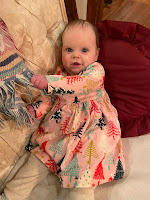
On to pleasant matters. Our daughter, Elizabeth Cordelia Scales, and her partner, Drew Rodkey, have presented us with a granddaughter, Ada Xiomara Rodkey. They live in Chester, Pennsylvania, just south of Philadelphia, and we have enjoyed two visits, the most recent over Christmas. We're also grateful to Drew for the work he did on our apartment and furniture during their visit. We look forward to seeing them again soon.

Finally, thanks to all my friends and readers for your support and encouragement. I wish you all the best of everything for 2023.

Sunday, November 24, 2019

Sarah Stone and friends perform English and Scottish music at Communitea.

On Friday evening Sarah Stone, on cello in the center of the GIF above, along with (left to right) Francis Liu on violin, Kevin Devine on harpsichord and hurdy gurdy (you can see him cranking it in the GIF), and soprano Madeline Healey, shown above tapping on a small drum similar to what in Irish music is called a bodhrán, gave a delightful concert of English and Scottish songs and instrumental pieces at Communitea, in Long Island City, Queens.

This was not "classical" chamber music, although some of the tunes were by classically esteemed composers like Purcell, but rather "pop" or "folk" music of its time. The first set began with three songs about drinking and food. "The Wine Was Made to Rule the Day" introduced us to the awesome (an adjective that actually belongs here) voice of Ms. Healey, with its crystalline clarity and precision. "A Song in Praise of Old English Roast Beef" had us joining in on the chorus. "Ye Mortals That Love Drinking" described all, or at least most of all, of us there.

Some of the remaining pieces in the set gave Mr. Devine a chance to show his skill with the hurdy gurdy. The first three of these were selections from the Scottish composer James Oswald's Airs for all Seasons, all of which are named for seasonal flowers: "The Fox Glove"; "The Periwinkle": and "The Rocket". There were five Playford Dances: "The Virgin Queen"; "Young Jemmy"; "Never Love Thee More"; "Coxes Dance"; and "Up Its Aily". John Playford adapted these from an informal folk dance tradition popular among "country" people, who had no time nor money for formal dance instruction. City sophisticates took to these because on a long evening they would tire of the elaborate formal dances typical for their class. A modern parallel to this can be seen in the "urban cowboy" craze of about forty years ago.

Playford dances are still done in England, as the video above shows.

After an intermission, the second set began with three Scottish songs, sung spritefully by Ms. Healey (I was searching for an adjective that would describe her singing while continuing an "s" alliteration; I may have been influenced by my first car's having been an Austin-Healey Sprite). The first song was a lullaby, "O Can Ye Sew Cushions", followed by the mournful ballad "Auld Robin Gray", written by Lady Anne Lindsay, but the third was much sprightlier.

"There's Nae Luck About the House" is a lively ballad with lyrics by the poet Jean Adam, sung in the clip above in its intended Broad Scots, by the Glasgow Irish singer Ella Logan, as it also was by Ms. Healey.

The set, and the evening's program, concluded with a series of short songs recounting the courtship of Jenny and Jockey. I'll quote here from Ms. Stone's notes, which lead to a sad conclusion:
Ending the program is the everyman story of Jenny and Jockey, told again and again by composers throughout England. Jockey is a shepherd. Jenny loves Jockey. Jockey is a wagg and doesn't want to get married. Someone should warn Jenny before her 'Maiden's Treasures' gone or (according to Purcell) 'she'll 'go to London-town... to Kiss for half a Crown'.
As with many a song tradition that has found root in various parts of the British Isles - see, for example, my summary of my late friend Nick Tosches'discussion of the evolution of the Greek Orpheus legend in British folk music (the summary is in the fourth paragraph of the linked post) - the Jenny and Jockey story has many variants. In Scotland,it may have a happier ending.

This was a most enjoyable evening, and we look forward to Ms. Stone's next performance at Communitea. We are also delighted that she has become a regular member of the Repast Baroque Ensemble, whose concerts we regularly attend (and I'm tickled pink that I'm quoted in the second paragraph on their home page).

Sunday, July 07, 2019

Remembering Sandy Denny

Alexandra Elene MacLean Denny, known to the world of devotees of British folk and folk rock, of which I'm part, as Sandy Denny, died on April 21, 1978 at the age of 31, following a fall down a flight of stairs. I got this news by radio while driving across the George Washington Bridge on my morning commute from my home in Greenwich Village to my job in suburban Rockland County. I got a lump in my throat, but managed to keep my eyes on the road.

I first heard Sandy Denny's voice coming from the dorm room of my law school classmate John Lovett in the spring of 1970. I was walking past his partly open door when I heard something sounding stately, like Anglican chant, with a lovely female lead and male harmony vocals. I knocked and asked John what he was playing. "Fairport Convention," he said.


The song I heard coming from John's room was "Percy's Song," an obscure Bob Dylan piece I didn't know. It was from Fairport's third album, Unhalfbricking. I didn't buy a Fairport album until after I graduated and moved to New York. The first one I got was Liege & Lief.


"Tam Lin" is a typical example (in my opinion a particularly good one) of the songs on Liege & Lief, which represent Fairport's turn, under Sandy's influence, to folk rock arrangements of traditional English and Scottish ballads, or new songs reflecting those influences.

After Liege & Lief, Sandy left Fairport and joined her future husband, Australian born singer and songwriter Trevor Lucas, in a group called Fotheringay, named for the castle in which Mary Queen of Scots spent her last days and was executed. The group had one, in my opinion excellent, eponymous album.

The album included "Peace in the End," an optimistic song about the then (1970) apparently insoluble "Troubles" in Northern Ireland. Fotheringay broke up after one year, as Sandy decided to pursue a solo career. In 1971 she released a critically acclaimed album, The North Star Grassman and the Ravens.


 That same year, at the behest of Robert Plant, she sang with Led Zeppelin on "The Battle of Evermore."

After Sandy left Fairport, it continued as an all male band.  Their first album in that guise had the title Full House, which I thought a bit cheeky, although I liked the album nevertheless. In October of 1974 I went to my first Fairport concert, at Carnegie Hall. When the band took the stage I was surprised to see Sandy taking her seat at a grand piano. A man sitting not far from me called out, "Welcome back!" She answered with a chirpy "Thenk you!"


They proceeded to give a riveting performance that included some old favorites from Liege & Lief and earlier albums, but also new material, including the searing antiwar ballad "John the Gun."


In 1975 Fairport released Rising for the Moon, with a stirring title track that showcased Sandy's voice beautifully. Its opening lines -- the lyrics are by Sandy -- tell of the life of a traveling musician:
I travel over the sea,
And ride the rolling sky,
For that's the way it is,
That is my fortune,
There are many ears to please,
Many people's love to try,
And every day's begun,
Rising for the moon.
Also in 1975 Sandy and Trevor Lucas, who were married in 1973, left Fairport. They had a daughter. Their marriage lasted until Sandy's death in 1978.

Yesterday I saw this Chicago Tribune piece by Greg Kot about Sandy, and how her influence lives in the work of groups like Mumford & Sons, Fleet Foxes, and the Decembrists. Kot focuses on the first song of hers to gain wide attention.

That song was "Who Knows Where the Time Goes?" It was made popular by Judy Collins who, as Kot notes, was a shrewd judge of talent, a year or so before Sandy recorded it with Fairport. Sandy's version is in the audio clip above.

I disagree with Kot in one respect. He calls Fairport's first and eponymous album, made before Sandy joined the group, "unremarkable." Its sales may have been disappointing , but I think it's a fine bit of artistry. It was the second Fairport album I acquired, and I was struck immediately by their rendition of the driving rocker "Time Will Show the Wiser". I was also captivated by their rendition of Joni Mitchell's "I Don't Know Where I Stand," featuring the voice of their first woman vocalist, Judy Dyble (unfortunately, no clip of this is available). She has -- she is still singing and recording -- a strong but sweet voice. It was perhaps stronger -- more Grace Slick than Joni Mitchell, although I think she covered Mitchell brilliantly -- than the guys in the group wanted for their turn towards more folk influenced material.

A version of Fairport Convention still exists; they most recently released an album in 2015, and may be the longest surviving major rock band save the Rolling Stones and the Who. Sandy Denny was an essential element in their success.

Sandy Denny photo: John Lyons, 1972

Monday, July 27, 2015

Steeleye Span at B.B. King's, New York, July 23, 2015.

When my wife said Steeleye Span were to appear at B.B. King's I was surprised, thinking the group, an old favorite of mine, had broken up years ago. They did break up in 1978, when lead singer Maddy Prior wanted to pursue a solo career. Nevertheless, Maddy later reconstituted the band, of which she is now the only original member. In the photo above the band members are (from left to right): guitarist and vocalist Julian Littman; fiddler and vocalist Jessie May Smart; Maddy Prior; bassist Nils JerusalemP, who recently joined the band in Seattle as a replacement for Maddy's son, Alex Kemp, who, according to Maddy, had some "paperwork problems" entering the U.S.; and drummer Liam Genockey.

The band opened with "Blackleg Miner," a song about a nineteenth century coal miners' strike. A "blackleg" was a strikebreaker, or scab. The clip above, made some years ago, shows an earlier lineup of musicians. Maddy carries the vocal by herself. At the performance last week, the other band members joined in harmony. Maddy, who will celebrate her 68th birthday on August 14, has a voice that is every bit as strong and in command of its full range as when she was younger, but the harmony vocals gave this song more of the "oomph" it needs.

Their next song came from my favorite of their albums, Commoners Crown. "Long Lankin" is a typical old English ballad, telling of betrayal, child murder, hanging, and burning at the stake. Some of Steeleye Span's songs, lovely as they are to hear, have very dark lyrics. This is because Medieval England, from which place and time these songs originated, was, for many, a place and time where life, to borrow the words of the seventeenth century philosopher Thomas Hobbes, could be "solitary, poor, nasty, brutish, and short." The clip above is audio only; it starts with an image of the album cover, then goes to solid black. Dark indeed.

"King Henry" starts darkly: the King finds himself in a haunted house in the company of a horrific female ghoul who, in the words of Julian Littman, who introduced the song and took the lead vocal, forces him to "kill his household pets," which she devours, then to join her in bed. It ends on a bright note, though; he wakes up the following morning to find next to him the loveliest woman he's ever seen. It's good to be the King.

The band ended the concert (except for a lovely a cappella encore, the title of which I can't remember) with "Thomas the Rhymer." This song has a theme common to many of its vintage: a man, or sometimes a woman, is captured by an elf or fairy queen or king, goes through some sort of ordeal, and returns changed in some way. In the case of Thomas, it was supposed to be having the gift of prophecy. Another song, "Tam Lin", as done by another great English folk rock group, Fairport Convention, tells a tale of a man saved from the ordeal by the intervention of his lady love.

I didn't know what to expect of this concert, and was prepared to be disappointed. I was very pleasantly surprised. Maddy Prior is still in top form, and the new band members performed admirably. Special mention goes to Jessie May Smart, whose fiddle playing was extraordinary, and to Nils JerusalemP, who obviously has learned the band's repertoire quickly and adeptly.

Saturday, June 28, 2014

Liam Clancy and Tommy Makem, "The Green Fields of France"

Today, June 28, 2014 is the centenary of the assassination in Sarajevo of Archduke Francis Ferdinand and his wife, Sophie, Duchess of Hohenberg. This started a series of events that led, within two months, to the outbreak of a war unprecedented in its ferocity and breadth; one that would cause about ten million military and seven million civilian deaths. It may have created the conditions that led to the 1918 influenza pandemic that is estimated to have killed between fifty and 100 million people; perhaps as much as five per cent of the world's then population. The war's economic and political aftermath certainly contributed to the outbreak of an even greater war two decades later. It caused the breakup of two empires: the Hapsburg Austro-Hungarian Empire in central and eastern Europe, and the Ottoman Empire that encompassed much of the Middle East. The carving up of the latter by victorious Britain and France, as described in David Fromkin's A Peace to End All Peace, resulted in the creation of the existing national boundaries in the Middle East; many of which boundaries are contested today.

World War I also helped to precipitate two revolutions: the Russian and the Irish. British recruitment of Irishmen to fight in the war (see poster image above) was a factor leading to the Easter Rising of 1916. As the rebel song "The Foggy Dew" declared:
Right proudly high in Dublin town
Hung they out a flag of war.
'Twas better to die 'neath an Irish sky
Than at Suvla or Sud el Bar.
"Suvla" and "Sud el Bar" were  disastrous amphibious landings on the Turkish coast in which British troops, including many Irish, took terrible casualties. Another verse, not included in the lyrics on the linked post, has the words
'Twas England bade our wild geese rove
That small nations might be free.
The second line is ironic. One of Britain's appeals to prospective recruits was to fight for "small nations," in particular Belgium (again see poster above) that had been or might be invaded and occupied by German troops.  The irony is that Ireland was a "small nation" that wanted to be free, but Britain would not allow it to be. The term "wild geese" in the first line was originally applied to the Irish Jacobite army that was allowed to go to France following its defeat by the army of King William in 1691. It was later used for Irish soldiers who served in the Royal Army in European wars.


"The Green Fields of France," sung in the clip above by Liam Clancy and Tommy Makem, is one of the saddest songs I know.  The line "Did the pipes play 'The Flowers of the Forest'?" at first suggested to me that Private McBride served in a Scottish regiment, as "Flowers" is a traditional Scots lament, but the notes to this YouTube clip say it has become "[t]he traditional lament for the fallen in forces of the British Commonwealth." So, the song was co-opted, after excising the lines
Sad day for the Order,
What's happened to the border?
The English, by guile,
For once won the day.
We all live in the world the Great War (I still call it that; the Second World War was vastly more destructive, but the effects of the First include the Second and much more) created. I pray we do not have to see its like again.

Addendum: When I posted this, I speculated that Private McBride was likely Protestant, because William would not have been a popular name among Irish Catholics given the unfortunate role of King William in their history. Dermot McEvoy corrected me on this, noting that William was a common name in his (Catholic) family, and that Liam Clancy was christened William, later changing his name to its Gaelic version. William is a popular name among Ulster Scots Protestants, probably because they revere King William for his victory over the Catholics. Many Ulster Scots emigrated to America, where they became known as "Scotch Irish." Many of these settled in Appalachia, and the term "hillbilly" reflects the prevalence of the name William among them.

Friday, April 26, 2013

Cockney rhyming slang.

So, what's a Godiva? It's a five pound note, or, in Cockney speech, a "five-ah," which rhymes with "Godiva." This is Cockney rhyming slang at its most basic--for the word intended, substitute another word with which it rhymes. There is another, more meta (to use a Greek-rooted prefix recently made into an adjective) version in which, instead of the word that rhymes with the intended word, another word associated with the rhyming word is used. For example, instead of "Godiva" for a five-ah, say "Lady," a word usually yoked to Godiva, as in, "That'll cost you a Lady."

I was introduced to the meta version some years ago at the bar of the Bells of Hell. I was chatting with an English friend when a--how you say?--well-endowed young woman walked by. "Nice set of Bristols," my friend said. His meaning was obvious to me, but the usage wasn't. "There's a football club called Bristol City," he explained, "and city rhymes with... ."

One Briticism that piqued my curiosity is "Gone for a Burton." Having seen this in Private Eye, I asked another English friend what it meant. "It means he died," was the answer. "How does it mean that?" I asked. My friend didn't know. I later read that it may have originated with Royal Air Force flyers in World War Two, to refer to a comrade who hadn't survived a mission. Burton, or Burton-on-Trent to give its full name, is a city known for its breweries, as acknowledged by A.E. Housman in A Shropshire Lad:
Say, for what were hop-yards meant,
Or why was Burton built on Trent?
Oh many a peer of England brews
Livelier liquor than the Muse,        
And malt does more than Milton can
To justify God’s ways to man.
A plain meaning of "Gone for a Burton" then would be "Gone to the pub for a pint." Regarding a deceased friend, it could mean "Gone to that big pub in the sky." Still, I wonder if it might not be an instance of Cockney rhyming slang. Burton doesn't have any obvious rhyme relating to death, nor does Trent, nor ale, the brew that made Burton famous. But it occurred to me that a properly drawn pint of ale has a head, which rhymes with dead. If this is in fact the origin of the expression, it could be an instance of meta-meta rhyming slang, going from Burton to ale to head. If, however, Burton is taken as a synonym for ale, then it's only a single meta.

Regarding the sign in the photo at the top of this post, I found translations for "monkeys" (hundred pound notes) and "ponies" (twenty-fivers) in this glossary. I don't know the meaning of "edges" or of "carpets." Perhaps one of my English friends can help. "Visa," I presume, means just what it is.