
Tuesday, July 31, 2012
Cape Cod sunset.

Monday, July 30, 2012
Space news sad and glad: Sally Ride and Pluto

Happier news is the discovery of a fifth moon of Pluto. Six years ago I noted, a bit wistfully, Pluto's demotion from
Sunday, July 29, 2012
A sail on Cape Cod Bay

After lunch we took a walk on one of the long piers that extend into Provincetown harbor. Our friends recommended a sail on the two masted schooner Bay Lady II (photo above), to which we eagerly agreed.

Your correspondent looks pensive as the crew prepares to cast off (photo by M. Foley).

We left the pier under auxiliary motor power, and headed out of the harbor behind the high speed Provincetown to Boston ferry and a sport fishing boat.

Moored at the end of the pier was Kalmar Nyckel, the official tall ship of Delaware, a replica of the ship that brought the first European settlers--Swedes and Finns--to the Delaware Valley, where, arriving in 1638, they established a colony called New Sweden at the site of what is now Wilmington. Their leader in this venture was the Dutchman Peter Minuit who, on an earlier visit to North America as an agent of the Dutch East India Company, was credited with purchasing Manhattan from the indigenous Native Americans. Kalmar Nyckel is visiting Provincetown, and will return to her home port of Lewes, Delaware after August 4.

After we cleared the breakwater, the sails went up and the engine was shut down. Here's the foresail being raised (photo by M. Foley).

Looking landward, I could see the Pilgrim Monument, an Italian style campanile that commemorates the arrival of English venturers (only later called "Pilgrims") aboard the Mayflower in 1620. Mayflower's first New World anchorage was in what is now Provincetown harbor, and the Mayflower Compact was signed there.

As we left Provincetown harbor, the trawler Sao Jacinto was coming in. Many fishing vessels based at southern New England ports have Portuguese names, reflecting substantial immigration from Portugal proper, the Azores, the Cape Verde Islands, and Brazil into the region, beginning in colonial times.

Off to our starboard, a small sloop was coming about on a tack.

The view from the bow, looking forward. There was about a twenty knot breeze coming from the east, towards our bow on the outward leg of the voyage, and I got wet a few times as we plowed into approaching seas.

The view from the bow, looking aft.

The view at the stern; Captain Bob Burns is at the wheel.

Returning, we passed this green bouy. The bluffs behind are in Truro.

On our way back into Provincetown harbor, we passed Long Point Light.
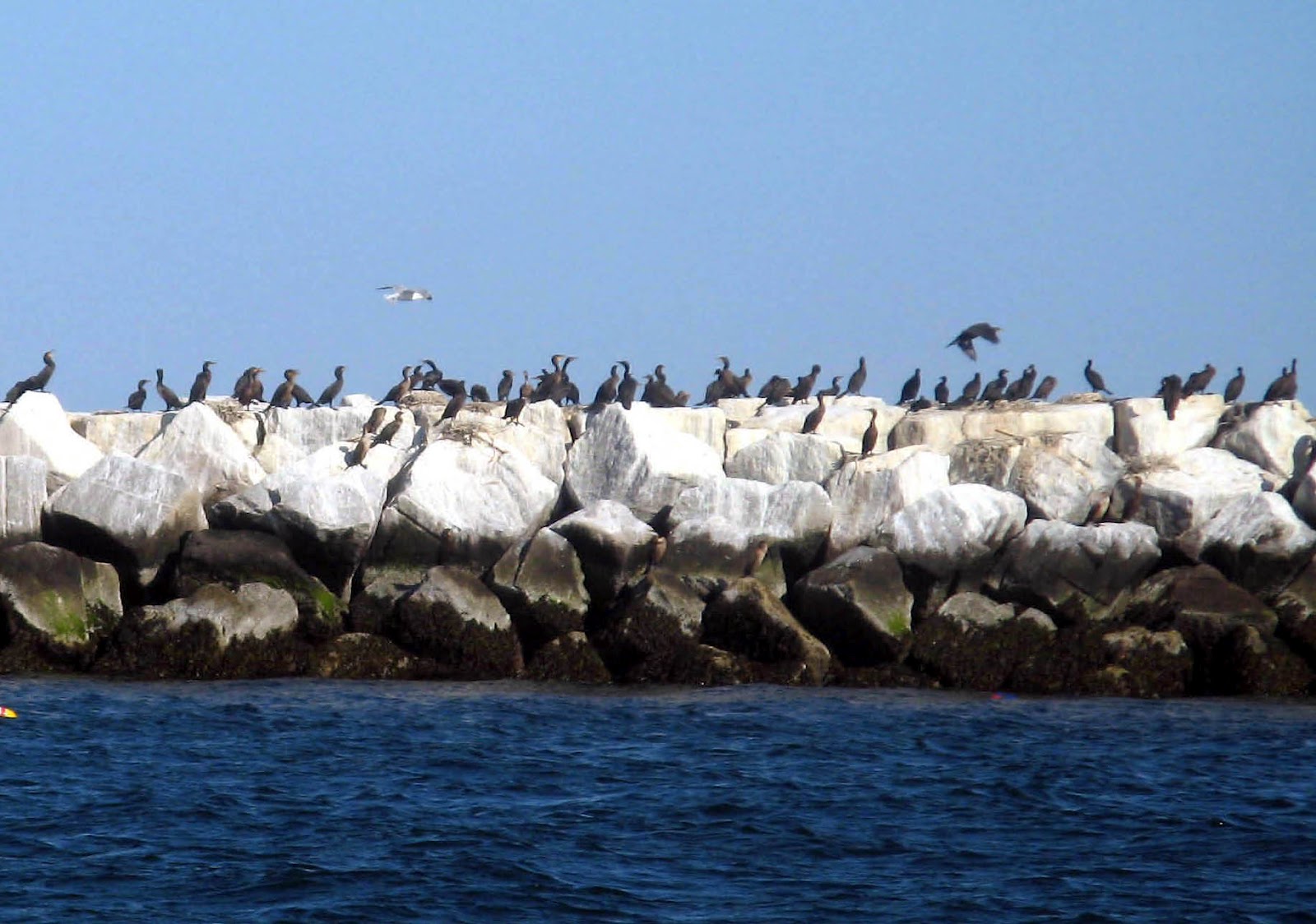
Cormorants were resting on the breakwater, while a gull glided above. I got a close-up of a cormorant four years ago in what is now part of Brooklyn Bridge Park.

Approaching the pier, we got another view of Kalmar Nyckel. All in all, a delightful afternoon's voyage.
Friday, July 27, 2012
The Austin Lounge Lizards, "Brain Damage"
Admit it: you've long wanted to hear a bluegrass rendition of Pink Floyd's "Brain Damage", from Dark Side of the Moon. This is it. (Thanks to vegasdaddy17 for the excellent montage of Lizards album covers, band photos, and images of other public figures that accompanies the audio.)
Thursday, July 26, 2012
The Connecticut Lobster Roll

On our way to visit friends on Cape Cod last weekend, my wife suggested that we have lunch at a little seafood restaurant in Madison, Connecticut that she and a friend had discovered. "Delicious lobster rolls," she said, which easily convinced me.

Tuesday, July 17, 2012
Kitty Wells
She was "The Queen of Country Music." Born and raised in Nashville, Ellen Muriel Deason found her voice in church. She married Johnnie Wright, a musician, and got her professional start singing with him. He gave her the name "Kitty Wells" for the heroine of an old favorite song. When she started singing on her own, she was something of a pioneer. Mother Maybelle Carter was an early woman country music star, but she stayed in the context of The Carter Family. Kitty was the first to make it big solo. She was an inspiration for the next generation of women in country music, including Patsy Cline, Loretta Lynn, and Dolly Parton. She was also known for her duets with male stars like Red Foley and Webb Pierce.
The video above, courtesy of academic51, has audio of her singing one of my favorite songs of hers, "Will Your Lawyer Talk to God?", with a montage of still photos. Kitty Wells died on Monday, at the age of 92.
The video above, courtesy of academic51, has audio of her singing one of my favorite songs of hers, "Will Your Lawyer Talk to God?", with a montage of still photos. Kitty Wells died on Monday, at the age of 92.
Sunday, July 15, 2012
S.S. United States breaks transatlantic speed record: a movie newsreel from 1952.
A year ago this past February, I posted about the S.S. United States getting at least a temporary reprieve from the threat of going for scrap. Since then, the S.S. United States Conservancy has been busy publicizing the efforts to save the ship and raising funds for her preservation. You can contribute on the Conservancy's website.
The video above is of a movie newsreel (if you're my age you probably can remember these; they were shown at movie theaters, along with previews of coming attractions and cartoon shorts, before the featured film) announcing the "Big U's" setting of a new transatlantic speed record, which entitled her to the Blue Riband, an award that retired with her. The broom seen in the foreground in the still above is to be attached to her mainmast for the next voyage as an acknowledgement of her record setting run.
Thanks to Carl R. Weber for the link to the video.
The video above is of a movie newsreel (if you're my age you probably can remember these; they were shown at movie theaters, along with previews of coming attractions and cartoon shorts, before the featured film) announcing the "Big U's" setting of a new transatlantic speed record, which entitled her to the Blue Riband, an award that retired with her. The broom seen in the foreground in the still above is to be attached to her mainmast for the next voyage as an acknowledgement of her record setting run.
Thanks to Carl R. Weber for the link to the video.
Saturday, July 14, 2012
Thursday, July 12, 2012
Dewey & LeBoeuf: why I'm mourning the death of a law firm, part 3.

For a time, I occupied an office next door to that of Charles P. Sifton (photo at left by Tyrone Dukes for The NY Times), later to become a Federal District Judge. He was known to all as "Tony".*
Tony had a strong sense of decorum that I sometimes tested. In the mid 1970s Cameron F. MacRae, III, son of the then senior active partner, was brought into the firm laterally. This started some mutterings about nepotism. "Young Cam" had previously been the chief lawyer in the New York State Banking Department. His immediate predecessor in that job, Mike Iovenko, had also come to the firm as a partner. At the time, I was the host of the "Associates' Lunches," periodic gatherings of the firm's lawyers at which one partner would be called on to talk about a case or deal he or she had worked on, or an area of practice generally. Before announcing the speaker, I would introduce any new lawyers who had come to the firm since the last lunch. At Cam's first, I said this:
I know that all of us associates have our pet theories about how to become a partner in this firm, but perhaps many of you, like me, have now come to the conclusion that there is only one absolutely certain route to partnership...and that is, of course, to first become deputy superintendent and general counsel of the New York State Banking Department, which is by way of introducing Cam MacRae.Cam stood up, chuckled, and said, "Wait'll you see my successor!" After the lunch, a junior partner (the same one who had, in the previous instalment, abandoned me to the fleshpots of Baltimore) said to me, "You handled that beautifully; it really de-fused the situation." But the next day, I heard a rapping and, looking up, saw Tony Sifton at my office door. "Uh, Claude, how long have you been host of the Associates' Lunches?" "About a year and a half, " I answered. "Well, uh," Tony said, "don't you think it's about time to let someone else do it?" I readily assented. ("Young Cam" proved to be a valuable addition to the firm; some time after his father's death he became chair of its corporate and finance department and later the firm's Vice Chairman.)
LeBoeuf produced my first marriage. Joanna was a paralegal in trusts and estates. When I first met her, I was puzzled by this tall Midwestern woman with a gentile Dutch surname who wore a gold Star of David on a chain. I learned that she had converted to Judaism after the breakup of her marriage, while a student at Vanderbilt, to a graduate student who she said proved to be a physically abusive beast. She was now living with a boyfriend named Leon who was studying to be a cantor. One night, I threw a party to which she came. As others left, she hung around, offering to help clean up. She stayed the night. She and Leon had parted; "Not Jewish enough" was his verdict on her. Within a month, Joanna and her two cats had moved in. When I asked her why someone who had gone to the trouble to convert to Judaism wanted to marry a goy, she said, "You may raise the children however you want."
Our engagement raised a few eyebrows at the firm, but it was agreed that it was technically OK since I didn't do T&E work and therefore wasn't her supervisor. The morning after we returned from our honeymoon she said, "By the way, we're never having children." It later became apparent that, for reasons seeming to have little if anything to do with me, she had come to regret her decision to marry. On my thirtieth birthday we had a big party, and I got thoroughly drunk. When all the guests had left, I told her I wanted a divorce. She agreed.
After we separated, Joanna moved to Chicago to be closer to her family. We remained friends and stayed in touch by phone. She even gave the ultimate compliment of naming a cat for me. After a few years, when I tried to reach her at her office several times and was repeatedly told she was out sick, I called her at home, and she said she had been diagnosed with multiple sclerosis. Several years later, after she had gone through a third brief, unhappy marriage, she called, told me she had decided to move back to New York, and asked if she could sleep on my couch while she looked for an apartment. I said I'd be delighted. She found a place to live, and a job. One day, as I was walking across Sheridan Square in the Village with Martha, then my girlfriend and now my wife, we ran into Joanna, and I introduced them. The next day Joanna called me and said she thought Martha and I "looked good together." A couple of years later I got a call from Joanna's sister; Joanna had died the day before, evidently of congestive heart failure.

In the process of moving, I had occasion to walk the block of Thirteenth Street between Sixth and Seventh avenues, and there discovered the Bells of Hell, which was to become my home away from home during non-working hours. These non-working hours began to expand, though on occasion I tried to combine them with work. I wrote a section of a brief in a proceeding before the Massachusetts Department of Public Utilities while sitting at the bar of the Bells. It was on a tricky economic question, one on which I thought our client had a reasonable argument but would probably lose given some language in earlier decisions. We did lose, but the DPU's decision on this point included the words "Counsel for the Company ably argued..." I could only wonder what they would have thought had they known where I was when I so argued.
Now it's time for a musical interlude. The house band at the Bells for much of the time I spent there was Turner and Kirwan of Wexford. You can read more about them, and see a video of Pierce Turner as a solo artist, here. Larry Kirwan went on to front Black 47; here's a video of them doing "Funky Céilí":
The video ends abruptly, like Larry's career at the Bank of Ireland, but unlike mine at LeBoeuf.
During 1975 and '76 I had experienced two of what psychologists consider among the most wrenching life changes: marriage and divorce. My divorce, as such things go, hadn't been traumatic, but I entered the final stretch of the seventies feeling itchy and introspective. My life since high school had been a rapid progression through college, which I completed in three years by dint of taking overloads and summer courses, then law school, then to the firm, with a break for military service, then back. I was wondering if I might have been happier had I followed a different path. Like Charlie McCrann (see the previous installment) I had artistic pretensions, though mine were of the Great American Novel instead of the Academy Award kind.
Unfortunately, my turn toward introspection and the Village demimonde came as LeBoeuf was getting substantial amounts of new business and associates were facing greater demands. One night I was working in the library during the wee hours, not because I was overburdened but because I had procrastinated, when the phone rang. I picked it up, and a woman said "Who is this?"
"This is Claude Scales."
"Claude, oh my God! This is terrible. Why are you working at this hour?"
"I just have to get something done. Who are you?"
She identified herself as a third year associate I knew, though not very well. She continued to bewail my late night labors, then giggled and said "Michael, cut it out!" Finally, I said I had to get back to work. She said "OK" and hung up. Later that morning I went to the office of Susan, an associate I knew was a friend of my late night caller. I told her what had happened; she sighed and said, "She's been working on a deal that kept her in the office for several days and nights straight." I told Susan about the giggling and "Michael." She rolled her eyes, and said Michael was a senior litigation associate I knew fairly well who had been through a bitter divorce and a breakdown. "The blind leading the blind," I said. Susan smiled wryly.
Charlie and I were moved from our shared office on the firm's main floor to adjoining small offices in a portion of the floor below that the firm had leased as expansion space. In Lions in the Street, his book about the great Wall Street law firms, Paul Hoffman wrote about how, when Simpson Thacher & Bartlett had its offices in the old Equitable Building at 120 Broadway, an associate getting his (they were all male at the time) first individual office could tell if he was on partnership track by whether his window faced the street or an air shaft. Of those who suffered the latter fate it was said, "He got the shaft." I soon concluded that being assigned to one of the small associate offices in this isolated section, not connected to the rest of the firm by a stairway, was the equivalent of getting the shaft. This was confirmed at my next annual review when Don Greene told me I was not destined to be one of the elect. Nevertheless, he said, I should not "rush away" from the firm. He would try to find something for me.
Shortly after that, a younger partner who was regarded as a rising star invited me to dinner at what was then one of Manhattan's most trendy restaurants, followed by drinks at a members only** night spot. The purpose of this sybaritic night on the town was for him to let me know that a client of the firm, a utility company headquartered in the suburbs, was looking for an in-house lawyer. I was diffident; I didn't want to leave my Village digs for a place in the 'burbs, and reverse commuting seemed like a chore. Over the next few weeks, this partner and several others, including a senior partner for whom I had great respect, kept pressing me to consider the job. I met Ken, vice president and secretary of the client (the firm held the title of "general counsel"), who would be my supervisor, and we both had favorable first impressions. I was offered a deal: I would work for the client at its offices full time for a trial period while remaining on LeBoeuf's payroll. If either the client or I was dissatisfied, I would return to work at LeBoeuf.
At first, it worked out well. I found that I could make the run up the FDR Drive, over the George Washington Bridge, and up the Palisades Parkway to the company's office in about 45 minutes. The return trip was usually a bit slower, as there was some traffic going into the city for the evening. I had to leave the Bells earlier on week nights to be able to get up at 6:30 the following morning, but I was seldom required to work late or on weekends. After about a month, Ken called me into his office, said he and his colleagues were pleased with my work, and offered me the job. I accepted.
After a while, though, I felt the sense of restlessness returning. I didn't want to spend the remainder of my career working in the suburbs. Ken hired another lawyer, Steve, to share our growing workload. Unlike me at the time, Steve was focused and ambitious. He found that the officer in charge of purchasing had made a hash of hedging against fluctuations in the cost of oil and, with Ken's support, took this to top management. This made Steve unpopular with some people, but feared and respected by others. Meanwhile, I was taking long weekends to work on Charlie's movie (see previous installment) and finding it hard to concentrate on my work. When a project I was assigned, in which the company's president took an interest, became overdue, Ken's limited supply of patience was exhausted. He called me into his office. Steve was there. Ken said that henceforth I would report to Steve. I felt like quitting on the spot, but I couldn't take the immediate financial hit.
I considered my options. Jobs were not widely available; these were the "stagflation" years. My work on regulatory matters had kindled an interest in economics. I had taken one undergraduate course in that subject, which I liked and aced. The New York University Graduate School of Business Administration (now called the Stern School) offered an M.B.A. degree with a major in economics. I had G.I. Bill educational benefits available. Going back to school was an attractive prospect. I could look for part-time work, and my parents agreed to help as necessary. My application to N.Y.U. was accepted, and I left my in-house job in June of 1979.
In the fall of that year, I was invited to a black tie dinner dance to celebrate LeBoeuf's fiftieth anniversary. Everyone was cordial, and after dessert had been eaten and the band struck up, Sheila, the firm's first woman partner, came over to where I was sitting and said, "Ask me to dance." I managed not to step on her toes, and my date was impressed. It was a delightful evening.
One afternoon around that time, I was sitting at the bar of the Lion's Head, which had again become my principal watering spot since the Bells closed a few months before, and got into a conversation with a Weil, Gotshal partner who frequented the place. When he found out I had been doing public utility work, he said, "I could use you. We have this strange antitrust case where our client is a public utility holding company suing other public utilities under the Sherman Act, and we don't have anybody who knows the industry." He said I should mail him my resume with a cover letter claiming I had been given his name by a common acquaintance of ours, and swear in blood that I would never disclose to anyone at the firm how we met, or even mention the Lion's Head. I got the job, working on an hourly basis, and this led to further projects that sustained me through the time I was taking classes at N.Y.U.
By 1982, I was ready to re-join the full time work force, and got an in-house job with an insurance company. Being in that business meant that I was able to keep up my contacts with LeBoeuf, at NAIC meetings and also, from time to time, as a client. I was proud to see my old mentor Taylor, who had become the firm's chairman, profiled in The American Lawyer as "LeBoeuf's Gentle Expansionist". Later, after Don Greene had succeeded Taylor at the firm's helm, I was surprised to see an associate, anonymously quoted, describing Don as "like the great flaming head in The Wizard of Oz." This didn't seem like the Don I remembered, and still saw on occasion. I was deeply saddened to see Peter Demmerle, a very smart and personable lawyer and former Notre Dame football star who seemed to be Don's heir apparent, fall victim to, and eventually die from, Lou Gehrig's disease. At the same time, I was glad to see Jim Woods, who had been one of my associate friends in the early '70s, and who had become the head of LeBoeuf's San Francisco office, rise to a position of prominence in the firm by developing a thriving insurance practice on the West Coast and in East Asia.***
My friendship with Charlie, and several other former LeBoeuf associates, had continued from the time we left the firm. Charlie and I both got married and became fathers, which somewhat dampened our Bohemian inclinations (although we made it a tradition to meet once a year with the sound man from his movie at a Bohemian beer garden in Queens). He became a senior executive with Marsh & McLennan, the world's largest insurance brokerage, and had an office on the 100th floor of One World Trade Center.
On the morning of September 11, 2001, I had just dropped off my daughter at P.S. 150 in lower Manhattan, about a quarter mile north of the World Trade Center, and had turned off of Greenwich Street, where I had a clear view of the WTC towers, onto Reade Street, when I heard the sound of a plane overhead, seeming much closer than it should be. A few seconds later, the noise abruptly stopped. There was a brief silence, followed by a very loud explosion. People behind me on Greenwich Street started screaming. I ran back, looked up, and saw a gash in the side of One WTC right about where I knew Charlie's office was. A moment later, a fireball emerged from the gash. In 2003, I posted this on Charlie's page in Marsh's memorial website for those lost in the September 11 attack:
Two years ago today, on a crisp, clear morning just like this, I lost someone very dear to me. Charlie's and my friendship took root in the early 1970's in a shared office at LeBoeuf's, was watered during bachelor hours at the Lion's Head and the Spring Street Bar, flowered in exotic locales at NAIC meetings, endured and strengthened through his and my marriages and the births and growth of our children. He was responsible for my brief, less than glorious but delightfiul movie career. I miss him very much.I later learned that Cameron F. MacRae, III lost a daughter, who worked for Fred Alger Management, Inc., a few floors away from Charlie's office.
After I moved to Brooklyn Heights, Tony Sifton and I were neighbors, and would occasionally see each other on the street or in the bank or a shop. He would sometimes stop to chat, and was keen to hear how my life was progressing. The last time I saw him, we were both in line to buy bread at Almondine. He looked frail and was wearing a ventilator. Not long after, I saw his obituary. This past February I had the pleasure of meeting his son Sam, who had recently been appointed National Editor of The New York Times, when he spoke at a Brooklyn Heights Association meeting.
I had mixed feelings about the Dewey-LeBoeuf merger. I was sorry to see the LeBoeuf name lose precedence to the more prestigious Dewey, but hoped this would enable the firm to thrive in the increasingly competitive, globalized market of the megafirms. Every once in a while I would see an announcement that a highly regarded lawyer in some lucrative area of practice had left another firm to join Dewey LeBoeuf. While I assumed they were doing so because they thought they could make more money, I knew nothing of the lavish guarantees they were given. Perhaps Steve Davis, the firm's chairman, was hearing the words of Brutus:
We at the height are ready to decline.Maybe these same words echoed in the head of the "London Whale". For some, no doubt, they have inspired great deeds; for others, including Brutus and Cassius, they have pointed the way to disaster.
There is a tide in the affairs of men
Which, taken at the flood, leads on to fortune.
Omitted, all the voyage of their life
Is bound in shallows and miseries.
On such a full sea are we now afloat,
And we must take the current when it serves
Or else lose our ventures.****
Erratum: I erroneously wrote that Cameron MacRae's daughter worked for Cantor Fitzgerald. LeBoeuf alum Peter Smedresman, whom I saw yesterday evening for the first time in about thirty years, told me she worked for Fred Alger Management. I've made the necessary correction to the text.
___________
* It is evidently an haut WASP tic for a man to have a nickname commonly associated with a given name other than his own. I never asked Tony how he came by his nickname, but I did later find the origin of a similar one. After leaving LeBoeuf, I worked for a time for Whitney North Seymour, Jr., former U.S. Attorney for Manhattan, and learned that he was known as "Mike." After one of my friends asked how "a guy with three last names" could be so called, I made a discreet inquiry and was told that when Whitney Jr. was in utero his mother called him "Microcosm." Update: I've since learned that "Tony" had a similar origin. When he was a baby, his older brother called him "Bunny", which later got changed to Tony.
**Note: no apostrophe. I get lots of hits off web searches by people wondering if "members only" takes an apostrophe.
***At the outset of this series I mentioned how my infatuation with a law school classmate who had been a summer associate at LeBoeuf led to my interviewing for a job there. This woman also indirectly and unwittingly caused Jim to go to work at the firm. For a time she dated Larry, a classmate of ours, and told him she had enjoyed her time at LeBoeuf. Larry later met Jim when they both had summer jobs at the United Nations. Jim, a native Californian, was impressed by New York City, and asked Larry what law firms he would recommend as prospective employers. Larry, remembering his former girlfriend's praise, told Jim he should check out LeBoeuf. The rest, as they say, is history.
****Julius Caesar, 4.2.269-276.
Wednesday, July 11, 2012
Real baseball wins: NL 8, AL 0.

It turns out, though, that Ms. Zinser was bemoaning the overall level of seriousness afforded to this "exhibition game" exemplified by "Tony La Russa['s] scowl." She allowed that it has been afforded seriousness because of MLB's decision, a few years back, to make its outcome determine home field advantage in the World Series. Fun, she said, is what we need. She saw her fellow pundits saying things like: "How dare anyone suggest it would have been more fun to watch Buster Posey try to catch R.A. Dickey's knuckleball at the start of the game?", or criticizing AL starter Justin Verlander for having a little fun by trying to throw the hottest stuff ever and getting "hit like a pinata". Like many Mets fans, I would have liked to see Dickey honored as the starter. Still, I think 8-0 was fun.
Monday, July 09, 2012
So, what's all this fuss about the Higgs boson?
Why is it called the Higgs? It was named for Peter Higgs (see video above), a theoretical physicist now retired from the faculty of the University of Edinburgh, who predicted its existence. Around the same time, two other physicists, François Englert of the Free University of Brussels and Tom Kibble of Imperial College London, independently came to a similar conclusion. Had the last of these published first, we might now be celebrating the discovery of the Kibble boson.
So, what is a theoretical physicist? A theoretical physicist is someone who, using mathematics, tries to find solutions to as yet unexplained issues in physics. An experimental physicist tests these solutions in experiments using equipment such as the enormous CERN Large Hadron Collider in which the Higgs Boson has evidently now been found. Richard Feynman, one of the great theoretical physicists of the last century, who played an important role in defining what physicists call the "Standard Model" in which the Higgs plays a vital role, once described the difference by recalling a talk he gave to some experimental physicists at the Lawrence Livermore Laboratory in California. Referring to a recently discovered particle, he said, "Let's suppose its spin [a quality all particles have, which can always be expressed as an integer or an integer plus one half] is two and a half." A voice with a heavy Brooklyn accent called out from the audience, "Hey! It ain't two and a half, it's tree. Dey measured it."
This isn't to say that experimental physicists are all down-to-earth types; far from it. The Guardian's Sample describes Fabiola Gianotti, a leader of the CERN team that may have discovered the Higgs, as having "an education steeped in ancient Greek, philosophy and the history of art--she had also trained as a pianist at the Milan conservatory." Sample also quotes her as saying: "physics is art, aesthetics, beauty and symmetry."
Wednesday, July 04, 2012
The Green Mountain Boys
Vermont, despite its place on the map, was not one of the original thirteen colonies. It was a sliver of territory lying west of New Hampshire (from which it was separated by the Connecticut River), north of Massachusetts, and east of Lake Champlain, to the west of which lay northern New York. It had been claimed by France, though never extensively settled apart from a few forts, and was surrendered to the British, along with Quebec, in the Treaty of Paris (1763) which concluded the Seven Years' War (better known here as the French and Indian War).
Shortly after the cession of Vermont by the French, Governor Wentworth of New Hampshire began giving land grants there to settlers. King George III had a different plan. He decided to place the boundary between New Hampshire and New York at the Connecticut River, thereby giving Vermont (or, as the beneficiaries of Wentworth's munificence called it, the "New Hampshire Grants") to New York. Some of the Wentworth grantees, led by the brothers Ethan, Ira and Levi Allen, along with Seth Warner and Remember Baker, formed a militia called the Green Mountain Boys that prevented New York grantees from settling in the territory.
When hostilities between the colonists and Great Britain began in 1775, the Green Mountain Boys joined the rebel side and, along with Colonel Benedict Arnold from Connecticut, captured the British forts at Ticonderoga and Crown Point on the New York side of Lake Champlain. Later, there was a schism between Ethan Allen and Seth Warner, which led to Warner's heading the Vermont Militia and Allen leading a rump group of Green Mountain Boys in an unsuccessful attempt to take Montreal.* Allen and his contingent were captured and held prisoner by the British.**
In January of 1777, Vermont declared itself an independent republic, though allied with the colonies in the fight against the Crown. In August of that year, Warner's militia played an important role in the Battle of Bennington, in which the British General Burgoyne's forces, marching south from Quebec in an effort to split the northern from the southern colonies, suffered heavy losses that contributed to their later defeat at Saratoga, considered to be the turning point of the war. Vermont gave up its independence and became the fourteenth state in 1791.
While the song in the video above is billed as a "Revolutionary War song", in my opinion it is of much more recent provenance. Still, I like it.
__________
*This was the first attempt by forces from what is now the U.S. (actually, the Green Mountain Boys had earlier briefly held St. John, Quebec, but quickly retreated when British troops approached) to invade what is now Canada; another happened during the War of 1812. Both times, we got whupped. I was amused to read, some years ago, that in the 1920s a group of Canadian military officers took what was billed as a good will tour of U.S. military installations, during which they drew up secret plans for an invasion. The initial thrust was to capture and hold what they called the "Albany salient." Little did they realize that any army compelled to occupy and defend Albany is an army liable to mutiny en masse.
**One of those who accompanied Allen, but who either evaded capture, escaped, or was released, was one of the more colorful minor characters in early U.S. history, Matthew Lyon. A native of County Wicklow, Ireland, he was an early settler in the New Hampshire Grants, and formed a unit of what became the Green Mountain Boys. During the course of the war, he was court martialed by General Horatio Gates for cowardice and, as punishment, made to carry a wooden sword. Despite this, he later had the distinction of serving in Congress from two states, Vermont (1797-1801) and Kentucky (1803-1811), and after that unsuccessfully tried to become a delegate from the Arkansas Territory. In 1798 he became the first person to be convicted under the alien and sedition laws, for publishing letters opposing President Adams' policies with respect to France, and was re-elected to Congress while in jail. He was also the first member of Congress to be charged with an ethics violation, accused of "indecency" for expectorating in the face of a fellow Congressman (this earned him the nickname "The Spitting Lyon"), but was exonerated. Lyon's one great contribution to history was casting the deciding vote for Jefferson when the presidential election of 1800 went to the House.
Shortly after the cession of Vermont by the French, Governor Wentworth of New Hampshire began giving land grants there to settlers. King George III had a different plan. He decided to place the boundary between New Hampshire and New York at the Connecticut River, thereby giving Vermont (or, as the beneficiaries of Wentworth's munificence called it, the "New Hampshire Grants") to New York. Some of the Wentworth grantees, led by the brothers Ethan, Ira and Levi Allen, along with Seth Warner and Remember Baker, formed a militia called the Green Mountain Boys that prevented New York grantees from settling in the territory.
When hostilities between the colonists and Great Britain began in 1775, the Green Mountain Boys joined the rebel side and, along with Colonel Benedict Arnold from Connecticut, captured the British forts at Ticonderoga and Crown Point on the New York side of Lake Champlain. Later, there was a schism between Ethan Allen and Seth Warner, which led to Warner's heading the Vermont Militia and Allen leading a rump group of Green Mountain Boys in an unsuccessful attempt to take Montreal.* Allen and his contingent were captured and held prisoner by the British.**
In January of 1777, Vermont declared itself an independent republic, though allied with the colonies in the fight against the Crown. In August of that year, Warner's militia played an important role in the Battle of Bennington, in which the British General Burgoyne's forces, marching south from Quebec in an effort to split the northern from the southern colonies, suffered heavy losses that contributed to their later defeat at Saratoga, considered to be the turning point of the war. Vermont gave up its independence and became the fourteenth state in 1791.
While the song in the video above is billed as a "Revolutionary War song", in my opinion it is of much more recent provenance. Still, I like it.
__________
*This was the first attempt by forces from what is now the U.S. (actually, the Green Mountain Boys had earlier briefly held St. John, Quebec, but quickly retreated when British troops approached) to invade what is now Canada; another happened during the War of 1812. Both times, we got whupped. I was amused to read, some years ago, that in the 1920s a group of Canadian military officers took what was billed as a good will tour of U.S. military installations, during which they drew up secret plans for an invasion. The initial thrust was to capture and hold what they called the "Albany salient." Little did they realize that any army compelled to occupy and defend Albany is an army liable to mutiny en masse.
**One of those who accompanied Allen, but who either evaded capture, escaped, or was released, was one of the more colorful minor characters in early U.S. history, Matthew Lyon. A native of County Wicklow, Ireland, he was an early settler in the New Hampshire Grants, and formed a unit of what became the Green Mountain Boys. During the course of the war, he was court martialed by General Horatio Gates for cowardice and, as punishment, made to carry a wooden sword. Despite this, he later had the distinction of serving in Congress from two states, Vermont (1797-1801) and Kentucky (1803-1811), and after that unsuccessfully tried to become a delegate from the Arkansas Territory. In 1798 he became the first person to be convicted under the alien and sedition laws, for publishing letters opposing President Adams' policies with respect to France, and was re-elected to Congress while in jail. He was also the first member of Congress to be charged with an ethics violation, accused of "indecency" for expectorating in the face of a fellow Congressman (this earned him the nickname "The Spitting Lyon"), but was exonerated. Lyon's one great contribution to history was casting the deciding vote for Jefferson when the presidential election of 1800 went to the House.
Friday, June 29, 2012
iPod Log 8: a long morning walk.
 |
My work schedule and other duties have kept me from doing the long version of my morning walk for some time. I was able to do it again a couple of weeks ago; below is the list of songs I heard (with links to videos, where available), and some photos I took along the way.
Neil Young, "Like a Hurricane". One of my favorite rock songs of all time. Hear it here.
Scott Joplin, "The Cascades", (New England Conservatory Ragtime Ensemble, Gunther Schuller, cond.) Video, by the h2 Quartet, here

Lightnin' Hopkins, "I'm Wit' It". Hear it here.
James Brown, "Chonnie-On-Chon". From Roots of a Revolution, Polydor's great collection of his early stuff recorded at King Studios in Cincinnati. Listen here.

Ruth Brown, "5-10-15 Hours". Hear it here.

Sibelius, Karelia Suite, Op. 11, 3rd movement, alla marcia (Helsinki Radio Orchestra, Okku Kamu cond.) Listen to the same piece by the London Philharmonic, Sir Charles Mackerras conducting, here.

Fleetwood Mac, "Rhiannon". In 1978 I adopted a young street cat and named her for this song. Original recording, with still photo montage, here.

Marshall Tucker Band, "Heard it in a Love Song". Hear it here.
The Drifters, "This Magic Moment". One of my favorite R&B songs of all time. Listen here.

Rod Stewart, "Reason to Believe". From Every Picture Tells a Story, in my opinion one of the top five or so greatest rock albums ever. Video of live performance here.
Dave & Ansel Collins, "Double Barrel". Sizzling reggae from the expanded version of the great The Harder They Come CD. Live performance video here.

Johnny Cash, "I Walk the Line". Live performance video, with history lesson, here.
Stevie Wonder, "Living for the City". Live performance video here.

The Byrds, "Bugler". One of my favorite rock groups ever, here with a mellow country sound. Hear it here.

Tom Russell Band, "Gallo del Cielo". Thrilling, and like many Mexican and Mexican-inspired songs, tragic. Video with photo montage and live performance audio here.

Grateful Dead, "Ripple". This song perhaps best exemplifies what one critic called the Dead's "patchouli oil philosophy", but I still like it. Live performance video here.

Sue Foley, "Bad Luck Woman". A Canadian blues singer. Yes. Unfortunately, there's no video of this song, but here she is doing "Truckin' Little Woman".

Rusty & Doug, "Louisiana Man". Sounds just like crawfish étouffée tastes. Hear it here.

The Band, "Long Black Veil". Live performance video here.
Bruce Springsteen, "Open All Night". Live performance audio with photo montage here.

Fleetwood Mac, "Station Man". From Kiln House, a post Peter Green and pre Buckingham-Nicks album that critics drubbed but I love. Hear it here.
Fleetwood Mac, "Buddy's Song". From the same album; the best Buddy Holly song he didn't write (and never heard). You can hear it here.

Carole King, "Smackwater Jack" (live version). a bonus track from the Tapestry CD. Video of a different live performance (BBC) here.

The Byrds, "Renaissance Fair". Audio of live performance at 1967 Monterey Pop Festival with still photo here.
Lynyrd Skynyrd, "Jacksonville Kid" (aka "Honky Tonk Night Time Man"). A live bonus track from the Street Survivors CD. Audio of studio version here.

Lambert, Hendricks & Ross, "Everybody's Boppin'". Annie Ross was a regular at the Lion's Head. Audio of the original recording, with a still of the album cover here. A fitting finish.
Sunday, June 24, 2012
A small victory in the apostrophe wars.

Yes, I think the old sign was prettier than the new one, except for that egregious grammatical error.
Tuesday, June 19, 2012
I missed Bloomsday, but it's never too late for Finnegan's Wake.
So, the sixteenth of June passed, and unlike last year I did not go to the Ulysses' Folk House and do a reading; I didn't even have a glass of Burgundy and a gorgonzola cheese sandwich.
By way of penance I'm here paying tribute to James Joyce's other massive novel, Finnegan's Wake, which I will let the Clancy Brothers explain in their delightful way in the video above, for which I thank Vlikavec, who has a superb collection of Clancys videos on his channel.
By way of penance I'm here paying tribute to James Joyce's other massive novel, Finnegan's Wake, which I will let the Clancy Brothers explain in their delightful way in the video above, for which I thank Vlikavec, who has a superb collection of Clancys videos on his channel.
Monday, June 18, 2012
Dewey & LeBoeuf: why I'm mourning the death of a law firm, part 2.

When I returned to LeBoeuf in 1973 from my Army stint, the firm had grown modestly, to about 45 lawyers. While I had spent most of my first year working on public utility matters, I now found myself called on to work in different areas of practice. The firm was not departmentalized, so an associate like me could be assigned tasks in various fields. One of these, to my delight as a ship buff, was maritime law. I had to learn the intricacies of charter parties, which is what contracts to charter ships are called, including such concepts as demurrage and laytime, and, when the client decided to build its own fleet of tankers, I worked on drafting and negotiating the shipyard construction contract and the operating contract with an experienced ship owner that would supply officers and crews.
I also began to get assignments in what had become the firm's second major practice area: insurance. Our clients were London based insurers whose operations in the U.S. were mostly in what's called the excess or surplus lines market, in which unlicensed insurers could write business--typically large or unusual risks--that couldn't be placed with licensed carriers, and in reinsurance. My mentor in this area was Donald J. Greene, then a rising younger partner but later to become the firm's chairman and a "name" partner. Early on, I got an assignment from Don and wrote a memo, which I gave to his secretary. The next day she called: "Mr. Greene wants to see you in his office." "Close the door," he said as I entered. My memo was prominently centered on his desktop, which typically looked like the flight deck of an aircraft carrier after all the planes had gone on a mission. The memo had prominent red marks. "Sit down." He then told me how, in the course of his Jesuit education, he had asked whether a Buddhist, Hindu, Taoist or such who lived an exemplary life was still condemned to hell for not being Christian. The answer he was given was "No," provided that person was completely unaware of Christian teaching. This, he said, was called the Doctrine of Invincible Ignorance, and my memo demonstrated it.
Despite this, Don evidently saw some redeeming virtue in my work, as I became a recipient of his "fun, travel, and adventure" talk.
Claude, I'd like for you to do more work for our [insurance clients]. This work will be challenging, and will involve a great deal of travel, some of it on short notice. You're a bachelor, right?...Good. Please make sure your passport is up-to-date and keep it handy.Over the next several years I did a fair amount of traveling, none of which required a passport. I was assigned to keep track of legislative and regulatory developments in the Southwest Zone of the National Association of Insurance Commissioners, which involved trips to Austin, Cheyenne, Dallas, Houston, Oklahoma City, and Omaha. On one occasion, the associate assigned to the Northeast Zone had a schedule conflict and I was sent to an NAIC meeting in Baltimore. After one day, the junior partner who accompanied me said, "I can't take this any longer; give me a report when you come back Wednesday." That evening, sitting at the Hilton's bar, I got into conversation with Fred, the CEO of a Miami based insurance company. A man about my age came up to him and said, "Fred, the desk won't let the girls in without escorts." Fred looked at me and, in his best CEO voice, said "Come!" I went. Outside the door were three women with teased hair, wearing scanty tops, tight fitting pants, and stiletto heels, shivering slightly in the evening chill. We each took one by the arm, and walked them through the lobby, past the glowering desk clerk and concierge, to the elevators. We rode up to the top floor, where Fred had a deluxe suite. Inside were two state insurance commissioners, one accompanied by his wife, several other state insurance department officials, and some of Fred's junior execs. One of the commissioners asked me who I was. "I'm Claude Smith; I'm with Allstate," I answered. He said, "I have a real problem with that." Fred paid one of the women fifty dollars to remove her top and bra. He later paid another one hundred to undress completely; this prompted the commissioner with wife to bid goodnight. The naked woman then went around the room, perching on each man's lap in turn. Afterward, she gave her opinion of each of us. My diagnosis: "This one's scared of pussy." I finished my drink, thanked Fred for his hospitality, and went to my room, alone.
.jpg)
The following day everything went as planned until I got to the Pentagon reception desk. After I had identified myself, my firm, and our clients, no guard was summoned. I was told, "Go down the corridor with the entrance to your right until you get to the third ring, then turn left, and it's the fourth door on your right." Once I got there, I was greeted cordially by the Air Force lawyer. "Any plans to use the CRAF?" I asked. "No, it's going to be all military." I thanked him, flew back to New York, and drafted a Telex (how we sent instantaneous written communications in those days, though fax was beginning to catch on) to London. The Telex, no doubt, was intercepted and read by both the CIA and the KGB.

One particular in which we were very different was this: Charlie was determined to keep his work life and his social life separate. I was, along with a few other associates, a rare exception he allowed to this rule. Several times when Charlie and I were out drinking together, I spotted someone else from the firm entering the bar. His reaction was always, "We've got to get out of here, now!" I was the opposite. I loved to mix people from different parts of my life together. I threw parties in my Village apartment to which I'd invite friends from the firm, law school classmates, and various characters I'd met at the Bells of Hell or the Lion's Head. At one of these, I looked across the room and saw a LeBoeuf partner sharing a joint with the members of a punk rock band.
Charlie was a movie buff. He had been president of the Yale Law School Film Society. While we worked at LeBoeuf, he took evening film classes at New York University (I was sworn to secrecy about this). We both left the firm at about the same time (late 1977), I to a utility company client in the suburbs (I reverse commuted from the Village) and Charlie to be legislative counsel to the chairman of the New York State Assembly's Insurance Committee. His job allowed him about six months off each year when the legislature wasn't in session, during which time in 1978 he took a feature length horror film script he had written as an NYU class project, in which almost all of the characters have the names of LeBoeuf lawyers, and turned it into a real movie. The plot was based on the paraquat scare of a few years previous. A group of hippies growing marijuana in a remote clearing in a national forest kill two federal agents who try to bust them. The feds then hire a cropduster to dump an as yet untested, highly toxic herbicide, Dromax, on their crop. The plane arrives just as the hippies are frantically harvesting, they get covered with Dromax, and are transformed into blood craving zombies who go on a murderous rampage.
Most of the cast and crew were recruited through ads in the Village Voice, though a few parts were given to Bells of Hell denizens, including me. Charlie pulled off a coup in getting John Amplas, who had played the title role in Pittsburgh goremeister George Romero's 1978 hemophagic thriller Martin, to play a federal agent (not one of those who get offed at the beginning). Aided by a New York State arts grant (the application described the project as a film about the dangers of herbicides), Charlie was able to hire top notch camera, sound, and special effects people, and to commission appropriately eerie music by Ted Shapiro. Most of the film was shot at locations close to the country house of a couple who were Bells regulars. It was in the wilds of north central Pennsylvania; to get there, you passed a sign that read "Welcome to Potter County, God's Country".
Charlie's working title was Forest of Fear. The distributor he convinced to handle the movie in the domestic market thought that sounded too much like an arty Japanese film, and changed it to Bloodeaters--Butchers of the Damned. Under that title, it played drive-ins and movie houses across the nation. Another distributor later acquired the rights to make it into a VHS tape (and later DVD) with the title Toxic Zombies; in the 1980s it played under that title on the USA Cable network. Charlie and I, and several other cast members (Charlie played the lead role, a forest ranger, as well as producing and directing) went to the East Coast premiere of Bloodeaters at the Twin Pine Drive-In on the outskirts of Waterbury, Connecticut. After the movie we went to the concession stand and were mobbed by local teens asking for our autographs (I can say this has happened once in my life). We were then feted at a party at what may have been Waterbury's classiest discotheque.
Here is the trailer for Bloodeaters:
Here's a favorable (!) review of the movie. Charlie's photo is next to the first paragraph; the photo on the wall is of Beverly Shapiro, who played his wife, Polly. During the scene from which this still was taken, Charlie opens a pressboard binder enclosing a thick sheaf of paper, supposedly weather statistics. It's actually the LeBoeuf fifty state excess and surplus lines law survey. The photo next to the third paragraph shows an especially clever bit of special effects gore involving a barbecue glove, a pig's foot, a wristwatch, a turkey baster, and stage blood (clear Karo syrup with red food coloring).
There will be a part three to the LeBoeuf saga. Can you stand it?
Update: It's here.
Second update: A few years ago Toxic Zombies was revived in Italy as Il ritorno degli zombi. You can see it here. I sound good dubbed in Italian.
Saturday, June 02, 2012
Count Basie and Jackie Wilson cover Jerry Butler's "For Your Precious Love".
A little over a year ago, I posted a clip of Count Basie and Jackie Wilson, great jazz and R&B artists, respectively, doing the Stevie Wonder Motown classic "Uptight". Unfortunately, that video clip is no longer available, but I was glad to find the clip above, evidently from the same recording series, of Jackie and the Count covering what, in my opinion, is one of the best R&B ballads ever, "For Your Precious Love".
Here's the original, by Jerry "The Ice Man" Butler. Much as I'm a fan of both Basie and Wilson, I still prefer Butler's understated yet emotionally intense delivery of this song, with its subtle accompaniment: guitar, bass, very quiet snare, and soft harmony vocals. Still it's good to have both. What do you think?
About the annoying pop-up ads on this blog; or, how to get rid of Text-Enhance/DealPly
You may have noticed, as I just did, that certain words in my posts are being highlighted--not the ones I've highlighted as links--and that, when you mouse over these words, ads pop up. I didn't, at least not knowingly, authorize this, and I'm trying to find out how to get rid of it. Sorry for the distraction.
Update: It seems the problem was an extension, which I never knowingly added, to my Chrome browser, called Text-Enhance. Unless you had this on your browser, you wouldn't have seen the highlighted and underlined words (links that I put in are highlighted but not underlined) in my blog posts, and wouldn't get the pop-up ads. If you are seeing these things on my blog or on any website you visit, follow these directions to get rid of the malware that has attached itself to your browser. When you see the list of extensions on your browser, it may not include Text-Enhance, but it may show as DealPly. I hasten to add: there is no malware in this blog, and visiting it is perfectly safe.
Update: It seems the problem was an extension, which I never knowingly added, to my Chrome browser, called Text-Enhance. Unless you had this on your browser, you wouldn't have seen the highlighted and underlined words (links that I put in are highlighted but not underlined) in my blog posts, and wouldn't get the pop-up ads. If you are seeing these things on my blog or on any website you visit, follow these directions to get rid of the malware that has attached itself to your browser. When you see the list of extensions on your browser, it may not include Text-Enhance, but it may show as DealPly. I hasten to add: there is no malware in this blog, and visiting it is perfectly safe.
Friday, June 01, 2012
Santana sits 'em down for the Mets.

Typically for the Mets, it wasn't without drama. Santana came within inches of losing it in the sixth, when a long drive down the left field line was, in what I'm sure in the eyes of most Cards fans was an example of "home cooking", called foul. That the drive came off the bat of Carlos Beltran, who subsequently grounded out, casts doubt on the "curse of the ex-Met" theory. Photo: Wikipedia.
Subscribe to:
Posts (Atom)