Monday, September 11, 2006

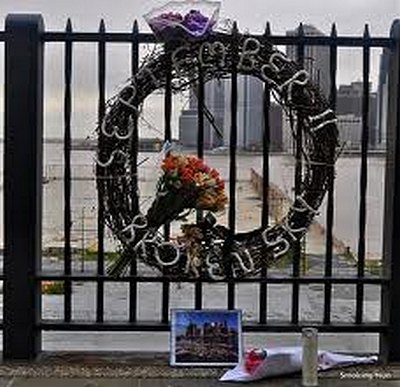
Remembering Charlie (9.11.06)

It’s five years since
the turbofan clatter, the sudden silence,
the loud report, the screams,
the gashed tower, the smoke,
then the flame, and the realization…

I like to imagine a time
when you, George and I
take the heavenly PATH
to celestial Hoboken, where,
at the bar of the cosmic Brass Rail,
we’ll sip ambrosial Berliner weisse.
This time, Brando will join us.

Sunday, September 10, 2006

Portentous?

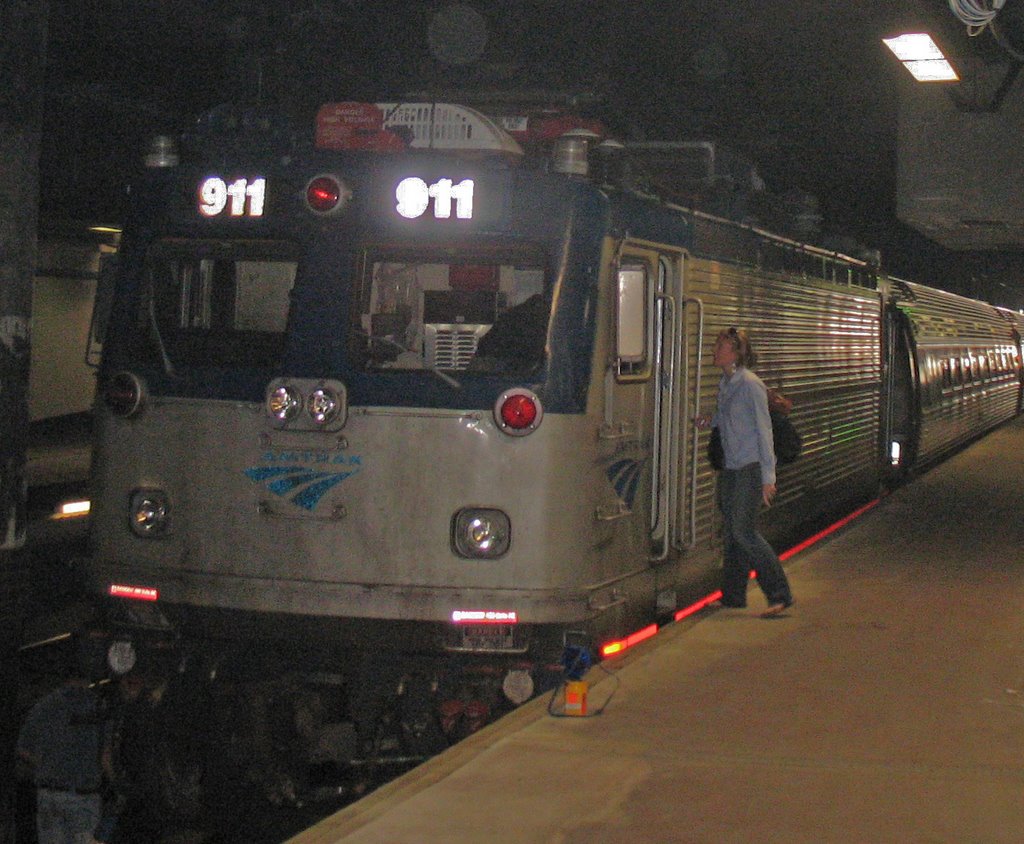
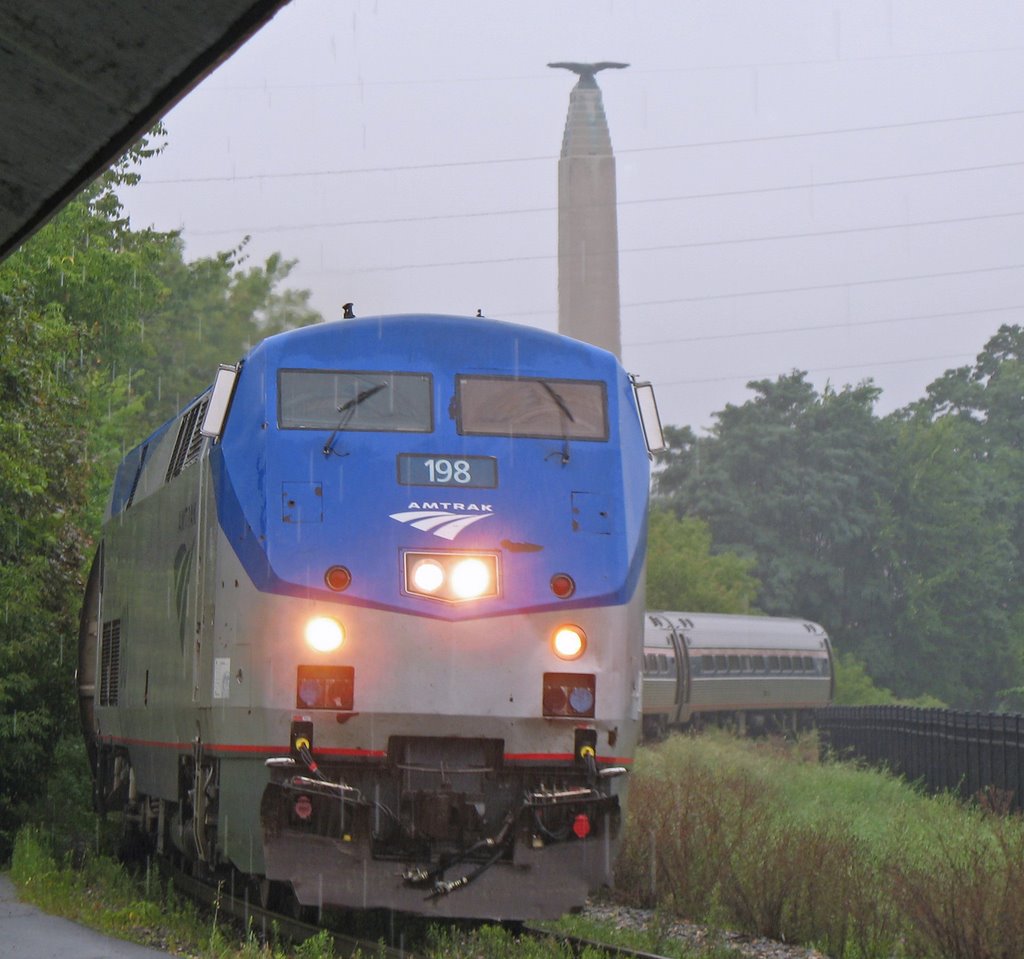
Yesterday I rode the Amtrak Keystone from Penn Station to Philadelphia, to attend a gathering of Fray participants there (I'll be posting more about my visit to Philly later). When I got off the train at 30th Street Station, I did a double take as I walked past the locomotive and saw its number.

Monday, September 04, 2006

Why I won't give up on college football.

Earlier this evening, I was ready to write a post headed "Why I'm giving up on college football." I had turned on the TV to find Florida State, midway in the first quarter, leading Miami by a field goal. The 'Noles had the ball, deep in their territory, third and ten. The quarterback took the snap, dropped back, and, with good protection, set up and threw a perfect spiral downfield. The receiver was covered, but jumped up, and the ball hit his hands. Of course, it bounced off them and fell into the hands of a Miami defender, who fell to the ground, covering the ball and giving the 'Canes great field position. I didn't want to see the inevitable touchdown, so I turned off the tube while muttering an expletive that made my wife say something negative about my relationship to sports in general.

So it was that I began mentally drafting my explanation of why Miami owns Florida State (If you were a premier prospect, where would you rather spend four or (more likely) five years: beach 'n' bling city USA or a small metropolis in the red clay country that is subject to ice storms in winter and has government and higher education as its principal reasons for being?). And, for my coda; well, it's all just too predictable. Except when you want it to be. (For a contrary example to this rule, see here).

Anyway, I braved myself to check the late score and found the 'Noles with a 13-10 lead late in the 4th. This proved to hold, much to my surprise.

Steel yourselves. There will be more college football rants.

9/7 addendum: Reggie hits me with the "Why bother with the college game when the NFL is so much better?" meme. My short answer is, "acculturation." I got to know football as a child and youth in Florida long before there were Dolphins, Buccaneers or Jaguars. There were, however, Gators, Seminoles, Hurricanes, and even (in those days) University of Tampa Spartans. They were the ones who made the Tampa Tribune Sunday headlines. Of course, there was token coverage of the Giants, Steelers, Browns, Bears and Packers for the benefit of vacationing snowbirds.

I note that Reggie is a Tarheel, meaning he's from a place where college football has always been a poor second cousin to college basketball. It's interesting to note that North Carolina now hosts a first-rate NFL team, but the NBA couldn't succeed there. Maybe there's some kind of inverse relationship. (Yeah, but the Colts and Pacers are both good. OK, something about exceptions that prove rules?)

Steve Irwin

My daughter said she really wished I would post on my blog about him. She and I watched many of his shows on Animal Planet. I found him engaging and humorous, and admired his commitment to conservation. I think the fact that she felt so strongly about his death says something very positive about her.

9/12 update, with which I think my daughter would heartily agree.

Meet Wellington.


He's a Cavalier King Charles spaniel. On his first exploration of the sidewalks of Brooklyn Heights, he met a French bulldog named Napoleon. They didn't fight.

Thursday, August 31, 2006

Happy 61st, Van Morrison.

I'll never forget the first time I heard you, as I was having lunch - roast beef on a bulkie with Russian dressing - in a little sandwich shop called Hazen's, on my first day in Cambridge, Massachusetts, when someone played "Brown-Eyed Girl" on the jukebox. Little did I know that even better things were to come.

Wednesday, August 30, 2006

Blogbirthday.

Take back this pudding. It has no theme.
- attributed to Winston Churchill

One year ago tonight I started this blog. I did it because a group of posters on the Fray (the online discussion group appended to Slate magazine) was starting a writing group, and decided to publish their contributions through blogs. I had thought about blogging before, but assumed there was some financial outlay involved in getting set up. The organizer of the Fray writing group gave directions on how to set up a blog on Blogger, and I followed them. Having set the thing up, I began using it to publish whatever came across my mind, all unrelated to the writing group, to which, I'm afraid, I never contributed.

Why the awful name? Shortly before I set up the blog, I saw the phrase "self-absorbed boomer" in several contexts. I was born in 1946, so I'm on the leading edge of the post-World War 2 baby boom, and my wife does occasionally accuse me of being self-absorbed. So I put it down, with the thought that, since I wasn't likely to draw a big readership, I could always blame the blog's lack of popularity on its title (or, should it enjoy any degree of success, revel in its having succeeded despite its name). Anyway, changing it now seems like too much of a hassle.

So, what's it all about? Well, despite the name, it's nothing like Jonathan Franzen's memoir. It is self-absorbed in the sense that it includes stuff about a number of childhood fascinations that I've never lost (dinosaurs, ships, trains) as well as ones I've developed later in life (architecture, baseball, economics) which, taken together, are, if not unique to me, certainly not a constellation of interests likely to coincide with those of a very large group of people. What I'm doing is taking the long tail theory to a length it probably can't reach. If, say, someone with a strong interest in architecture hits on my blog when that's the topic of my top post, she may bookmark it and come back. But if she then finds a post about college football, she may give up on it. If this were a business, and I was depending on it for my sustenance, I'd disaggregate; that is, I'd have "Claude's Baseball Blog", "Claude's Life in Brooklyn Heights Blog", and so forth. But it's not, and I won't.

How long will I keep on doing this? So long as marginal utility > marginal cost. (Thank you, Barbara Katz and Larry White.)

One thing I am going to change. I'd like very much to hear from you; to get your reaction to the blog in general and to what I've written about it here. However, with a few exceptions (mostly fellow Fraysters), people have not been eager to leave comments. One probable reason is that I've not allowed anonymous comments. I'm going on to Blogger Dashboard now to change that. Please feel free to comment anonymously if that's the only way you're comfortable doing it.

Thank you all. Here's hoping we can do this again one year hence.

Tuesday, August 29, 2006

Eisenhower Lock revisited.

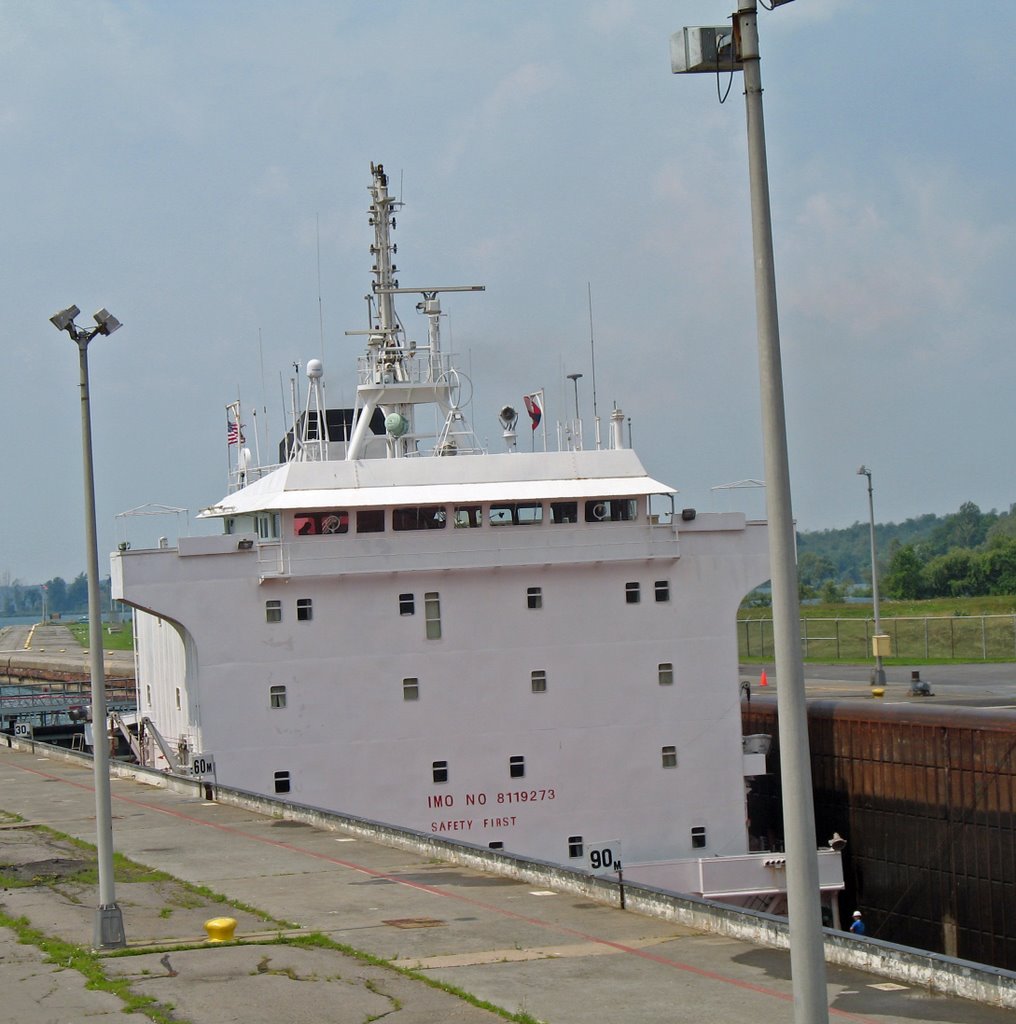
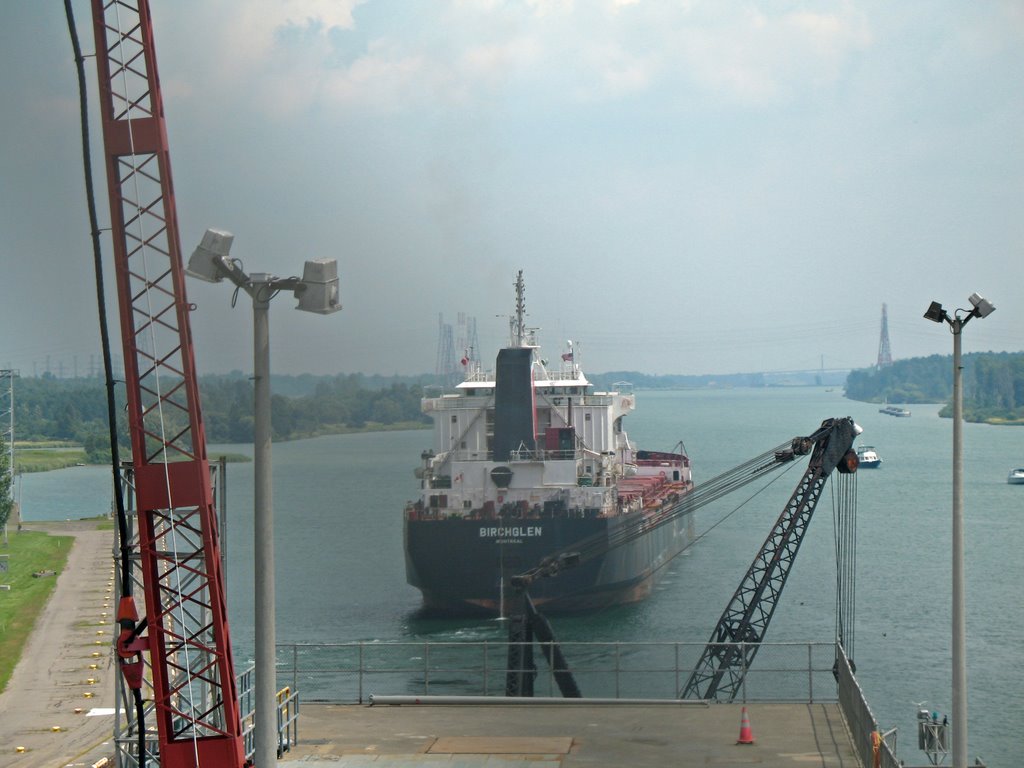
About a year ago, I posted about a visit to Eisenhower Lock, on the St. Lawrence Seaway at Massena, New York. What I didn't do then was document the entire process of a ship locking through. On my recent visit to Massena, I checked the traffic report on the Seaway website and noted that the Birchglen was due at the Lock in a couple of hours.
I got there in time to see her enetering the lock. Birchglen proved to be a new style Great Lakes bulk cargo carrier, or "laker", in that she has both her bridge and engine room aft instead of having a separate wheelhouse and crew quarters perched on her bow (compare with the photos of Frontenac in my earlier post linked above). In this respect, she looks like a typical oceangoing bulker; her laker pedigree is proclaimed by her very rounded bow, which contrasts with the sharper-edged stem of a typical "salty", and her relatively narrow beam compared to her length, which enables her to fit the Seaway locks.


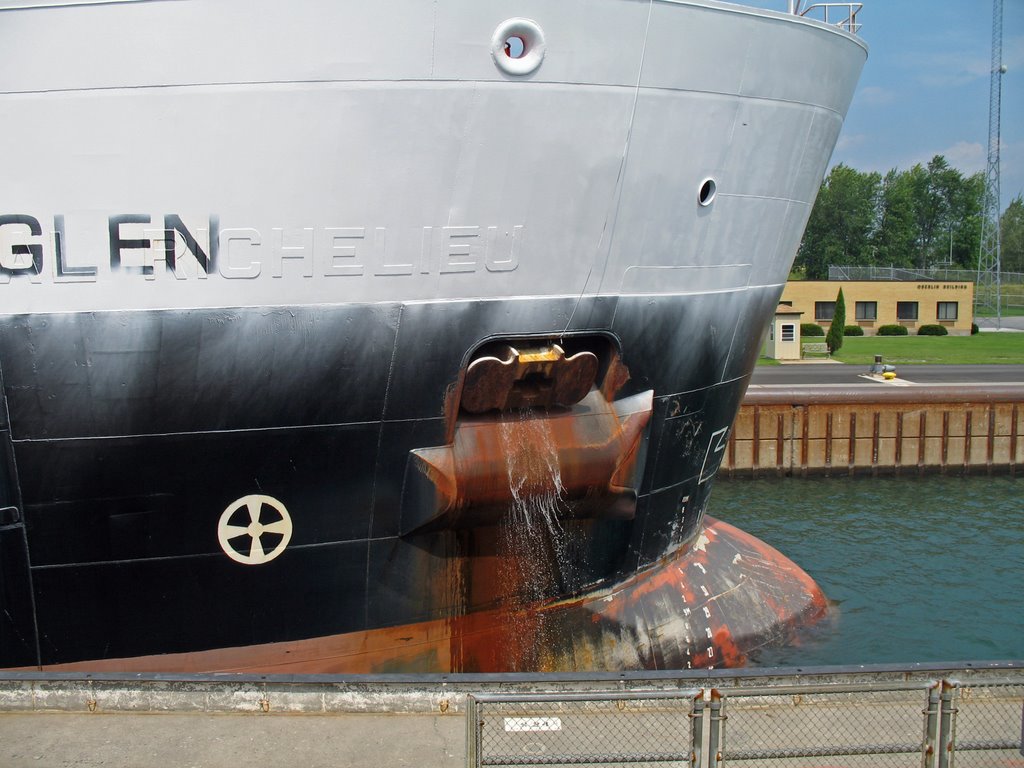
To the right is a closer view of Birchglen's bow, revealing a sloppy paint job covering raised metal letters spelling out her earlier name, Federal Richelieu. Sailors used to consider it bad luck to sail on a vessel if its name had been changed. Today, it is rare to find a merchant ship more than five years old that hasn't had its name (and probably its ownership) changed at least once. In fact, Birchglen was launched in 1983 as Canada Marquis, sailed under that name until 1991, when she became Federal Richelieu, had her name changed again to Federal MacKenzie in that same year (ironically, the name she bore for the shortest time is the one memorialized in raised lettering), stuck with Federal MacKenzie for ten years until becoming simply MacKenzie for the period 2001-02, then was given her present name. No wonder her owners, Canada Steamship Lines Inc., don't worry too much about the neatness of the paint job. As a lawyer, I assume this name-changing mania is driven by tax considerations, this being what seems to be behind any seemingly economically nonsensical business activity. (Information on the name chages comes from the very useful Know Your Ships: Guide to Boats & Boatwatching, Great Lakes & St. Lawrence Seaway, published by Marine Publishing Co., Inc. of Sault Ste. Marie, Michigan, and available at the Eisenhower Lock Visitor Center gift shop.)


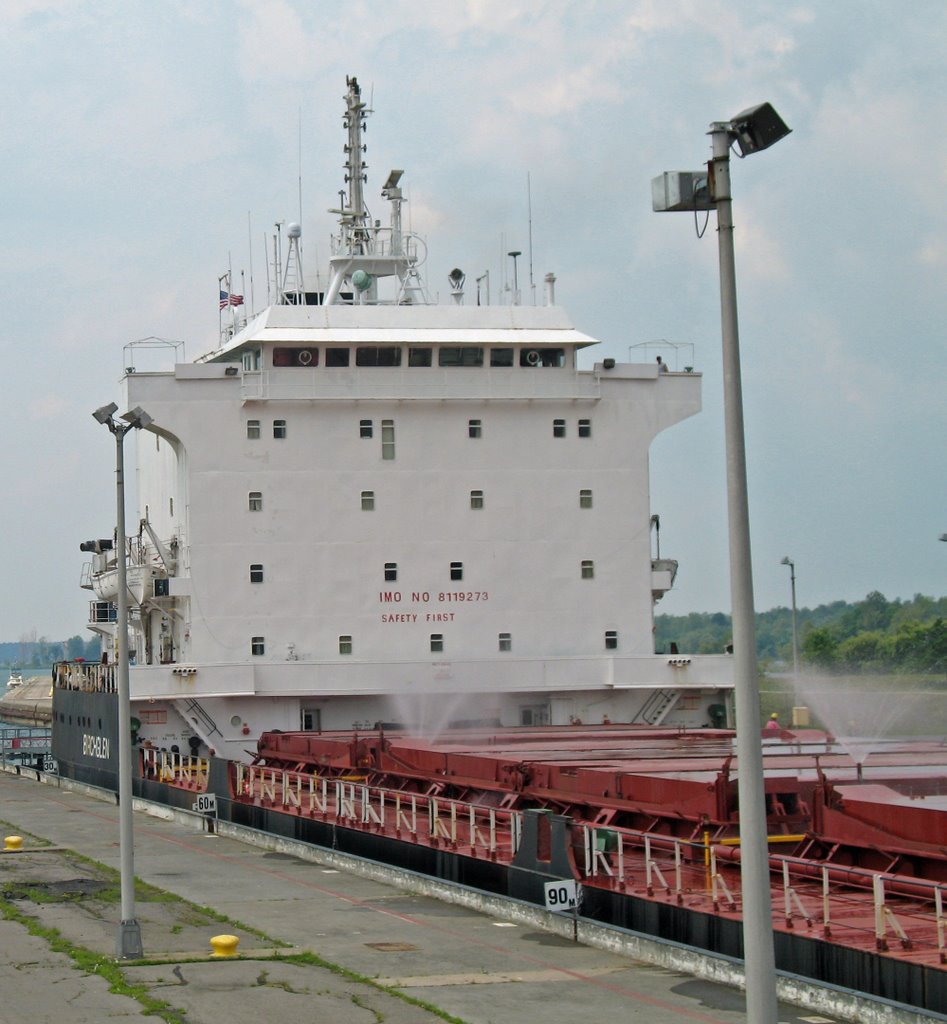
These photos show Birchglen's superstructure in a full lock (having come in from the west), and after the lock has emptied to the level of the Seaway downstream. This lowering of a 35,000 deadweight ton vessel (or raising of a vessel going in the opposite direction) is accomplished by the force of gravity; the only electric energy used is that needed to open and close a couple of valves.


Finally, we see Birchglen, having left Eisenhower Lock, sailing down the St. Lawrence toward her destination, Quebec City, where her cargo of grain will either be transshipped onto oceangoing vessels for transport overseas, or, perhaps, be milled into flour to make baguettes for hungry Quebecois.

Update: Alert reader (and friend) Ellen tells me by e-mail that frequent ship name changes aren't tax-driven. In her words:

"As I recall from my super brief stint as a sometime admiralty lawyer (wish I'd been able really to learn the stuff; it was quirky and fascinating in many respects, though it could be frustrating as well. Because of goddamn name changes, even while the vessel was at sea, I once lost a tanker for a while), it's often that a vessel is a corporation's only asset, and when there are liens against the corp or other liabilities, the principal "transfers" the vessel to "another" corporation, changes its name, and puts the first corporation in bankruptcy. Or something like that. It wasn't as much, always, about taxes as about crookedness and avoiding liability. But maybe that kind of thing isn't as easy anymore."

Second update. A very big thank you to Homer Fink of Brooklyn Heights Blog (today featuring a photo of Robert Moses, who, coincidentally, was one of the principal promoters of the St. Lawrence Seaway, looking very predatory under his broad-brimmed fedora) for telling me how to link directly to an old post instead of to an entire month's archive. I've fixed the link in the first sentence of this post accordingly.

New dino species found in Brazil.

South America seems to be the hot spot these days for dinosaur discoveries. At 39 feet and nine tons, Maxakalisaurus topai isn't particularly big as sauropods go, but this Reuters article points out, it's a significant discovery because it appears to provide an evolutionary link to a branch of the Titanosauridae found in more recent Cretaceous formations in Argentina.

Kids may love or hate it based on its name. I'm not sure how the Maxakali, the tribe from which the name is derived, pronounce the "X"; i.e., is it "Macks-a-kal-i" or "Mash-a-kal-i"?

I'm very impressed by the reconstruction of the head of the theropod Mapusaurus roseae, which you can find by scrolling down a bit in the linked article.

Saturday, August 26, 2006

Riding Amtrak's Adirondack.

Amtrak's Adirondack runs daily, both ways, between New York City's Penn Station and Montreal. The northbound and southbound trains both leave early in the morning and arrive at their destinations in the evening. This allows passengers to enjoy some impressive scenery along the way. The conductor announced that the train had been named by National Geographic Traveler magazine as having one of the five most scenic routes in the world, which, he noted, put it in the same category as the Orient Express. If only its accomodations were as posh as those on the Direct-Orient, to use (for you persnickety railfans) its proper name. Nevertheless, for Amtrak, this is a pretty good operation. The equipment is standard, i.e. basic aging Amfleet coaches (this route cries for domes; alas, tunnel clearances don't allow them) (Update: According to Trains magazine, a dome car will be added to the train during the fall foliage season, but only for the route between Albany and Montreal, where tunnel clearances are sufficient), but the crew, at least on this run, was top notch. Rating special mention are Pat, the conductor from Albany to points north, whose thirty-eight year career extends back to the days when passenger service on this part of the route was provided by the Delaware & Hudson, and the cafe car attendant, identified by his badge as Mr. Graves, whose limited counter space and food-heating facilities were taxed by a crowded train, but who dealt with the impatient and sometimes cranky passengers with grace and humor.

Subway delays meant I made the Adirondack's 7:45 A.M. departure with seconds to spare, so I was forced to take an aisle seat. Consequently, I wasn't able to get photos of the first stretch of great scenery: the Hudson valley between New York City and Albany. As we approched the Hudson Highlands, the conductor announced that volunteers from the National Park Service would give a narrative about the historical and geological significance of the places we were passing, and that those wishing to hear it should gather at the rear of the cafe car. By the time I got there, all the seats were taken, so I returned to my coach and waited until we reached Albany/Rensselaer, a division point where there's both a crew and engine change, the latter meaning we swapped one GE Genesis type loco for another.
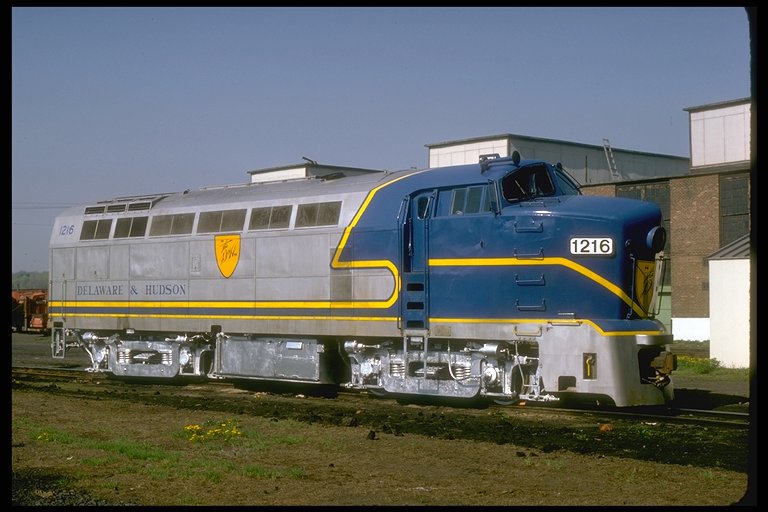
My first visit to this station was in 1970 or '71, when, as a first year associate in a New York City law firm, I was sent to Albany to do research on the legislative history of an obscure tax statute. This was before Amtrak, so the train I rode was operated by Penn Central, then on its last legs. When I got off, I saw across two tracks an A/A pair of Alco PAs in Delaware & Hudson colors, but in livery that was an obvious copy of the Santa Fe's "Warbonnet" scheme (see photo below, by J. Testagrose, which is courtesy of Brent Holt's Exotic Diesel site (the link is to the PA page), sponsored by The Railfan Network.)
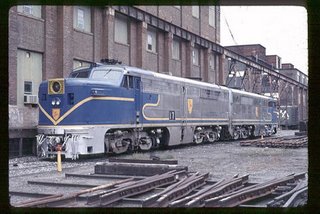


I later learned why: D&H's PAs were purchased from Santa Fe, so the paint scheme they bore was basically a matter of putting blue over red. Indeed, I may have seen these same PAs heading AT&SF's Grand Canyon at its terminus when my parents and I visited the Canyon several years before.


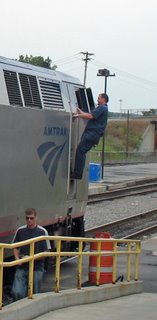
The PA is regarded by many railfans as the best looking diesel ever made. To my eye, the Genesis (see left), while not so handsome as the PA, has a similar austere elegance. It's certainly an improvement on the clunky looking FP-40 that preceded it. Its sculptured lines suggest my own favorite of the first generation diesels, the Baldwin "Sharknose" (see photo below, by J. Hunt, again courtesy of Exotic Diesel), minus the nose.


After leaving Albany/Rensellaer station, we crossed the Hudson just north of downtown Albany, then headed west to Schenectady. Following a stop there, we turned north again towards Saratoga. Shortly after, Pat the conductor announced that a National Park Service volunteer would be in the front coach to talk about sights along the way. This time, I was able to find a seat. The volunteer, Dave, was a high school teacher from Schenectady. The first thing he said after I took my seat confirmed what I had suspected, that the abandoned industrial complex we had passed just after leaving Schenectady station was the American Locomotive Works ("Alco"), birthplace of the PA and many other steam and diesel locos.

As we approached Saratoga, Dave talked about the significance of the Revolutionary War battle fought there, in which Benedict Arnold, along with Horatio Gates, got credit for a victory which thwarted the British plan to isolate New England from the colonies to the south. He then discussed theories about Arnold's later turn to treachery, noting that the most plausible was his wife's hatred of their subsequent post at West Point. Arnold had sustained a wound at Saratoga that necessitated the amputation of his right leg, and there is now a monument at the Saratoga Battlefield National Historical Site to that booted leg, the only part of him, as Dave said, that never betrayed the revolutionary cause.


A short time after leaving Saratoga, we re-crossed the Hudson, now running almost west to east after descending soutwestwards from its source in Lake Tear of the Clouds, in the High Peaks region of the Adirondacks. What you see in the photo on the right is just the southern part of the river, as the far bank is Rogers Island, a place steeped in the history of the French and Indian War, as well as the ancestral home of the U.S. Army Rangers.

North of Rogers Island our route was parallel to the Champlain Canal, which connected the Hudson with Lake Champlain. This, along with another short canal bypassing rapids on the Richelieu River, through which Lake Champlain drains into the St. Lawrence, enabled watercraft to travel from New York City (or, later, after completion of the Erie Canal, from Buffalo and points on the Great Lakes to the west) to Montreal, or down the St. Lawrence to Quebec City.
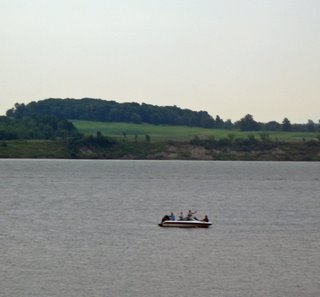
As we continued northward, the canal broadened into what seemed a wide river, but was actually the southern part of Lake Champlain. The woods and green pasture on the opposite bank are in Vermont, which, as Dave noted, was not one of the thirteen rebellious colonies. In fact, it was for a time an independent republic.

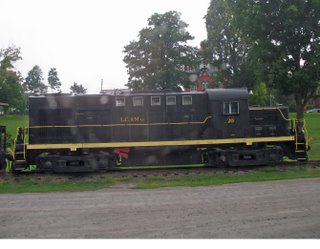
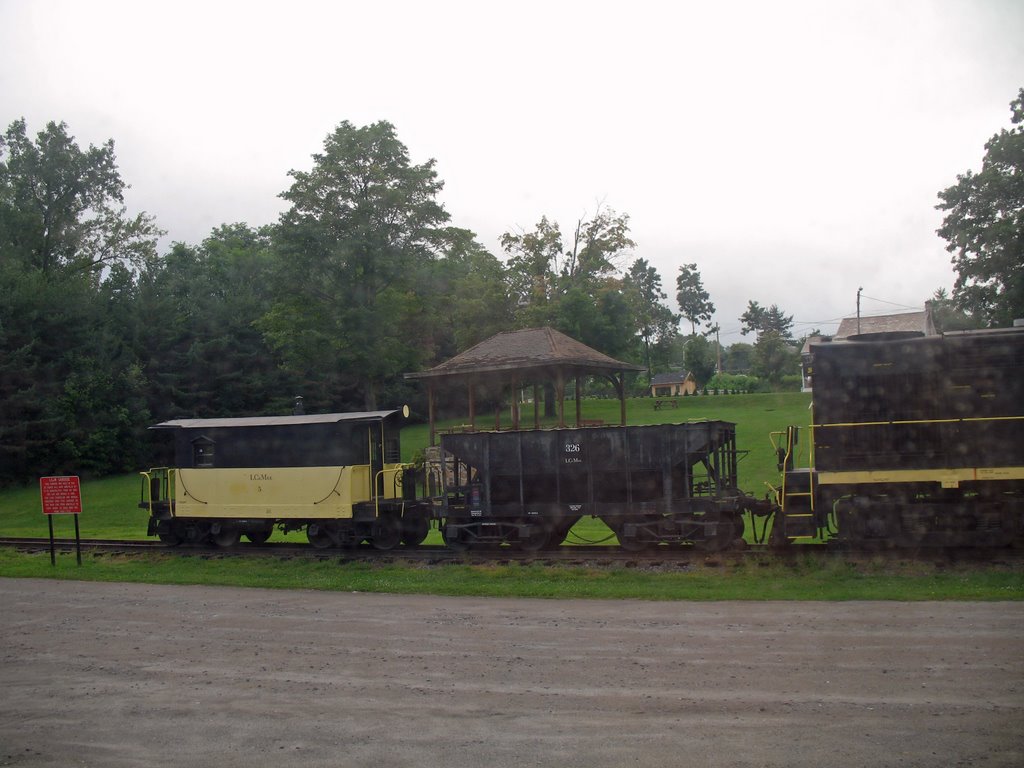
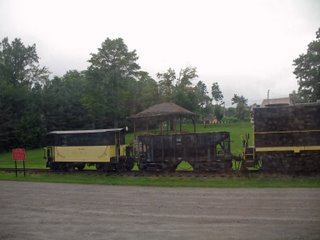
One of our stops on the west bank of Champlain was Port Henry, where there is a museum commemorating the Lake Champlain & Moriah, a mining railroad that hauled iron ore from a mine to the west to the Champlain shore, where it was loaded onto boats for transport north to Canada or south through the canal to the Hudson or the Erie. Below are photos of the rolling stock on display, which include an Alco freight engine, an ore bogey and a caboose; unfortunately, it was raining at the time I took them, and drops on the coach windows affect the quality of the images (there was no time to detrain there). (Update: for better photos, taken the following summer and winter, see here and here.)


At Westport, Pat announced that there would be time to get off and stretch our legs or placate our nicotine cravings. This allowed me to get
a shot of the still functional Victorian depot there.

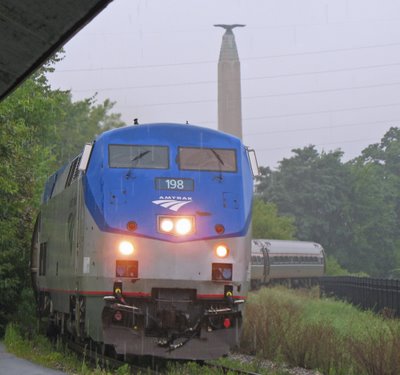
Shortly after Westport, we reached my destination, Plattsburgh. The following afternoon, I got the photo below of the southbound Adirondack arriving at Plattsburgh station. The monument in the background, surmounted by an eagle, commemorates the Revolutionary War capture of Fort Ticonderoga, which lies some seventy miles to the south, and is briefly visible from the train.


Update: for more photos and text from a later journey on the Adirondack, see here For a video showing scenery along the lower Hudson Valley taken from the train, along with an interview of your correspondent by a Wall Street Journal reporter, see here.
Thursday, August 24, 2006

Clyde Tombaugh: a distinguished life in astronomy.

The decision by a council of astronomers meeting in Prague to demote Pluto to "dwarf planet" status brings to mind the remarkable man who discovered the little devil some seventy six years ago. Clyde Tombaugh secured his job as an assistant at Harvard's Lowell Observatory on the strength of some sketches of planets he had made based on observations through a home-made telescope. He was only 24 when he compared some photographic plates and noticed a dim object that moved in the manner to be expected of a distant planet. He has ever since been remembered as the discoverer of Pluto, but, as this brief biography points out, made many other contributions to our knowledge of the universe during his long career, including delineating a supercluster of galaxies spanning the sky from Andromeda to Perseus.

Here's hoping that the reclassification of Pluto doesn't dim the memory of this fine man, who died nine years ago at the age of 90.

Wednesday, August 23, 2006

A Brooklyn blog well worth a visit.

Through the medium of the excellent and useful Brooklyn Heights Blog, I've discovered a unique blog called runs brooklyn/brooklyn runs. It's the baby of one Gary, a fortysomething recent arrival (from New Jersey by way of Iowa) in the Borough of Cherce, who has made it his project to run every block of every street therein. His descriptions of the neighborhoods he runs through are tasty slices of cake, and his superb photographs are the icing.

Tuesday, August 22, 2006

Good news for the Mets.

It now appears that Tom Glavine will be able to pitch again soon. Nevertheless, it's still an open question whether either he or Pedro Martinez will be in top form for the post-season.

Evening update: Mets survive John Maine's inevitable Dark Night of the Soul (I hope John does, too), coming back from a 7-1 deficit to win 8-7. Nights like tonight, it looks like 1986 again. Nevertheless, I have to agree with Tim Marchman's assessment.

Unfortunately, it appears that, if the Mets do get to the Series, they won't face the same opponent as in '86.

Monday, August 21, 2006

Out of the frying pan ... ?


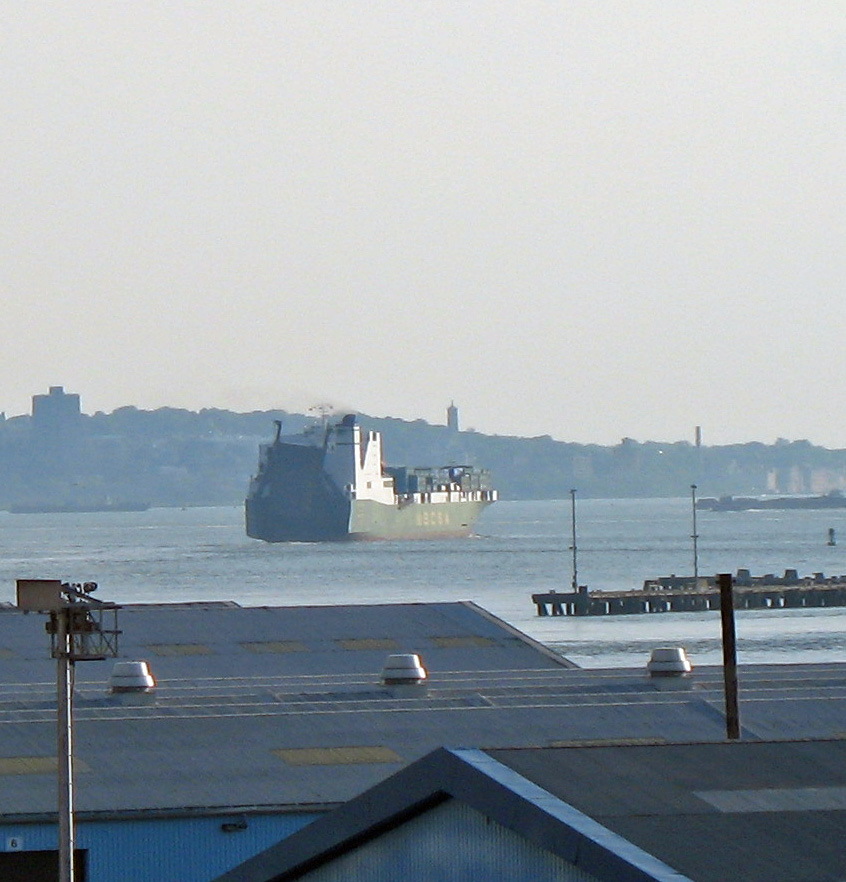
As seen from the Brooklyn Heights Promenade, on the hot, hazy afternoon of July 30, a Saudi ro-ro/container ship sails from the Red Hook terminal. Next stop Jiddah?

Thursday, August 17, 2006

An apology to my non-Fray readers.

I know there are one or two of you.

If the last two posts seemed incomprehensible to you, please bear with me. We're about to go back to business as usual.

What's the Fray? Here's a description from a post almost a year ago:

"For anyone reading this who's unfamiliar with the Fray (which I've now referred to in two posts, and certainly will again), there's a good description in Wikipedia, written, I believe, largely by Fray stalwarts Deej and Betty the Crow."

Mets 7, Phillies 2

No, it wasn't a never-ending death spiral, just a phase. Right, topazz?

Wednesday, August 16, 2006

Oopsnosity

There. That should put this buggy in the fast lane.

A big thank-you to Hipparchia, and a friendly shout to our neighbours up north, with special thanks for your air.

Tuesday, August 15, 2006

Narrow gauge in Portland, Maine (cont'd).

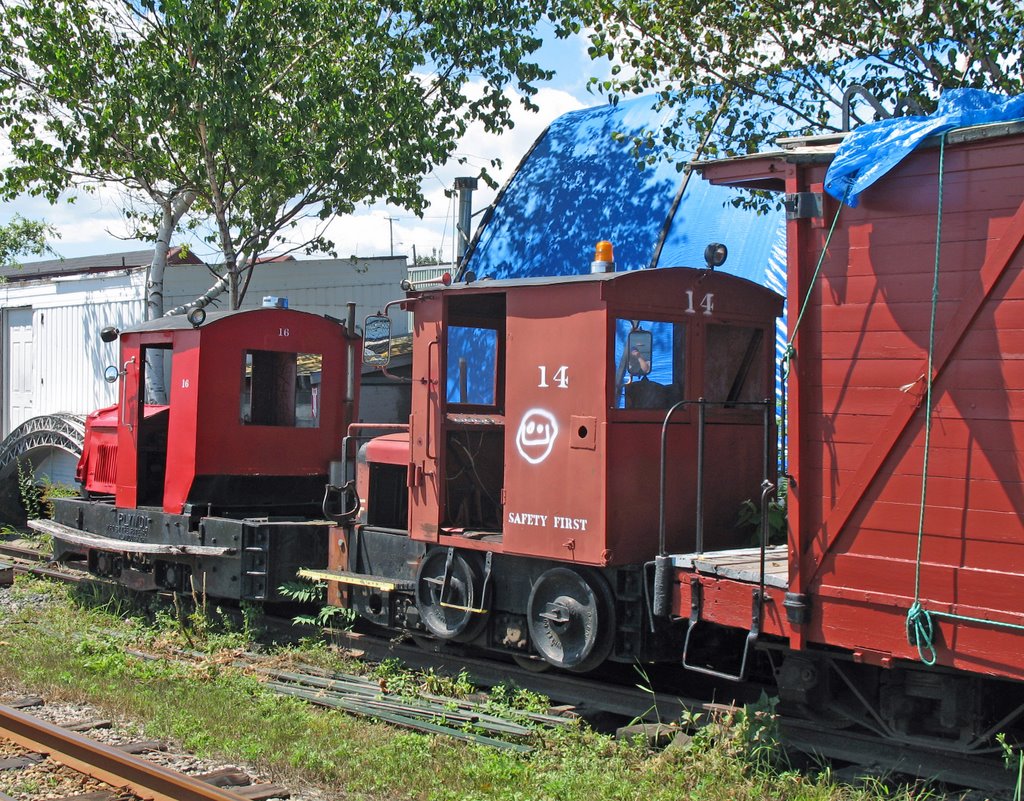
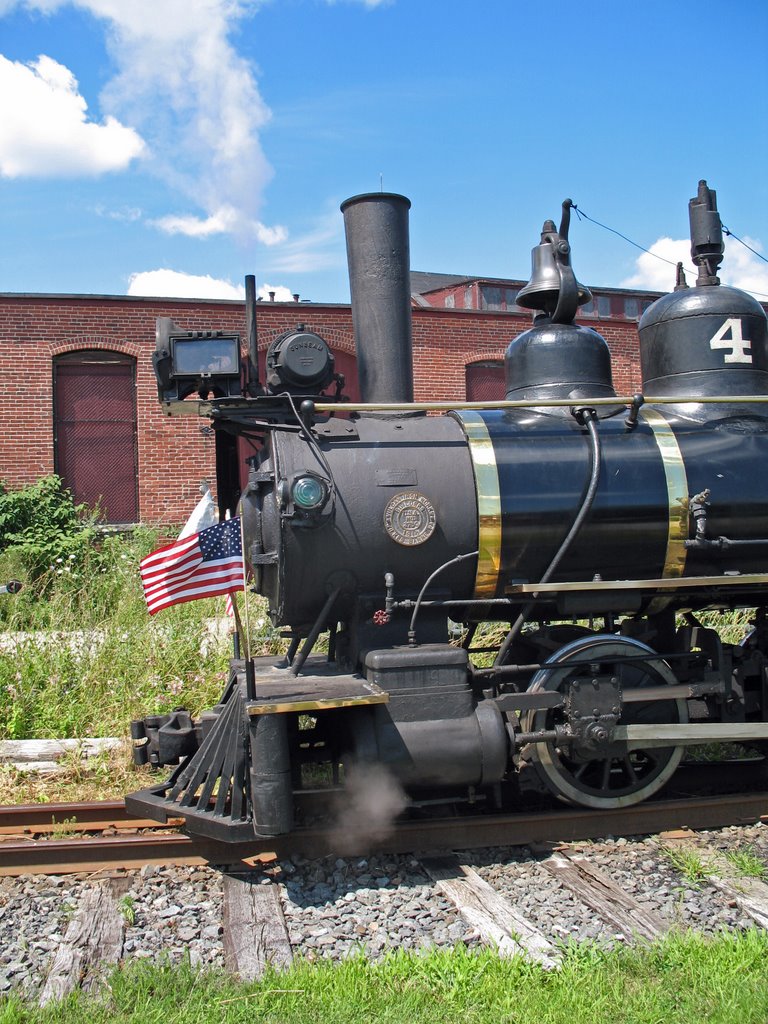
As noted at the close of my previous post on this subject, Maine's narrow gauge railroads had rails only two feet apart. This, I believe, was the narrowest gauge in common use in the U.S. Below are two tiny engines standing on the same siding as the freight cars shown in the earlier post.


After I took these photos, we began walking back towards the fishermen's wharves to buy some lobsters for our evening meal. We had gone a short way, and were passing a couple going in the opposite direction, when the woman said, "Look! Here comes The Cat." I looked over towards the harbor and saw the big catamaran ferry that runs between Portland and Yarmouth, Nova Scotia entering the mouth of the Fore River.


Having photographed The Cat, I rejoined my wife and our friend to continue our walk to the fish market. However, I saw something out of the corner of my eye that made me excuse myself and go running back toward the railroad museum.

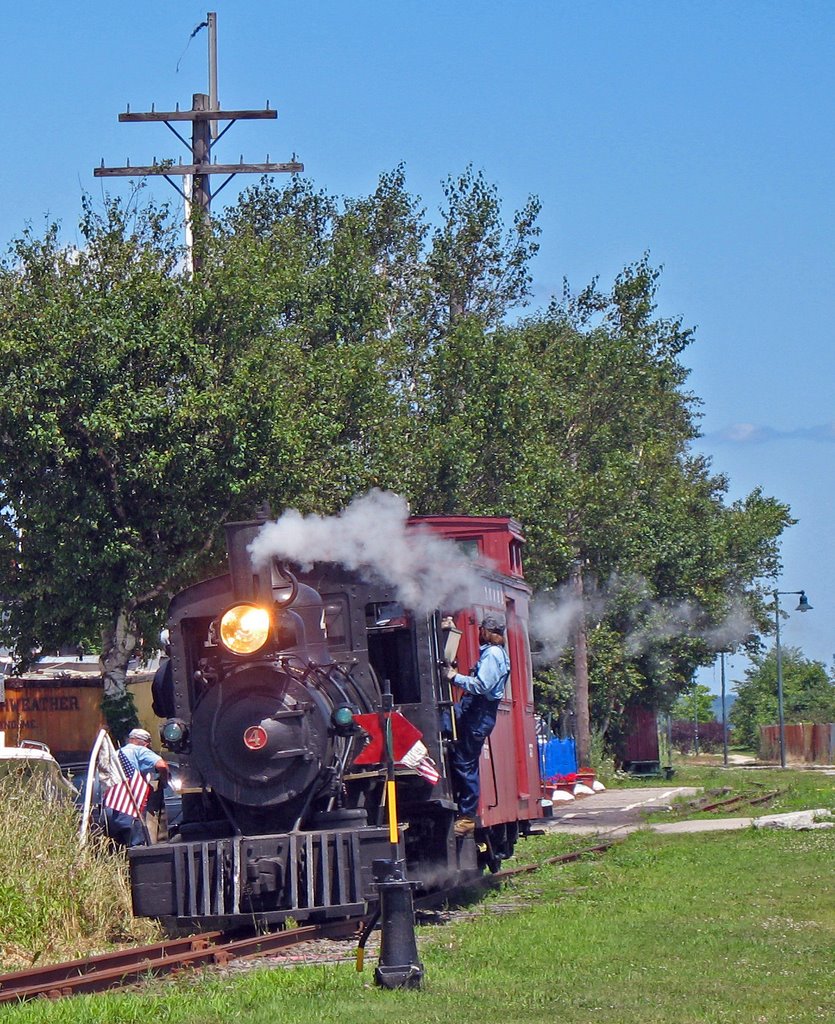
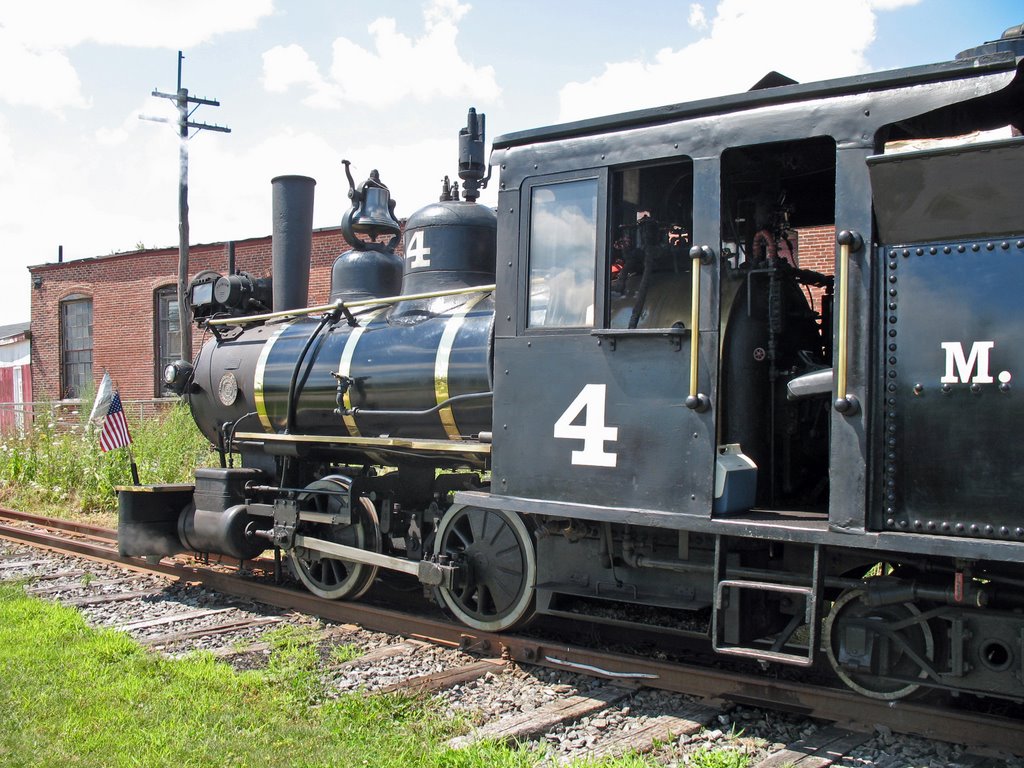
It was old No. 4, a gorgeously preserved 0-4-4 loco, pulling another S.R.& R.L. combine car. A fitting finish to a fine afternoon of train watching.

Monday, August 14, 2006

Sometimes, pessimism works.

Especially when you've gotten to the point of discounting it.

Could Pedro Martinez be like The Wonderful One-Hoss Shay?

After all, 'twas a poem writ in Boston.

Saturday, August 12, 2006

Narrow gauge in Portland, Maine.

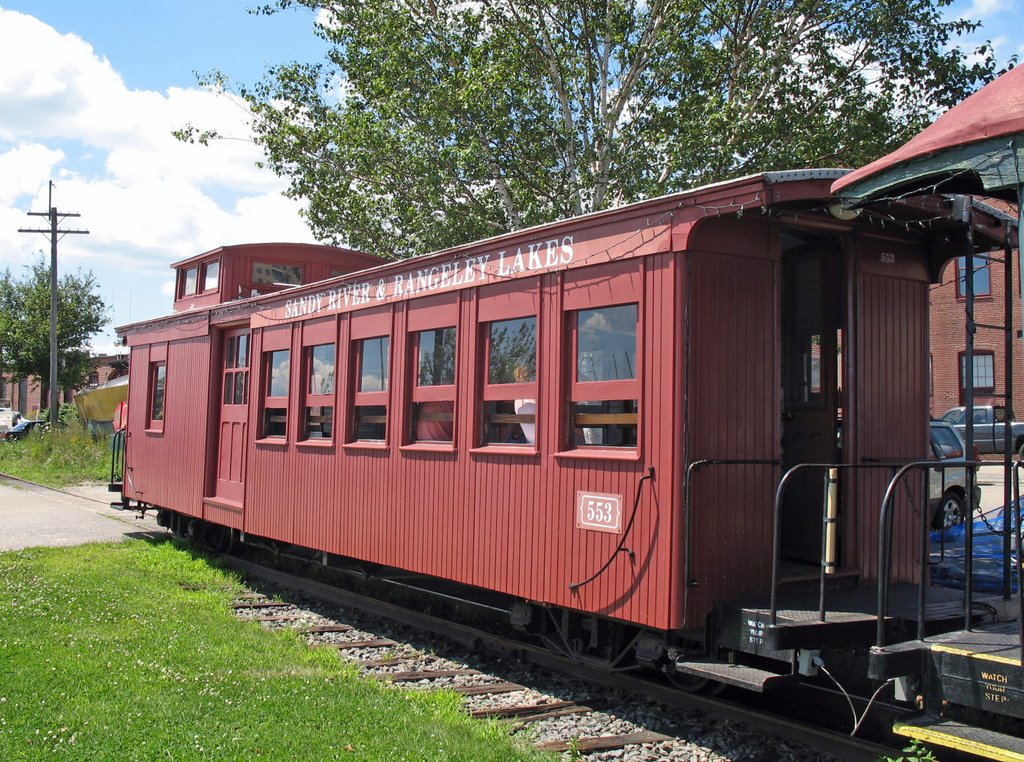
The State of Maine once had an extensive system of narrow gauge railroads; many of them, as in the Pacific Northwest, serving the logging industry. A small part of this system remains on the north side of Portland, preserved under the aegis of the Maine Narrow Gauge Railroad Co. and Museum. The MNGRR runs trains from just outside its museum and headquarters north along the Portland waterfront and back. When we arrived last weekend, a train loaded with tourists was about to leave. At the end was this handsome passenger car - caboose combination that formerly served in northern Maine on the Sandy River & Rangeley Lakes.

I walked to the front of the train, where I found this small steeple-cab diesel about to be coupled for departure. Note the formidable looking cluster of airhorns on this little engine. We then went into the museum, located in the red brick building in the background at the right. After we had looked at the many exhibits there, we came out to find that the train had departed. On a side track were these well-preserved freight cars. The tanker evidently dates to before the merger of Standard Oil Company of New York ("SOCONY") with Vacuum Oil Company to form the awkwardly named Socony-Vacuum, which later sensibly became Mobil. This later merged with Exxon, the lineal descendent of Standard Oil Company of New Jersey, to form Exxon-Mobil. Thus was the work of trust-busters of almost a century ago partially undone.

If you look at the empty track in the foreground, you can get a feel for how narrow it is: only two feet separate the rails.

Continued here.

Postscript to "When good things ... "

The suggestion in Fred Kaplan's Slate article, to which I linked a couple of posts below, that the blanket refusal of the current administration to engage in discussions with the Syrians is dysfunctional, is echoed, and extended to the Iranians, by Richard Holbrooke in this Washington Post column.

Interestingly, Holbrooke's WaPo column was reprinted in the neocon organ, The New York Sun, which is where I first saw it. If Slate and the Sun can agree on something, well, ...

Friday, August 11, 2006

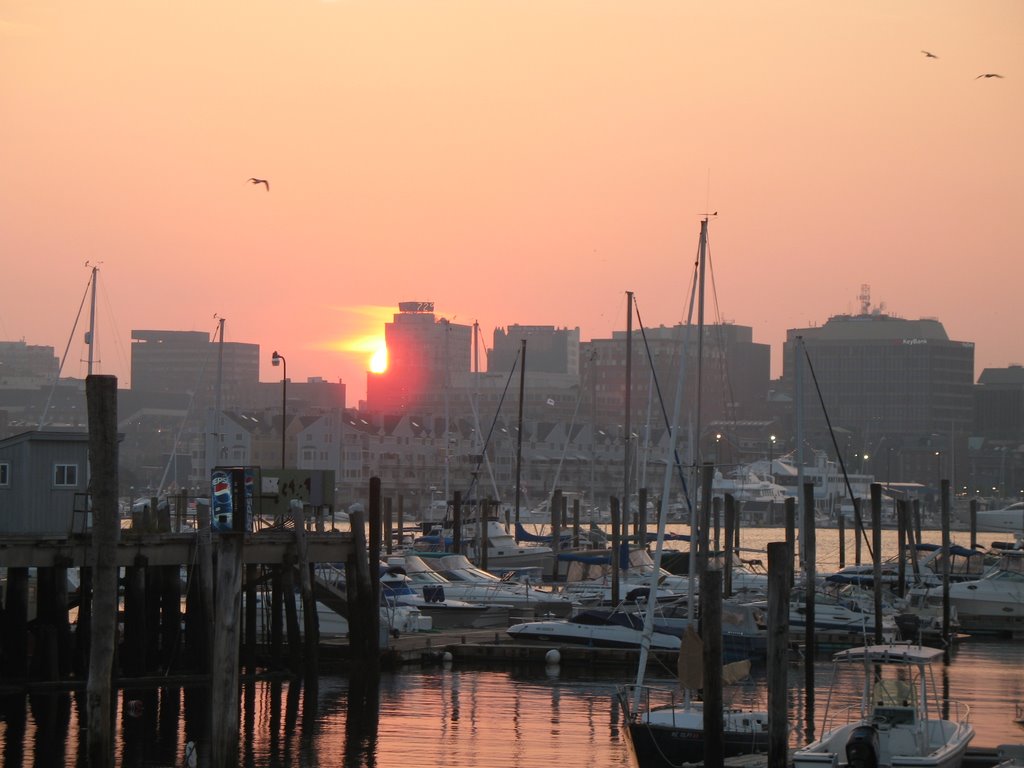
Brooklyn Heights sunset.


Top this, Key West.

The Curse explained.

Back at the All-Star break, I bemoaned the appearance of five Mets on the cover of Sports Illustrated, predicting "dire consequences." My prediction has, so far, been off the mark, much to my delight. Now, with typical acuity, Tim Marchman explains the SI cover curse, in a way that makes me say "D'oh!"

This leads to another question: are the Mets, as the saying goes, the exception that proves the rule? I've never understood that one. How can an exception "prove" a rule?

Thursday, August 10, 2006

When good things happen because of bad people.

There's an interesting article by Fred Kaplan in yesterday's Slate that reveals the source of at least much of the information Britain's MI5 relied on to thwart the transatlantic airliner bombing plot as being the Pakistani military intelligence agency. Kaplan also refers to a New Yorker piece by Seymour Hersh, which I somehow missed, that described Syria as a valuable source of information about al-Qaeda in the period following the September 11 attacks. However, this helpful connection was cut after the invasion of Iraq, and a Syrian offer to rein in Hezbollah in return for continued exchanges of intelligence was allowed to expire.

Of course, the government of Bashar Assad wasn't being munificent out of sympathy with this country over the September 11 tragedy. The Baathists who rule Syria, as Kaplan explains, are no friends of al-Qaeda, which is allied with their principal internal opposition, the Muslim Brotherhood. It was simply a case of the enemy of my enemy being, perforce, if not my friend, at least someone with whom I'll cooperate. Similarly, Pervez Musharraf's military regime is, no doubt, less concerned about loss of innocent life than the consequences concerning substantial U.S. and British aid likely to ensue from massive loss of life caused by a plot hatched at least partially in Pakistan.

Kaplan's point is that an excessively Manichaean world view, which he ascribes to the Bush administration, can be unhelpful in coping with real world problems. This is something any fan of noir fiction can appreciate. To put it another way, the real lesson of Munich is not "Don't do deals with bad people", it's "Don't do bad deals with bad people."

Monday, July 31, 2006

Pessimism never works.

That's the slogan on a t-shirt I'm thinking of buying. Yes, I was convinced that the Mets would go to Atlanta carefree and cocky, and leave saddened and swept. I just knew that the Ray Gliers of the world would pound their keyboards, proclaiming the resurgence of the rightful NL East champs and lauding the unsurpassable genius of Schuerholz and Cox.

Well, it kinda went the other way. Yes, Braves fans, I'll grant that your DL resembled the Roll of Honor from the Battle of the Somme while ours was a mere four names, one of whom, Victor Zambrano, arguably constituted addition by subtraction. Nevertheless, it does feel good.

Ah, but the life of a Mets fan has few stretches of unrelieved joy. In the process of moving the road show to Miami, ace setup man Duaner Sanchez boarded a cab that promptly got into a smash-up, separating Sanchez's shoulder. To plug this breach in their bullpen, the Mets gave up Xavier Nady, who has done yeoman service in right field and at the plate. In return, the Pirates gave back to the Mets (who let him go in the off-season) Roberto Hernandez, who comes with a respectable 2.93 ERA and some experience of pitching at Shea, as well as 41 years under his belt. Oh, yes, we also got a starter, Oliver Perez, who had a great season two years ago, has since collapsed, and is optioned to Norfolk.

As for right field, Lastings Milledge will return from the minors to share that space with Endy Chavez, another of the Mets' surprising yeomen of the season. (I can recall seeing Endy's brother, Ender, playing center field for the Brooklyn Cyclones a couple of seasons ago. Endy, Ender. What is it with the name game in Venezuela, the country that also gave us siblings Edgardo and Edgar Alfonso?) Anyway, it looks like we'll get to see this season whether Tim Marchman's misgivings about young Milledge's potential are well founded.

Tuesday, July 25, 2006

Little Toot goes psychedelic.


While walking along the Battery Park Esplanade, I saw this unusually decorated tug sailing past Ellis Island.

Monday, July 24, 2006

"[T]ruly, deeply, tragically inconvenient."

I've been loath to post about the Middle East. I tell myself this is because I'm no expert, but I know it's really because, whatever opinion one may express on the subject, no matter how apparently anodyne, someone is going to find it mightily offensive. Moral cowardice? I prefer to think it's just that my thoughts on the matter, ill-informed as they may be, are - how you say? - nuanced.

So I'm glad to find a link in Eric Alterman's MSNBC blog to an essay in, of all places, New York magazine, which I dismissed years ago as lightweight fare for superficial yups - a kind of upscale People - that I think I can recommend almost (Okay, I have problems with the first paragraph. I agree that global warming is a serious problem. I'm not sure that any solution "doesn't look that onerous.") unreservedly. It's by Kurt Andersen, and you can find it here.

Walter Benjamin on Proust

"He is filled with the insight that none of us has time to to live the true dramas of the life that we are destined for. This is what ages us -- this and nothing else. The wrinkles and creases on our faces are the registrations of the great passions, vices, insights that called on us; but we, the masters, were not at home."

Illuminations, (Trans. Harry Zohn, Schocken, 1969), 211-212; quoted in Michael D. Jackson, "In the Footsteps of Walter Benjamin", Harvard Divinity Bulletin, Spring, 2006, at p.44.

Friday, July 21, 2006

John Maine pitches a complete game shutout.

Okay, maybe I was wrong.

I'm glad.

But I'm still worried about that series in Atlanta next week.

Monday, July 17, 2006

Postcard from Maine

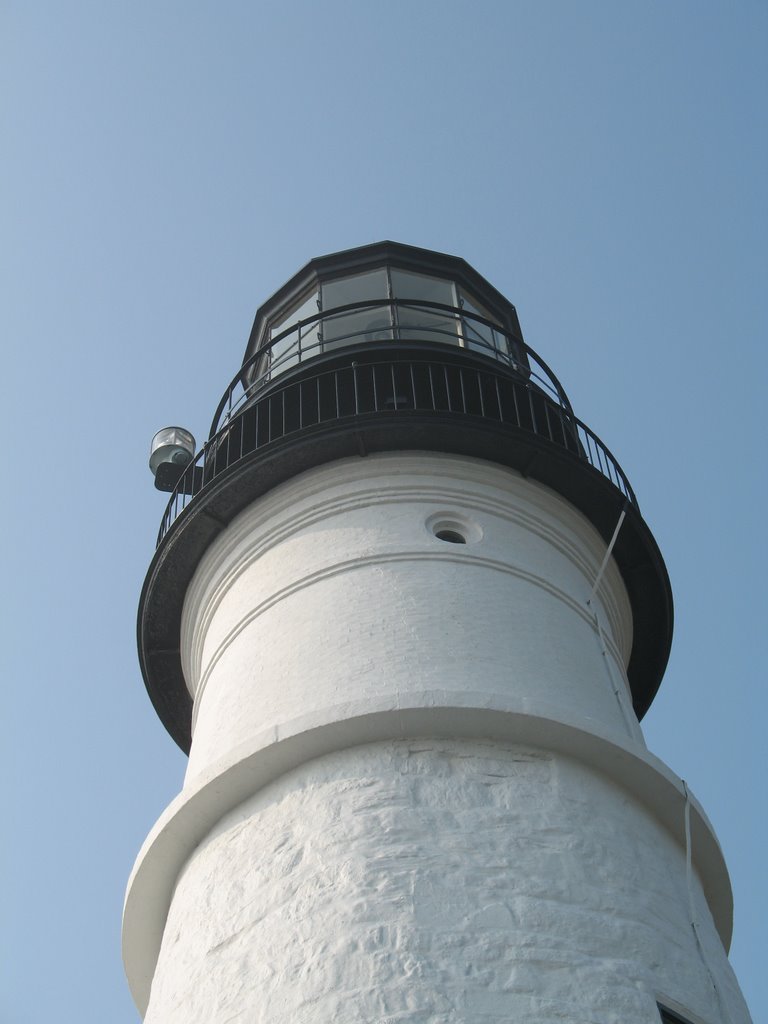
Portland Head Light was commissioned by President Washington to guide mariners entering Portland harbor, and was put into service in 1791. It remains in use today. Several years ago, it was converted to computer-controlled operation, and the position of lighthouse keeper was eliminated. The handsome keeper's house, to the right of the lighthouse tower in the scene above, is now a museum.

Below is a view of Portland harbor and downtown, taken from the deck of the Saltwater Grill in South Portland, at sundown.