Showing posts with label Remembrances. Show all posts

Tuesday, December 16, 2025

Remembering Rob Reiner


Rob Reiner (1947-2025) will, for me, always be the maker of three of my favorite movies: This is Spinal Tap, in which he played the narrator of a "mockumentary" about the U.S. tour of "Britain's loudest band"; When Harry Met Sally, which his wife, Michele, who died with him, convinced him to give an upbeat ending, and in which his mom, in a cameo, gave an unforgettable line at the end of the Katz's Deli scene; and The Princess Bride, with its wedding scene that rivals the one in another of my favorites, Alan Arkin's and Jules Feiffer's Little Murders. I haven't seen A Few Good Men, but it's on my list because, as Alissa Wilkinson notes in her Reiner "appraisal" in today's New York Times,
it’s really in movies like “A Few Good Men” that you can see his notion of what makes for real goodness shine through: not getting everything perfect, or fixing the world, but more simply standing up to powerful people who hurt the weak. 

Robert Reich reminds me of something I'd forgotten, or more likely never focused on, which is that early in Reiner's acting career he played Michael Stivic, Archie Bunker's "Meathead" son-in-law, in "All in the Family". In the video clip above, courtesy of Reich, I see that Arch (Carroll O'Connor) and I had something in common: at least a mild form of OCD.

Tuesday, August 30, 2022

Mikhail Gorbachev, 1931-2022

 By no reasonable person's standards could he be considered a saint. Attaining the position he held at the apex of his power, General Secretary of the Communist Party of the Soviet Union, which he held from 1985 to 1991, required a high degree of ruthlessness. He combined this with skill at making allies who would support his ambition. According to his New York Times Obituary, as a student "[h]e became familiar with Machiavelli, Hobbes, Hegel and Rousseau." 

During his time as General Secretary he pursued perestroika, or restructuring, and later glasnost, or openness (though perhaps not quite transparency). These were pragmatic moves. Throughout his career he became keenly aware of the sclerotic condition of the Soviet economy and politics. He sought a way to change Soviet society so as to eliminate the sclerosis while staying within the Marxist-Leninist tradition. 

In December of 1990 I attended a Christmas party given by a friend and law school classmate and his wife. My friend had become a United Nations official and worked in a division of the Secretariat that, under U.N. protocol, was always headed by someone from the Soviet Union. My friend's boss, who to hold that position most likely was at least a KGB colonel, was there. He was quite the contrast with a predecessor of his whom I had met at a Christmas party during the Reagan years who, when I asked him how he liked living in New York, scowled and said, "Why should I like it?" The new boss was nothing like that, and I recall his insisting that we should take what "Michael" - he deliberately used the English version of Gorbachev's name - was saying and doing seriously.

It's tempting to use the buzzword "transformative" to describe Gorbachev's time as General Secretary. In some important ways the transformations he helped to bring about endure today. The former "captive nations" of Eastern Europe are now independent, though some, Hungary in particular, are lapsing into authoritarianism, as Russia itself unfortunately has. In his later years, Gorbachev had an uneasy relationship with Putin; the Times reports that he praised the seizure of Crimea and Putin's restoration of order after the chaotic Yeltsin period, but opposed "Mr. Putin's crackdown on news media freedom and his changes in electoral laws in Russia's regions." Gorbachev described Putin as thinking himself "second only to God".

Sunday, December 26, 2021

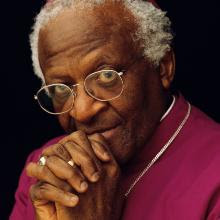
Archbishop Desmond Tutu, 1931-2021

I've said before that the two people I am proudest to have met and with whom I've enjoyed short but inspiring conversation are the late Congressman John Lewis, whom I met at an ecumenical student conference in Atlanta in 1967 when he was head of the Student Non-Violent Coordinating Committee and the prospect of his ever serving in Congress seemed remote, and Archbishop Desmond Tutu, who died today in his beloved homeland, South Africa. I had the good fortune to hear Archbishop Tutu preach at St. James' Church during the early 1980s, and to meet and have conversation with him after the service. I regret that I don't have better recollection of the specifics of my conversations with these two most worthy men, but I know that I came away from them better for the experience.

Perhaps the defining characteristic of Archbishop Tutu was his generosity of spirit, which led him to seek healing and reconciliation following the end of the brutal apartheid regime which he had struggled to overcome. He also showed moral consistency in his opposition to corruption that undermined the government following the transition to full equality of citizenship for all South Africans. I chose the photo above, a profile photo from Prabook.com, because it reflects his intelligence but also hints at his playfulness and sense of humor.

Monday, October 18, 2021

Colin Powell, 1937-2021

Some years ago - probably in the fall, winter, or early spring, because I had left work and it was dark - I was walking along Madison Avenue, past the former General Motors building, when I saw a man coming out of it and walking parallel to me. He looked to be maybe five-eight; I was five-ten at the time (age has reduced me to five-seven). I wondered if he might be a partner in a law firm for which I had done some work several years before and had its offices in that building. 

When we got to the corner of 59th Street and Madison, a young cop looked at him and said, "General! I was in the Gulf War." He went on to praise his leadership and say how proud he was to have been on his team. 

I mentally slapped myself for not having recognized Colin Powell in the flesh. As, it seems, often happens, I had expected him to be much taller.

I won't try to add to all that's been written about this son of Jamaican immigrants who became a transformational leader in the military as well as in civilian politics and diplomacy. We've lost a great one.

Monday, January 20, 2020

Remembrances and appreciations, 2018 and '19

For some years I posted a remembrance of the past year, including a summary of the remembrances of those, either friends or those I admired, who have died, and an appreciation of those who have been helpful to my blogging. I last did these together in 2016. In 2017, the look back and the remembrances got separated. In 2018 I posted remembrances, promising "happier reminiscences soon," but never got around to that. Last year I began this post in February, and have left it in very incomplete draft form until now.

I posted individually during 2018 in memory of Aretha Franklin, Rusty Staub, Roger Bannister, and the congregants of the Tree of Life Synagogue murdered in the Pittsburgh massacre. These would have been included in my 2019 remembrances, had I gotten around to posting them. In 2019 I posted for Doris Day, Bill Buckner, Sandy Denny (although she had died 41 years before), John Phillips (not the one from the Mamas and the Papas), and Nick Tosches.

In recent years I've lamented the increasing number of people either that I had known in person or admired as artists, musicians, sports figures, or otherwise, who were dying. I put this down as a natural result of my growing old, and it mostly is. Of those who died last year and were noted on my blog, three - Bill Buckner, John Phillips, and Nick Tosches - were younger than me. I had known John for his entire life. Indeed, my first contact with him was when he was in utero. I was fourteen at the time, and his mother, Mary, during her eighth month of pregnancy, invited me to put a hand on her distended belly, where I could feel one of his feet moving.

The youngest of those I knew who died last year was Jack Hatton, 24. Jack was a year behind my daughter, Liz, in elementary school on September 11, 2001. Their school was close to the World Trade Center, and the principal decided to evacuate the students, either to a school farther north or, at parents' discretion, to home. Jack's mother, Marie Hatton, and I both decided to take our children home to Brooklyn Heights. Since transit wasn't working and the Brooklyn and Manhattan bridges were closed, Marie, Jack, Jack's brother Harrison Hatton, Liz, and I had to take a long, circuitous walk through the Lower East Side, where the Tenement Museum provided a respite, giving water and access to restrooms, then across the Williamsburg Bridge. On the Brooklyn side we were greeted by Hasidim offering us cups of water. Once off the bridge we found rest on the steps of the Peter Luger Steak House, where the staff gave the kids fries. I was able to reach Jack's father, Mark Hatton, by phone. He came and gave us all a ride back to Brooklyn Heights. Jack was the youngest in our group, but he never complained.

There are others whose passing I didn't note on the blog, not because I thought them less significant, but because their deaths came late in the year, when I was preoccupied with holiday preparations and events. Amy Talcott was a friend of many years, an administrator at Plymouth Church, a skilled seamstress who made dresses for several of our friends, and a loving wife to Ahsan Farooqi and mother to Amos Farooqi. Another loss was Elisabeth Brewer, mother of my friend Geoff Brewer and wife of my friend Wally Brewer. She was a stalwart of our own Grace Church and always a lively and engaging conversationalist. Annabella Gonzalez was a superb dancer and choreographer who led her own dance company. Her dances drew on various influences, including the traditions of her native Mexico as well as more contemporary themes. I got to know her many years ago when she married my previous colleague and long time friend Richard Grimm and later became the mother of Henry Grimm.

Other sad news came with the announcement that Congressman John Lewis had been diagnosed with cancer. I had a brief encounter with him in 1966, long before his election to Congress, when he was head of the Student Non-violent Coordinating Committee and we were both attending an Ecumenical Conference on Urbanization and Technology at Emory University in Atlanta. I don't recall the specifics of our short conversation, except that it stiffened my resolve to continue in the fight for racial equality and justice.

Another cancer diagnosis that hit me hard was that of Judy Dyble. I fell in love with her, or at least with her voice and artistry, in 1970 when I acquired the first Fairport Convention album (yes, the band still exists after more than forty years, with some personnel changes), and heard her cover of Joni Mitchell's "I Don't Know Where I Stand." In 2008, I posted an iPod Log that included a video clip of "Time Will Show the Wiser," a song from the first Fairport album, on which Judy sings harmony. This led to my getting in contact with Judy via email. Later that year I posted a video clip of Judy with some present Fairporters and others doing an obscure Bob Dylan song in French. This has, as they say, gone viral, though many of the hits have come from Russia and Ukraine. Is there something about Dylan in French that has peculiar appeal to the Slavic soul? More recently, Judy and I became friends on Facebook, which is how I learned of her diagnosis. She has begun a course of chemotherapy, keeps the proverbial English "stiff upper lip" about hair loss and such, and treats me with news of the British music scene and with photos of her rescued greyhound Jessie.

Despite all this sadness, there was much to celebrate in 2019. I've taken considerable inspiration from two courageous women. Jennifer Garam is the daughter of Peter Garam, with whom I shared an office when I first came to New York in 1970. I met Jennifer some years ago at a gathering of Brooklyn bloggers, and we became Facebook, as well as occasional encounters on the street, friends. Two years ago she was diagnosed with late stage ovarian cancer. She underwent surgery and chemotherapy, is now cancer free, and still writing compellingly.

The other is Lauren Jonik, whom I first got to know through her comments about my posts on the Brooklyn Heights Blog. I learned she was a skilled photographer, and met her face to face at an exhibition of her works. You can see her photos at Shoot Like a Girl Photography. She told me she had suffered a severe case of Lyme disease that struck her in her teens and kept her from completing her education on schedule. Nevertheless, she had since managed to study both photography and writing, and is now finishing her studies for a Masters in Media at The New School. She is the co-founder and editor of The Refresh, for which she wrote an essay about Mary Oliver, a poet whose works I love. Stephen Muncie, please take note.

It's de rigueur in pieces like this to express gratitude to one's immediate family, but it's not a sense of duty that makes me credit my wife, Martha Foley, and my daughter, Elizabeth Cordelia Scales. Yes, Martha has been patient about my hours of absorption with writing, but she and Liz have also been helpful as a critical audience for my ideas, often helping to sharpen my thinking.

There are many other friends, on Facebook and otherwise, who have been very helpful. They are too numerous to try to list. Among them are some with whom I disagree profoundly on some issues, but whose opinions I am always keen to understand. Please know you have my sincerest appreciation.

Monday, May 13, 2019

Farewell, first crush!

Well, first celebrity crush. Sometime in my earlier, polymorphously perverse years, there was a redhead named Irene from whom I, in my first of many displays of male emotional fuckwittage (to borrow a term from Bridget Jones), surreptitiously pocketed and took home a toy airplane, on the belief that a girl had no business owning such a thing. After my father spotted it and couldn't recall buying it, I surreptitiously returned it.

When I was seven, my father took me to the local cinema (we were living in England at the time) to see Calamity Jane, starring Doris Day in the title role (photo) and Howard Keel as her love interest, Wild Bill Hickok. From the opening scene, I knew I was in love:


To me, at age seven, there seemed something compellingly attractive about a woman who could do what were considered guy things but still be very much a woman.

Later in life, when my love interests became more complicated, there were times when I couldn't listen to "Secret Love," also from Calamity Jane, without my eyes misting over:


So, rest in peace, Doris Mary Anne Kappelhoff from Cincinnati. You meant a lot to me, and to millions of others, both men and women. You also meant a lot to animals, whose welfare you championed. An admirable person in all respects.

Tuesday, March 14, 2017

Another remembrance I missed: Mose Allison (1927-2016).

I first heard of Mose Allison during my college years. I had a copy of Johnny Rivers' album Meanwhile Back at the Whiskey à Go Go, which led off with the Willie Dixon song "Seventh Son," which I loved. I later heard a version by Mose that I liked even better. For a time, I assumed he had written the song. I was thereby led to seek more by him, and acquired some albums, which gave me a sense of the breadth of his talent. It encompassed jazz, blues, and R&B. Not bad for a self described "middle class white boy" from Mississippi.

In 1981 I went with some friends to a sailboat race in Annapolis. I saw in a local paper that Mose was playing at a venue there, and I convinced my friends, none of whom had heard of him, that we should go that evening. He ended his set with this:
 
At the end of the show, my friends were all fans.

Sunday, February 19, 2017

Remembrances--an addendum: John Glenn

When I had finished my Remembrances post, I had a feeling that I'd left out someone very significant. I had noted the death of John Glenn on Facebook, and had meant to post about him here, but got caught up in pre-Christmas madness along with my paying work.

John Glenn was a hero to me long before he rode Friendship 7 into orbit, circled the earth three times, and piloted the capsule to a safe landing in the Pacific. As an Air Force brat, during my childhood I read everything I could about jet pilot heroics. I knew of him as the pilot who first flew across the continental U.S. at an average speed above Mach I. I also learned of his exploits as a fighter pilot in World War II and the Korean War.

Permanently engraved on my memory is the morning of February 20, 1962. I was in tenth grade, and in Mr. Bonar's biology class at Robinson High School, in Tampa. We were excused from class and went outside--February 20 in Tampa was clear and just a bit crisp--and, looking to the east, saw the rising vapor trail that eventually curved slightly away. As the school day progressed, we got occasional updates, including the frightening news that his capsule's heat shield might have broken away. We cheered at the report of his safe splashdown.

At the age of 77, he returned to space as a member of a space shuttle crew, thereby becoming the oldest person to go beyond earth's atmosphere. I'll turn 71 one month from today. Maybe I have something to look forward to.

Sunday, February 12, 2017

Remembrances, 2016

Back in January I posted my "Look Back" at 2016. I noted that past New Year's posts had included remembrances of those friends and significant people in my life who had died during the previous year, and promised that I would post my remembrances for 2016 soon. It's now almost mid-February, and I'm getting around to it

I also noted that 2016 had taken a heavy toll, both of those close to me and those who had served as cultural icons. I'll start with four lovely women whose friendship graced my life.

Dorothy Pilch (photo, by Martha Foley) was the senior parishioner of Grace Church, and a steadfast member, along with my wife, of the church's cooking crew. With a degree from Rutgers in economics and a background in banking, she devoted many hours of her later years to helping fellow seniors with financial advice. She frequently joined us for Sunday dinner. Her birthday was two days before mine, so for some years Steve Muncie, former Rector of Grace, would host her (and me incidentally) for a celebratory dinner at the Heights Cafe.

Martha and I had the misfortune of losing our next door neighbors on both sides early this year. Dorothy Azouni and her husband, Adel, greeted me when I moved into my apartment in 1983. She was a Brooklyn native, and Jewish; he was a Palestinian Arab. They met in Paris in the time shortly after World War Two, when she was working for a United Nations agency providing relief to people in war-ravaged Europe. She and Adel were together many years, until he died several years ago. Dorothy stayed in their apartment, visited regularly by members of a nearby synagogue who would bring her pastries and other baked goods that she insisted on sharing with us. She loved Liz and our cats.

The other neighbor we lost was Lillie DeBevoise. She moved in about ten years ago, and we immediately struck up a warm friendship. She was a retired teacher, widowed, with two grown daughters, a son, and several grandchildren, all of whom were regular guests at her apartment, as were Martha, Liz, and I. Lillie would often invite us, along with some other neighbors, for cocktails on a Friday evening. She was also my "date" for the New England Society's black tie fall dinner when Martha was out of town that evening one year. Her daughter Jane, also a widow, who lives a block away on Remsen Street, owns a lovely country house in the Catskills to which Lillie took us for a couple of delightful weekends. You can read about them here and here. During our second visit, Lillie introduced us to the Dai Bosatsu Zendo.

Another woman I miss is my Lion's Head companion of some years past, with whom I remained friends following the Head's sad demise, Alice Denham. A Jacksonville native, she was an early Playboy playmate, a founder of the National Organization of Women ("NOW"), and a published novelist. Photo and more about her here.

Henrik Krogius, who died in October, was a man of many talents and accomplishments: historian, journalist, photographer, and NBC news producer. I met him once, briefly, but for many years, until his retirement at the end of 2012 from the Brooklyn Eagle and its local Brooklyn Heights Press, for which I later became an occasional free-lance contributor, I was a regular and eager reader of his columns. From them, and from his books, I learned much about the rich history of our neighborhood.

Last year saw the passing of many musicians I admired. Ones I noted here are Natalie Cole (whose death on New Year's Eve wasn't reported until New Year's Day); David Bowie; Glenn Frey; Dan Hicks; Sir George Martin (although known as a producer, I'm sure he was also a musician; besides, I think being able to handle a mixing board is a kind of musicianship); Merle Haggard; Guy Clark; and Leonard Cohen. Others--Prince, George Michael, Leon Russell--I should have noted.

One death that hit me hard was that of Sharon Jones, a fellow Brooklynite whom I heard in performance at several venues. I first posted about her in 2010. She performed with Lou Reed in 2013, but was also diagnosed with cancer that year. She continued to preform whenever she could through her courses of chemotherapy, but finally succumbed in November. A brave and very talented woman.

A non-musician I mourned is Bob Elliott, of the radio comedy team Bob and Ray. Another was physicist Tom Kibble, whose work laid the foundation for some important discoveries, including the Higgs Boson.

On a happier note, we celebrated some birthdays: Antoine "Fats" Domino (88); Ringo Starr (76); Tony Bennett (90); and Van Morrison (71).