The photo above is of three stalwarts of the Bells of Hell, a Greenwich Village pub that served as my second home from the summer of 1977 until it closed in the fall of '79. On the left is Barry Murphy, who tended bar and provided lively conversation. In the center is Pierce Turner, who, along with Larry Kirwan, as Turner and Kirwan of Wexford (their Irish hometown), were the house band at the Bells during much of my tenure there. On the right is Peter Myers, half owner of the Bells from the time he and Tony Heyes bought it from its founder, Malachy McCourt until the late weekend afternoon in '79- I was present at the time - when Peter and Tony got into a physical scuffle, started by Tony and Gary Sellers, the first person I met after first crossing the Bells' threshold in '77, and which resulted in Peter making Tony the sole owner while he went on to found Myers of Keswick, Keswick being Peter's English hometown.
The occasion of the photo was a party to celebrate Peter's 80th birthday, given at Myers of Keswick. It was a grand affair, bringing together a sizeable collection of surviving Bells alumni. Specialties of the house, including Cornish pasties, Scotch eggs, and sausage rolls, were in profusion, as were beer and wine. I was able to catch up with some old friends I hadn't seen in some years. The store is now managed by Peter's daughter, Jennifer Myers Pulidore, whom I remembered as a kindergartener. By all appearances she's doing an excellent job. I also had some pleasant conversation with Peter's wife, Irene, whom I hadn't seen since the Bells days.
The photo was taken as the party was ending, and Pierce was singing "The Parting Glass."
The clip above is of an exquisite rendition of this beautiful song by Celtic Woman.
As I was leaving the party, I saw Peter and a friend sitting on a bench outside the store. I stopped for a bit of last minute chat. Peter reminded me that, after his unfortunate encounter with Tony, I had offered my opinion that Tony's words, "It's your f---ing bar!" were not sufficient to transfer ownership, especially given Tony's state of intoxication at the time. Peter was happy with this advice.
I then recounted an anecdote I'd read some years ago, about an anthropologist who visited one of the remotest of the Scottish Western Isles and sought someone who would have a long memory and knowledge of the island's lore. He was directed to an old man who, when asked his age, said seventy-something. The anthropologist asked if there were any octogenarians on the island. The old man said, "Octogenarians ... oh, yes, there were two. But my brother shot the one, and the other flew away." I suggested that Peter should avoid the Western Isles. "I go there all the time," he said. Good luck, Peter.
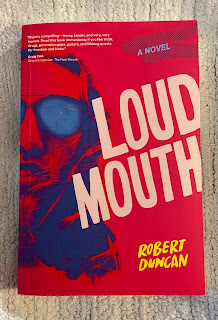
Robert Duncan's Loudmouth was published in October of 2020, and I've had my copy for just over a year. Various things have delayed my reading, and thus this late review, for which I offer Rob an apology. You should know that I consider Rob a friend, more than just of the Facebook variety (although that's been our sole means of communication in recent years) and I'm confident that he returns the favor.
I got to know Rob near the tail end of the 1970s when we were both regulars at the Bells of Hell. We shared a love of rock music, and enjoyed the company of some of the other regulars, two of whom, legendary rock critic Lester Bangs and "The Village Legend" to whom Rob gives the pseudonym Eddie Neil, appear as important characters in Loudmouth. I was invited to Rob's birthday party, held in a Village apartment much spiffier than the Gum Joy Tower flat occupied by Thomas Ransom, protagonist of Loudmouth. When I got there, I saw a long black limo, its engine idling, parked in front. At the party a woman with black hair, wearing a black dress, broke into an upward mezzo soprano glissando. Someone standing next to me said, "That's Liza Minnelli." He then said he understood she and Rob had been in high school together.
But enough about me; what did I think of the book? First, it's bracketed by rivers. The brief "Chapter 0" at the beginning has the title "Cuyahoga," that being the river that flows through Cleveland and is notorious for having once caught fire. It concerns a tour arranged by Tom Ransom for "Bruce," identified only as such but obviously The Boss, and guided by Charlie, a Cleveland native and friend of Tom's. Charlie shows them a series of dive bars, a record store, and the radio studio where Allen Freed held forth back in the day. At this point I can't resist another personal anecdote. One afternoon in 1970 I was in a law school friend's room when he tried to return a call from his brother, a writer for Cleveland After Dark. When there was no answer at home he called information for Cleveland (remember those days?) and got an operator who, asked for the number of Cleveland After Dark, said something like, "You've got to be kidding." Anyway, at the end of the tour, Charlie takes three 45 caliber bullets, gives one each to Bruce and Tom, then holding his says, "This is how we'll remember."
At the book's end comes "Chapter 00," even shorter than "0," with the title "Hudson." In it, Tom removes the bullet from his Rolodex, in which it's rested for some time. He worries that the gunpowder might be deteriorating in a way that will cause it to discharge spontaneously, with possible fatal consequences. He takes it to a nearby pier and throws it into the Hudson.
Why rivers? One of my teachers, probably my late, beloved twelfth grade English teacher Eleanor Blalock, asserted that rivers, in literature, always signify Life. Loudmouth is a "life," in the sense in which the British use that word where Americans use "biography." Consider W.H. Auden's "A Shilling Life Will Give You All the Facts." in which the poet observes that "all the facts" don't tell the reader what was really important to its subject. Loudmouth is biography. It is a fictional autobiography of Thomas Ransom. Unlike the book mentioned in Auden's "Shilling Life" it lays bare Tom's secret longings, failures, and disappointments, along with his accomplishments.
After I had gotten into Loudmouth, I began to wonder how much of it is fictional. I was led to compare Loudmouth's description of Tom Ransom's life with Rob's, as given in the brief "About the Author" squib at the back of the book. Southern mother; check. Writer for Creem magazine; check. Author of a book about Kiss; check. Singer and songwriter; check. And, as I've mentioned above, hanger out at the Bells; friend of Lester and of The Village Legend. So, is Loudmouth just disguised autobiography? Rob answered that question when he was interviewed by Deborah Kalb:
"Like most debut novels, there's a lot of non- in Loudmouth's fiction. But it's still not an autobiography or memoir. And if only a part of it is fact, all of it is the truth -- perhaps the deeper truth, arrived at by reimagining a life at slightly different times and places, in a slightly different order, with slightly different characters, blurring the physical reality to bring the metaphysical into slightly sharper focus."
I know that when I contemplated writing a novel, I started with my present situation, then tried to imagine how things might be if, at certain junctures, I had - taking a cue from Robert Frost - chosen a different path, or if I were to set off on a different one. Unlike Frost, I took what was, I'm sure, the path more travelled, seeking success in a conventional, bourgeois way. Still, there was that part of me that wanted to be a writer, as well as a corporate lawyer. This had a bad effect on my career in two ways. First, I got into a pattern of missing deadlines because I wanted my memos not only to be legally airtight but also stylistically worthy of consideration for a Pulitzer. Second, as I noted here, the amount of time I was spending in the "Village demimonde," meaning the Bells, and after it closed, the Lion's Head, contributed to my work woes. The Head had a reputation as a writers' hangout. A woman once came in and said to those assembled at the bar, "I hear this is a place for writers with drinking problems." Village Voice scribe Ace Gillen replied, "No, it's for drinkers with writing problems."
My writing problem was that I never got started, except for a few short pieces in professional journals, at least until I started this blog. Loudmouth gave me a view of what life was like for a music writer in the 1970s. More than that, it gave me a sense of what my life might have been like had I decided to jettison my desire for conventional respectability and indulge that for artistic renown. It wouldn't necessarily have turned out badly; things didn't turn out badly for Rob.
Returning to Rob's interview, Ms. Kalb asked him, "What do you want readers to take away from the novel?" His answer:
"I hope that readers think it's funny, sad, surprising and maybe, in parts, lovely. I hope they enjoy the words, sentences, and paragraphs, the rhythms and music, as much as the characters and scenes. I hope they pick up on what's going on between the lines and among the lines, the wordplay, inside jokes, compulsive allusions to songs, bands and pop culture."
I found it funny, sad, surprising, and, yes, lovely. I can't say I caught all the inside jokes and allusions, but did get enough to give myself a figurative pat on the back. Then there's this:
"Ultimately, I hope it gives the reader a fresh glimpse of the wonderous/disastrous complexity of life."
That it gave to this reader. I commend Loudmouth without reservation.
On New Year's day 1980, as I recall, someone observed, "Here's to the passing of a real kidney stone of a decade." The seventies had their ups and downs for me, but on balance more up than down. They began with my finishing law school and getting a job in New York. After a year I had to leave temporarily to do two years' Army Reserve active duty. When I returned, I settled into a Greenwich Village that was still an affordable neighborhood for artistic and journalistic sorts, and had bars like the Bells of Hell and the Lion's Head where I could enjoy their company. I had a brief marriage that didn't end traumatically; Joanna and I remained friends until her untimely death in 1993.
I found that the temptations of the Village demimonde didn't mix well with being an associate at what was becoming a high powered corporate law firm, so I left and took an in-house job with a corporate client. When I found even that more than I wanted to handle at the time, I decided to go back to school. My work in regulatory law had sparked an interest in economics, and New York University offered an MBA program with an econ major. With the GI Bill, indulgent parents, and the availability of part-time work, I was able to enjoy a slightly before mid life sabbatical from the demands of full time law practice. I ended the seventies as I had begun them, as a student. They also saw my brief moment of glory as a movie actor, thanks to my friend Charlie McCrann, who would later die in the World Trade Center. There's more about my late seventies adventures here.
Like the seventies, 2020 started for me on a comfortable note. I was still working; my profligacy in my younger days had assured that retirement would be a distant goal. Martha, my wife of over 28 years, was working on interesting projects for clients concerning their archives and genealogy. When COVID-19 hit, I was able to transition to working at home. Martha had already been doing most of her work on her computer here, with occasional visits to her clients to examine archival material. The COVID restrictions had no impact on our ability to continue our gainful employment.
It did affect our social life, though not in a completely devastating way. About a month after the restrictions were imposed, our favorite place to sit at the bar, have a light supper with cocktails or wine, and socialize with friends or with strangers we met there, along with the bartenders and floor staff, and with Tim, the genial owner who would sometimes join us at the bar, Jack the Horse Tavern (Tim named it for a lake in his native Minnesota), closed permanently. Other places around us managed to keep going, and in good weather we could meet friends for drinks and snacks at outdoor tables, dine on take out, or dine indoors while it was allowed, with strict occupancy limits and spacing. Now that indoor restaurant dining is banned and winter weather is putting a severe crimp on outdoor dining, despite the gas heaters and overhead canopies many restaurants have provided, we fear for the survival of our other neighborhood haunts.
We live in a large building, and have several close friends in the building with whom we've been able to socialize in very small gatherings. We've had Zoom sessions with our more far flung friends and relatives. Our daughter, Liz, and her boyfriend came up from Philadelphia for two days during the week before Thanksgiving. We shared our Thanksgiving meal with one friend, and had Christmas dinner by ourselves.
As I noted here previously, the COVID restrictions imposed in March initially made us give up in person church services. These were replaced by Zoom and live streamed ones. When the infection numbers declined, unfortunately after Easter, we went back to in person services, but with attendance limited - reservations required - and strict social distancing. When infection rates went up, just before the Christmas season, we were required to go back to Zoom and live streaming.
The "New Normal" has, for Martha and me, so far been tolerable, though its long term effects may be less so. We support the requirements intended to limit the spread of the pandemic, such as mask wearing and social distancing. I know that COVID-19 has been disastrous for many other less fortunate people, often fatally. It has also intensified, or at least made more evident, a rift in our social and political fabric. I hope to do whatever I can, in my small way, to mend that rift. I know that those on my side of the rift - one of the few things I celebrate about 2020 is the outcome of the presidential election - have no monopoly on virtue.
It's been my custom, sometime in January, to look back on the previous year and note those among my friends, relatives, and heroes who have died, along with those who have been helpful to my writing venture or inspirational in a broader sense. I will continue that custom this coming month. As for now, goodbye 2020. Don't let the door hit your backside on the way out.
Robert Ward's The Stone Carrier is a book that will grab you and not let you go. I read it because the author and I hung out at the same Greenwich Village bars during the late 1970s, and reviews promised that the novel captured the zeitgeist of New York City at that time. I can vouch for its accuracy about the downtown scene, which was my milieu. (One small quibble: I never knew the Bells of Hell to smell of "moldy bread and dog piss." I took my parents there once. If it had, my mother would have taken one step in, wrinkled her nose, and demanded that we leave.) Two beloved Lion's Head staffers, bartender Tommy and waitress Sha, get fond remembrances; Sha even plays a small part in the action, and there is plenty of that.
Much of that action, including a climactic scene that unfolds over the novel's last few chapters, happens at Elaine's, a bar and restaurant on Second Avenue near 88th Street, that was the favored hangout of New York's glitterati. I never entered Elaine's, though when I arrived late for a party given by my former roommate and his wife, who lived near there, I said I had been walking past Elaine's, looked in, saw Oscar de la Renta and Francoise de Langlade (then New York's top power couple) beckoning to me, and had to join them for a drink. My friends believed me, or more likely pretended to.
Terry Brennan, the central character in The Stone Carrier, is known at Elaine's, and at Studio 54, the disco that drew many of the Elaine's crowd and where more of the novel's action happens. His admission ticket to these places was an article he wrote for Rolling Stone about Thaddeus Bryant, whose first novel, The Debt, was a great success and is being made into a movie. In evident gratitude, Thaddeus introduces Terry to Elaine's and to some of the celebrities he's met there, including Norman Mailer. Terry tells Mailer it was reading his work that inspired him to become a writer. Mailer says, "if that's the truth, then you better be good. 'Cause I don't want to inspire any hacks."
The Stone Carrier (the cryptic title is explained in chapter 32) begins, not at Elaine's, but with a double murder in Central Park at two a.m. The victims are Joey Gardello and his brother Ray. Joey is a boyhood friend of Thaddeus and struggling to make it as a filmmaker. Like he has for Terry, Thaddeus brings Joey into the charmed circle of Elaine's. The murder sets in motion a series of events that lead to Terry's being pursued by both the NYPD and by henchmen of Nicky Baines, a thinly disguised version of Nicky Barnes, the drug kingpin of Harlem. While the plot elicits many surprises, it never strains the reader's - or at least this reader's - willingness to believe. My reaction to plot developments was often "Wow!" but never "WTF?"
Like many, if not most, stories set in New York City, the central theme of The Stone Carrier is ambition; of how small missteps, like allowing a friend to deal coke from your apartment, can threaten it; but mostly about how it can keep you from questioning things that seem to be too good to be true, because they may be.
Harry Chapin grew up in the neighborhood I've called home for the past 32 years, Brooklyn Heights. His singing skills were honed in the Grace Church Youth Choir and the Brooklyn Boys Choir. He died in a car crash in 1981, two years before I moved here.
I found his first hit, "Taxi", unsettling. It charted in 1972, as I was near the beginning of my career, and its story of youthful dreams washed away in a cold bath of reality was scary. I did like the song's having a narrative arc. Most of Chapin's songs were like this; he gave his third album for Elektra the title "Short Stories." One of the songs on that album is "W*O*L*D":
I first heard "W*O*L*D" on WNEW-FM, then New York's great album-oriented rock station, sometime in 1974. The DJ (was it Vin Scelsa?) wondered aloud if the title was a play on WNEW. That would seem logical, Harry being a New Yorker, but the song was about being a DJ at a small town top 40 AM station. Like "Taxi" it's about growing older and facing that frigid reality bath, with respect both to career and relationships.
Harry Chapin wrote most of the songs he recorded (although his only number one hit, "Cat's in the Cradle," was written by his wife) and therefore can be considered part of the genre of "singer-songwriters" who became popular in the late 1960s and early '70s; other examples are Joni Mitchell and James Taylor. Rock critics were, as a rule, disdainful of this group. Reviews of their work often included descriptors like "precious" and "self-indulgent." Lester Bangs, in an essay titled "James Taylor Marked for Death," wrote:
DECIDE whether you want to jump and caper with music that's alive or molder in the Dostoyevskian hovels of dead bardic auteur crap picking nits out of its navel and so sickly that to see it shake its ass would be a hilarious horror indeed.
As I've recounted in an earlier post, one night at the Bells of Hell I had a "Bless me, Lester, for I have sinned" session in which, among other things, I confessed to liking Gordon Lightfoot. Lester's response was, "Hmph! I know Gord. Do you know what he does when he needs inspiration to write a song? He goes to the hardware store and stares at the labels on cans of paint." He didn't give me a penance; if he had, it would probably have been to listen to something like the album Blank Generation by Richard Hell and the Void-oids five times. I did go through my set of Lightfoot albums looking for song titles incorporating color imagery, but came up blank.
Lester, if you've broken away from frugging on the head of a pin long enough to read over my shoulder, please understand that there are times when I "want to jump and caper," but also times when I want to sojourn in "Dostoyevskian hovels." In other words, I'm not taking "DECIDE" as a command. No disrespect: to be true to what one believes is most admirable. I am made of less adamant stuff. And Harry, if you're having a peek, the only thing I can't forgive is your having unwittingly launched the career of Billy Joel, who tried to channel you in his first hit, "Piano Man".
I got to know Larry Kirwan back in 1978, when he and Pierce Turner, as Turner & Kirwan of Wexford, were the house band at the Bells of Hell, one of the two greatest bars (can you guess the other one?) that ever were in New York. The Bells closed in 1979, and Larry and Pierce continued on for a while, making a move into electronica and disco as the Major Thinkers, then each went his own way. For a while, Larry concentrated on his other talent, writing, and produced a play called Liverpool Fantasy, based on the question: What would the world be like if the Beatles never made it? (Larry has since expanded it into a novel.) Then, in the late 1980s, Larry got together with some other superb musicians and formed Black 47, a band that I love despite having once tongue-in-cheekedly described them as "traditional Irish hip-hop thrash metal punk" or something similar. In the video above, they do my favorite of their songs, one about the 1916 Easter Rising, "James Connolly":
My name is James Connolly, I didn't come here to die,
But to fight for the rights of the working man, the small farmer too,
Protect the proletariat from the bosses and their screws,
So hold on to your rifles, boys, and don't give up your dream,
Of a republic for the working class, economic liberty!
I've posted before about my visit to Kilmainham Gaol in Dublin, where the surviving sixteen leaders of the 1916 Rising were taken and shot; the wounded Connolly having been tied to a chair to face the firing squad.
Larry has now sent word that, a little over one year from now, on the 25th anniversary of their first gig, Black 47 will disband. As their website notes:
There are no fights, differences over musical policy, or general skulduggery, we remain as good friends as when we first played together. We just have a simple wish to finish up at the top our game after 25 years of relentless touring and, as always, on our own terms.
In their remaining year, they'll continue to tour, and are working on one final album, Last Call. I will get a copy, and attend as many of their gigs as I can. I'll report more here from time to time.
Honor Molloy, playwright, novelist, and superb reader, is the daughter of an American who went to Ireland to do graduate study and the Irishman she fell in love with and married. I saw her first at a Bloomsday event, and again tonight at the twice monthly salon of the Irish American Writers & Artists, where she read her "Sixpence the Stars" (video above, courtesy of bennettcerffan), a delightful rendition of the Christmas story as told by a Moore Street, Dublin "shawlie," or fruit vendor.
Ms, Molloy is the author, most recently, of Smarty Girl, a novel "loosely based" on her girlhood in Dublin. Here she is reading from the novel:
Thanks to Larry Kirwan of Black 47, and formerly of Turner & Kirwan and the Bells of Hell, for inviting me to the salon.
This is the conclusion of a story that begins here and was continued here.
For a time, I occupied an office next door to that of Charles P. Sifton (photo at left by Tyrone Dukes for The NY Times), later to become a Federal District Judge. He was known to all as "Tony".*
Tony had a strong sense of decorum that I sometimes tested. In the mid 1970s Cameron F. MacRae, III, son of the then senior active partner, was brought into the firm laterally. This started some mutterings about nepotism. "Young Cam" had previously been the chief lawyer in the New York State Banking Department. His immediate predecessor in that job, Mike Iovenko, had also come to the firm as a partner. At the time, I was the host of the "Associates' Lunches," periodic gatherings of the firm's lawyers at which one partner would be called on to talk about a case or deal he or she had worked on, or an area of practice generally. Before announcing the speaker, I would introduce any new lawyers who had come to the firm since the last lunch. At Cam's first, I said this:
I know that all of us associates have our pet theories about how to become a partner in this firm, but perhaps many of you, like me, have now come to the conclusion that there is only one absolutely certain route to partnership...and that is, of course, to first become deputy superintendent and general counsel of the New York State Banking Department, which is by way of introducing Cam MacRae.
Cam stood up, chuckled, and said, "Wait'll you see my successor!" After the lunch, a junior partner (the same one who had, in the previous instalment, abandoned me to the fleshpots of Baltimore) said to me, "You handled that beautifully; it really de-fused the situation." But the next day, I heard a rapping and, looking up, saw Tony Sifton at my office door. "Uh, Claude, how long have you been host of the Associates' Lunches?" "About a year and a half, " I answered. "Well, uh," Tony said, "don't you think it's about time to let someone else do it?" I readily assented. ("Young Cam" proved to be a valuable addition to the firm; some time after his father's death he became chair of its corporate and finance department and later the firm's Vice Chairman.)
LeBoeuf produced my first marriage. Joanna was a paralegal in trusts and estates. When I first met her, I was puzzled by this tall Midwestern woman with a gentile Dutch surname who wore a gold Star of David on a chain. I learned that she had converted to Judaism after the breakup of her marriage, while a student at Vanderbilt, to a graduate student who she said proved to be a physically abusive beast. She was now living with a boyfriend named Leon who was studying to be a cantor. One night, I threw a party to which she came. As others left, she hung around, offering to help clean up. She stayed the night. She and Leon had parted; "Not Jewish enough" was his verdict on her. Within a month, Joanna and her two cats had moved in. When I asked her why someone who had gone to the trouble to convert to Judaism wanted to marry a goy, she said, "You may raise the children however you want."
Our engagement raised a few eyebrows at the firm, but it was agreed that it was technically OK since I didn't do T&E work and therefore wasn't her supervisor. The morning after we returned from our honeymoon she said, "By the way, we're never having children." It later became apparent that, for reasons seeming to have little if anything to do with me, she had come to regret her decision to marry. On my thirtieth birthday we had a big party, and I got thoroughly drunk. When all the guests had left, I told her I wanted a divorce. She agreed.
After we separated, Joanna moved to Chicago to be closer to her family. We remained friends and stayed in touch by phone. She even gave the ultimate compliment of naming a cat for me. After a few years, when I tried to reach her at her office several times and was repeatedly told she was out sick, I called her at home, and she said she had been diagnosed with multiple sclerosis. Several years later, after she had gone through a third brief, unhappy marriage, she called, told me she had decided to move back to New York, and asked if she could sleep on my couch while she looked for an apartment. I said I'd be delighted. She found a place to live, and a job. One day, as I was walking across Sheridan Square in the Village with Martha, then my girlfriend and now my wife, we ran into Joanna, and I introduced them. The next day Joanna called me and said she thought Martha and I "looked good together." A couple of years later I got a call from Joanna's sister; Joanna had died the day before, evidently of congestive heart failure.
After the divorce I moved from what had been our floor-through on Bank Street in the far West Village to a one bedroom pad in the newly renovated Van Rensselaer, formerly a notorious hot pillow hotel, on Eleventh Street just east of Fifth Avenue. It has since been renamed The Alabama and is used as a residence for Cardozo Law School students (photo at right), though Mr. Van Rensselaer continues to glower down through rectangular spectacles from under his broad-brimmed hat at the apex of the arch over the front door
In the process of moving, I had occasion to walk the block of Thirteenth Street between Sixth and Seventh avenues, and there discovered the Bells of Hell, which was to become my home away from home during non-working hours. These non-working hours began to expand, though on occasion I tried to combine them with work. I wrote a section of a brief in a proceeding before the Massachusetts Department of Public Utilities while sitting at the bar of the Bells. It was on a tricky economic question, one on which I thought our client had a reasonable argument but would probably lose given some language in earlier decisions. We did lose, but the DPU's decision on this point included the words "Counsel for the Company ably argued..." I could only wonder what they would have thought had they known where I was when I so argued.
Now it's time for a musical interlude. The house band at the Bells for much of the time I spent there was Turner and Kirwan of Wexford. You can read more about them, and see a video of Pierce Turner as a solo artist, here. Larry Kirwan went on to front Black 47; here's a video of them doing "Funky Céilí":
The video ends abruptly, like Larry's career at the Bank of Ireland, but unlike mine at LeBoeuf.
During 1975 and '76 I had experienced two of what psychologists consider among the most wrenching life changes: marriage and divorce. My divorce, as such things go, hadn't been traumatic, but I entered the final stretch of the seventies feeling itchy and introspective. My life since high school had been a rapid progression through college, which I completed in three years by dint of taking overloads and summer courses, then law school, then to the firm, with a break for military service, then back. I was wondering if I might have been happier had I followed a different path. Like Charlie McCrann (see the previous installment) I had artistic pretensions, though mine were of the Great American Novel instead of the Academy Award kind.
Unfortunately, my turn toward introspection and the Village demimonde came as LeBoeuf was getting substantial amounts of new business and associates were facing greater demands. One night I was working in the library during the wee hours, not because I was overburdened but because I had procrastinated, when the phone rang. I picked it up, and a woman said "Who is this?"
"This is Claude Scales."
"Claude, oh my God! This is terrible. Why are you working at this hour?"
"I just have to get something done. Who are you?"
She identified herself as a third year associate I knew, though not very well. She continued to bewail my late night labors, then giggled and said "Michael, cut it out!" Finally, I said I had to get back to work. She said "OK" and hung up. Later that morning I went to the office of Susan, an associate I knew was a friend of my late night caller. I told her what had happened; she sighed and said, "She's been working on a deal that kept her in the office for several days and nights straight." I told Susan about the giggling and "Michael." She rolled her eyes, and said Michael was a senior litigation associate I knew fairly well who had been through a bitter divorce and a breakdown. "The blind leading the blind," I said. Susan smiled wryly.
Charlie and I were moved from our shared office on the firm's main floor to adjoining small offices in a portion of the floor below that the firm had leased as expansion space. In Lions in the Street, his book about the great Wall Street law firms, Paul Hoffman wrote about how, when Simpson Thacher & Bartlett had its offices in the old Equitable Building at 120 Broadway, an associate getting his (they were all male at the time) first individual office could tell if he was on partnership track by whether his window faced the street or an air shaft. Of those who suffered the latter fate it was said, "He got the shaft." I soon concluded that being assigned to one of the small associate offices in this isolated section, not connected to the rest of the firm by a stairway, was the equivalent of getting the shaft. This was confirmed at my next annual review when Don Greene told me I was not destined to be one of the elect. Nevertheless, he said, I should not "rush away" from the firm. He would try to find something for me.
Shortly after that, a younger partner who was regarded as a rising star invited me to dinner at what was then one of Manhattan's most trendy restaurants, followed by drinks at a members only** night spot. The purpose of this sybaritic night on the town was for him to let me know that a client of the firm, a utility company headquartered in the suburbs, was looking for an in-house lawyer. I was diffident; I didn't want to leave my Village digs for a place in the 'burbs, and reverse commuting seemed like a chore. Over the next few weeks, this partner and several others, including a senior partner for whom I had great respect, kept pressing me to consider the job. I met Ken, vice president and secretary of the client (the firm held the title of "general counsel"), who would be my supervisor, and we both had favorable first impressions. I was offered a deal: I would work for the client at its offices full time for a trial period while remaining on LeBoeuf's payroll. If either the client or I was dissatisfied, I would return to work at LeBoeuf.
At first, it worked out well. I found that I could make the run up the FDR Drive, over the George Washington Bridge, and up the Palisades Parkway to the company's office in about 45 minutes. The return trip was usually a bit slower, as there was some traffic going into the city for the evening. I had to leave the Bells earlier on week nights to be able to get up at 6:30 the following morning, but I was seldom required to work late or on weekends. After about a month, Ken called me into his office, said he and his colleagues were pleased with my work, and offered me the job. I accepted.
After a while, though, I felt the sense of restlessness returning. I didn't want to spend the remainder of my career working in the suburbs. Ken hired another lawyer, Steve, to share our growing workload. Unlike me at the time, Steve was focused and ambitious. He found that the officer in charge of purchasing had made a hash of hedging against fluctuations in the cost of oil and, with Ken's support, took this to top management. This made Steve unpopular with some people, but feared and respected by others. Meanwhile, I was taking long weekends to work on Charlie's movie (see previous installment) and finding it hard to concentrate on my work. When a project I was assigned, in which the company's president took an interest, became overdue, Ken's limited supply of patience was exhausted. He called me into his office. Steve was there. Ken said that henceforth I would report to Steve. I felt like quitting on the spot, but I couldn't take the immediate financial hit.
I considered my options. Jobs were not widely available; these were the "stagflation" years. My work on regulatory matters had kindled an interest in economics. I had taken one undergraduate course in that subject, which I liked and aced. The New York University Graduate School of Business Administration (now called the Stern School) offered an M.B.A. degree with a major in economics. I had G.I. Bill educational benefits available. Going back to school was an attractive prospect. I could look for part-time work, and my parents agreed to help as necessary. My application to N.Y.U. was accepted, and I left my in-house job in June of 1979.
In the fall of that year, I was invited to a black tie dinner dance to celebrate LeBoeuf's fiftieth anniversary. Everyone was cordial, and after dessert had been eaten and the band struck up, Sheila, the firm's first woman partner, came over to where I was sitting and said, "Ask me to dance." I managed not to step on her toes, and my date was impressed. It was a delightful evening.
One afternoon around that time, I was sitting at the bar of the Lion's Head, which had again become my principal watering spot since the Bells closed a few months before, and got into a conversation with a Weil, Gotshal partner who frequented the place. When he found out I had been doing public utility work, he said, "I could use you. We have this strange antitrust case where our client is a public utility holding company suing other public utilities under the Sherman Act, and we don't have anybody who knows the industry." He said I should mail him my resume with a cover letter claiming I had been given his name by a common acquaintance of ours, and swear in blood that I would never disclose to anyone at the firm how we met, or even mention the Lion's Head. I got the job, working on an hourly basis, and this led to further projects that sustained me through the time I was taking classes at N.Y.U.
By 1982, I was ready to re-join the full time work force, and got an in-house job with an insurance company. Being in that business meant that I was able to keep up my contacts with LeBoeuf, at NAIC meetings and also, from time to time, as a client. I was proud to see my old mentor Taylor, who had become the firm's chairman, profiled in The American Lawyer as "LeBoeuf's Gentle Expansionist". Later, after Don Greene had succeeded Taylor at the firm's helm, I was surprised to see an associate, anonymously quoted, describing Don as "like the great flaming head in The Wizard of Oz." This didn't seem like the Don I remembered, and still saw on occasion. I was deeply saddened to see Peter Demmerle, a very smart and personable lawyer and former Notre Dame football star who seemed to be Don's heir apparent, fall victim to, and eventually die from, Lou Gehrig's disease. At the same time, I was glad to see Jim Woods, who had been one of my associate friends in the early '70s, and who had become the head of LeBoeuf's San Francisco office, rise to a position of prominence in the firm by developing a thriving insurance practice on the West Coast and in East Asia.***
My friendship with Charlie, and several other former LeBoeuf associates, had continued from the time we left the firm. Charlie and I both got married and became fathers, which somewhat dampened our Bohemian inclinations (although we made it a tradition to meet once a year with the sound man from his movie at a Bohemian beer garden in Queens). He became a senior executive with Marsh & McLennan, the world's largest insurance brokerage, and had an office on the 100th floor of One World Trade Center.
On the morning of September 11, 2001, I had just dropped off my daughter at P.S. 150 in lower Manhattan, about a quarter mile north of the World Trade Center, and had turned off of Greenwich Street, where I had a clear view of the WTC towers, onto Reade Street, when I heard the sound of a plane overhead, seeming much closer than it should be. A few seconds later, the noise abruptly stopped. There was a brief silence, followed by a very loud explosion. People behind me on Greenwich Street started screaming. I ran back, looked up, and saw a gash in the side of One WTC right about where I knew Charlie's office was. A moment later, a fireball emerged from the gash. In 2003, I posted this on Charlie's page in Marsh's memorial website for those lost in the September 11 attack:
Two years ago today, on a crisp, clear morning just like this, I lost someone very dear to me. Charlie's and my friendship took root in the early 1970's in a shared office at LeBoeuf's, was watered during bachelor hours at the Lion's Head and the Spring Street Bar, flowered in exotic locales at NAIC meetings, endured and strengthened through his and my marriages and the births and growth of our children. He was responsible for my brief, less than glorious but delightfiul movie career. I miss him very much.
I later learned that Cameron F. MacRae, III lost a daughter, who worked for Fred Alger Management, Inc., a few floors away from Charlie's office.
After I moved to Brooklyn Heights, Tony Sifton and I were neighbors, and would occasionally see each other on the street or in the bank or a shop. He would sometimes stop to chat, and was keen to hear how my life was progressing. The last time I saw him, we were both in line to buy bread at Almondine. He looked frail and was wearing a ventilator. Not long after, I saw his obituary. This past February I had the pleasure of meeting his son Sam, who had recently been appointed National Editor of The New York Times, when he spoke at a Brooklyn Heights Association meeting.
I had mixed feelings about the Dewey-LeBoeuf merger. I was sorry to see the LeBoeuf name lose precedence to the more prestigious Dewey, but hoped this would enable the firm to thrive in the increasingly competitive, globalized market of the megafirms. Every once in a while I would see an announcement that a highly regarded lawyer in some lucrative area of practice had left another firm to join Dewey LeBoeuf. While I assumed they were doing so because they thought they could make more money, I knew nothing of the lavish guarantees they were given. Perhaps Steve Davis, the firm's chairman, was hearing the words of Brutus:
We at the height are ready to decline.
There is a tide in the affairs of men
Which, taken at the flood, leads on to fortune.
Omitted, all the voyage of their life
Is bound in shallows and miseries.
On such a full sea are we now afloat,
And we must take the current when it serves
Or else lose our ventures.****
Maybe these same words echoed in the head of the "London Whale". For some, no doubt, they have inspired great deeds; for others, including Brutus and Cassius, they have pointed the way to disaster.
Erratum: I erroneously wrote that Cameron MacRae's daughter worked for Cantor Fitzgerald. LeBoeuf alum Peter Smedresman, whom I saw yesterday evening for the first time in about thirty years, told me she worked for Fred Alger Management. I've made the necessary correction to the text.
___________
* It is evidently an haut WASP tic for a man to have a nickname commonly associated with a given name other than his own. I never asked Tony how he came by his nickname, but I did later find the origin of a similar one. After leaving LeBoeuf, I worked for a time for Whitney North Seymour, Jr., former U.S. Attorney for Manhattan, and learned that he was known as "Mike." After one of my friends asked how "a guy with three last names" could be so called, I made a discreet inquiry and was told that when Whitney Jr. was in utero his mother called him "Microcosm." Update: I've since learned that "Tony" had a similar origin. When he was a baby, his older brother called him "Bunny", which later got changed to Tony.
**Note: no apostrophe. I get lots of hits off web searches by people wondering if "members only" takes an apostrophe.
***At the outset of this series I mentioned how my infatuation with a law school classmate who had been a summer associate at LeBoeuf led to my interviewing for a job there. This woman also indirectly and unwittingly caused Jim to go to work at the firm. For a time she dated Larry, a classmate of ours, and told him she had enjoyed her time at LeBoeuf. Larry later met Jim when they both had summer jobs at the United Nations. Jim, a native Californian, was impressed by New York City, and asked Larry what law firms he would recommend as prospective employers. Larry, remembering his former girlfriend's praise, told Jim he should check out LeBoeuf. The rest, as they say, is history.
Pierce Turner was one half of Turner and Kirwan of Wexford, the house band at the Bells of Hell from sometime in 1977 to 1979. The band was just the two of them: Pierce played Moog; Larry Kirwan played guitar while using a pedal to strike a drum; and both sang. Their repertoire included some original songs ("Absolutely and Completely", "Father Reilly Says Goodbye", "The Girl Next Door"), arrangements of traditional Irish songs ("Free Born Man of the Traveling People"; a version of the rebel song "The Foggy Dew" ending in Moog pyrotechnics), and covers ("Death of a Clown", "Lola"--they were great Kinks fans--and the New Riders' "Panama Red", which, to their chagrin, a certified public accountant named Stu would frequently and loudly request).
Toward the end of their time at the Bells, they were producing more original material. They added a bassist and a full-time drummer, and changed their name to The Major Thinkers. As such, their music evolved into a kind of post-disco electronica with new wave overtones, done very well. (I still have an unscratched Major Thinkers twelve inch disc.) You can hear them here.
Today, Larry fronts Black 47, and Pierce is a solo artist. His latest is in the clip above (thanks to odriscl for the clip and to Bells/Lion's Head friend Cheryl Floyd for the link) and, in my opinion, shows him still at the top of his game.
Update: Pierce leaves a comment (see link below) on this post which includes the following information:
I will be performing at Joe's Pub on March 3rd at 7pm-I have a new album pending-I'm mixing right now-and I think fondly of those Bells of Hell days.
I hope to see lots of my New York friends there.
Meanwhile, I've found a video clip of "Wicklow Hills", a song that's on Pierce's first solo album, and which I heard him perform live back in 1983. About a month after attending his concert, I was walking along Hicks Street in Brooklyn Heights, my then new home, late at night, when a drunken man came by singing, "Tell everybody I'm going away for ten years; I'm gonna wander, among...those...hills." I bit my tongue to keep from shouting out, "Wicklow!"
Larry is a prolific writer as well as a musician. I once saw one of his plays (the title now escapes me), which was based on the idea, "What if the Beatles never made it big?" Set in Liverpool in the late 1970s, the story was built on a reunion of the group, which broke up after Paul McCartney unwisely insisted that "Till There Was You" should be their second song promoted for the charts. At the time of the play's action, racist demagogue Enoch Powell has become Prime Minister and Britain is wracked by violence. John Lennon is still in Liverpool with Cynthia, living in public housing, unemployed, and on one occasion getting crazy drunk and running naked through the streets shouting, "All you need is love!" Ringo Starr soldiers on, playing drums for local pub bands like Gerry and the Pacemakers. George Harrison is a priest. The big splash is Paul, returning from the U.S., where he's become a pop star, bragging of having written the theme song for Spiro Agnew's successful presidential campaign.
Back in 1978, when I was (as I often did in those times) spending an evening at the Bells of Hell, I slipped a quarter into the jukebox and played Dylan's "Positively Fourth Street". The music had barely started when Lee, the pretty Gypsy waitress, confronted me with blazing eyes. "I thought you were a nice guy."
"I try," I said, with a shrug.
"How could you play that song?"
"I know it's a bitter song, but I guess I'm in a bitter mood now."
"That's not the point. Don't you know? That song drove Phil Ochs to suicide."
I expressed my regret, and promised never to play the offending song again, a promise I kept so long as Lee was around. She stayed until a shrewish little woman who drank there for a time ratted her out for getting state benefits that partly covered the cost of her treatments for breast cancer while she worked off the books for a paltry wage plus tips.
I told some friends who had been involved in the Village folkie scene in the 1960s and early '70s about my confrontation with Lee, and they assured me she was mistaken. Dylan and Ochs had been friends to the end; the song was about someone else. I was relieved to be able, when the mood struck me, to wallow in self-pity with "Positively" and not feel guilty.
Phil Ochs was never my favorite folk singer. I liked "There but for Fortune" but I thought his voice was too pretty and precious. I didn't like "Here's to the State of Mississippi," which I thought unfairly ignored the presence of a large number of good people, white as well as black, in that much-maligned state, and perversely supported Ross Barnett and his ilk by making it seem that the whole state was under attack by "outside agitators."
Since I wasn't much of a fan, I didn't closely follow Ochs's career or music in the years leading up to his death. Today I received an e-mail from my friend Michael Simmons in L.A., with a link to his article about Ochs, written in conjunction with the release of Kenneth Bowser's documentary, Phil Ochs: There but for Fortune.
Having read Michael's piece, and seen the trailer for Bowser's movie (which I will certainly see), I now realize Ochs was a much more complex (dare I say "nuanced"?) and interesting character than I'd thought, and I regret (even more than the incident with Lee) not having paid more attention to him. For those in the New York area, the movie premieres tomorrow at the IFC Center, 323 Sixth Avenue at West Third Street. Call (212) 924-7771 for times.
"Old friend" may be a strong claim. I haven't seen or spoken to Frank, other than on a couple of isolated occasions such as the memorial party for our common friend Dennis Duggan, since he became famous as a writer and television commentator. Back in the day, though, we spent some hours talking on adjacent barstools at the Bells of Hell and the Lion's Head. I heard many of the stories that later were told in Angela's Ashes, 'Tis and Teacher Man in the course of those conversations.
The Frank McCourt anecdote I have to offer, however, comes from a public event--a memorial concert for Tommy Clancy of the Clancy Brothers--at which he emceed and told the following joke:
How do you tell an Irishman from an Englishman? It's in how they propose marriage. An Englishman says, "Dahling, I love you. Will you marry me?" But an Irishman says, "Mary, how would you like to be buried with my people?"
I pray this will be the last of the "goodbye" posts I must write for a while.
This is a slightly abridged and edited version of a piece I posted on the Fray three years ago as a comment on an article in Slate about "Bohemian New York", by Inigo Thomas, in which he mentioned Café Loup, which now occupies the space formerly taken by a great bar called The Bells of Hell.
The bells of hell go ting-a-ling-a-ling,
For you but not for me,
And the little devils how they sing-a-ling-a-ling,
For you but not for me.
Oh death, where is thy sting-a-ling-a-ling,
Oh grave, thy victory?
The bells of hell go ting-a-ling-a-ling
For you but not for me.
-British Army song
I discovered the Bells in the summer of 1976, following the breakup of my brief first marriage, when I was moving from Bank Street off Abingdon Square to smaller digs in what had been the notorious Van Rensselaer Hotel, newly rehabbed as a yuppie warren, on 11th Street just east of Fifth Avenue. Although I had lived in the Village for three years, I'd never had occasion before to walk the block of 13th between Sixth and Seventh Avenues. When I saw the awning with "The Bells of Hell" on it, my first thought was that this was a bit far north and east for a gay leather bar. On the way back, I looked in the window and saw a sign that said, "Traditional English, Irish and Scottish Music." Being a big fan of Fairport Convention, Steeleye Span and their ilk, I resolved to check the place out sometime.
My first visit to the Bells was on a weeknight, when there was no live music. I found a vacant barstool near the door. To my left was a burly man with dark hair, and beyond him a brown-haired woman with glasses and a Scottish accent. The man introduced himself as Gary and his friend as Barbara. We chatted pleasantly while the jukebox cycled through "Dancing Queen" by Abba, Billy Connolly's spoof on Tammy Wynette's "D-I-V-O-R-C-E", Mna Na h'Eireann by the Chieftains, "Rivers of Babylon" by Boney M, "Hot Stuff" by the Rolling Stones, "I Can't Get Started" by Bunny Berigan, and "Highland Paddy" by the WolfeTones. Gary and Barbara filled me in on the history of the place. It had been started a couple of years before by the actor Malachy McCourt (now, along with his brother Frank McCourt, famous as a writer), who had been somewhat cavalier in the matter of paying Con Ed (the local electric company) and, as a consequence, had for a time done business by candlelight and with an ancient mechanical cash register. Malachy later sold the place to two Englishmen, Tony Heyes and Peter Myers. Tony is a Liverpudlian dockworker's son who had gone to Oxford on scholarship, gotten a Ph.D. from Michigan, ran the McGovern presidential campaign in Kentucky and Tennessee, and, during his tenure as a Bells owner, had a day job as an academic dean at the College of New Rochelle. (He later gave up academe and wrote a newspaper column on horse racing; the last I heard, he was doing some sort of business in Latvia.) Peter is a mountaineer and member of the Keswick Mountain Rescue Team. (He is now the proprietor of Myers of Keswick.) He is also a friend of Mick Jagger, who would visit the Bells now and then. (Many times I walked in and was told, "Oh, Mick just left" or "Right after you left last night, Mick came in." What I might have said if I actually encountered Mick is beyond my comprehension.)
The following Friday, I went again, and caught a show in the back room by two singers named Chris King and Mike O'Brien. As they were singing about "Men who strived, and men who died/ To tear the red rag down", I looked behind me and saw the two Brit owners grinning, no doubt thinking about the money they were making off this "Paddy music," as Gary had told me they called it. I decided it was definitely my kind of place.
During my time at the Bells I had lots of long, alcohol-fueled conversations with the likes of Nick Tosches and the late Lester Bangs. One night I was moved to make my confession of musical sin to Lester. I told him about several what I was sure he would consider lapses of taste, including liking Gordon Lightfoot. "Hmph," Lester said, "I know Gord. Do you know what he does when he needs inspiration to write a song? He goes to the hardware store and stares at the labels on cans of paint."
One of the Bells' regulars was an elderly Black man named Al Fields. Al had a private drink he called "kerosene" that included two or three kinds of clear liquor as well as (I think) Ouzo, served over ice in a beer mug. After a couple of these, he would often go to the back room and play the old upright piano that stood on the stage. One night, the members of The Clash were at the bar (I was elsewhere that night, natch) and were so impressed by Al's performance that they had him back them up on "Julie's Been Working for the Drug Squad" for their album Give 'em Enough Rope; however, Al's contribution was not included in the album's final cut.
I introduced my friend and law firm colleague Charlie McCrann to the Bells, and he also became a regular. He recruited several members of the cast of Toxic Zombies there. To my everlasting regret, Charlie was in his office on the 100th floor of One World Trade Center on the morning of September 11, 2001.
For much of 1978 and '79, the Bells' house band was Turner and Kirwan of Wexford, consisting of Pierce Turner, who is now a successful solo artist, and Larry Kirwan, who now fronts Black 47. I have a CD made from a tape of Pierce and Larry's last performance at the Bells, climaxing with their cataclysmic 22 minute version of "The Foggy Dew," at the end of which you can hear me whooping ecstatically.
The Bells died in August of 1979. Its nemesis, I understand, was (fittingly) an enormous arrearage due to Con Ed. Afterwards, most of the Bells crowd, including me, migrated to the Lion's Head, a somewhat more staid venue frequented by, as Ace Gillen, one of its regulars put it, "drinkers with writing problems." The Head lasted until the mid 1990's, and its demise marked, for me at least, the end of any semblance of Bohemia in Greenwich Village.