Showing posts with label Self Absorption. Show all posts

Thursday, October 30, 2025

Should I Keep the Blog Going?

 I'll start by answering that question. I will, because I'm too much of a narcissist not to. Still, there are concerns. My frequency of posting was high during the early days, but dropped off considerably once I got onto Facebook. Small items that would have gone on the blog went to Facebook instead, where they got more attention. Over the past few years I've been averaging about two posts per month. It's now the end of October, and this will be my only post for the month. This can partly be blamed on my having been in a physical therapy facility all month, during which time I've focused on keeping the Brooklyn Heights Blog going. I hope to be home soon.

Apart from my posting frequency, there are larger concerns. I've read that blogging is a dying pursuit, except perhaps for some well financed organizations that link their blogs to other public communications. I link all my posts to Facebook, but facebookers seem largely reluctant to follow links, preferring to keep scrolling. My blog's masthead has the boast, "Taxing your attention span since 2005." Has today's internet environment contributed to even further shrinkage of that span? 

Then there's the name. In 2005 the term "self absorbed boomer" had become something of a meme; largely, I think, because of President George W. Bush's having used it as a jab at John Kerry in Bush's successful re-election campaign. Again as noted on my masthead, a New York Times reporter, Sewell Chan, called my blog "delightfully named." Today, to members of younger generations, "boomer" has become an expletive. We are seen as holding them down, either by our younger members keeping positions to which they aspire, or by older ones consuming financial resources. 

I see my blog as a kind of diary, not of day to day concerns but of my interests and thoughts. I hope that this will prompt at least a few helpful obervations and suggestions. Thank you for bearing with me.

Friday, May 03, 2024

Of Tom Rush, Joni Mitchell, and Neil Young


Tom Rush has been a favorite singer of mine since I first heard him in the spring of 1968 on Boston's WBCN, which had recently adopted what came to be known as an "underground rock" format. I was in Cambridge then, finishing my first year of law school, and missed the chance to see him live at Club 47, now Passim. The clip above shows him singing "The Circle Game" at the Firehouse Center for the Arts in Newburyport, Massachusetts on January 31, 2020. At 82 he's still doing shows, although he's limited his early 2024 travel to the New England and Middle Atlantic coasts.

In January I got on my Facebook home page this link to a post by Canadian music historian John Einarson that tells the story behind the song "The Circle Game." I had forgotten that it was written by Joni Mitchell, whom Rush got to know when they were both on the Boston/Cambridge folk circuit in the late sixties. Einarson quotes Mitchell from a talk she gave during a concert at London's Albert Hall in 1970:
"In 1965 I was up in Canada, and there was a friend of mine up there who had just left a rock 'n' roll band (...) he had just newly turned 21, and that meant he was no longer allowed into his favourite haunt, which was kind of a teeny-bopper club and once you're over 21 you couldn't get back in there anymore; so he was really feeling terrible because his girlfriends and everybody that he wanted to hang out with, his band could still go there, you know, but it's one of the things that drove him to become a folk singer was that he couldn't play in this club anymore. 'Cause he was over the hill. (...) So he wrote this song that was called "Oh to live on sugar mountain" which was a lament for his lost youth. (...) And I thought, God, you know, if we get to 21 and there's nothing after that, that's a pretty bleak future, so I wrote a song for him, and for myself just to give me some hope. It's called The Circle Game."

The friend who inspired Mitchell to write "The Circle Game" was Neil Young. It would be some time before the "better dreams and plenty" promised near the song's close came his way. As Einarson tells it, he went through a time of frustration trying to succeed as a folk singer in Toronto, where "Young's career stalled amid stinging criticism of his material." In December of 1965 he traveled to New York and the offices of  Elektra Records. He "remains unsure who secured this" but hoped for a full scale studio recording session. Instead, he was sent into the tape library and greeted by Peter K. Siegel, whom I heard discussing his experiences as a producer at Folkways and later at Elektra last November at the Brooklyn Folk Festival. Siegel gave Young what he, quoted by Einarson, described as "this funky old tape recorder" and told him to sing into it. 

One of the songs he sang into that tape recorder was "Nowadays Clancy Can't Even Sing." According to Einarson,  

"Young identified 'Clancy' as his former Winnipeg high school classmate Ross 'Clancy' Smith. Young described Smith as a 'strange cat'—an aberrant figure tormented by others for singing blithely."

Young did not sing "blithely" for Elektra's tape recorder; consequently, Elektra had no interest in signing him. The clip above is audio of Young singing "Clancy," accompanied only by his acoustic guitar and by piano, at Carnegie Hall in December of 1970. In the five years since his failed Elektra session, he'd had plenty of "practice" to get there. This included his time with Buffalo Springfield (1966-68), which recorded "Clancy," with vocal by Richie Furay instead of Young, and issued it as their first single. It became a local hit in Los Angeles. It was also included in their self-titled first album.

Now, back to Tom Rush. The song that made me a fan of his in the spring of 1968 was his cover of another Joni Mitchell song, "Urge For Going."

The clip above, audio only, is the version I heard on WBCN many times as I sat at my desk, often into the early morning hours, trying to focus on what I needed to know for my forthcoming first year finals. It was springtime in Massachusetts. Why did this song about autumn falling into winter resonate so with me? 

For thirteen years, from 1954, when my parents and I returned from our three year sojourn in England, to 1967, I had lived in Florida. We had "seasons" there, but nothing so dramatic as going from a New England winter with the ground covered in snow for months on end to a riotous spring with almost  every tree on Cambridge Common in bloom. Perhaps it was this sense of what I had missed that made the melancholy of "Urge For Going" meaningful for me.


Saturday, January 21, 2023

How I learned to love David Crosby

The past few months have seen the passing of three musicians who profoundly influenced the development of rock music: Jerry Lee Lewis, Jeff Beck, and now David Crosby, who died Wednesday at the age of 81. The clip above, made in 2018 when Crosby was in his late 70s, shows him, along with mandolinist Chris Thile, doing "Déjà Vu", the title song of the first (1970) album by Crosby, Stills, Nash & Young. 

I first became aware of David Crosby in 1965 when I was nineteen and a student at the University of South Florida, and heard on the University Center café jukebox the Byrds' cover of Bob Dylan's "Mr. Tambourine Man". What excited me was the "jingle jangle" of Jim (later called Roger) McGuinn's Rickenbacker guitar and the group's celestial singing harmony. I didn't know it at the time, but it was Crosby's high tenor and precise melodic sense that gave the harmonies their special quality. 

Crosby later became my least favorite Byrd. What precipitated this was "Mind Gardens", to me at the time (1967) the one great blot on the Byrds' otherwise superb fourth album Younger Than Yesterday. My musical taste at the time was broad, encompassing classical, baroque, folk, country, bluegrass, blues, and soul, along with rock. Thanks to the Beatles I was beginning to appreciate Indian raga, and to Dave Brubeck jazz. "Mind Gardens", though, was a step too far for me at the time. Crosby's solo vocal and the instrumental accompaniment didn't follow any convention I could understand; it simply sounded discordant. Despite its ultimately optimistic lyrics, it seemed to me to lead nowhere. 

Jon Pareles, in the New York Times, provides a list of what he considers Crosby's "Fifteen Essential Songs". About "Mind Gardens" he writes:
"An artifact of psychedelia's experimental heyday, 'Mind Gardens' is a parable about protection and openness, with an Indian-tinged vocal line rising above a multi-tracked droney web of guitar picking: acoustic and electric, picked and sustained, running forward and backward and completely reveling in disorientation."

Now, with the benefit of half a century plus more of living, which have included a generous share of disorientation, I've come to appreciate "Mind Gardens", along with other Crosby songs like "Everybody's Been Burned", also from Younger Than Yesterday, which ends with the lines, "But you die inside/ Every time you try to hide/ So I guess instead I'll love you."


Sunday, January 08, 2023

Remembrances and appreciations, 2022

 On June 2, 1953, Coronation Day, I was with my parents and Rex, the bull terrier mix puppy I had been given as a seventh birthday present, at Stile End, a cottage built, if you believed what was on the doorpost, in 1597. We occupied half of the cottage, located at the edge of the village of Rushden in Hertfordshire. The other half belonged to its owners, a farm family named Warner. They were lovely people, and their daughter, Peggy, single and in her thirties, was my caretaker whenever my parents were out for a play in London or an event at the Officers' Club at Chicksands, the small outpost in Bedfordshire where my father, a U.S. Air Force captain, was stationed. 

In 1953 BBC television's signal didn't extend beyond metropolitan London, so we listened to the coronation of Queen Elizabeth II on our radio. She had been Queen since February 6, 1952, the day her father, King George VI, died. Her ascension to the monarchy took place while she and Prince Phillip were on tour in Kenya. In the almost year and a half from then until the coronation I saw many newspaper and magazine articles with photos of the, I thought, beautiful young Queen. She was also a prominent subject of conversation at the Sandon County Council School, where I was the only American but, in the course of two and a half years, became thoroughly anglicized in habits and speech.

I would no doubt have been surprised to know, at age seven, that her reign would last until I was almost seventy seven. Indeed, I would have been surprised to know I would live that long. I was a military brat, and thought that my destiny was to die gloriously in battle, after uttering some phrase that would later resound in history. The Queen was not known for stirring quotes, but this one seems very characteristic: "It’s worth remembering that it is often the small steps, not the giant leaps, that bring about the most lasting change." 

As I've noted before, with my advancing age, every year brings a larger number of contemporaries and admired or influential elders who have died. This year I won't try to make a comprehensive list; I'll stick to those who were most important to me, either because I knew them personally or found them especially impressive or influential. Besides the Queen, among those who were influential worldwide that we lost were Mikhail Gorbachev and Madeleine Albright. Although I'm not a soccer fan, I can't not mention Pelé.

F. Donald Logan was Martha's professor, mentor, and history major adviser at Emmanuel College. I got to know him when Martha and I visited Boston on several occasions, and enjoyed his hospitality, cooking, and love for Bailey's Irish Cream. He was a superb raconteur with a great depth of knowledge about medieval Europe, Church politics, and contemporary controversies. I enjoyed reading his The Vikings in History. Once, when I was attending a convention in Boston and Martha was unable to join me, Don let me stay in his Brookline apartment alone while he was on one of his annual trips to London, thereby saving my clients a hotel bill.

Clark Green schooled me in the fine art of church ushering during his term as Head Usher at Grace Church. Another Grace parishioner I will miss is the always delightful Shirley Baldwin. A neighbor missed by Martha, me, and many is Lesley Carter, a charming Scottish woman whom I would often encounter during my daily walks as she walked Bear, her massive and placid brown Labrador. Whenever we stopped to chat, Bear would attract kids who would shower him with attention, which he received gladly. I lost a Facebook friend whom I never met in the flesh, Walter William Milner, whose intelligence and wry English wit I'll never forget.

Among the ever dwindling roster of Lion's Head alumni, ones I will keenly miss are former co-owner Al Koblin (the Kettle of Fish, which Al mentions in the linked interview, later moved into the spot at 59 Christopher Street previously occupied by the Head), Cheryl Floyd, Jules Kohn, Marie Murphy, and Virginia Lucy Zox, known to all as "Sha", who served on the waitstaff and was a constant source of joy. She became a character in Head alum Robert Ward's novel The Stone Carrier. Thanks to friend Dermot McEvoy for keeping me, and many others, abreast of news concerning former Head regulars.

Among the musicians lost were all-around wild man Jerry Lee Lewis (for a comprehensive biography see my late friend Nick Tosches' widely praised Hellfire), composer Ned Rorem, jazz saxophonist Pharoah Sanders, singer-songwriter and producer Thom Bell, singers Gary Brooker, Loretta Lynn, Christine Perfect McVie, Meat Loaf, Olivia Newton-John, Anita Pointer, Bobby Rydell, and Ronnie Spector, guitarists and singers Ronnie Hawkins and Danny Kalb,  mandolinist and singer Roland White, and drummer Dino Danelli. 

The stage and cinema world lost, among many others, actors Kristie Alley, Angela Lansbury, James Caan, William Hurt (whom I had the pleasure of seeing in 1989 when he played Augie-Jake in Joe Pintauro's "Beside Herself" at Circle Repertory Company, for which I then served on the Board of Advisors), and the incomparable Sidney Poitier; comedian and fellow USF alum Gallagher; and directors Peter Bogdanovich and Jean-Luc Godard.

The visual arts lost painters Carmen Herrera, Sam Gilliam, Jennifer Bartlett, and Paula Rego, along with sculptors Lee Bontecou and Claes Oldenburg and New Yorker cartoonist George Booth. Among those lost to the world of literature are my law school classmate John Jay Osborn, Jr., author of The Paper Chase; historian David McCullough; historical novelist Hilary Mantel; drama critic, biographer, and playwright Terry Teachout; satirist P.J. O'Rourke, with whose political views I didn't always agree but whose writing I often found delightful; Barbara Ehrenreich, author of the indispensable Nickel and Dimed; and restaurant critic Gael Greene, whose novel Blue Skies, No Candy. was once described as an exemplar of the "shopping and f---ing" genre. 

One writer lost last year with whom I was unfamiliar is Peter Straub, whose works are described in his linked New York Times obituary as "novels of terror, mystery and the supernatural" but who "insisted that his work transcended categorization". As he observed, "Adult human beings live with the certainty of grief, which deepens us and opens us to other people, who have been there, too." He was the father of Emma Straub, also a novelist, and the co-owner of Books Are Magic, which now has a location two blocks from where I live. 

Now I'll turn to appreciations. As always, I must start with my wife, Martha Foley. For those who don't know, I fractured my left ankle on November 24, 2021. Since then I have had two surgeries and periods of rehabilitation, and now face a third surgery this coming Thursday, January 12. This has been a most trying period for Martha, who has had to do household chores and shopping that I would otherwise do,  tend to my medical needs, and work for her clients as well as volunteering at the Brooklyn Women's Exchange. I'm hoping this coming surgery will resolve all remaining problems. My thanks to the physicians at NYU Langone Health, including Doctors Kenneth Egol, Pierre Saadeh, Mikel Sadek, and Mona Bashar, and the physicians' assistants, nurses, and technicians, who have provided me with the finest of care.
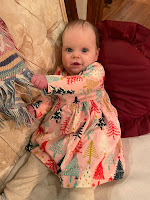
On to pleasant matters. Our daughter, Elizabeth Cordelia Scales, and her partner, Drew Rodkey, have presented us with a granddaughter, Ada Xiomara Rodkey. They live in Chester, Pennsylvania, just south of Philadelphia, and we have enjoyed two visits, the most recent over Christmas. We're also grateful to Drew for the work he did on our apartment and furniture during their visit. We look forward to seeing them again soon.

Finally, thanks to all my friends and readers for your support and encouragement. I wish you all the best of everything for 2023.

Sunday, February 13, 2022

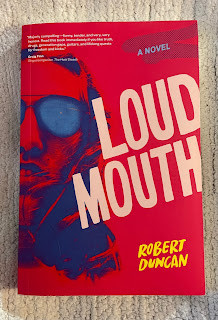
Loudmouth by Robert Duncan

Robert Duncan's Loudmouth was published in October of 2020, and I've had my copy for just over a year. Various things have delayed my reading, and thus this late review, for which I offer Rob an apology. You should know that I consider Rob a friend, more than just of the Facebook variety (although that's been our sole means of communication in recent years) and I'm confident that he returns the favor.

I got to know Rob near the tail end of the 1970s when we were both regulars at the Bells of Hell. We shared a love of rock music, and enjoyed the company of some of the other regulars, two of whom, legendary rock critic Lester Bangs and "The Village Legend" to whom Rob gives the pseudonym Eddie Neil, appear as important characters in Loudmouth. I was invited to Rob's birthday party, held in a Village apartment much spiffier than the Gum Joy Tower flat occupied by Thomas Ransom, protagonist of Loudmouth. When I got there, I saw a long black limo, its engine idling, parked in front. At the party a woman with black hair, wearing a black dress, broke into an upward mezzo soprano glissando. Someone standing next to me said, "That's Liza Minnelli." He then said he understood she and Rob had been in high school together. 

But enough about me; what did I think of the book? First, it's bracketed by rivers. The brief "Chapter 0" at the beginning has the title "Cuyahoga," that being the river that flows through Cleveland and is notorious for having once caught fire. It concerns a tour arranged by Tom Ransom for "Bruce," identified only as such but obviously The Boss, and guided by Charlie, a Cleveland native and friend of Tom's. Charlie shows them a series of dive bars, a record store, and the radio studio where Allen Freed held forth back in the day. At this point I can't resist another personal anecdote. One afternoon in 1970 I was in a law school friend's room when he tried to return a call from his brother, a writer for Cleveland After Dark. When there was no answer at home he called information for Cleveland (remember those days?) and got an operator who, asked for the number of Cleveland After Dark, said something like, "You've got to be kidding." Anyway, at the end of the tour, Charlie takes three 45 caliber bullets, gives one each to Bruce and Tom, then holding his says, "This is how we'll remember."

At the book's end comes "Chapter 00," even shorter than "0," with the title "Hudson." In it, Tom removes the bullet from his Rolodex, in which it's rested for some time. He worries that the gunpowder might be deteriorating in a way that will cause it to discharge spontaneously, with possible fatal consequences. He takes it to a nearby pier and throws it into the Hudson.

Why rivers? One of my teachers, probably my late, beloved twelfth grade English teacher Eleanor Blalock, asserted that rivers, in literature, always signify Life. Loudmouth is a "life," in the sense in which the British use that word where Americans use "biography." Consider W.H. Auden's "A Shilling Life Will Give You All the Facts." in which the poet observes that "all the facts" don't tell the reader what was really important to its subject. Loudmouth is biography. It is a fictional autobiography of Thomas Ransom. Unlike the book mentioned in Auden's "Shilling Life" it lays bare Tom's secret longings, failures, and disappointments, along with his accomplishments.

After I had gotten into Loudmouth, I began to wonder how much of it is fictional. I was led to compare Loudmouth's description of Tom Ransom's life with Rob's, as given in the brief "About the Author" squib at the back of the book. Southern mother; check. Writer for Creem magazine; check. Author of a book about Kiss; check. Singer and songwriter; check. And, as I've mentioned above, hanger out at the Bells; friend of Lester and of The Village Legend. So, is Loudmouth just disguised autobiography? Rob answered that question when he was interviewed by Deborah Kalb:
"Like most debut novels, there's a lot of non- in Loudmouth's fiction. But it's still not an autobiography or memoir. And if only a part of it is fact, all of it is the truth -- perhaps the deeper truth, arrived at by reimagining a life at slightly different times and places, in a slightly different order, with slightly different characters, blurring the physical reality to bring the metaphysical into slightly sharper focus."
I know that when I contemplated writing a novel, I started with my present situation, then tried to imagine how things might be if, at certain junctures, I had - taking a cue from Robert Frost - chosen a different path, or if I were to set off on a different one. Unlike Frost, I took what was, I'm sure, the path more travelled, seeking success in a conventional, bourgeois way. Still, there was that part of me that wanted to be a writer, as well as a corporate lawyer. This had a bad effect on my career in two ways. First, I got into a pattern of missing deadlines because I wanted my memos not only to be legally airtight but also stylistically worthy of consideration for a Pulitzer. Second, as I noted here, the amount of time I was spending in the "Village demimonde," meaning the Bells, and after it closed, the Lion's Head,  contributed to my work woes. The Head had a reputation as a writers' hangout. A woman once came in and said to those assembled at the bar, "I hear this is a place for writers with drinking problems." Village Voice scribe Ace Gillen replied, "No, it's for drinkers with writing problems."

My writing problem was that I never got started, except for a few short pieces in professional journals, at least until I started this blog. Loudmouth gave me a view of what life was like for a music writer in the 1970s. More than that, it gave me a sense of what my life might have been like had I decided to jettison my desire for conventional respectability and indulge that for artistic renown. It wouldn't necessarily have turned out badly; things didn't turn out badly for Rob.

Returning to Rob's interview, Ms. Kalb asked him, "What do you want readers to take away from the novel?" His answer:
"I hope that readers think it's funny, sad, surprising and maybe, in parts, lovely. I hope they enjoy the words, sentences, and paragraphs, the rhythms and music, as much as the characters and scenes. I hope they pick up on what's going on between the lines and among the lines, the wordplay, inside jokes, compulsive allusions to songs, bands and pop culture."

I found it funny, sad, surprising, and, yes, lovely.  I can't say I caught all the inside jokes and allusions, but did get enough to give myself a figurative pat on the back. Then there's this:

"Ultimately, I hope it gives the reader a fresh glimpse of the wonderous/disastrous complexity of life."

That it gave to this reader. I commend Loudmouth without reservation.