Showing posts with label Photography. Show all posts

Monday, January 20, 2020

Remembrances and appreciations, 2018 and '19

For some years I posted a remembrance of the past year, including a summary of the remembrances of those, either friends or those I admired, who have died, and an appreciation of those who have been helpful to my blogging. I last did these together in 2016. In 2017, the look back and the remembrances got separated. In 2018 I posted remembrances, promising "happier reminiscences soon," but never got around to that. Last year I began this post in February, and have left it in very incomplete draft form until now.

I posted individually during 2018 in memory of Aretha FranklinRusty Staub, Roger Bannister, and the congregants of the Tree of Life Synagogue murdered in the Pittsburgh massacre. These would have been included in my 2019 remembrances, had I gotten around to posting them. In 2019 I posted for Doris Day, Bill Buckner, Sandy Denny (although she had died 41 years before), John Phillips (not the one from the Mamas and the Papas), and Nick Tosches.

In recent years I've lamented the increasing number of people either that I had known in person or admired as artists, musicians, sports figures, or otherwise, who were dying. I put this down as a natural result of my growing old, and it mostly is. Of those who died last year and were noted on my blog, three - Bill Buckner, John Phillips, and Nick Tosches - were younger than me. I had known John for his entire life. Indeed, my first contact with him was when he was in utero. I was fourteen at the time, and his mother, Mary, during her eighth month of pregnancy, invited me to put a hand on her distended belly, where I could feel one of his feet moving.

The youngest of those I knew who died last year was Jack Hatton, 24. Jack was a year behind my daughter, Liz, in elementary school on September 11, 2001. Their school was close to the World Trade Center, and the principal decided to evacuate the students, either to a school farther north or, at parents' discretion, to home. Jack's mother, Marie Hatton, and I both decided to take our children home to Brooklyn Heights. Since transit wasn't working and the Brooklyn and Manhattan bridges were closed, Marie, Jack, Jack's brother Harrison Hatton, Liz, and I had to take a long, circuitous walk through the Lower East Side, where the Tenement Museum provided a respite, giving water and access to restrooms, then across the Williamsburg Bridge. On the Brooklyn side we were greeted by Hasidim offering us cups of water. Once off the bridge we found rest on the steps of the Peter Luger Steak House, where the staff gave the kids fries. I was able to reach Jack's father, Mark Hatton, by phone. He came and gave us all a ride back to Brooklyn Heights. Jack was the youngest in our group, but he never complained.

There are others whose passing I didn't note on the blog, not because I thought them less significant, but because their deaths came late in the year, when I was preoccupied with holiday preparations and events. Amy Talcott was a friend of many years, an administrator at Plymouth Church, a skilled seamstress who made dresses for several of our friends, and a loving wife to Ahsan Farooqi and mother to Amos Farooqi. Another loss was Elisabeth Brewer, mother of my friend Geoff Brewer and wife of my friend Wally Brewer. She was a stalwart of our own Grace Church and always a lively and engaging conversationalist. Annabella Gonzalez was a superb dancer and choreographer who led her own dance company. Her dances drew on various influences, including the traditions of her native Mexico as well as more contemporary themes. I got to know her many years ago when she married my previous colleague and long time friend Richard Grimm and later became the mother of Henry Grimm.

Other sad news came with the announcement that Congressman John Lewis had been diagnosed with cancer. I had a brief encounter with him in 1966, long before his election to Congress, when he was head of the Student Non-violent Coordinating Committee and we were both attending an Ecumenical Conference on Urbanization and Technology at Emory University in Atlanta. I don't recall the specifics of our short conversation, except that it stiffened my resolve to continue in the fight for racial equality and justice.

Another cancer diagnosis that hit me hard was that of Judy Dyble. I fell in love with her, or at least with her voice and artistry, in 1970 when I acquired the first Fairport Convention album (yes, the band still exists after more than forty years, with some personnel changes), and heard her cover of Joni Mitchell's "I Don't Know Where I Stand." In 2008, I posted an iPod Log that included a video clip of "Time Will Show the Wiser," a song from the first Fairport album, on which Judy sings harmony. This led to my getting in contact with Judy via email. Later that year I posted a video clip of Judy with some present Fairporters and others doing an obscure Bob Dylan song in French. This has, as they say, gone viral, though many of the hits have come from Russia and Ukraine. Is there something about Dylan in French that has peculiar appeal to the Slavic soul? More recently, Judy and I became friends on Facebook, which is how I learned of her diagnosis. She has begun a course of chemotherapy, keeps the proverbial English "stiff upper lip" about hair loss and such, and treats me with news of the British music scene and with photos of her rescued greyhound Jessie.

Despite all this sadness, there was much to celebrate in 2019. I've taken considerable inspiration from two courageous women. Jennifer Garam is the daughter of Peter Garam, with whom I shared an office when I first came to New York in 1970. I met Jennifer some years ago at a gathering of Brooklyn bloggers, and we became Facebook, as well as occasional encounters on the street, friends. Two years ago she was diagnosed with late stage ovarian cancer. She underwent surgery and chemotherapy, is now cancer free, and still writing compellingly.

The other is Lauren Jonik, whom I first got to know through her comments about my posts on the Brooklyn Heights Blog. I learned she was a skilled photographer, and met her face to face at an exhibition of her works. You can see her photos at Shoot Like a Girl Photography. She told me she had suffered a severe case of Lyme disease that struck her in her teens and kept her from completing her education on schedule. Nevertheless, she had since managed to study both photography and writing, and is now finishing her studies for a Masters in Media at The New School. She is the co-founder and editor of The Refresh, for which she wrote an essay about Mary Oliver, a poet whose works I love. Stephen Muncie, please take note.

It's de rigueur in pieces like this to express gratitude to one's immediate family, but it's not a sense of duty that makes me credit my wife, Martha Foley, and my daughter, Elizabeth Cordelia Scales. Yes, Martha has been patient about my hours of absorption with writing, but she and Liz have also been helpful as a critical audience for my ideas, often helping to sharpen my thinking.

There are many other friends, on Facebook and otherwise, who have been very helpful. They are too numerous to try to list. Among them are some with whom I disagree profoundly on some issues, but whose opinions I am always keen to understand. Please know you have my sincerest appreciation.

Sunday, September 06, 2015

Some scenes from Cape Cod

The Bourne Bridge, our entryway to the Cape. There are two other bridges that cross the Cape Cod Canal onto the Cape proper. To the north is the Sagamore Bridge, and to the south is a railroad bridge with a lift span that stays up to let ships pass and is only lowered when a train needs to cross. Rail passenger service to the Cape was restored recently after many years' absence.
Skaket Beach, on the Cape Cod Bay side of the Town of Orleans, at high tide.
Skaket Beach at low tide. Note how far out on the sandbars people go.
Typical Cape marshland. What's that tower?
Aha! It's an osprey nest platform, and an osprey has nested on it.
Here's a close-up of the osprey.
This rabbit was often seen near our friends' driveway.
Provincetown harbor.
Looking back at Provincetown from the MacMillan Pier. The building in the background is the Provincetown Public Library.
On the way back from Provincetown, we made our second visit to Truro Vineyards; a photo of their vineyard is above (compare to photos taken in early June of 2013 in the post linked above). I bought a bottle of their estate grown cabernet franc and one of their estate grown chardonnay. I'll be tasting both and reporting about them here; stay tuned.
Here's a tiger swallowtail butterfly getting nectar from a butterfly bush in our friends' backyard.

Wednesday, August 12, 2015

Maritime views from an evening walk.

Yesterday evening I took a walk down to Brooklyn Bridge Park's Pier 5. As I walked out onto the pier, the sun had already set, but its rays were still reflected from clouds to the west.
As I reached the end of the pier and looked south, I saw the tug Miriam Moran "on the hip" of a barge loaded with cargo containers, taking them from the Red Hook container port; their probable destination being a railhead in New Jersey. You can find another photo of Miriam, and a link to an explanation of "on the hip," in this post.
The small container ship Nefeli was docked further down at Red Hook. Most ships using this facility bring containers loaded with bananas from Central and South America.
Looking to the west, I saw my old friend the self-unloading bulk carrier Alice Oldendorff coming through the channel between Governors Island and lower Manhattan, heading for her dock at the Brooklyn Navy Yard. Like her sister Sophie Oldendorff, seen in this post, she will deliver a load of Canadian crushed stone.
The attractive motor launch Kingston was moored at the north side of the pier, waiting for the next day's work.

Tuesday, July 14, 2015

Queen Mary 2 arrives in Brooklyn from England, celebrating 175 years of transatlantic service.

In July of 1840 RMS Britannia inaugurated the British and North American Royal Mail Steam Packet Company's transatlantic liner service. That company would later become the Cunard Line. Today, Cunard's Queen Mary 2 commemorated that voyage on its 175th anniversary, arriving at her American home port in Red Hook, Brooklyn after a voyage from Southampton, England. She was scheduled to arrive at 6:00 a.m., and your correspondent got himself to Pier 5 in Brooklyn Bridge Par to watch and photograph her arrival. In the photo above, the great ship was beginning to emerge from behind Governors Island.
The retired, now privately owned New York City fireboat John J. Harvey saluted Mary as she approached her berth.
The enormous ship had to be turned so that she would be berthed with her bow facing toward the sea. Meanwhile, the tug Kings Point was headed outward, as the high speed ferry Finest came in.
Here's Mary stern on, with Staten Island, an anchored Stolt tanker, and barges in the background.
Among the flotilla of vessels greeting Queen Mary 2 was the historic harbor tanker Mary A. Whalen, now owned by PortSide NewYork, headed by my friend Carolina Salguero.
The great Queen approaches her berth, ending an historic voyage. While she is used mostly for cruising, Queen Mary 2 makes a couple of transatlantic voyages each summer, keeping alive a worthy tradition.

Saturday, October 18, 2014

iPod log: Brooklyn Heights; Brooklyn Bridge Park; Fulton Ferry; DUMBO; Cadman Plaza Park

Haven't done one of these since January. The idea is: I take a walk, usually around my neighborhood, Brooklyn Heights, as well as through Brooklyn Bridge Park and adjoining areas, but sometimes across the Brooklyn Bridge and back. On my walk, I have my iPod on, set in the "shuffle" mode so that it plays music randomly. At or near the start of each piece of music, I take a photo. The photos are therefore also random, though I do try to shoot whatever looks best or most interesting at the time. What follows is the log of a walk I took on September 16. After each photo I tell what was playing when I took it, giving a link to a site (usually a YouTube clip) where you can listen to it. Where necessary, I also give some explanation of what's in the photo.
The Spinners' "One of a Kind Love Affair" is an excellent example of the Gamble & Huff smooth and danceable Philly soul style from the 1970s. Hear it here.

2. Gin Blossoms, "Miss Disarray." One of many songs Eliot Wagner has turned me on to. Hear it here.

3. Great Speckled Bird, "Trucker's Cafe." In 1969 the Canadian folk duo Ian and Sylvia, who had earlier recorded an album, Nashville, with backing by Nashville studio musicians, decided to go the country rock whole hog, and formed a band, into which they briefly merged their identity, named for a classic country song. The band recorded one, eponymous, album, which I love, and which was Todd Rundgren's maiden production. "Trucker's Cafe" features the voice of Sylvia Fricker Tyson, backed by Buddy Cage on pedal steel, Amos Garrett on guitar, and N.D. Smart on drums. Hear it here.

Photo: This is a view down the "charming cloister like walkway" (Francis Morrone, An Architectural Guidebook to Brooklyn) that leads from Hicks Street to the entrance to the Grace Church Parish House (1931), which also houses the Grace Church School (pre-K and K; hence  the carriages on the walkway). On the right of the photo is the south wall of Grace Church, completed in 1848 and designed by Richard Upjohn, one of the pre-eminent American church architects of the nineteenth century.

4. Sue Foley, "Careless Love." More Canadian content, from another woman singer who knows how to do the blues. Here she does a traditional song of obscure origins, but which was in the repertoire of Buddy Bolden perhaps a century ago or more. Live performance video here.

Photo: This is a portion of "The Fence", which extends most of the length of Brooklyn Bridge Park, and showcases the work of photographers who will be featured in Photoville, an annual event at the Park.

5. Rod Stewart, "Tomorrow is Such a Long Time." Rod covers a Dylan song on Every Picture Tells a Story, one of the best rock albums ever. Hear it here.

Photo: In the foreground, the harbor tanker Patrick Sky (not named for the folk singer) leaves Buttermilk Channel heading into the East River, while a U.S. Army Corps of Engineers debris collection vessel (probably Driftmaster) goes in the opposite direction.

6. Jimmy Crawford with Frank Motley's Crew, "That Ain't Right."  1954 R&B originally recorded by Savoy Records, Newark's pioneer indie label; the linked clip shows the Gem label, which evidently later acquired rights to it. "Don't nobody stay out and drink bad green wine all night." Hear it here. I think of this as the metaphorical flip side of Dolly Cooper's 1953 sparkler "I Wanna Know", from the Savoy archives.

Photo: The former U.S. Navy helicopter training carrier Baylander and the "Fredonia" type fishing schooner Lettie G. Howard, which belongs to the South Street Seaport Museum and is used for educational purposes in conjunction with the New York Harbor School, are moored beside Brooklyn Bridge Park's Pier 5.

7. John Mayall's Bluesbreakers with Eric Clapton, "Steppin' Out." A lively blues instrumental, written by James Bracken and originally recorded by Memphis Slim, featuring a young Eric Clapton on lead guitar. Hear it here.

8. Johnny Cash, "Flushed from the Bathroom of Your Heart." A heart-rending ballad of lost love, from the legendary Live at Folsom Prison album. Hear it here.

Photo: The sculpture is part of Dahn Vo's We the People, in which the sculptor has modeled, in full scale, fragments of the Statue of Liberty, and placed them in locations around the world, including Brooklyn Bridge Park.

9. The Light Crust Doughboys, "Knocky, Knocky." John "Knocky" Parker was a professor in the English department at the University of South Florida when I was a student there in the mid 1960s. He would sometimes give jazz piano performances, and I heard that he had a career as a musician before becoming an academic. I later learned, by dint of acquiring the album OKeh Western Swing, which included "Knocky, Knocky", that he had been a member of the Light Crust Doughboys. You can hear it here. You can also hear Professor Parker playing Scott Joplin rags here.

10. The Rolling Stones, "Sweet Virginia." "Got to scrape that shit right off your shoe." Live performance video here.

11. Neil Young, "Ohio." The version I have on my iPod is his solo acoustical performance, at Massey Hall, Toronto in 1971 of this gut-wrenching song about the unjustified killings of four Kent State University students in May of 1970. This song was originally recorded by Crosby, Stills, Nash and Young and included in their album 4 Way Street. There is no video of the Massey Hall performance, which I think unparalelled for its emotional immediacy, but I found this clip of another performance, with a montage of scenes from the Kent State killings.

12. John Stewart, "Friend of Jesus." This isn't the John Stewart of The Daily Show, of whom I'm a fan, but the singer I loved. "Friend of Jesus" was originally on his album Willard, but I have it as a bonus cut from the CD version of California Bloodlines. You can hear it here.

13. J.S. Bach, Brandenberg Concerto No. 2, 1st Movement, Allegro; Academy of St. Martin in the Fields, Sir Neville Marriner, Cond.  One of the liveliest things Big Daddy Bach wrote. There's no video of the Academy performing this piece, but there's a clip here of an uncredited orchestra (commenter "Chuck Norris" suggests the conductor may be Karl Fischer) playing the piece, accompanied by a "graphical score" made by Stephen Malinowski, which I found fun to watch. It shows you what the various instruments are doing.

14. Saïan Supa Crew, "La Patte." What better to follow German baroque than French hip-hop (with a segment in English by guest rapper and techno-geek Will.I.Am)? Video here.

 
15. The Chieftains, "Jabadaw." My iPod decides to jump the English Channel with this version of a dance tune from Cornwall by Ireland's Chieftains, taken from their album Celtic Wedding. You can hear it here.
16. The Kingston Trio, "Low Bridge." Raise your hand if you didn't sing this song in elementary school music class. You probably knew it as "The Erie Canal," but on the album The Kingston Trio No. 16 it got the title "Low Bridge." The Trio's version is probably a bit more uptempo than the one you knew, and has some extra lyrics. Hear it here.

17.  Jo-El Sonnier, "Jambalaya." Hank Williams made this song a hit. Here it's done in the original Cajun French. Hear it here.

18. Bonnie Raitt, "Love Has No Pride." The "definitive version" (Dave Marsh) of this doleful but lovely Eric Kaz/Libby Titus song. Hear it here.

19. James Cotton, "No Cuttin' Loose." Cotton, a blues musician with an eclectic backgrouund, shows his talents on harmonica and as a singer on this piece. Hear it here.

20. Joan Baez, "Farewell Angelina."  This song takes me back to my third year of law school, and to my friend Tom's dorm room, were he was host to a weekly TGIF. Several of us would gather there to drink cheap Scotch, get high, and listen to tapes on Tom's Akai reel-to-reel. One of these was the Joan Baez album of which this is the title song. Hear it here.

Photo: What we see from the back is the Henry Ward Beecher Monument (1891), by John Quincy Adams Ward. Beecher was the first minister of Plymouth Church in Brooklyn Heights, and is remembered principally for his fierce dedication to the cause of abolishing slavery. Flanking the pedestal of the monument are images of slave children, their arms stretched upward in their struggle for freedom.

21. Robert Johnson, "Sweet Home Chicago." Robert Johnson was a gifted singer and guitarist who is credited with having established the style that became known as Delta blues. There's a clip here where you can hear "Sweet Home Chicago," accompanied by vintage film of life in the City of Broad Shoulders.

Photo: Late summer bounty at the Borough Hall Greenmarket.

22. Warren Zevon, "Mohammed's Radio." "Don't it make you want to rock and roll all night long, Mohammed's radio?" Hear it here.

22. Marlene Dietrich, "Schlittenfahrt." Ever wonder what "The Surrey With the Fringe on Top" from Oklahoma sounds like in German? The Blue Angel will let you know, if you dare.

Photo: This is the south facade of St. Ann & the Holy Trinity Church. It was designed by Minard LaFever, another pre-eminent nineteenth century American church architect, and completed in 1847. It has the first complete set of figural stained glass windows to have been made in North America.

24. Ian & Sylvia, "Maude's Blues." My walk ends with another example of Sylvia's talent for singing the blues. Hear it here.

Photo: These are the facades of two adjoining mid-1880s apartment buildings on Montague Street, the Berkeley at left and its near twin, the Grosvenor at right. Both were designed in a typically Victorian style by the English born architects the Parfitt Brothers.

Sunday, September 21, 2014

The American Victory floating museum in Tampa.

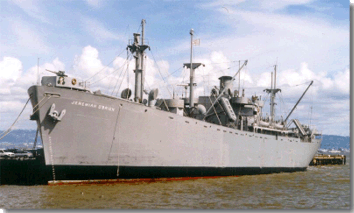
American Victory is one of three surviving examples of the "victory" class of cargo ships built near the end of World War Two to serve in the Allied war effort. They succeeded the liberty ships, of which 2,710 were built in the early war years; certainly the greatest feat of ship mass production in history. While the liberties were, as FDR called them, "ugly ducklings," the victories were, in my opinion, among the handsomest of twentieth century freighters.

I've known two men who served on American Victory. One was Paul Schiffman, whom I knew over the course of many years when he served as afternoon and early evening bartender at the Lion's Head. Paul was a mate on her maiden voyage in 1945, when American Victory was used to ship cargo to American forces in the Pacific. The other is Mike Wholey, whom I met at a memorial gathering for Paul, and who served as a mate on her final voyage in cargo service, delivering supplies to American forces in Vietnam in 1969.
After that final voyage in 1969, American Victory was mothballed and put into the reserve fleet.  She was kept at anchor in Virginia's James River. In the late 1990s she was due to go for scrap, but in 1999 she was acquired by a private company, The Victory Ship, Inc., and brought to Tampa. She is docked there, at a former commercial dock adjacent to the Florida Aquarium, where she serves as the American Victory Mariners Memorial and Museum Ship. She has been maintained in seaworthy condition, and makes occasional short cruises. She is listed in the National Register of Historic Places. As I approached her from the stern, I saw a laughing gull perched on her rudder.
View of the ship's bridge and funnel from the main deck.
Seen from the main deck, the tug Brendan J. Bouchard and a barge were docked across the channel.
One of American Victory's antiaircraft guns, seen from near the stern, looking forward.
The ship's bridge. Note the wheel at right, the compass and radar screen housings, and the engine room telegraph with the dial face, used to send instructions to the ship's engineers below.
Outside on the bridge.
The galley.
Seamen's stateroom.
Looking down to the engine room, from a catwalk.
Looking aft from American Victory's stern, a  cargo ship is docked further up the channel. Beyond, the tug Sea Eagle is in drydock.

American Victory is one of several victory ships that were named for American colleges and universities. She is named for American University, in Washington, D.C., in recognition of that institution's contributions to the war effort.