Showing posts with label Academe. Show all posts

Saturday, October 20, 2012

Stanley Fish on Gertrude Stein on Cézanne

Paul Cézanne, Still Life with Apples and a Pot of Primroses, c. 1895 (oil on canvas).
I have a passion about connections between different kinds of art. On this blog, it's mostly been between music and painting (see here and here). Now, thanks to Stanley Fish's How to Write a Good Sentence (the link is to a review in the Financial Times by my fellow Grace Church parishioner, Adam Haslett), I know that Gertrude Stein's writing was inspired by Paul Cézanne's painting:
Usually a sentence does not deliver its meaning until the end, and only at the end do its components acquire their significance and weight. But what Stein wants is meaning to be present at every instant, to be always the same in weight and yet different as each word is different. Before Flaubert and Cézanne, she explains, "composition had consisted of a central idea to which everything else was an accompaniment and separate but was not an end in itself." But then "Cézanne conceived the idea that in composition one thing was as important as another thing. Each part is as important as the whole, and it impressed me enormously," and as a consequence, she continues, "I tried to convey the idea of each part of a composition being as important as the whole" ("A Transatlantic Interview," 1946).
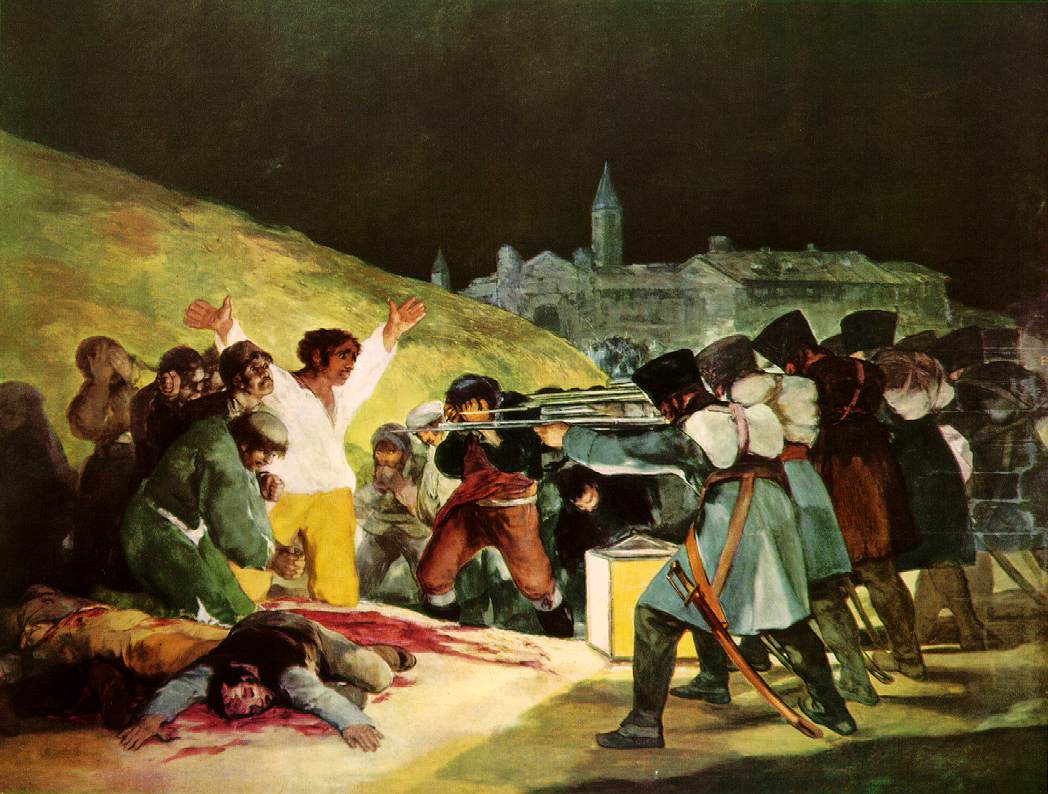
Is Stein right about Cézanne? In the image of the painting shown above, is the surface of the table as "important" (not in a structural but in a compositional sense) as the fruit, or the white cloth? Is the pot as important as the flowers, or the leaves? Cézanne's painting doesn't have the compositional drama of, say, Goya's The Shootings of May 3, 1808, in which the eye is drawn irresistibly to the man in the white shirt with outstretched arms. Still, one does notice things like the pot, the table, and even the walls, which have a mottled texture, more than one might in the work of many other painters.

What about Stein's writing? Fish gives us this sample:
When I first began writing I felt that writing should go on I still do feel that it should go on but when I first began writing I was completely possessed by the necessity that writing should go on and if writing should go on what had colons and semi-colons to do with it, what had commas to do with it what had periods to do with it what had small letters and capitals to do with it to do with writing going on which was at the time the most profound need I had in connection with writing.
--Lectures in America, 1935
Does every part of this long sentence have equal weight? The frequent repetition of the phrase "writing should go on" seems to give it particular importance. The words "completely possessed" and "most profound need" draw attention to what immediately follows them. There's a cute irony in her use of a comma just before "what had commas to do with it [?]" Nevertheless, this sentence is more flowing stream than marble monument. To say that every element of a sentence should "be the same in weight" (Fish's words, not Stein's) brings to mind Mary McCarthy's quip about Lillian Hellman: "Every word she says is a lie, including 'and' and  'the.' "  But that, as Fish (and, I suppose, Stein) would agree, is a reductio ad absurdum.

Stein, and perhaps Cézanne, adumbrated the aversion to "privilege" that came to characterize "postmodernism" or "theory" in late twentieth century academic discourse. In painting, this was carried a step further by Pierre Bonnard, whose compositions are, as a whole, much busier than Cézanne's, and who frequently marginalized elements that would have been afforded pride of place in the works of other artists.

Fish continues his commentary on Stein with this observation:
The insight is theological, although Stein probably doesn't intend it that way. In a world created and presided over by an omnipotent God who fills all the available spaces, the distinctions between things, persons, and events are illusory, a function of a partial, divided, and dividing consciousness....If we would only...stop laboring to put discrete significances together in an effort to combine them into a larger whole, we would see, theologians tell us, that the larger whole we seek is already everywhere and that our very efforts to apprehend it themselves signify it.
Image thanks to the Metropolitan Museum of Art's Heilbrunn Timeline of Art History.

Thursday, April 29, 2010

Harvard Law Dean Martha Minow on the Stevens succession and other things.

Martha Minow is the twelfth Dean of Harvard Law School (not counting those who have served in an acting capacity) since the deanship was established in 1870 (the Law School itself was established in 1817), and the second woman--the first of whom was her immediate predecessor, Elena Kagan--to hold that office. She and Kagan, who left Harvard to serve as Solicitor General, are now both under consideration as the successor to retiring Supreme Court Justice John Paul Stevens.

Last weekend, I attended a class reunion in Cambridge, and Dean Minow spoke to the returning alumni. As expected, she concentrated on what was happening at the Law School, prominent among which was the curriculum revision, the first of any real substance since the Law School's first Dean, Christopher Columbus Langdell, introduced the case method. Minow had been appointed by Kagan, while she was still Dean, to take on curriculum reform, and so was instrumental in adding to the first year curriculum (by reducing the traditional courses such as contracts to four hours from five) courses on legislation and regulation, as well as a January inter-term devoted to problem solving.

When she invited questions, Dean Minow got many about Law School issues, but some on national ones as well. One alum asked how she felt about a former student of hers, Barack Obama, becoming President. A Yale Law alumna, she responded with a paraphrase of the final words of another famous Yalie, Nathan Hale: "I only regret that I have but one faculty to give to my country." She explained that, since President Obama's inauguration, Harvard Law had lost seven faculty members (Kagan presumably included) to Washington.

Inevitably, she was asked her thoughts on replacing Stevens. She said that his were "very big shoes to fill." She recalled being called into his chambers, during her time as a clerk to Justice Thurgood Marshall, and told by Stevens that her memorandum had caused him to reconsider his position on a case. In any event, she said, she hopes his successor equals his qualities of character, independence, and conscience.

Monday, March 29, 2010

John Lennon recites Kerouac, and more on Walt Whitman and the Beats


Dr. John Lennon, Assistant Professor of English at St. Francis College, Brooklyn, reads the 241st Chorus of Jack Kerouac's Mexico City Blues in Greenwich Village on March 28, 2010. Across the street is the former site of Cafe Bohemia, a jazz club where Kerouac, among many other luminaries, was a frequent customer.


The story of how Charlie Parker, subject of the 241st Chorus, made Cafe Bohemia a successful jazz spot despite never playing there, is told here.


John's performance marked the close of a two day conference on the topic "Walt Whitman and the Beats", presented by St. Francis College. The first day included eight panel discussions among which twenty four scholars presented papers on topics relevant to both the poetry of Whitman and the literature of the Beats a century later. The keynote address was given by noted Beat Generation scholar Ann Charters, who built her talk around Allen Ginsberg's "A Supermarket in California", a part of which is:
I saw you, Walt Whitman, childless, lonely old grubber, poking
among the meats in the refrigerator and eyeing the grocery boys.
I heard you asking questions of each: Who killed the pork chops? What price bananas? Are you my Angel?
I wandered in and out of the brilliant stacks of cans following you, and followed in my imagination by the store detective.
We strode down the open corridors together in our solitary fancy tasting artichokes, possessing every frozen delicacy, and never passing the cashier.


The following day there were two walking tours. The first was of "Whitman's Brooklyn", of which, unfortunately, little physical evidence remains. The tour was led by Greg Trupiano, Artistic Director of The Walt Whitman Project, shown in the photo above standing next to Whitman Close, the townhouse development that replaced the building that housed the Rome brothers' print shop, where Whitman labored over typesetting to produce the first edition of Leaves of Grass. Greg is holding up a booklet about the print shop. Photos of this area before it was leveled to provide space for the townhouses and adjacent high rises are here; as you scroll down through the photos, beginning with the fourth photo you will find a building with a red sign on which is "restaurant" in white letters. This was the building that housed the Rome print shop.

Following the Whitman tour, your correspondent and others took the subway to Manhattan to explore landmarks of Beat Generation history in Greenwich Village. Fortunately, thanks in part to the efforts of Jane Jacobs, many of these have survived, although in some instances in different guises.


We gathered next to the Minetta Tavern, where William S. Burroughs would treat his less affluent friends, Ginsberg and Kerouac, to dinner.


One Beat landmark rendered unrecognizable is Fugazzi's, now remade into "Kudo Beans", partly obscured in the photo above by the marquee of the International Film Center. It was immortalized in Ginsberg's Howl:
...who sank all night in submarine light of Bickford's floated out and sat through the stale beer afternoon in desolate Fugazzi's, listening to the crack of doom on the hydrogen jukebox...


This is the door to the brownstone house in which the poet, playwright and political activist Amiri Baraka, then known as LeRoi Jones, lived for a time in the 1950s. Standing next to the door is Fiona Anderson, of Kings College London, who, the previous day, read her paper "A trail of drift and debris: Traces of Whitman in the correspondence art of Ray Johnson", and thereby introduced me to an artist associated with the Beats with whom I was previously unfamiliar (see clip below).


The tour concluded with Dr. Lennon's reading of the 241st Chorus of Mexico City Blues, but at the beginning (unfortunately, he was well into it before I had the sense to think of video) Dr. Thomas Bierowski, Assistant Professor of English at Alvernia University, treated us to a recitation of the 228th Chorus, which concludes:
Praised be the embrace of soft sleep
--the valor of angels in valleys
of hell on earth below--
Praised be the Non ending--
Praised be the lights of earth-man--
Praised be the watchers--
Praised be my fellow man
For dwelling in milk

Tuesday, November 20, 2007

Postscript to my screed on consequentialism.

I posted earlier on this topic here. Aaron tells why, if you're shot down over enemy-occupied territory, it's much better to take shelter among consequentialists than among deontologists here.

Aaron might similarly appreciate my post here.