"[A] delightfully named blog", (Sewell Chan, New York Times). "[R]elentlessly eclectic", (Gary, Iowa City). Taxing your attention span since 2005.
Tuesday, January 28, 2025
Robert Burns' birthday, and my wife's, celebrated thanks to Repast Baroque and Anna O'Connell
The program was provided by members of Repast Baroque, joined by harpist and soprano Anna O'Connell. In the photo Ms. O'Connell is at the left, with her Celtic harp. Repast members, left to right, are: Sarah Stone, on baroque cello; Gabe Shuford on keyboard (at Repast concerts Gabe plays harpsichord; the space here was too small to fit one); and Stephanie Corwin on bassoon. The festivities began with Ms. O'Connell's spirited reading of Burns' poem, "The Flowers of Edinburgh." This was followed by a number of Burns poems set to music by various composers, which Ms. O'Connell sang in her clarion clear and wide ranging soprano voice. She also performed several pieces by Scottish composers inspired by Burns, solely on harp.
It being Martha's birthday, I was delighted that one of the Burns poems set to music chosen for the program was "My Wife's a Winsome Wee Thing." I don't know if this was inserted on Martha's behalf, but the musicians did break from the Burns performance to lead us all in "Happy Birthday," and a cake was presented. The program continued with a lively "There's Nae Luck About the Hoose," and concluded with "The Parting Kiss" and what is Burns' best known poem, "Auld Lang Syne," in which we all joined.
Repast's next concert will be on Saturday, March 15 at 3:00 PM, at the McKinney Chapel of the First Unitarian Congregational Society, 116 Pierrepont Street, Brooklyn, celebrating The Ides of March, at which Sarah, Gabe, and Stephanie will be re-joined by violinist and new mother Natalie Rose Kress and by guest musician Margaret Owens on oboe and recorder. The program will feature music by Handel accompanied by projections of the 1908 silent film Julius Caesar and other early silent films. The concert will be repeated the following day, Sunday, March 16, at 3:00 PM, at the Manhattan Country Day School, 150 West 85th Street.
Wednesday, December 11, 2024
"I grow old ... I grow old ..."
"I shall wear the bottoms of my trousers rolled."
When I was in high school and first read this couplet from T.S. Eliot's (photo) "The Love Song of J. Alfred Prufrock" I assumed that a man's having the bottoms of his trousers rolled, or cuffed, was a new fashion trend in 1915, when the poem was written, and that Eliot ascribed to the aging Mr. Prufrock a desire to appear au courant.
This morning a different reason occurred to me as I tucked, or rolled under, the bottoms of my trousers. From my teen years until now I have worn trousers with a thirty inch inseam. However, I now find that instead of the desirable "break" at shoe level, I get an unsightly sprawl. The reason became evident when a doctor measured my stature and found it was five feet seven, down from the five feet ten it had been for most of my life. I had, for some time, noticed that people, especially women, seemed on the average taller than I was used to seeing.
This I now know, is because a loss of stature frequently occurs during aging. According to this article, by losing three inches I've lost the maximum expected amount. I hope that's true.
Perhaps, then, poor J. Alfred had lost an inch or more growing old, and that's why he needed to roll his trousers.
Photo: Thomas Stearns Eliot with his sister and his cousin by Lady Ottoline Morrell.jpg: Lady Ottoline Morrell (1873–1938) derivative work: Octave.H, Public domain, via Wikimedia Commons
Sunday, September 04, 2022
Pete Seeger - "The Bells Of Rhymney" - live in Australia 1964
Friday, September 10, 2021
Twenty Years
I'm adding to my post to mention two others who weren't close friends but who also perished on 9/11. I enjoyed some conversation with Kristin Gould White at the Lion's Head. She was on Flight 93, which crashed in Pennsylvania. The story at the close of her linked tribute of how her daughter learned of her death is heart-rending. I met Joe Lostrangio at a reinsurance related event less than a week before 9/11, and we had a tentative lunch date for the week after. Having read his linked tribute, I wish I'd had the chance to get to know him better. For those of you who didn't know Charlie McCrann, here's his obituary.
Monday, January 20, 2020
Remembrances and appreciations, 2018 and '19
I posted individually during 2018 in memory of Aretha Franklin, Rusty Staub, Roger Bannister, and the congregants of the Tree of Life Synagogue murdered in the Pittsburgh massacre. These would have been included in my 2019 remembrances, had I gotten around to posting them. In 2019 I posted for Doris Day, Bill Buckner, Sandy Denny (although she had died 41 years before), John Phillips (not the one from the Mamas and the Papas), and Nick Tosches.
In recent years I've lamented the increasing number of people either that I had known in person or admired as artists, musicians, sports figures, or otherwise, who were dying. I put this down as a natural result of my growing old, and it mostly is. Of those who died last year and were noted on my blog, three - Bill Buckner, John Phillips, and Nick Tosches - were younger than me. I had known John for his entire life. Indeed, my first contact with him was when he was in utero. I was fourteen at the time, and his mother, Mary, during her eighth month of pregnancy, invited me to put a hand on her distended belly, where I could feel one of his feet moving.
The youngest of those I knew who died last year was Jack Hatton, 24. Jack was a year behind my daughter, Liz, in elementary school on September 11, 2001. Their school was close to the World Trade Center, and the principal decided to evacuate the students, either to a school farther north or, at parents' discretion, to home. Jack's mother, Marie Hatton, and I both decided to take our children home to Brooklyn Heights. Since transit wasn't working and the Brooklyn and Manhattan bridges were closed, Marie, Jack, Jack's brother Harrison Hatton, Liz, and I had to take a long, circuitous walk through the Lower East Side, where the Tenement Museum provided a respite, giving water and access to restrooms, then across the Williamsburg Bridge. On the Brooklyn side we were greeted by Hasidim offering us cups of water. Once off the bridge we found rest on the steps of the Peter Luger Steak House, where the staff gave the kids fries. I was able to reach Jack's father, Mark Hatton, by phone. He came and gave us all a ride back to Brooklyn Heights. Jack was the youngest in our group, but he never complained.
There are others whose passing I didn't note on the blog, not because I thought them less significant, but because their deaths came late in the year, when I was preoccupied with holiday preparations and events. Amy Talcott was a friend of many years, an administrator at Plymouth Church, a skilled seamstress who made dresses for several of our friends, and a loving wife to Ahsan Farooqi and mother to Amos Farooqi. Another loss was Elisabeth Brewer, mother of my friend Geoff Brewer and wife of my friend Wally Brewer. She was a stalwart of our own Grace Church and always a lively and engaging conversationalist. Annabella Gonzalez was a superb dancer and choreographer who led her own dance company. Her dances drew on various influences, including the traditions of her native Mexico as well as more contemporary themes. I got to know her many years ago when she married my previous colleague and long time friend Richard Grimm and later became the mother of Henry Grimm.
Other sad news came with the announcement that Congressman John Lewis had been diagnosed with cancer. I had a brief encounter with him in 1966, long before his election to Congress, when he was head of the Student Non-violent Coordinating Committee and we were both attending an Ecumenical Conference on Urbanization and Technology at Emory University in Atlanta. I don't recall the specifics of our short conversation, except that it stiffened my resolve to continue in the fight for racial equality and justice.
Another cancer diagnosis that hit me hard was that of Judy Dyble. I fell in love with her, or at least with her voice and artistry, in 1970 when I acquired the first Fairport Convention album (yes, the band still exists after more than forty years, with some personnel changes), and heard her cover of Joni Mitchell's "I Don't Know Where I Stand." In 2008, I posted an iPod Log that included a video clip of "Time Will Show the Wiser," a song from the first Fairport album, on which Judy sings harmony. This led to my getting in contact with Judy via email. Later that year I posted a video clip of Judy with some present Fairporters and others doing an obscure Bob Dylan song in French. This has, as they say, gone viral, though many of the hits have come from Russia and Ukraine. Is there something about Dylan in French that has peculiar appeal to the Slavic soul? More recently, Judy and I became friends on Facebook, which is how I learned of her diagnosis. She has begun a course of chemotherapy, keeps the proverbial English "stiff upper lip" about hair loss and such, and treats me with news of the British music scene and with photos of her rescued greyhound Jessie.
Despite all this sadness, there was much to celebrate in 2019. I've taken considerable inspiration from two courageous women. Jennifer Garam is the daughter of Peter Garam, with whom I shared an office when I first came to New York in 1970. I met Jennifer some years ago at a gathering of Brooklyn bloggers, and we became Facebook, as well as occasional encounters on the street, friends. Two years ago she was diagnosed with late stage ovarian cancer. She underwent surgery and chemotherapy, is now cancer free, and still writing compellingly.
The other is Lauren Jonik, whom I first got to know through her comments about my posts on the Brooklyn Heights Blog. I learned she was a skilled photographer, and met her face to face at an exhibition of her works. You can see her photos at Shoot Like a Girl Photography. She told me she had suffered a severe case of Lyme disease that struck her in her teens and kept her from completing her education on schedule. Nevertheless, she had since managed to study both photography and writing, and is now finishing her studies for a Masters in Media at The New School. She is the co-founder and editor of The Refresh, for which she wrote an essay about Mary Oliver, a poet whose works I love. Stephen Muncie, please take note.
It's de rigueur in pieces like this to express gratitude to one's immediate family, but it's not a sense of duty that makes me credit my wife, Martha Foley, and my daughter, Elizabeth Cordelia Scales. Yes, Martha has been patient about my hours of absorption with writing, but she and Liz have also been helpful as a critical audience for my ideas, often helping to sharpen my thinking.
There are many other friends, on Facebook and otherwise, who have been very helpful. They are too numerous to try to list. Among them are some with whom I disagree profoundly on some issues, but whose opinions I am always keen to understand. Please know you have my sincerest appreciation.
Monday, January 04, 2016
New Year's Shout-Outs and Remembrances
One of those I most looked forward to seeing at my law school reunion in October was my classmate, and later roommate when we first moved to New York, Mario Diaz-Cruz. When we arrived in Cambridge, I saw from the reunion program that he had died just three weeks before. From friends, I learned the details. It had been a brief but fatal illness that struck while he and Sissy, his wife of 45 years, were on vacation in the Hamptons. He was a superb lawyer and friend.
Another loss in 2015 was Tania Grossinger, an erstwhile Lion's Head companion whom I wish I had gotten to know better after I read her autobiography Memoir of an Independent Woman. My ecclesiastical home, Grace Church, saw the loss of its Rector Emeritus Goldy Sherrill and of Don Yule, veteran of the New York City Opera and stalwart in the bass section of the Grace Church choir.
Others whose passing I've noted here are Ernie Banks, Philip Levine, Lesley Gore, the Left Banke's Michael Brown, Ornette Coleman, Wendell Holmes (whom I had the pleasure of getting to know when the Holmes Brothers were playing at Dan Lynch back in the early 1980s), Yogi Berra (a Yankee hero who became a Met), Frankie Ford, Allen Toussaint, and, most recently, Natalie Cole. No doubt you can think of others I should have similarly honored. Update: somehow I missed B.B. King.
Turning to the more pleasant side, I always credit those who have aided my blogging, either through providing me with material or by giving me encouragement, or both. Some of the usual suspects return: Michael Simmons; The Rev. Stephen Muncie; architectural historian Francis Morrone; historical novelist and master of good craic Dermot McEvoy. There are also some new ones: John Wirenius, whom I met in the flesh for the first time at a Sunday evening service at St. Bart's in Manhattan, and who was ordained a Deacon of the Episcopal Church earlier this year; old college friends Larry Brennan and Steve Griffith, as well as Gene Owen, to whom Steve introduced me during the Cosmic American Music Festival in Winter Haven, Florida; Tricia Collins, a for a time long lost Lion's Head companion now back in her hometown, Tallahassee, whom I re-discovered through our common friendship with Kevin Clarke, father of one my daughter's elementary school classmates (in which connection I'll also mention Tom Jenkins); and Permian Extinction--that's her nom de Facebook--whom I met on line because of her friendship with Marian Saska, and whom, because of our common interests in painting and birds, I suspect has in common with Marian connections to the Art Institute of Chicago and the Field Museum. My former LeBoeuf colleague Richard Cole last year gave me a story about his friendship with Robin Williams, and this year allowed me to show him around Brooklyn Heights during a visit to New York; and my law school classmate Richard B. Hoffman has been an invaluable source on movies, theater, law, and much else. I can't end this without mentioning my wife, Martha Foley, and my fellow Robinson Knights, so many of whom I've re-established communication with after many years. If I tried to list you all, along with your contributions to my venture, I'd be up past midnight, and it's a work night. Please accept my heartfelt thanks.
Monday, February 16, 2015
Philip Levine, 1928-2015
my name, no longer a portion
of me, no longer inflated
or bruised, no longer stewing
in a rich compost of memory
or the simpler one of bone, kitty-
litter, the roots of the eucalyptus
I planted back in '73,
a tiny me taking nothing, giving
nothing, empty, free at last.
--Philip Levine, "Burial Rites" (from News of the World; New York, Alfred A. Knopf, 2011) Photo: Detroit Jewish News.
Philip Levine, who died on Valentine's Day, was born in Detroit to immigrant Russian Jewish parents, and wrote poetry while he held various blue collar jobs, including working the night shift at the Chevrolet Gear and Axle plant. He later taught at Fresno State University in California, won a Pulitzer Prize and two National Book Awards, and was Poet Laureate of the United States from 2011 through 2012. After he retired from teaching, he divided his time between California and my neighborhood, Brooklyn Heights, which he came to consider his real home. In the Cortland Review video clip below, which I embedded in a Brooklyn Heights Blog post in November of 2013, he walked around the neighborhood and talked about what inspired him.
Addendum: his Heights neighbor, Michael Bourne, remembers him fondly:
It was pelting rain in Brooklyn and I was out with my son, then about four, headed to the grocery store. Directly across the street, I saw a lanky elderly man, his iron-gray hair matted with rain, on the top step of his stoop, banging on the front door of his brownstone and shouting up at the third-floor window to be let in. It was the poet Philip Levine. I had seen him around the neighborhood for years, and may have even waved to him the way one does to familiar-looking strangers, but now I recognized him because just a couple weeks before his picture had been in the paper when he was appointed the nation’s Poet Laureate.Full story here.
Monday, April 07, 2014
Karen Shaw proves Mies and Browning right ...
Ms Shaw's (photo above) art is based on a simple premise that yields a plenitude of results. The premise is: assign to each letter of the Roman alphabet its ordinal number, A=1 through Z=26. For any word, sum up the numbers of the letters. Find other words having letters that yield the same sum. This can lead to interesting relationships that may be used as the basis for a work of art. For example:
At the time she developed her numerological system, Ms Shaw wasn't aware of its kinship to the Jewish mystical practice called Gematria, but was delighted to learn of it.
Saturday, November 30, 2013
Sam Edwards, "In the Last Days of the Empire."
Sam's video and poem, for which I must again offer thanks to Michael Simmons, is about Greenwich Village before I arrived; the Village of my high school and college aspirations that I, and others like me, unwittingly helped to destroy. Like Michael, I was delighted to see, in one of the photos in the montage that accompanies the reading of the poem, a poster for a concert by David Amram.
Thursday, November 28, 2013
e.e. cummings, "i thank you God," by The Western Wind.
Tuesday, October 29, 2013
Reading Arthur Danto on the Subway
Monday, September 02, 2013
Seamus Heaney, 1939-2013.
I may even have been in the same room with Heaney without knowing who he was. One of my friends reported on Facebook that he was known to visit the Lion's Head when in New York.
A Catholic born and raised in Protestant dominated, and British ruled, Northern Ireland, Heaney had a sharp sense of the way tribal divisions affect communication. His poem "Whatever You Say, Say Nothing," quoted in Saturday's New York Times obituary by Margalit Fox, concludes:
O land of password, handgrip, wink and nod,Some of Heaney's compatriots found his work insufficiently engaged with the political conflict in Northern Ireland, condemning him as "accommodationist." According to the Times obit, his reply was in an essay on Osip Mandelstam, exiled by Stalin:
Of open minds as open as a trap,
Where tongues lie coiled, as under flames lie wicks,
Where half of us, as in a wooden horse
Were cabin'd and confined like wily Greeks,
Besieged within the siege, whispering morse.
“We live here in critical times ourselves, when the idea of poetry as an art is in danger of being overshadowed by a quest for poetry as a diagram of political attitudes,” [Heaney] wrote. “Some commentators have all the fussy literalism of an official from the ministry of truth.”While most criitcs praised Heaney's work, and he was awarded the Nobel Prize in 1995, he had his artistic, as well as political, detractors; those who, the Times observed, found his work "facile." The obit quotes Al Alvarez, in a 1980 review of Heaney's Field Work:
If Heaney really is the best we can do, then the whole troubled, exploratory thrust of modern poetry has been a diversion from the right true way. Eliot and his contemporaries, Lowell and his, Plath and hers had it all wrong: to try to make clearings of sense and discipline and style in the untamed, unfenced darkness was to mistake morbidity for inspiration.The reference to "clearings of sense and discipline and style in the untamed, unfenced darkness" made me think of a poem I love, Wallace Stevens' "The Idea of Order at Key West." It begins with the image of a woman walking on the beach, singing, against the sound of surf. Stevens observed:
She was the single artificer of the worldThe poem continues:
In which she sang. And when she sang, the sea,
Whatever self it had, became the self
That was her song, for she was the maker.
Ramon Fernandez, tell me, if you know,Stevens took particularities--a woman singing on a beach; the lights on boats at anchor--and used them to illustrate how artifice imposes order (also see his "Anecdote of the Jar"), making, if you will, "clearings...in the untamed, unfenced darkness." Heaney gave us particularities, as in the short poem "Nerthus," which Alvarez quotes in its entirety:
Why, when the singing ended and we turned
Toward the town, tell why the glassy lights,
The lights in the fishing boats at anchor there,
As the night descended, tilting in the air,
Mastered the night and portioned out the sea,
Fixing emblazoned zones and fiery poles,
Arranging, deepening, enchanting night.
For beauty, say an ash-fork staked in peat,This poem includes an artifact--the ash-fork--that is simply there, a "taker of the weather." It does not impose any order or scheme, it was simply, in Heaney's view, beautiful. The natural features--peat, kesh, loaning, and heather--have their own beauty, but the ash-fork is beautiful in their context. It could be beautiful in some other context, or none, as well.
Its long grains gathering to the gouged split,
A seasoned, unsleeved taker of the weather,
Where kesh and loaning finger out to heather.
The modernists Alvarez contrasted to Heaney--Eliot, Lowell, and Plath--had in the critic's view what Stevens (whom I would add to that group), in the final stanza of "The Idea of Order at Key West" called "blessed rage for order." (I believe that his "Connoisseur of Chaos" supports that argument.) Heaney didn't rage; he showed us what is there. He didn't idealize or prettify it. He could, for example in one poem, "The Skunk", that Alvarez cites as an example of Heaney at what, in the critic's view, is his best, compare his memory of his absent wife to the skunk that visits his porch in California:
It all came back to me last night, stirredSo, what do I prefer: the "rage for order" or the savor of the particular? My answer is typical for me: I prefer neither, and like both. I've sometimes been accused of wanting to have my cake and eat it, too. My answer is, "Who wouldn't?" To me, the modernists and the particularists are like the Thatcher brothers in Peter Wheelwright's As It Is On Earth, epistemological yin and yang, forever connected and completing a whole.
By the sootfall of your things at bedtime,
Your head-down, tail-up hunt in a bottom drawer
For the black plunge-line nightdress.
And, as an epitaph for Heaney--I promise to read Beowulf and more of your original poetry soon--I offer a paraphrase of Auden's elegy on Yeats:
Earth, receive an honored guest;But, though the vessel lie empty, let the poetry live on, and on... .
Seamus Heaney is laid to rest.
Let the Irish vessel lie
Emptied of its poetry.
Addendum: Christopher Benfey remembers Heaney as a teacher in this New York Review of Books piece.
Photo: By Sean O'Connor, cropped by Sabahrat (File:Seamus Heaney.jpg) [Public domain], via Wikimedia Commons
Friday, March 16, 2012
Sinéad O'Connor and the Chieftains, "The Foggy Dew"
As down the glen one Easter mornThe lyrics are said to be "traditional," hence the author is unknown, though this was written within the last century. The Easter Rising happened in 1916; Suvla and Sud el Bar (Sedd el Bahr) were both disastrous World War I amphibious landings on the shores of Turkey, which was allied with Germany and Austria-Hungary. At Sedd-el-Bahr, a large contingent of Irish troops took heavy casualties; Suvla is remembered in the song, "The Band Played Waltzing Matilda", which tells how Australian soldiers, many of Irish origin or descent, were "butchered like lambs at the slaughter." Here it is by Liam Clancy:
To a city fair rode I,
There armed lines of marching men
In squadrons passed me by.
No pipe did hum, no battle drum
Did sound its loud tattoo
But the Angelus bells o'er the Liffey swells
Rang out in the foggy dew.
Right proudly high in Dublin town
Hung they out a flag of war.
'Twas better to die 'neath an Irish sky
Than at Suvla or Sud el Bar.
And from the plains of Royal Meath
Strong men came hurrying through;
While Brittania's sons with their long-range guns
Sailed in through the foggy dew.
The bravest fell, and the requiem bell
Rang mournfully and clear
For those who died that Easter-tide
In the springing of the year.
While the world did gaze with deep amaze
At those fearless men but few
Who bore the fight that freedom's light
Might shine through the foggy dew.
My only visit to Ireland was in the summer of 1988. A friend advised me that there were two things I absolutely must see in Dublin: the Book of Kells in the library of Trinity College, and Kilmainham Jail (or "Gaol"), where the surviving particpants in the 1916 Easter Rising were held and executed.
While walking through the corridors of Kilmainham, I was stunned by this graffito (image courtesy of EAD Living), the words of which are: "Beware the risen people, that have harried and held, ye that have bullied and bribed."
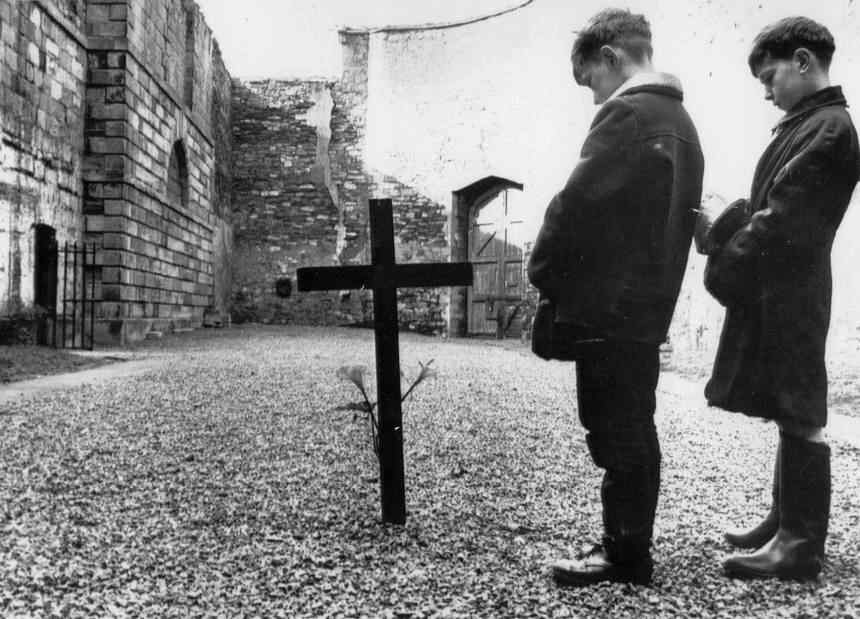
Afterwards, I went to the courtyard and saw the cross marking the spot where the wounded James Connolly was tied to a chair and shot. There were fourteen participants in the Easter Rising executed in the Kilmainham courtyard during May of 1916.
St, Patrick's day is, and should be, a joyous time, even for one like me whose Irish heritage is thin (Update: not so!) and, so far as I know, all on the Protestant side (but remember, Wolfe Tone was a Protestant). Still, it should also be a time to remember what led William Butler Yeats to conclude his poem Easter, 1916 with the words: "A terrible beauty is born."
Sunday, April 24, 2011
e.e. cummings on the unimaginable.
Thanks to The Rev. Stephen D. Muncie, Rector of Grace Church, Brooklyn, for printing this in today's Easter Sunday Bulletin.
Friday, July 23, 2010
Untitled (Irish Hunger Memorial)
I'm sitting on a stone from County Armagh,
facing New Jersey,
listening to Van Morrison.
Two young women climb
the curving path, stop,
then talk by the fence.
One walks to the stone to my left.
"Monaghan;" she says, "so, where is Armagh?"
"Here is Armagh!" I say, and stand.
She sees the name, kneels and caresses
the rock.
"It's my home."
Thursday, July 15, 2010
Tuli Kupferberg (1923-2010); Harvey Pekar (1939-2010); George Steinbrenner (1930-2010)
Tuli Kupferberg
What amazes me most about Tuli? That he became a rock star in his 40s (something I still fantasize about doing in my 60s)? That he was on the countercultural cutting edge through the hipster/beatnik/hippie/punk/grunge/hipster phases? That he could sing about swimming in a river of shit, then do another song the lyrics of which were a Blake poem? He and Ed Sanders named their group the Fugs, with inspiration from Norman Mailer's The Naked and the Dead. In 1948, Rinehart and Company wouldn't publish a book that contained the word "fuck", and Mailer couldn't write dialogue among American soldiers in the Phillipines in World War Two without using that word liberally, so Mailer compromised with a misspelling. This led to Tallullah Bankhead's saying, upon meeting Mailer, "Oh, so you're the young man who can't spell 'fuck'."
The clip above, courtesy of tulifuli, is described in its accompanying notes as follows:
Some time in the mid or late 1990's, before it's [sic] release on the Fugs Final CD part 1, Tuli performed "Where is My Wandering Jew?" on Coca Crystal's Manhattan public access TV show, "If I Can't Dance You Can Keep Your Revolution." Charming hostess Coca introduces Tuli who introduces the song and explains some of the references. "The Wandering Jew is a figure from medieval Christian folklore whose legend began to spread in Europe in the thirteenth century. The original legend concerns a Jew who taunted Jesus on the way to the Crucifixion and was then cursed to walk the earth until the Second Coming. The exact nature of the wanderer's indiscretion varies in different versions of the tale, as do aspects of his character; sometimes he is said to be a shoemaker or other tradesman, sometimes he is the doorman at Pontius Pilate's estate."(Wikipedia)
Harvey Pekar
Harvey Pekar was a very neurotic guy who lived in Cleveland all his life, dropped out of college because math courses gave him too much anxiety, and, until his retirement at age 62, worked as a file clerk in a Veterans' Administration hospital. In the early 1960s, he became friends with R Crumb, who was then living in Cleveland and working as an illustrator for American Greetings. Crumb had just begun experimenting with drawing comics, and when Pekar gave him ideas for his own strip, Crumb drew them for him. Pekar's strip evolved into American Splendor, which was about the everyday adventures of a file clerk living in Cleveland who looked a lot like Harvey Pekar. His work has been compared to that of Chekov and Dostoyevsky.
George Steinbrenner
Anyone who's read this blog knows that I loathe the New York
Yankees. You might suppose that I also loathed their principal owner, one of two Americans commonly known simply as "The Boss". Actually, my opinion of him was complex. I inherited from my father a visceral dislike of people with "overinflated egos". However, I came to realize that without such people, life would be--let's face it--dull. The societal dough needs the gas given off by leavening to rise.
Years from now, I suspect, Steinbrenner will be remembered less for the seven championships his team won during his incumbency than as the man who destroyed the House that Ruth Built (see photo above). While I was fond of the old Yankee Stadium, if not of the team that made it home, I found some perspective in this piece by New York Times sports columnist William C. Rhoden, who lives near the Stadium, in an apartment allegedly once occupied by Babe Ruth.
Some words of Steinbrenner's that should be remembered (other than "Billy, you're fired!") were uttered thirty seven years ago, when he had just become the Yankees' principal owner. Asked by a journalist if he intended to get involved in the day-to-day management of the team, he said, "I'll stick to building ships."
Update: The American Bar Association Journal notes that, by dying in 2010, Steinbrenner may have saved his heirs about $600 million.
Today's Times has a fond reminiscence of a dashing young Steinbrenner by a high school girlfriend.
Saturday, May 08, 2010
Windy
trees do legless tarantellas
as molecules schuss the isobar slope.
Gas gives as good as it gets.
Tuesday, April 20, 2010
In the Grand Central Food Hall
I'm sampling wild boar salami
while Jon Corneal asks the musical question:
"Do you know how it feels to be lonesome?"
I'm in love with the modern world.
Wednesday, April 14, 2010
Allen Ginsberg and Peter Orlovsky take a tugboat ride.
Monday, March 29, 2010
John Lennon recites Kerouac, and more on Walt Whitman and the Beats
Dr. John Lennon, Assistant Professor of English at St. Francis College, Brooklyn, reads the 241st Chorus of Jack Kerouac's Mexico City Blues in Greenwich Village on March 28, 2010. Across the street is the former site of Cafe Bohemia, a jazz club where Kerouac, among many other luminaries, was a frequent customer.
The story of how Charlie Parker, subject of the 241st Chorus, made Cafe Bohemia a successful jazz spot despite never playing there, is told here.
John's performance marked the close of a two day conference on the topic "Walt Whitman and the Beats", presented by St. Francis College. The first day included eight panel discussions among which twenty four scholars presented papers on topics relevant to both the poetry of Whitman and the literature of the Beats a century later. The keynote address was given by noted Beat Generation scholar Ann Charters, who built her talk around Allen Ginsberg's "A Supermarket in California", a part of which is:
I saw you, Walt Whitman, childless, lonely old grubber, poking
among the meats in the refrigerator and eyeing the grocery boys.
I heard you asking questions of each: Who killed the pork chops? What price bananas? Are you my Angel?
I wandered in and out of the brilliant stacks of cans following you, and followed in my imagination by the store detective.
We strode down the open corridors together in our solitary fancy tasting artichokes, possessing every frozen delicacy, and never passing the cashier.
The following day there were two walking tours. The first was of "Whitman's Brooklyn", of which, unfortunately, little physical evidence remains. The tour was led by Greg Trupiano, Artistic Director of The Walt Whitman Project, shown in the photo above standing next to Whitman Close, the townhouse development that replaced the building that housed the Rome brothers' print shop, where Whitman labored over typesetting to produce the first edition of Leaves of Grass. Greg is holding up a booklet about the print shop. Photos of this area before it was leveled to provide space for the townhouses and adjacent high rises are here; as you scroll down through the photos, beginning with the fourth photo you will find a building with a red sign on which is "restaurant" in white letters. This was the building that housed the Rome print shop.
Following the Whitman tour, your correspondent and others took the subway to Manhattan to explore landmarks of Beat Generation history in Greenwich Village. Fortunately, thanks in part to the efforts of Jane Jacobs, many of these have survived, although in some instances in different guises.
We gathered next to the Minetta Tavern, where William S. Burroughs would treat his less affluent friends, Ginsberg and Kerouac, to dinner.
One Beat landmark rendered unrecognizable is Fugazzi's, now remade into "Kudo Beans", partly obscured in the photo above by the marquee of the International Film Center. It was immortalized in Ginsberg's Howl:
...who sank all night in submarine light of Bickford's floated out and sat through the stale beer afternoon in desolate Fugazzi's, listening to the crack of doom on the hydrogen jukebox...
This is the door to the brownstone house in which the poet, playwright and political activist Amiri Baraka, then known as LeRoi Jones, lived for a time in the 1950s. Standing next to the door is Fiona Anderson, of Kings College London, who, the previous day, read her paper "A trail of drift and debris: Traces of Whitman in the correspondence art of Ray Johnson", and thereby introduced me to an artist associated with the Beats with whom I was previously unfamiliar (see clip below).
The tour concluded with Dr. Lennon's reading of the 241st Chorus of Mexico City Blues, but at the beginning (unfortunately, he was well into it before I had the sense to think of video) Dr. Thomas Bierowski, Assistant Professor of English at Alvernia University, treated us to a recitation of the 228th Chorus, which concludes:
Praised be the embrace of soft sleep
--the valor of angels in valleys
of hell on earth below--
Praised be the Non ending--
Praised be the lights of earth-man--
Praised be the watchers--
Praised be my fellow man
For dwelling in milk

.jpg)


.jpg)