At my age, I find myself often having to pay final tributes to old friends, or to people I've admired from afar. My last post here was an obituary of a cat. Now I mourn a friend of very long standing. I met Allan Tremmel in 1958 when we were students at James Monroe Junior High School in Tampa, a city to which we were both recent arrivals. I found his accent intriguing. He was born and raised in Brooklyn, a place I would then have been very surprised to know would be my home for over half of my life.
As schoolmates, Allan and I quickly found we had common interests. One was in astronomy and space travel. My parents gave me a small refractor telescope, and we spent many clear evenings looking at the planets, the M31 galaxy in Andromeda, and other celestial sights. Another was trains, particularly model trains. We each had small train sets, and would visit each other to play with them. My parents were always happy to see Allan, whose unfailing politeness and unassuming disposition appealed to them.
As we went together through high school, Robinson in Tampa, and college, the University of South Florida, our common interests expanded to include art, history, literature, and music. During junior high and high school we had both listened to pop music - Chuck Berry through the Beatles - but in college our now late friend Mike Starling and I introduced Allan to the baroque music of Bach, Telemann, Vivaldi, and others, which Allan came to enjoy. I remember that he loved, as did I, Robert Penn Warren's novel All the King's Men, a required reading in our first year "The American Idea" course at USF.
After USF Allan and I separated geographically. I went north to law school, while he stayed in Tampa, got a job with Verizon, and married Marcia. I saw both of them during summer breaks, and later, when I settled in New York and into my career as a lawyer, when I visited my parents in Florida. We also kept in touch by email. He was delighted when I told him I'd moved from Manhattan to his native borough. When I told him that a well known theater couple had paid a hefty sum for an apartment on Sterling Place, his childhood home, he replied that he regretted having left Brooklyn.
The last time I saw Allan face to face was in March of 2013, at the ceremony for the commital of my mother's ashes to lie with my father's, who had died in 2008. Marcia, who is an ordained Episcopal priest, read the appropriate liturgy. I introduced Allan to Julene Gordon, who had been my parents' across-the-street neighbor, and whose late husband Robert had, like Allan, worked for Verizon. Allan said he had known Robert well and had enjoyed working with him.
Since then we were in frequent touch on Facebook. Allan was always keen to send me news of planetary conjunctions, photos from the Hubble Space Telescope, videos of steam locomotives, and the like. I did my best to respond in kind, and to give him occasional news about Brooklyn that he might find interesting. I continued to hear from him into June, then got word from Marcia that he had been hospitalized with cancer. Several days later I got the news of his passing, which took place two days before his eightieth birthday. I've lost a friendship that I valued long and deeply. Marcia told me that his last days were painful for him. I'm grateful that he was released from that pain, and is at rest with God.
In the summer of 1954 I was eight years old, and my parents and I returned from a three year sojourn in England, where my father, a U.S. Air Force officer, had been stationed. I had been the only American in an English school, so I had been thoroughly Anglicized. I knew of cricket, of what my schoolmates had called "football" but we call soccer, and of something called "rounders," which I later realized had some vague resemblance to baseball. Of baseball itself, though, I knew nothing. Neither of my parents were fans, so it hadn't been part of my acculturation.
On September 29, 1954 my third grade classmates at the Eglin Air Force Base Elementary School and I were excused from our classrooms early in the afternoon to go to the "cafetorium," where a big black-and-white TV was set up on the stage for us to watch the opening game of the World Series, pitting the New York Giants against the Cleveland Indians. I don't recall having any rooting interest, though I may have favored the Giants since I had been to New York but never to Cleveland (I still haven't, unless you count the airport). One thing remains engraved on my memory from that game: Willie Mays of the Giants making "The Catch" (video above). That was enough to convince me that baseball was something worth watching, and knowing. Thank you, Mr. Mays.
Willie Mays, considered by many the greatest all-around baseball player ever, died today at 93. I can't help adding that he ended his playing career with the Mets, and that his last hit was a run scoring single in game 3 of the 1973 World Series. Joan Whitney Payson, then the Mets' principal owner, had promised that his number would be retired, but she died in 1975 and her promise remained unfulfilled until Old Timers' Day in August of 2022.
Tom Rush has been a favorite singer of mine since I first heard him in the spring of 1968 on Boston's WBCN, which had recently adopted what came to be known as an "underground rock" format. I was in Cambridge then, finishing my first year of law school, and missed the chance to see him live at Club 47, now Passim. The clip above shows him singing "The Circle Game" at the Firehouse Center for the Arts in Newburyport, Massachusetts on January 31, 2020. At 82 he's still doing shows, although he's limited his early 2024 travel to the New England and Middle Atlantic coasts.
In January I got on my Facebook home page this link to a post by Canadian music historian John Einarson that tells the story behind the song "The Circle Game." I had forgotten that it was written by Joni Mitchell, whom Rush got to know when they were both on the Boston/Cambridge folk circuit in the late sixties. Einarson quotes Mitchell from a talk she gave during a concert at London's Albert Hall in 1970:
"In 1965 I was up in Canada, and there was a friend of mine up there who had just left a rock 'n' roll band (...) he had just newly turned 21, and that meant he was no longer allowed into his favourite haunt, which was kind of a teeny-bopper club and once you're over 21 you couldn't get back in there anymore; so he was really feeling terrible because his girlfriends and everybody that he wanted to hang out with, his band could still go there, you know, but it's one of the things that drove him to become a folk singer was that he couldn't play in this club anymore. 'Cause he was over the hill. (...) So he wrote this song that was called "Oh to live on sugar mountain" which was a lament for his lost youth. (...) And I thought, God, you know, if we get to 21 and there's nothing after that, that's a pretty bleak future, so I wrote a song for him, and for myself just to give me some hope. It's called The Circle Game."
The friend who inspired Mitchell to write "The Circle Game" was Neil Young. It would be some time before the "better dreams and plenty" promised near the song's close came his way. As Einarson tells it, he went through a time of frustration trying to succeed as a folk singer in Toronto, where "Young's career stalled amid stinging criticism of his material." In December of 1965 he traveled to New York and the offices of Elektra Records. He "remains unsure who secured this" but hoped for a full scale studio recording session. Instead, he was sent into the tape library and greeted by Peter K. Siegel, whom I heard discussing his experiences as a producer at Folkways and later at Elektra last November at the Brooklyn Folk Festival. Siegel gave Young what he, quoted by Einarson, described as "this funky old tape recorder" and told him to sing into it.
One of the songs he sang into that tape recorder was "Nowadays Clancy Can't Even Sing." According to Einarson,
"Young identified 'Clancy' as his former Winnipeg high school classmate Ross 'Clancy' Smith. Young described Smith as a 'strange cat'—an aberrant figure tormented by others for singing blithely."
Young did not sing "blithely" for Elektra's tape recorder; consequently, Elektra had no interest in signing him. The clip above is audio of Young singing "Clancy," accompanied only by his acoustic guitar and by piano, at Carnegie Hall in December of 1970. In the five years since his failed Elektra session, he'd had plenty of "practice" to get there. This included his time with Buffalo Springfield (1966-68), which recorded "Clancy," with vocal by Richie Furay instead of Young, and issued it as their first single. It became a local hit in Los Angeles. It was also included in their self-titled first album.
Now, back to Tom Rush. The song that made me a fan of his in the spring of 1968 was his cover of another Joni Mitchell song, "Urge For Going."
The clip above, audio only, is the version I heard on WBCN many times as I sat at my desk, often into the early morning hours, trying to focus on what I needed to know for my forthcoming first year finals. It was springtime in Massachusetts. Why did this song about autumn falling into winter resonate so with me?
For thirteen years, from 1954, when my parents and I returned from our three year sojourn in England, to 1967, I had lived in Florida. We had "seasons" there, but nothing so dramatic as going from a New England winter with the ground covered in snow for months on end to a riotous spring with almost every tree on Cambridge Common in bloom. Perhaps it was this sense of what I had missed that made the melancholy of "Urge For Going" meaningful for me.
The Fenimore Art Museum is on the outskirts of the Village of Cooperstown, New York, named for William Cooper, who founded it in 1786. The Museum is named for his son, James Fenimore Cooper, a novelist known for his depictions of Indigenous Americans and of frontier life. The Museum's building was originally the mansion, completed in 1933, of Edward Severin Clark, an heir to the Singer Manufacturing Company (best known for sewing machines) fortune. After his death his brother, Stephen Carlton Clark, gave it to the Museum, along with substantial collections of American fine and folk art. The Museum also has a large collection of Indigenous American art.
Upon our arrival at the Museum, Martha and I headed for the exhibition "Drawn from Life: Three Generations of Wyeth Figure Studies". Our visit in 2007 to the Farnsworth Art Museum in Rockland, Maine, and its extensive collection of works by Andrew Wyeth, had made us admirers. Unfortunately, the gallery holding the Wyeth exhibition was crowded, so we turned to the nearest other exhibition.
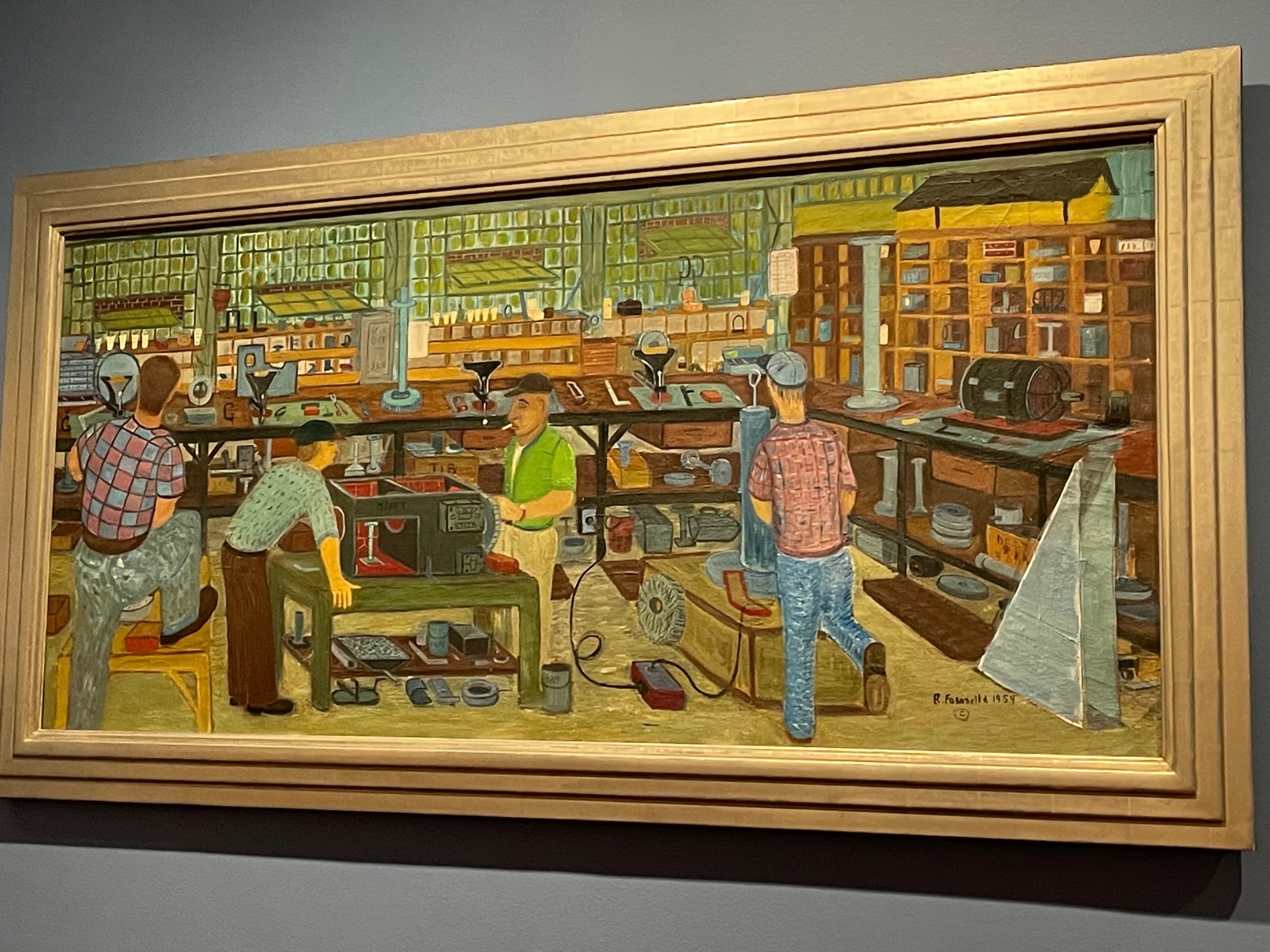
That was "Ralph Fasanella: Americans Unseen". This proved fortuitous. Ralph Fasanella (1914-1997) was born in the Bronx to Italian Immigrant parents. As a boy he helped his father on his ice route. He later worked at various jobs, became a union organizer, and prominent in leftist causes. Martha was already aware of him because of her previous work at the NYU Tamiment Library & Wagner Labor Archives. He was a self taught artist who didn't start painting until 1945, when he was over thirty. His early works were typically scenes of workers in their workplaces, like "Bench Workers (Morey Machine Shop)" (1954) above, in which Fasanella himself is the worker on the right, or crowded outdoor urban scenes, often depicting events like strikes or May Day celebrations.
The Fasanella exhibition at the Fenimore, according to the website text,
"explores Fasanella's portrait-making as a vital tool for staying connected with people in an intimate, emotional, personal way, in order to give meaning to their collective actions in society at large."
"Zingarella" (1973) above is, according to the explanatory text accompanying the painting, "an Italian word for a lively and vivacious woman." It is "loosely based on a friend, Virginia Simon, who encouraged Fasanella to draw in the mid 1940s."
"Marc's World" (1973) "depicts the artist's son, Marcantonio Fasanella, posed as a confident -- and a little cocky -- young man." Note the figure of a striptease dancer in the background, and the magazine on the floor. Marc Fasanella went on to get a PhD in Art and Art Education from New York University and now does consulting work on environmental design through Ecological Design Partners. According to his website linked above, he
"has also written and lectured about his father, a self-taught social realist painter, and wrote the monograph Ralph Fasanella: Images of Optimism which was published by Pomegranate Press in 2017."
Leaving the Fasanella exhibition, I made another fortuitous discovery. On the hallway wall outside was an exhibit concerning The Florida Highwaymen, twenty six Black artists who, according to the explanatory material, "from the early 1950s through the 1980s . . . used vivid and bright colors to capture the beauty of the untouched Florida landscape." The Highwaymen "were self taught and painted on basic material like Upson board, a material made of compressed wood fiber, and used crown molding for frames."
Two Florida Highwaymen paintings were displayed. Both were untitled. The one on the left is by Mary Ann Carroll (1940-2019), the only woman member of the Highwaymen. "The painting depicts a singular palm tree surrounded by lush greenery and the inviting blue waters of the ocean." The one on the right is by Tracy Newton, considered a second generation Highwayman as he is a nephew of Harold Newton (1934-1994), considered a founding member of the group, and a son of Sam Newton (1948-), also considered one of the original twenty six, but who denies that either he or Harold was ever part of the group. "[Tracy's] landscape, done in the same style as his predecessors, depicts the changeable Floridian weather as a storm rolling in on the Atlantic Ocean."
There will be a second part to this account of our visit to the Fenimore, in which will be some Al Hirschfeld caricatures and some American artists' views of Venice.
"To give" as opposed to "to gift" is still a good and useful verb. Using the past tense "gave" instead of "gifted" saves space, and avoids confusion with an adjective meaning "having great natural ability: talented" (Merriam-Webster). I know I've lost this battle; I'll never forgive you, Jerry Seinfeld.
Apostrophes belong in possessives and contractions; not in plurals. You're going to a show with the Smiths, not the Smith's. Some exceptions: (1)"its" as a possessive doesn't take an apostrophe, to avoid confusion with "it's" as a contraction of "it is"; (2) hers, his, ours, theirs, and yours don't take apostrophes. Mostly it's the misuse of apostrophes in plurals that annoys me.
If you drop something on the sidewalk and don't pick it up, you lose it. If you deliberately let something go, you loose it.
Tampa is a city; Tampa Bay is a body of water. If you say "I'm going to Tampa Bay" I'll advise you to pack your SCUBA gear (unless you're a pro baseball, football, or hockey player).
The worlds of jazz, country, and rock music have lost many great performers this year -- in chronological order I've noted here the deaths of Al Jarreau, Chuck Berry, J. Geils, Gregg Allman, and Glen Campbell -- but I've yet to see an outpouring of grief on Facebook as tsunami-like as that following the death yesterday of Tom Petty. This, I think, is testimony to Petty's musical charisma as well as his adaptability over many years, not to changing fashions in rock but to new styles he created. It's also, sadly, testimony to his death at the age of 66, when he was still near the peak of his game.
I first heard him sometime in the late 1970s on WNEW-FM, the then AOR station that ended and began most of my days. I'm pretty sure the first song of his I heard -- at least the first I remember -- was "Listen to Her Heart":
I love the song for its triumphantly defiant lyrics and for its Byrds-like jangling guitars. The clip above is from a concert in Tom's home town, Gainesville, Florida, in 2006. Despite the passage of almost thirty years and some band personnel changes, the song is done just as it was recorded.
Tom had a long and fruitful musical association with Stevie Nicks, as exemplified by the clip below, from the same 2006 tour, of them doing "Stop Dragging My Heart Around":
I remember reading, years ago, that when Stevie met Tom's then wife Jane and asked her how they had met, Jane said, "I met Tom at the age of seventeen." Stevie mistook Jane's North Florida Cracker rendition of "age" for "edge," and it inspired this song:
This weekend we remember the men and women whose lives were lost in defense of our nation and its allies. Among these have been many merchant mariners, whose service was essential in delivering ammunition, fuel, equipment, food, and medical supplies to our troops, and those of our allies, fighting overseas. It is estimated that, in World War II, as many as 9,300 died at sea or later succumbed to wounds inflicted when their ships were attacked by enemy submarines or aircraft, or struck mines.
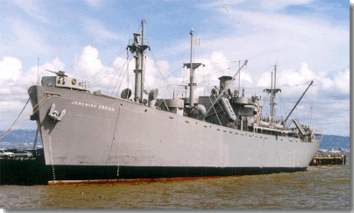
American Victory (photo above) is one of the few surviving "emergency" cargo ships from World War II. She has been preserved in my old home city, Tampa, by the American Victory Ship Mariners Memorial Museum. Her dock is at 705 Channelside Drive, near the Florida Aquarium. I visited her there several years ago. Paul Schiffman, a retired Merchant Marine master who tended bar at the Lion's Head, for many years my favorite Greenwich Village saloon, served as a mate on her maiden voyage in 1945, delivering supplies to U.S. forces in the Pacific. At a memorial gathering for Paul, who died in 2011, I learned that Mike Wholey, another Lion's Head regular, had served as a mate on American Victory's last voyage in service, delivering supplies to our troops in Vietnam.
In 1988, pursuant to a court order, merchant mariners who served during World War II were granted veteran status, allowing them to receive discharge papers and medical benefits.
In July of 1954, my father, mother, and I boarded the USNS Geiger at Southampton for our return voyage to the U.S. following Dad's three year tour of duty in England. Geiger was one of three--her sisters were Barrett and Upshur--passenger and cargo liners that had been under construction during the early 1950s for American President Lines but, because of the Korean War, had been taken for military service (they were heavily subsidized by the government, which allowed this option). As we boarded Geiger I saw a sleek new cargo ship docked astern of us, also in Military Sea Transport Service livery, with the name Cracker State Mariner. We departed Southampton that afternoon, with Cracker State Mariner still at dock. After a smooth summer crossing, we arrived several days later at the MSTS terminal on Staten Island. As we pulled into our dock, I could see, already docked at the next pier, Cracker State Mariner, which had outpaced Geiger, a new ship herself, across the Atlantic.
The photo above shows Cracker State Mariner after she left government service in 1956 and became part of the American President Lines fleet, renamed President Coolidge, She remained with APL until 1974, when she became Export Defender of American Export Lines. Four years later she reverted to government ownership and to her original name. As breakbulk freighters were quickly going out of style at that time, I suspect she went out of service and was laid up in the government's reserve fleet. In 1992, having survived a respectable 38 years, she went for scrap in India.
Sometime in the mid 1970s I was taking a mid-day stroll around Battery Park, at the southern tip of Manhattan, and saw the Thomas Jefferson, of the Waterman Steamship Corporation, heading outward through the channel between Manhattan and Governors Island. I didn't know it, but this was to be my last view of a Mariner class ship. She was originally Golden Mariner, completed, like Cracker State Mariner, in 1954, but on the opposite coast. Golden Mariner named for California, the Golden State, was built at Bethlehem's San Francisco yard; Cracker State Mariner at Newport News Shipbuilding in Virginia. In 1955 Golden Mariner became part of the Pacific Far East Line fleet, and in 1961 she was renamed California Bear. She was acquired by Waterman and became Thomas Jefferson in 1973, not long before I saw her. She was broken up at Kaohsiung, Republic of China, in 1980.
No doubt I'll get some disagreement with my calling the Mariners the handsomest of cargo ships. There are many rivals, American and foreign. My nominee for runner up in that category is the Victories, the war emergency class that preceded the Mariners and succeeded the "ugly duckling" but much loved Liberties. I've written before about American Victory, one of three surviving members of that class, that is now a floating, and sometimes mobile, museum in my old home city, Tampa.
Photo of President Coolidge ex Cracker State Mariner: Photographer / Collection: Bar, Marius / Boman, J. Robert – Source: Sjöhistoriska Museet, Stockholm, Sweden – (Swedish Maritime Museum), via 7seasvessels.com, from which I got historical information about the ship, as well as about Thomas Jefferson ex Golden Mariner.
I first heard of the Derry Down in 1966, when I was friends with some fellow University of South Florida students who were from Winter Haven. It was a nightclub for teens, serving non-alcoholic Daiquiris and the like, and presenting local bands. Early on, this prominently included groups in which th young Gram Parsons was a member. After all, Gram's stepfather owned the place.
Although the Derry Down closed many years ago, somehow the rather unprepossessing building survived. It was recently donated by the real estate company that owned it, 6/10 Corp., to the civic group Main Street Winter Haven, which began the Derry Down Project to restore it as a venue for music. To raise funds for the project, Main Street promoted a Cosmic American Music Festival, which I attended. "Cosmic American" was the term Gram used for his music, a syncretic style that melded influences from country, rock, folk, and blues. Today it's called "Americana" or "roots" or "alt/country."
The festival opened the evening of Friday, September 18 with a concert in the Derry Down. The opening act was the Toni Brown Band (photo above). Ms. Brown has a musical history that includes performances with a "Who's Who" of rock and country acts. She is also a former editor and publisher of Relix magazine.
One of the songs she and her band did that evening was "Rabbit Hole Soul" (clip above). Others included the Grateful Dead's "Friend of the Devil" and Gram's "Sin City," which first was released on the Flying Burrito Brothers' premiere album, The Gilded Palace of Sin
One of several musicians who joined Toni and her band on stage that night was Walter Parks. I noticed he was wearing a Brooklyn Lutherie t-shirt. Later, when I met him and commented about it, he showed me a guitar that had belonged to Richie Havens, for whom Parks had been lead guitarist. It had an abraded surface and other signs of wear, and he said he'd be taking it to Brooklyn Lutherie for repair soon. Also in the photo is sax wizard David Prince.
The night's headliner was Jay Farrar, formerly of Uncle Tupelo, a band that drew on many influences, from punk to Woody Guthrie, Lead Belly, and, yes, Gram Parsons. After the band broke up because of tensions between Farrar and Jeff Tweedy, who went on to found Wilco, Farrar put together Son Volt, which continued in a style similar to that of Uncle Tupelo. Recently, he's been touring accompanied by another Son Volt member, Gary Hunt, whom Farrar described as "a talented multi-instrumentalist."
Was he ever. Here he is playing fiddle,
mandolin,
and steel guitar.
One of the songs Jay and Gary performed was a favorite of mine from Son Volt's album Wide Swing Tremolo, "Driving the View." The clip above is of their performance at STHLM Americana in 2019 (I've added it in 2022 to replace an earlier clip that disappeared from YouTube). Other songs they did included Farrar's "May the Wind Take Your Troubles Away" and a song about Highway 61 that wasn't Dylan's "Highway 61 Revisited." Called back for an encore, they did Dylan's "Rainy Day Women #12 & 35."
The following day, Saturday, September 19, the show moved outdoors during the afternoon.
One of the acts to take the stage that afternoon was The Hummingbirds, a power roots duo consisting of husband and wife S.G. and Rachel Wood, Detroit natives who now live in my old home city, Tampa. (Detroit and Tampa are umbilically connected by Interstate 75.)
Later we went to The Fire Restaurant, where I'd had dinner (oysters and sirloin, both excellent, and at a price that, as a New Yorker, very pleasantly surprised me) the evening before. This time, having had a hefty grouper sandwich from one of the food trucks serving the afternoon outdoor concert, I chose lighter fare: their "Old Skool" burger, It was very good, too.
Finishing my burger, I went to the patio in back where Walter Parks and his band, Walter Parks's Swamp Cabbage, were setting up.
Walter said something like, "We'd never do anything commercial, like playing under a beer sign...oh, wait."
Catch them live in the clip above, doing the Tallahassee Theme to "American Guns." Despite his Southern roots, Walter and the band are based in the New York City area, and gig at local venues. I'll keep my eye out for them.
Returning to the Derry Down Saturday evening for the Festival's final event (well, not quite final; I had an early afternoon flight on Sunday and couldn't make the farewell brunch at Tanner's Lakeside, again featuring I Want Whisky) I was treated to a second performance by The Hummingbirds, this time accompanied by a bass and drums.
Also on the bill that night was a musician who had a closer connection to Gram Parsons than any other in the Festival's line-up: Jon Corneal (photo above; Jon played both guitar and drums during his set). Jon played drums and sang in the International Submarine Band, Gram's first country rock group. He also later played drums with the Flying Burrito Brothers.
Jon gets name-checked by Gram as the singer on their version of "Do You Know How it Feels to be Lonesome" on the ISB's only (but superb) album, Safe at Home.
The last group on the bill was the Hickory Wind Band, sometimes called the Hickory Wind Bluegrass Band. They took their name from what most consider Gram's signature song. Also, they're from Waycross, Georgia, a town in which Gram spent his childhood, and which is the locale for the Bobby Bare song "Miller's Cave," which ISB covered on Safe at Home. Unfortunately, there's no video clip available of the group.
To top off the evening, there was a jam session doing a medley of Gram's songs by various performers, including Toni Brown and Ed Munson, Walter Parks, the Hummingbirds, and members of the Hickory Wind Band.
Thanks to all who put this festival weekend together, including Gene Owen and Anita Strang.
Winter Haven is a small city--population about 36,000--in central Florida. It's a little south and west of Orlando, east of Tampa, and west of Melbourne. It has fifty lakes within or touching its city limits, and is surrounded by citrus groves. One thing it has in common with New York City is a Central Park, with a fountain (photo above).
When I was a student at the University of South Florida I became friends with several fellow students who were from Winter Haven. I visited there on several occasions, and got to like the place very much. I even wrote a paper for one of my political science classes about its city government. (Don't ask me what my conclusions were; I've forgotten.)
From my Winter Haven friends, as I've noted before, I learned about Gram Parsons before he became famous. About two years ago, through social media, I reconnected with one of those friends, Steve Griffith. He told me that there was an effort to restore the Derry Down, the former "teen age night club" established by Gram's stepfather, initially to give Gram and his high school folk group a place to play. I then learned that the group restoring the Derry Down was presenting a "Cosmic American Music [Gram's term for his style, now called "Americana" or "Roots" or "Alt Country"] Festival," and I decided to attend.
I hadn't been to Winter Haven since 1967--48 years. In this post, I'll show some photos of scenes around town, all my photos except where otherwise noted.
One thing you're not likely to find in New York is a cattle egret standing on a car roof in a drugstore parking lot
Another sign I'm not in the North: Spanish moss hanging from a tree.
The shore of Lake Howard, the largest of Winter Haven's lakes, was a block from where I was staying. I spotted this fly fisherman working along its shore. He's standing on a small boat that's hidden by the reeds.
This handsome building is at the corner of Central Avenue and 4th Street NW. Winter Haven is laid out with lettered avenues going east to west and numbered streets going north to south, divided into NE, NW, SE, and SW quadrants; because this pattern is frequently interrupted by lakes, some circumscribed by drives bearing their names, e.g. "Lake Howard Drive," I once described a map of Winter Haven as a Cartesian grid superimposed on a piece of Swiss cheese. The building is called "Time Square," and was given that name by my friend Steve, who, inspired by the clock on its northwest corner, won a contest to name it when he was eleven or so. I don't recall what prize he won. Photo: LoopNet.com
As a bibliophile, I believe you can tell a lot about a city by the quality of its library. The Kathryn L. Smith Memorial Library, done in the Spanish colonial style popular in Florida, looks impressive and capacious. I wish I'd had time to explore inside.
Lily pads near the shore of Lake May.
Another solitary egret perched by the lake shore.
I'll be doing another post soon about the Cosmic American Music Festival and some of the groups and musicians I saw, heard, and met there.
I'm off to the Cosmic American Music Festival in Winter Haven, Florida this weekend. Winter Haven was the home town of the late Gram Parsons who, in my estimation, was one of the most brilliant, and unfortunately one of the most troubled and wasted, pop musicians of the past century.
Gram dropped out of Harvard to form the International Submarine Band, a group that blended country, blues, and rock influences, a style he called "Cosmic American Music," that can be heard today as "Americana" or "alt/country." After one album, Safe At Home, he left to join the Byrds, one of the best American groups of the mid to late Sixties. He was with them for one great album, Sweetheart of the Rodeo, but left after he and Roger McGuinn disagreed about the band's direction. Chris Hillman, one of the original Byrds, left with him to form the Flying Burrito Brothers. After two critically praised albums, he was asked to leave that group because of his increasing alcoholism and drug use.
GP, recorded in 1972, when Gram had developed a close friendship with Keith Richards, was his first solo album. In it, he introduced the voice of a previously little known singer, Emmylou Harris. In the clip above, from that album, he and Emmylou do the country classic of the "cheatin' song" genre, written by Joyce Allsup, "We'll Sweep Out the Ashes in the Morning."
This is for my friends in Tampa, my old home town, although I'm sure you've heard it many times on local radio over the past few days. The Wikipedia entry for the song corrects what had been for me a mondegreen. The second verse begins, "I went down Virginia, seeking shelter from the storm." This made me hear subsequent lines as "Bobby plans a New Deal, wrapped in golden chains." "Bobby" seemed logical, as Robert Kennedy went to the University of Virginia Law School. Now I know it's "Five Year Plans and New Deals," implying what seems to me, though perhaps not to my more radical friends on both the left and right, an unfortunate parallel between FDR's liberalism and Stalin's totalitarianism.
At least my mondegreen wasn't as bad as someone's who heard "The girl with kaleidoscope eyes" in the Beatles' "Lucy in the Sky with Diamonds" as "The girl with colitis goes by." I suppose a helpful thing to say to her would be another mondegreen, this one from Creedence's "Bad Moon Rising": "There's a bathroom on the right."
The news that American Idol will be going the way of all pop culture phenomena after one more season brought to my mind a delightful send-up of the show in its salad days; one that ends with a Simon Cowell look-alike cringing in terror of imminent castration. This is the video of "Because I'm Awesome" by the Dollyrots:
The Dollyrots (not to be confused with the Dolly Dots, a Dutch girl group popular in the '80s), have a style that's been described as "bubblegum punk." The group consists of a husband and wife--Luis Cabezas, who plays guitar, sings, and jumps around a lot, and Kelly Ogden, who plays bass and sings--and whatever drummer they happen to be working with. They've had more drummers than Spinal Tap, though I don't think any of them died in a bizarre gardening accident, choked on someone else's vomit, or underwent spontaneous bodily combustion.
Cabezas and Ogden met when they were students at New College in Sarasota, Florida, at the time a branch campus of my alma mater. They now call L.A. home. They have a daughter, River, who was in utero when they made their album Barefoot and Pregnant. They also do a nice cover of Melanie's 1971 hit "Brand New Key," which I'm including as a bonus, since it also counts as a TBT:
Sometime in 1963 I was with the Robinson High School debate team at a tournament held on the campus of Florida State University in Tallahassee. The evening after we arrived, my teammates and I were in a student cafe, having burgers and cokes. The cafe had a juke box and a small dance floor. A couple looking much like those in the photo, except that the woman was wearing a tartan skirt and black-on-white saddle Oxfords with white bobby socks, got up; the man put a coin in the juke box, and a very lively tune began. The couple did a frenetic jitterbug with lots of twirling and, if I recall correctly, the man lifting the woman by the waist and swinging her around.
.The song was "You Can't Sit Down," a '63 hit for the Dovells, a Philadelphia group whose biggest hit was "The Bristol Stomp" and who recorded on Cameo Records, part of the Cameo-Parkway group that was central to the Philly rock and R&B scene in the late 1950s through the '60s.
Like last week's TBT, this is a memory from my law school years; this one from the spring of 1968, when I was a first year law student and, as a transplant from Florida to Massachusetts, experiencing my first real spring since I was a child. I had spring fever bad, which wasn't helping me concentrate on my studies. Many nights I stayed up late, trying to catch up on assignments and prepare for exams, and would always have WBCN, Boston's first "underground" FM rock station, playing.
Probably because of my emotional state at the time, music I heard often got engraved on my memory. One night the DJ announced what he said was an example of "Southern white soul," a song called "Georgia Pines" by a group I'd never heard of called the Candymen. He also mentioned that the singer's name was Rodney Justo. The video clip below shows the Candymen performing "Georgia Pines" at Greenwich Village's famous, and still extant, music venue The Bitter End in 1967:
Despite "Candymen" and "Rodney Justo" sticking in my memory, I didn't follow them at the time. WBCN didn't play the song again, at least not when I was listening, and no Candymen albums showed up in the record bins at the Harvard Coop. My principal musical interests at the time were the harder edged British Invasion groups--the Stones, the Who, the Yardbirds--along with Dylan and the country-tinged rock of the Byrds and Buffalo Springfield. From the last two I developed passions for, respectively, the "Cosmic American Music" of Gram Parsons and the protean Neil Young.
A few years ago I became Facebook friends with someone I had known in Tampa during my youth, and saw that one of that person's other friends was a "Rodney Justo." "Could it be?" I thought. I went to Rodney's Facebook page and--sho' nuff! It turned out we had both lived in Tampa and went to rival, though not arch-rival, high schools (I to Robinson; he to Chamberlain). Although I had never met him. I sent a friend request, which he graciously accepted. I learned that, before the Candymen, he had led a group called Rodney and the Mystics, which triggered a vague memory, as I'd probably heard of them during my Tampa years (they shouldn't be confused with the Mystics who had the 1959 hit "Hushabye; those Mystics came from what is now my adopted home, Brooklyn). What I didn't know was that Rodney and the Mystics became the go-to backup band for many established rock stars. Roy Orbison asked Justo to join his backup group, called the Candymen as a reference to Orbison's song "Candy Man". Although their principal commitment was to Orbison, the Candymen also recorded and performed on their own; witness "Georgia Pines."
After the Candymen, Justo became a founding member of Atlanta Rhythm Section; the photo at the top of this post is of him while he was with ARS. The video clip below is of a reunited ARS performing "Doraville" live sometime in the not-too-distant past; Justo is the lead singer.
Some years ago Justo left the full time music world and took a job with a beverage distributor because he decided it was more important to be a successful father than a successful musician. Nevertheless, he still does gigs with Coo Coo Ca Choo, a '60s-'70s revival band, in the Tampa area.
On my way to the American Victory Museum I saw one of Tampa's streetcars (photo above). I was going on foot from the Riverwalk across town to where American Victory is docked, on a hot, humid August afternoon. When I passed one of the streetcar stops on Channelside Drive, not far from American Victory, I saw a map showing that the route, which used to run only between the Convention Center and Ybor City, had since been extended to the southern edge of downtown, a few blocks from where my car was parked. The map below shows the streetcar route in red.
After touring the ship, I headed for the streetcar stop I had passed earlier and, after a few minutes' wait, boarded a car headed for downtown.
This is the view looking forward, through the motorman's cab. The car was air conditioned and the seat comfortable.
This is the view looking to the rear. There were few passengers on this run, in the early afternoon on a weekday. The system began operation in October of 2002, and quickly exceeded ridership expectations. Nevertheless, in 2006 the possibility was raised of the local transit agency, HART, not renewing its contract to operate the system. The reason given was that few local people, as opposed to tourists, used it. Extension of the system to downtown evidently has relieved this problem.
Here's a view of the streetcar taken just after I got off in downtown. Most of the system's cars are replicas of classic Birney streetcars that were used in Tampa from 1920 to 1946. The replicas are made by Gomaco Trolley Company of Ida Grove, Iowa. The Tampa fleet now includes a restored Birney that was used on the city's old system, as well as a replica of an open air "breezer" car.
If you aren't familiar with Tampa, you might think this photo was taken somewhere in the Middle East or North Africa. It's the main building of the University of Tampa, situated near the west bank of the Hillsborough River, across from downtown. I took the photo from The Tampa Riverwalk, which follows the river's east bank. The building was originally the Tampa Bay Hotel, designed by the architect J.A. Wood and completed in 1891 for the railroad and steamship magnate Henry B. Plant, who had completed a railroad connecting Tampa to points north and established Port Tampa as a terminal for steamships sailing to Havana, Jamaica, New Orleans, and other destinations. In 1898 the hotel became the headquarters for the U.S. military campaign to liberate Cuba during the Spanish-American War, and Colonel Theodore Roosevelt stayed there before embarking with his Rough Riders at Port Tampa for their voyage to Cuba. The building is now a National Historic Landmark.
Going along the Riverwalk, I found this bust of Plant, with his hotel in the background. Plant was responsible for making Tampa, which before the 1890s was a small town, into a major transportation hub and tourist destination. He died in 1899, and his heirs sold the hotel and surrounding grounds to the City of Tampa in 1905. The hotel continued to operate until the depths of the Great Depression, when the City leased it to the University for 100 years, at an annual rental of one dollar. It now contains classrooms and administrative offices, and a portion of it houses the Henry B. Plant Museum.
A little past the bust of Plant, I came to another, this of a woman. The plaque beneath read:
Kate Victoria Jackson
1857-1940
An environmentalist before that word was coined, Kate Jackson made many contributions to Tampa. At a time when women could not vote, she led the lobbying for essential public services.
Parks and playgrounds were her biggest achievement, and the Tampa Civic Association, which she founded in 1910, was a major factor in creating the city's first water and sewage system. This sanitation was key to preventing yellow fever epidemics that had plagued the area.
She was born in Tampa to Irish immigrants who had arrived in 1847. Because Tampa had no good schools at the time, she was educated in a Key West Catholic institution; this led her to recruit the nuns who built the Academy of the Holy Names in the 1870's. An astute businesswoman, she also was a generous philanthropist. Jackson's influence was statewide, especially via the General Federation of Women's Clubs, which was the first organization to preserve the Florida Everglades.
Although I spent my youth in Tampa, I had never heard of Kate Jackson. Her contributions to the city's history, though, rivaled those of H.B. Plant.
American Victory is one of three surviving examples of the "victory" class of cargo ships built near the end of World War Two to serve in the Allied war effort. They succeeded the liberty ships, of which 2,710 were built in the early war years; certainly the greatest feat of ship mass production in history. While the liberties were, as FDR called them, "ugly ducklings," the victories were, in my opinion, among the handsomest of twentieth century freighters.
I've known two men who served on American Victory. One was Paul Schiffman, whom I knew over the course of many years when he served as afternoon and early evening bartender at the Lion's Head. Paul was a mate on her maiden voyage in 1945, when American Victory was used to ship cargo to American forces in the Pacific. The other is Mike Wholey, whom I met at a memorial gathering for Paul, and who served as a mate on her final voyage in cargo service, delivering supplies to American forces in Vietnam in 1969.
After that final voyage in 1969, American Victory was mothballed and put into the reserve fleet. She was kept at anchor in Virginia's James River. In the late 1990s she was due to go for scrap, but in 1999 she was acquired by a private company, The Victory Ship, Inc., and brought to Tampa. She is docked there, at a former commercial dock adjacent to the Florida Aquarium, where she serves as the American Victory Mariners Memorial and Museum Ship. She has been maintained in seaworthy condition, and makes occasional short cruises. She is listed in the National Register of Historic Places. As I approached her from the stern, I saw a laughing gull perched on her rudder.
View of the ship's bridge and funnel from the main deck.
Seen from the main deck, the tug Brendan J. Bouchard and a barge were docked across the channel.
One of American Victory's antiaircraft guns, seen from near the stern, looking forward.
The ship's bridge. Note the wheel at right, the compass and radar screen housings, and the engine room telegraph with the dial face, used to send instructions to the ship's engineers below.
Outside on the bridge.
The galley.
Seamen's stateroom.
Looking down to the engine room, from a catwalk.
Looking aft from American Victory's stern, a cargo ship is docked further up the channel. Beyond, the tug Sea Eagle is in drydock.
American Victory is one of several victory ships that were named for American colleges and universities. She is named for American University, in Washington, D.C., in recognition of that institution's contributions to the war effort.