Thursday, May 22, 2014

The Monuments on Battle Hill, Green-Wood Cemetery, Brooklyn

Last week my wife and I, along with a friend, took a tour of some of the more impressive mausoleums in Brooklyn's Green-Wood Cemetery. Following the guided tour, about which I'll be blogging more in the near future, the three of us went to Battle Hill, the highest point in the cemetery grounds (indeed, the highest natural point in Brooklyn). It was the site of an important engagement in the Battle of Brooklyn (sometimes called the Battle of Long Island, as the area in which the fighting took place was not yet part of Brooklyn). The battle was the first engagement of George Washington's Continental Army against the British Army, and was a defeat for the Americans. It could have spelled the end for the young Revolution, but for some heroic rear guard actions, including that at Battle Hill, and a stroke of luck, in the form of bad weather, that allowed what remained of Washington's forces to retreat from what is now my neighborhood to Manhattan, then to New Jersey, then to Valley Forge, Pennsylvania, where they endured a harsh winter before re-crossing the Delaware and enjoying their first victories at Trenton and Princeton.

The monument in the photo above is topped by a statue of Minerva,"the Roman goddess of battle and protector of civilization." She faces toward, and waves to, the Statue of Liberty, which can be seen from Battle Hill. On the face of the base below the statue are the words, "Altar to Liberty." The mausoleum behind belongs to the family of Charles Higgins, the ink manufacturer who funded the monument.


There is also a Civil War monument (photo above) on Battle Hill.

The plaque on this face of the monument has the words:
Ever remember how much of National Prosperity is due to the brave exertions of the Soldiers who died in the service of their Country.

Tuesday, May 20, 2014

Planxty: "Raggle Taggle Gypsy/Tabhair dom do lámh"

This is great stuff. I've loved Planxty (about whom I've posted before) since I got a copy of The Planxty Collection at a little shop, no doubt long gone, somewhere on Bleecker Street between Sixth Avenue and Christopher Street, in the late 1970s. I especially like this medley of two songs.

"Raggle Taggle Gypsy" is one of a myriad of variations on the same song found throughout England, Ireland, Scotland, and the former British colonies. I also have a version, with the title "Black Jack Davy", by Scotland's Incredible String Band. Another, "Black Jack David", was recorded by Warren Smith, a rockabilly pioneer who was briefly more popular than Elvis. In his book Country: The Twisted Roots of Rock 'n' Roll, my erstwhile Bells of Hell and Lion's Head companion and friend Nick Tosches tells of an interview with Smith in which Nick asked him where he got "Black Jack David." Smith's reply was, "I wrote it." Nick's next paragraph:
Cut to Athens, fourth century B.C. In his Symposium, Plato refers to an attempt made by Orpheus, mythical poet and son of Oegrus the harper and Muse Calliope, to rescue his wife from the land of the dead. This is the earliest known mention of Orpheus's wife, Eurydice, and of his adventure in the lower world. It's also the beginning of "Black Jack David."
Nick then traces the Greek Orpheus legend* through various developments by the Roman writers Vergil, Ovid, and Boethius. Nick writes, "It was King Alfred's ninth-century translation of Boethius that ushered the Orpheus myth into medieval Britain." After this, Nick follows its development into poems and ballads in various parts of the British Isles. He notes a syncretic development in Ireland, where the story melds with pre-existing Celtic legends. Such are the roots of the many songs about the abduction and failed attempt to recover a nobleman's wife, or sometimes daughter, that include "Back Jack David" and "The Raggle Taggle Gypsy."

From "The Raggle Taggle Gypsy" Planxty segues into Tabhair dom do lámh, an instrumental featuring Liam O'Flynn (photo at left) on uilleann pipes. This enchanting tune is credited by Bunting in Ancient Music of Ireland to Ruairí Dall Ó Catháin, a chieftain from County Tyrone whose reputation for skill as a harper and composer may be second only to that of the great Turlough O'Carolan. The story behind Tabhair dom do lámh, as told in Ask About Ireland, is that Catháin was traveling in Scotland when a noblewoman, Lady Eglinton**, thinking him to be a simple itinerant musician, demanded that he play a tune. Angered by her effrontery, Catháin refused. When Lady Eglinton learned of his high status, she apologized, and he composed Tabhair dom do lámh for her.

My friend Larry Kirwan's band Black 47 gives the translation of Tabhair dom do lámh as either "Give me your hand" or "Let's be friends." Another source, Donal O'Sullivan, in his Carolan: The Life, Times, and Music of an Irish Harper, quoted by "Sarah" in the comment thread under a post about the tune in The Session, in turn quotes Arthur O'Neill as claiming Catháin's original title for it was the Latinized Da mihi manum, which also translates as "Give me your hand." The tune was later used for an Irish rebel song, "White, Orange and Green" (the colors of the Irish flag) which you can hear by Spailpin here. Later, the Wolfe Tones performed it as "Give Me Your Hand," with lyrics that seem both a simple love song and a plea for reconciliation between the sectarian factions in Northern Ireland; hear it here.

In the first comment in the thread below The Session post, "Zina Lee" includes this:
I've read the following regarding this tune: Note that the tune is pentatonic until the final phrase. The mixolydian seventh appears four measures from the end, while the fourth does not appear until the final measure.
Maybe this explains why, when I asked the uilleann piper who played at our wedding if he could play Tabhair dom do lámh, he politely declined, saying it was too difficult.

The musicians in the video above, other than Liam O'Flynn on the pipes, are: Christy Moore on guitar and vocal; Andy Irvine on tenor mandola (I was introduced to Andy by my date following his solo performance at the old Eagle Tavern on West 14th Street in 1989, and later learned that my future wife and her date were there the same evening); and Dónal Lunny on Irish bouzouki (as the linked Wiki tells, Lunny owned the first bouzouki specifically made for use in Irish music; he later became a member of The Bothy Band).
__________

*The Orpheus legend bears an interesting resemblance to the Biblical story of Lot and his wife. In the Orpheus tale, the hero is told that he may lead his wife back to the land of the living so long as, on the way, he does not turn to look at her. He does, and she disappears. In the Bible story, Lot and his wife are allowed to escape the destruction of Sodom on the condition that they not look back toward the doomed city. She does, and is turned to a pillar of salt (Genesis 19:26).

**The linked source spells her name "Eglington"; others spell it "Eglinton," which I think is correct. There is an Eglinton Castle in North Ayrshire.

Monday, May 19, 2014

Farewell to the old Tampa home.

Last weekend we made a brief visit to Tampa, staying with friends across the street from the house that had been my parents' and my home for many years (photo above). Note the English sunrise on the door. That isn't the original door. When my parents bought the house in 1957, it had jalousie windows, as did the door. They replaced the windows and door when they had central air conditioning and heat installed in the 1970s.
White ibises were feeding in the back yard next door.
This boldly marked crab spider had spun a cobweb near the carport.
We visited some other friends who live in a high rise building on Harbour Island. This is the view looking toward downtown Tampa from their terrace.
While we were there, several horn blasts alerted us to the departure of Carnival Paradise from the nearby cruise ship terminal. In this photo, the ship appears to be headed toward our friends' apartment as it turns to head out the channel to Tampa Bay. At the left of the photo you can see the funnel and masts of the World War II vintage cargo ship American Victory, on which my late friend Paul Schiffman served as an officer on its maiden voyage. The ship is preserved as a museum and docked near the Florida Aquarium, a favorite place for both my daughter and me.
Crossing our hosts' lawn, I saw something scurrying. I looked down, and saw this anole lizard clinging to the side of a plank.
Our return flight was delayed because of runway maintenance at New York's JFK Airport. While we waited, I took this photo of our plane sitting at the gate, with the towers of downtown Tampa beyond.
We took off heading southward; the setting sun appeared as a crescent through the clouds. Below is Old Tampa Bay and the Courtney Campbell Causeway.
After we turned northward, the moon could be seen in a brilliant sky.

Friday, May 09, 2014

It's May, and I may post again soon.


Like Anglocat, I've found May, so far, to be a slow month for posting on my blog. My difficulties haven't been caused, like his, by the imminent publication of a novel (I wish!) but rather by press of family business as well as by my duties to Brooklyn Heights Blog. I'm taking from him the YouTube clip above, of Vanessa Redgrave from the 1967 movie version of Camelot, as a way of amusing, and perhaps inspiring, you in the meantime. I will be back soon; like Mr. Dylan in "Maggie's Farm", "I have a head full of ideas that are driving me insane."

Thursday, May 01, 2014

Coney Island Brewing Company's "Tunnel of Love Watermelon Wheat"

IN WATERMELON SUGAR the deeds were done and done again as my life is done in watermelon sugar. Richard Brautigan, In Watermelon Sugar
The Tunnel of Love might amuse you....
Richard Thompson, "Wall of Death"
I wasn't sure what to expect when I was invited to a tasting of Coney Island Brewing Company's summer seasonal brew, "Tunnel of Love Watermelon Wheat." You can see it, freshly drawn, in the photo above, sitting on the bar of The Brazen Fox, where the event was held. Before I tasted it, I had Richard Brautigan's words in mind, and feared I might be getting something akin to alcoholic Hawaiian Punch. I took a sniff--hop aroma prevailed, but with a little hint of fruit--then a swig. Like Richard Thompson said I might be, I was amused. Even pleased. This was beer, not melon juice, though the melon flavor was there, working well with the cascade and citra hops, and with the two row barley malt, malted and unmalted wheat, and dark crystal malt. It's not something I'd make my everyday beer, but I'd be glad to take it to our roof deck or to a beach on a summer afternoon with some chips and salsa. At 4.8 percent ABV, you can have more than one without fear.
On the way in we were greeted by Sarina Appel, who encouraged me to try Mermaid Pilsner and Seas the Day IPL, both of which I'd previously tasted from bottles (see here and here), on draught. I did, and didn't taste any major difference from my earlier impressions, other than that the Pilsner seemed a bit more assertively hoppy, and the India Pale Lager perhaps a bit less so, than I remembered.
My wife and I had a delightful and informative conversation with Coney Island's brewmaster, Jon Carpenter. Actually, my wife got the conversation going, asking Jon about the varieties of yeast used in brewing. Jon is a native Californian and a graduate of U.C. Davis. He has previously worked for L.A.'s Golden Road and for Dogfish Head in Delaware, makers of 90 Minute Imperial IPA (I've yet to try their 120 Minute, but must soon; stay tuned). I also had the opportunity to meet Alan Newman, head of Alchemy & Science, Boston Brewing Company's "craft beer incubator," which now owns Coney Island Brewing. Alan told me a picaresque tale of how he and Steve Hindy, President and co-founder of the Brooklyn Brewery (see my reviews of their brews here and here and here) were at a convention in Las Vegas when the 9/11 attacks occurred and, because all air transport was grounded, bought or rented (I can't recall which) a van and returned by highway to the East Coast.

Sunday, April 27, 2014

Holocaust Remembrance Day

As my friend The Rev. Nicholas Temple reminds me, the 24 hours that began at sundown today (Sunday, April 27) and end at sundown tomorrow constitute Yom HaShoah (יום השואה), or Holocaust Remembrance Day.

The image above is of identification papers issued by the occupying German forces to Jewish residents of Krakow (or Krakau, in German spelling), Poland. All of these people may be presumed to have died in the Holocaust. The image is from an article posted on January 27, 2012 in The Northerner Blog of The Guardian. January 27, the date of the liberation of Auschwitz-Birkenau, largest of the Nazi extermination camps, is recognized as International Holocaust Remembrance Day or Holocaust Memorial Day, in many countries.

The Guardian story is about remembrance of the Holocaust in the City of York, England, which itself, in medieval times, was the site of a massacre, reminiscent of Masada.

Nick's post, linked in the first paragraph, includes a list of mass killings subsequent to the Holocaust. Even on a smaller scale, but just as heinous, murder based on ethnic or religious prejudice continues today.

Saturday, April 19, 2014

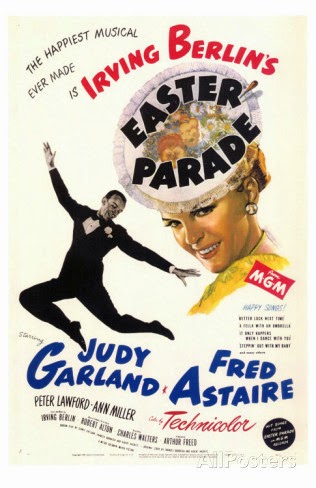
"In Your Easter Bonnet," Judy Garland and Fred Astaire

I never saw the movie Easter Parade, which was made two years after I was born, but I've always imagined this Irving Berlin song being sung by a man to a woman. The original version was the reverse, it's Judy singing to Fred about his top hat with a fancy pink ribbon for the band.

"On the Avenue, Fifth Avenue, the photographers will snap us, and you'll find that you're in the rotogravure." So, what is "the rotogravure"? It's a process developed in the nineteenth century that allowed newspapers to print color photographs and artwork on cheap newsprint paper, using rotary cylinders.

Fred Astaire intended to retire before Easter Parade was made, but agreed to take the male lead when Gene Kelly became unavailable.


Sunday, April 13, 2014

Mega-yacht Topaz arrives in New York

On my morning walk I spotted this enormous yacht sailing from New York Harbor into the Hudson River. I guessed it must belong to some Russian oligarch, since a couple of other such yachts--see here and here--have recently arrived here. Searching the net, I was able to determine that this yacht is Topaz, which arrived here today from Algeciras, Spain. Topaz, which is one of the world's largest yachts, is of mysterious ownership, although the owner, as reported here, may be His Highness Sheikh Mansour bin Zayed bin Zayed Al Nahyan, Deputy Prime Minister of the United Arab Emirates.

Saturday, April 12, 2014

"All Glory, Laud and Honor."

The traditional opening anthem for Palm Sunday services, as performed at King's College, Cambridge, last year. The tune is "St. Theodulph" by Melchior Teschner (1584-1635), arranged by William Henry Monk (1823-1889). The words are by St. Theodulph (Theodulph of Orleans) (ca. 750-821) himself, translated by John Mason Neale (1818-1866).

This rendition is more stately than those to which I'm accustomed; I like it.

Tuesday, April 08, 2014

Bluegrass hot, cool, and dreamy


I first knew of Tony Trischka as part of Country Cooking, whose album 14 Bluegrass Instrumentals I acquired some thirty years or so ago. (I now have its CD successor, 26 Bluegrass Instrumentals.) Above is Tony, backing up Tashina Clarridge, a brilliant young fiddler from Northern California (note her appreciative laughs when Tony does some fancy picking at 3:08 and 3:14), doing "Sally Goodin" at the 2011 Joe Val Bluegrass Festival in Framingham, Massachusetts.


Guitar on "Sally Goodin" is by Michael Daves, who is in his eighth year of residency at our local Rockwood Music Hall. In the video above he does "Mule Skinner Blues" at the Rockwood in December of 2010.


The bassist is Skip Ward. On "Sally Goodin" he plays acoustic bass. In the above clip of "Clean" by the Darren Lyons Group, he plays electric bass in a fusion piece, performed at B.B. King's Blues Club in 2011.

When I first heard Béla Fleck play banjo, I thought his style a bit weird. As I listened to him more, I became awed by his ability to syncretize bluegrass, jazz, and classical elements in his music. The clip above is of Bela doing "Big Country" along with Chris Thile on mandolin.


Brittany Haas is best known as a superb fiddler. In the video above she is in duet with Lauren Rioux doing a medley of "Grey Owl" and "Red, White, Blue and Gold"; on the latter she shows her talent on the banjo and, along with Lauren, as a vocalist.

Monday, April 07, 2014

Karen Shaw proves Mies and Browning right ...

...at least in fifteen out of nineteen languages.

Ms Shaw's (photo above) art is based on a simple premise that yields a plenitude of results. The premise is: assign to each letter of the Roman alphabet its ordinal number, A=1 through Z=26. For any word, sum up the numbers of the letters. Find other words having letters that yield the same sum. This can lead to interesting relationships that may be used as the basis for a work of art. For example:
The number 53 corresponds to O'Keeffe and to F Kahlo, artists associated with New Mexico and Mexico, respectively. It also is the sum of the word "sum," as well as of "emerge" and of the Spanish unidad ("unity").
Similarly, 77 yields print, Hogarth, Warhol, parallel, and character: something for aspiring art historians to contemplate.
The centerpiece of Ms Shaw's exhibit, "The Summantics of Art," was her demonstration that the statement "Less is more," which I have always associated with Ludwig Mies van der Rohe, one of the preeminent architects of the past century and designer of the Seagram Building, but which statement Ms Shaw noted was earlier used by the English romantic poet Robert Browning in Andrea del Sarto, is true in fifteen languages using the Roman alphabet. In each of these languages, including English, the sum of the numbers corresponding to the letters in the word meaning "less" is greater than that of the numbers corresponding to the letters in the word meaning "more." Ms Shaw admits this does not hold true for Polish, Serbo-Croatian, Gaelic, or Welsh, and wonders, "What could this mean?"

At the time she developed her numerological system, Ms Shaw wasn't aware of its kinship to the Jewish mystical practice called Gematria, but was delighted to learn of it.

Monday, March 31, 2014

Mets lose opener. Is this a good sign? Probably not.

At the treaty of Kilmainham Parnell threw it all away,
It was the turning point in his career and he turned the wrong way,
And the revolution missed its chance with victory in its sight,
And fell down like a house of cards collapsing overnight.
But not necessarily a bad one, either.

As I watched the top of the ninth in the Mets' opener against the Nationals this afternoon, the words from Andy Irvine's and Patrick Street's "Forgotten Hero" were going through my head as, indeed, Bobby (not Charles Stewart) Parnell failed to get a third strike that would have ended the inning with a Mets 5-4 victory. He then allowed a tying run that segued into a Mets batting drought in the bottom of the ninth, a bullpen fiasco that gave up four runs in the top of the tenth, and a bottom of the tenth partially redeemed by a David Wright homer that also brought in Juan Lagares, whose solo dinger in the eighth had broken a tie, making the final 9-7 instead of 9-5.

No, I don't think Parnell's blown save was "the turning point in his career." At least, I hope not. The TV announcers were talking about his recovery from surgery, saying it wasn't complete, despite Parnell's claims. I did see some encouraging signs. Mets' bats got to Nats ace Strasburg early, and Dillon Gee pitched well in his start. Despite some control problems, fireballer Jeurys Familia, who was tagged with the loss, showed promise as a potential table setter. The Mets were charged with just one defensive error: the passed ball by d'Arnaud that led to the go-ahead run in the tenth.

So, what do the tea leaves say now? The 1969 world champion Mets lost their season opener 11-10 to the Expos, and ended April with a 9-11 record. The 1973 Mets, who won the NL pennant but lost the Series to the A's, won their opener from the Phils 3-0. The world champion 1986 Mets won their opener from the Pirates 4-2. The 2000 NL champion Mets, losers to the Yanks in the Series marked by the Clemens-Piazza bat incident, lost their opener to the Marlins 6-2. No oracle here. But, as someone once said, a loss early in the season counts just as much as one near or at the end.

 Update: you know the old saying, "Cheer up; things could be worse?" I cheered up and, sure enough, they got worse. I'm putting Parnell's elbow on the prayer list.

Monday, March 24, 2014

Ken Radnofsky and Damien Francouer-Krzyzek play the third movement, "Christopher Street," of David Amram's Greenwich Village Portraits.

I've been fortunate to know David Amram since my Bells of Hell and Lion's Head days. Last month he presented a performance of his recent works at Le Poisson Rouge, a performance venue that occupies the space once belonging to Art d'Lugoff's Village Gate. My wife and I attended, along with a good number of other Lion's Head alums. One of the compositions on the program was Greenwich Village Portraits, with three movements dedicated, respectively, to Arthur Miller, Odetta, and Frank McCourt. The last of these, titled "Christopher Street," evokes the memory of the Lion's Head, which was Frank's favorite bar. It was performed by saxophonist Ken Radnofsky and by Damien Francouer-Krzyzek on piano. I made the video above from our table, some distance from the stage, which explains the people walking past and the unfortunate clattering of flatware. Nevertheless, I was pleasantly surprised that the sound came through as well as it did.

The movement begins with a sprightly Irish jig tune, the name of which escapes me (perhaps a reader can help) announced on piano, then developed in variations on sax. At 2:40, the piano announces the second theme, based on "Wild Mountain Thyme (Will Ye Go, Lassie, Go?)," picked up by the sax at 3:50. At 4:59, Radnofsky begins a variation at turns happy and mournful, but at 6:00 this gives way to a lively development that resolves back briefly to "Wild Mountain Thyme" at 7:50 before ending joyously.
 
"Wild Mountain Thyme" was a traditional closing song at the Lion's Head. The video above is of David playing it, and assembled Lion's Head veterans joining in voice, at the Cornelia Street Cafe two years ago.

Addendum: David offers the following news about future events:
They are presenting an evening of my chamber music, performed by members of the New York Philharmonic,  The Metropolitan Opera Orchestra and the Boston Symphony April 29th. Woody Guthrie's daughter , Nora Guthrie will also be there to speak about the   formal release of my new CD THIS LAND: Symphonic Variations on a Song by Woody Guthrie, which I conducted with the Colorado Symphony, based on her father's iconic song, and the evening will be dedicated in memory of Pete Seeger, with whom Amram often collaborated with for the past half century.

The opening event will be April 26th with a screening of Lawrence Kraman's new documentary film "David Amram:The First 80 Years".

following the Q.and A. after the screening, there will be an urban hike through the Upper West Side, where I will revisit many of the places where I have collaborated musically over the last  60 years with a great variety of gifted people

We'll begin our hike by visiting The Lincoln Center itself, where Leonard Bernstein appointed me as the New York Philharmonic's first-ever composer -in-residence, and go the the park outside near the fountains where i did concerts of every variety for years. 

We'll go to the old site where  Birdland once stood, as the final remaining landmark from the golden days of 52nd street, where i played with the jazz greats during the 1950s.

We will see some of the Broadway theaters where I composed incidental music for fifteen dramatic productions

We will walk by  Thelonious Monk's old dwelling (which now is landmarked by the city), where he took me under his wing and mentored me in the early 50s, when i was playing with Charles Mingus at night and studying composition at Manhattan school of /music during the day.

We will take a stroll to the old site where Shakespeare in the Park had their first season, before the Delecourt Theater was built, where Joseph Papp had me as the festival's first composer and musical director for 12 seasons, where i composed  scores for 30+ productions,

We will visit  the Lincoln Center Repertory Theater where i worked with Arthur Miller and Elia Kazan as their first composer for three years, while the building was being completed and many other venues in the neighborhood  where i conducted free out of doors Symphony concerts, played jazz.folk and world music concerts, performed for peace gatherings, political campaigns, jazz/poetry readings and all kinds of events. 

Programs, photographs, articles and videos of all of these endeavors are now documented in my archive which the Lincoln Center Library has acquired.

 I hope these activities and viewing of the archive itself  will be of value to young people who may come to any of the events this April and then check out the archive.

Hopefully it will make them feel that everyone of us can have a great life if we work hard, stay the course, refuse to accept career councilor's advice (which is usually to give up pursuing your path before you are even sure what that path is) and just go out start all over every day with renewed energy, share what blessings we have with others, show respect for every person who crosses our path, try to always do better than is expected and ENJOY life!!

Monday, March 17, 2014

Stout standoff: Guinness vs. Brooklyn Dry Irish

A few weeks ago I noticed Brooklyn Brewery's "Dry Irish Stout" on a shelf at my local supermarket. This piqued my curiosity. "Dry" isn't a word I've associated with stout. I decided to get some and compare it to the stout I, and most people, know best: Guinness. I know there are some of you who, seeing the photo above, are saying, "Why do this at home?" Bottled stout isn't stout as it should be, drawn slowly from a tap. I'll grant you that. My excuse is that I didn't have time to go bar-hopping until I found one that had both kinds on tap. Also, my wife needed some bottled stout to use as a marinade for the corned beef we had with cabbage, potatoes, and carrots for our pre-St. Patrick's supper tonight (see below):
I did the tasting this afternoon. The bottles were kept a little below room temperature until I was ready to pour. Here are the results:

Guinness

Color: very dark brown.

Head: ample and long lasting.

Aroma: malty, with hint of floral.

Taste: black coffee with a hint of caramel; some hop bitterness in the finish.


Brooklyn Dry Irish

Color: dark brown, a slight shade lighter than Guinness.

Head: small, brownish white; collapsed quickly (see photo at top, taken shortly after the Brooklyn stout was poured; the Guinness had been poured earlier). According to the brewery's website, this stout differs from Guinness and other widely marketed Irish stouts in that no nitrogen is added to enhance the head.

Aroma: floral, with a hint of berries.

Taste: initially tart and fruity; no strong coffee or chocolate taste (my wife, trying it without having had Guinness first, said she tasted chocolate; perhaps my palate was skewed by having just tasted Guinness). A pleasant but subdued hop bitterness at the finish.

The verdict: not a real contest, as these are very different beers. I like them both, and they went equally well with our corned beef repast. Brooklyn Brewery also makes a Black Chocolate Stout that might make for a better head to head (as it were) comparison to Guinness.

Beannachtaí na Féile Pádraig oraibh!

Saturday, March 15, 2014

Locks of love on the Brooklyn Bridge.

In my walks across the Brooklyn Bridge and back over the past year or so, I've noticed that couples have been writing their names on padlocks and attaching those locks to the fences beside the pedestrian walkway, as shown in the photo above.

Sometimes, a lock displays a  plea instead of an acknowledgement of existing commitment.

Some messages are too long to put on a padlock, so they get written on the bridge itself.

Addendum: this tradition seems to have started in Paris, where the Pont des Arts has become endangered by the weight of the locks. A reader says it has spread to Germany. Lots of European tourists take the walk across the Brooklyn Bridge, which may explain how it got started here.

Thursday, March 13, 2014

Aaron Copland, Clarinet Concerto, L.A. Philharmonic with Benny Goodman

This morning, I thought I heard a DJ on WQXR say, "Today is the birthday of Aaron Copland." Either he was misinformed, or I misheard, as two sources have told me he was born on November 14. Anyway, since I'm a great Copland fan, I decided to go ahead and post something of his. I found the clip above of a portion of his Clarinet Concerto, performed by the Los Angeles Philharmonic Orchestra, with Copland conducting, and with solo by the greatest jazz clarinetist ever, Benny Goodman. It ends abruptly, but what it gets is good.

Saturday, March 08, 2014

Billy Bragg & Wilco, "She Came Along to Me," lyrics by Woody Guthrie.

Today is International Women's Day, and I'm marking it by posting a video of a song done by a bunch of guys. The lyrics were written by a man, Woody Guthrie, in 1945, and were set to music by English singer-songwriter Billy Bragg along with Jeff Tweedy and the late Jay Bennett of the Chicago based rock band Wilco. This was done as part of a project called Mermaid Avenue, organized by Guthrie's daughter, Nora.

In an interview for the web site DVD Talk, Nora Guthrie described how work on her father's archives had led to finding a trove of lyrics that had not, to anyone's knowledge, ever been set to music.
[T]here were just so many lyrics that I had never heard of and my family hadn't heard of. And don't ask me why they were never recorded, because I can only suppose why. I wasn't there so I don't know the real answer to that one. But anyway, I just started finding these great lyrics and they sounded, I mean just as a piece of written word poetry, I just loved them. And I started tacking them up on my tack board here. I thought "Hmm, someday I want to do something with this stuff." And then cut to the chase, I found Billy Bragg and asked him if he wanted to work on it. He kindly said, "Yes."
The project was called "Mermaid Avenue" because the lyrics were written when Woody Guthrie and his wife lived on Mermaid Avenue in Coney Island, actually a peninsula projecting from, and part of, Brooklyn. (My immediately previous post is about Coney Island Brewing Company's "Mermaid Pilsner.") It resulted in three albums; "She Came Along to Me" is on the first, the cover (with photo of the house where the Guthries lived) of which is shown on the video above.

Coney Island Brewing's Mermaid Pilsner

A couple of weeks ago I tried Coney Island Brewing Company's "Seas the Day" India Pale Lager. Now I've also had their Mermaid Pilsner. It's good beer.

Pilsner (or Pilsener) is a style of lager--a lager being any beer made with bottom fermenting yeast--that originated in the city of Pilsen, or Plzeň, in what is now the Czech Republic. What distinguishes Pilsner from other lagers is that it is made with lighter colored malts, resulting in a golden, as opposed to a deep amber or brown, color. It usually also has a more pronounced hop flavor than other lagers. Most mass market American beers are made in the Pilsner style. Some, like Budweiser, have a forward hop flavor while others, like Coors, have a more subdued one.

For a food pairing I decided on something less spicy than the bánh mì I had with "Seas the Day." I chose a "Smokin' Henry" from our local deli, Lassen & Hennigs. It's made with smoked turkey, Black Forest ham, cheddar, bacon, lettuce, tomato, and Russian dressing. For a bit of spice, I had some of Trader Joe's cheddar and horseradish flavored chips on the side.
While I was waiting for my sandwich to be made, I took a look at Lassen & Hennigs' beer selection, and saw Mermaid Pilsner among their offerings.

The beer has a rich golden color, a shade darker than most American Pilsners, but similar to that of Pilsner Urquell, the original Pilsner from Plzeň. The head was moderate, creamy, and fairly long-lasting. The aroma was hoppy, with slight malt undertones and jasmine-like overtones. The flavor was a well balanced blend of hop bitterness and malt warmth, with a suggestion of spice and a pleasant, melon like finish. The beer worked well with the flavorful food, but would also be enjoyable on its own.

Unlike Czech or German Pilsners, which adhere to a purity law that allows only the use of barley malt, Mermaid Pilsner, like "Seas the Day,"  is made with a combination of malts. There is regular two-row barley malt, the staple of most fine beers, along with Cargill's "EuroPils," also made from two-row barley, but with a distinctive "grassy" flavor. There are also two non-barley malts: rye and wheat. It's the rye that imparts the hint of spiciness.

Mermaid Pilsner takes its name from Mermaid Avenue, one of Coney Island's main thoroughfares, and from the Mermaid Parade, an annual Coney Island event.

This is a well made and thoroughly enjoyable beer, equal to most and better than many imports and American craft-brewed Pilsners.

Monday, February 24, 2014

I'm no great Picasso fan, but I'm glad his threatened curtain at the Seagram Building got a reprieve.

Here [in 21st century New York], art is never spoken of in moral terms, and most aspects of everyday life--food and drink and bathroom fixtures--are mostly spoken of in aesthetic terms.
--Gerald Marzorati, former Editor, The New York Times Magazine

Pablo Picasso never got called an asshole;
Not in New York.

--Jonathan Richman

I have not been a great fan of Picasso. Maybe it's just my contrarian streak reacting to his conventional status as the preeminent painter of the past century. Maybe it's my overexposure to his "Bust of Sylvette", in an enlarged version executed by the Norwegian sculptor Carl Nesjär, that eyed me balefully (see photo above) on my regular Sunday transits of the Silver Towers courtyard going to and from brunch at the Prince Street Bar in SoHo when I was living in Greenwich Village. Mostly, though, it's that I never did get cubism. I can appreciate painters like Mondrian or Pollock (to name two whose styles seem, to me, as different as conceivable), who went the non-representational* whole hog, or like Bonnard who, while taking some liberties with perspective, scale, and other "naturalistic" qualities, produced images that were recognizable as real world objects. Cubism, which purported to portray objects from several perspectives simultaneously, seemed to me an uninformative and unnecessary, even annoying, exercise. I used to feel defensive about this, thinking that my failure to appreciate what Jed Perl, an art critic whose writing I enjoy and whose views I respect, calls an "epochal shattering of Renaissance space"** might be a symptom of some deficiency in my aesthetic sensibilities.

Then I found an ally in my wife, whose art background is considerably more extensive than mine. We were touring the Portland [Maine] Museum of Art and, as I started to move into another gallery, she--not knowing of my opinion--said, "Don't bother; it's all Picasso." Perhaps then my view, though at odds with that prevailing, could be justified on grounds less shaky than de gustibus non est disputandum. 


So, why should I care that the new owner of the Seagram Building wants to remove a nineteen by twenty foot curtain, Le Tricorne (image above), by Picasso, from where it hangs next to a passageway connecting the dining rooms of the Four Seasons restaurant?  For one thing, it isn't cubist. When I first walked past it (I've dined at the Four Seasons a couple of times, on both of which my employer was paying the tab) I thought it might be renaissance art--I wasn't paying much attention. Someone later told me it was a Picasso, which surprised me. Its history, as told by David Segal's New York Times story, is:
“Le Tricorne,” which translates to “the three-cornered hat,” was painted over three weeks in 1919, in a studio in Covent Garden, in London. It was commissioned by Serge Diaghilev, the impresario of the Ballets Russes, a traveling company based in Paris. The Russian scene painter Vladimir Polunin, who helped paint the curtain, wrote that Picasso wore slippers so he could stand on the canvas as he worked. His tools, according to the critic Sacheverell Sitwell, who visited the studio, included a toothbrush.
The Times piece also notes that what hangs at the Four Seasons is not the complete work. When Diaghilev needed to raise money, he had the center section cut out and sold, although the remaining two sections appear to have been joined seamlessly. So, we have a Picasso that was made as a stage prop, in collaboration with another artist, in a style other than the one for which Picasso is best known, and which is incomplete. Terry Teachout, in his Wall Street Journal piece, reports that Aby Rosen, head of  RFR Holding, the company that last year acquired full ownership the Seagram Building, was heard to describe Le Tricorne as a "schmatte" (rag).

RFR says Le Tricorne must be removed because of the condition of the wall on which it hangs, which is leaking steam. The architect Belmont Freeman disputes that assessment, saying there is nothing in the wall that could cause such leakage. Freeman was engaged by the owners of the Four Seasons to supervise its restoration. The restaurant was designed by Philip Johnson, so the Seagram Building as a whole, inside and outside, is a collaboration between two of the greatest architects of the past century. As Paul Goldberger notes in his Vanity Fair article, Johnson left the wall unfinished because "[h]e expected that the Picasso would cover it forever." Goldberger goes on to observe:
If the curtain is removed, it would be an act of destruction to Philip Johnson’s conception of the Four Seasons. “Le Tricorne” is, after all, a de facto part of the architecture, and so it would constitute a major alteration to one of the city’s most admired landmarks. It might also seriously damage the curtain itself, according to conservators hired by the Landmarks Conservancy. Even with the care the conservancy has given to the curtain, it is painted on fabric that is 95 years old, and it is brittle. The conservators say that the best way to protect it is to leave it alone.
Despite being "a de facto part of the architecture," Le Tricorne could not be included in the Seagram Building's landmark designation because, for purposes of such designation, it isn't considered part of the architecture. Nevertheless, its removal, and possible replacement with something else, would change the landmarked building in a recognizable way. The Picasso can be seen from outside the restaurant; in Goldberger's words, "it is part of the experience of anyone entering the building."

Is there something wrong with changing that experience? According to Goldberger, Rosen "reportedly will replace [Le Tricorne] with works he owns, perhaps rotating them as he has done successfully on the ground floor of Lever House across the street, which RFR also owns." I don't doubt there are some people, perhaps a significant number, who would prefer to see works by Damien Hirst or Jeff Koons--two artists that both Goldberger and Teachout mention as favorites of Rosen's--to La Tricorne. I'm not one of them, but that's just me.***

Nevertheless, I think there are valid arguments, other than my preference, for keeping Le Tricorne in place. One compelling reason is the possibility of irreparable damage to the curtain if it is removed. In Daniel Slotnick's Times story about the court order not to remove the Picasso pending further proceedings on March 11, a lawyer for RFR is quoted as making the incredibly crass statement, "If we break it, we buy it."

Moreover, I agree with Goldberger's argument that, despite the technicalities of the landmarks law, the curtain really is part of the architecture that should be protected. I'm not one of those who reflexively opposes change, and I believe there have been instances in which landmarks requirements have been applied in ways that are unnecessarily oppressive to property owners; usually, I think, because of the fear--which I consider in most instances to be excessive--of setting a bad precedent. Nevertheless, I'm troubled by what I see as a lionization of change for change's sake, and of "change agents," in contemporary culture. Yes, sometimes change is necessary. Organizations become sclerotic and need to be shaken up. Providing affordable housing without generating sprawl may necessitate construction of more high rise buildings. But unless occasioned by emergency, including by a manifest injustice, change should be considered carefully before it is implemented. It almost always has downsides as well as upsides, and it may have unintended consequences. In this respect, I suppose, I'm something of a Burkean.

If Le Tricorne goes, it will be the second loss by New York City of something by a major figure in twentieth century art within a year's time. I hope it doesn't happen.
__________

*I prefer "non-representational" to the more frequently used "abstract." All visual art, including photography, "photo-realist" painting, and sculpture is, of necessity, abstract.

**Perl, Jed, "The Abstract Imperfect", The New Republic. November 3, 2011 ( a review of De Kooning: a Retrospectve at the Museum of Modern Art).

***For an account of my naive groping toward a standard of aesthetic judgment, see this post.

Coney Island Brewing's "Seas the Day" India Pale Lager

India Pale Lager? I've long been a fan of India pale ales, or IPAs as they're usually called. I like their intense hop bitterness balanced, in the best of them, by a rich barley malt flavor. I didn't know quite what to expect from this lager offering by Coney Island Brewing Company. "India Pale" made me expect big flavor, so I paired it with a Vietnamese bánh mì from Hanco's, doused with some extra hot sauce.

I poured, and was rewarded with a full, foamy head. The color (photo above) was a golden amber. I took a whiff: the aroma was powerfully hoppy, with some floral notes. My first sip made my taste buds confirm the evidence of my nose. The hops have it! A few bites of the sandwich convinced me it was a good pairing. Still, I thought, while this beer goes well with spicy, flavorful food, is it something I'd want to drink by itself?

After a few minutes, though, the beer started to open up. I began to get some of the "[b]ig citrus and passion fruit aromas" promised on the label and on the brewer's website. The flavor also became more rounded, with fruit overtones softening the hoppy edge. I realized that I should have taken the beer out of the fridge and poured it a few minutes before tasting.

I checked the ingredients on the website. Five kinds of hops are used: Galena, Warrior, and Simcoe, all of which are considered "bittering" hops; Cascade, which is moderately bitter and gives a floral aroma; and Citra, a fairly new variety that has quickly become popular (with some dissenters) and that accounts for the notes of passion fruit. There are four malts: two row barley (commonly used in the best beers and ales), malted wheat, oats, and biscuit malt (I had to look that up). The last three would, I believe, tone down the flavor of the two row barley, and, set against the assertiveness of the hops, explains the beer's lack of any noticeable malt flavor or aroma.

On balance, this is a good beer. It would go very well with spicy food like bánh mì, Hunan or Szechuan cuisine, and the more picante of Mexican dishes. At a moderate 4.8 percent alcohol by volume, it shouldn't get you in trouble too quickly. My preference continues to be for IPAs that balance the hops with malt. Still, I would drink this again, maybe with my next takeout vindaloo curry.

So, what about this Coney Island Brewing Company? Is the beer made on Coney Island? No, it's brewed upstate, in Clifton Park, just south of Saratoga Springs. Coney Island Brewing is owned by Alchemy & Science, a "craft beer incubator" that is , in turn, owned by Boston Brewing Company, makers of the Sam Adams line of brews.

Next on my beer tasting agenda is Coney Island Brewing's Mermaid Pilsner. I'll be reporting on it soon.

Note: I've updated the post to reflect the fact that Coney Island Brewing is now owned by Alchemy & Science.

Friday, February 14, 2014

Frank Zappa, "Don't Eat the Yellow Snow."

Appropriate music for the weather we've been having here on the East Coast, and a dire warning to those who do violence to baby seals. Thanks to Eliot Wagner for the link.

Sunday, February 02, 2014

Photo and iPod log: January 27, 2014.

I've been doing these for a while: see here for my most recent example. What follows is a log I made of what I was listening to and seeing this past Monday on my last walk of my (fortunately) brief period of unemployment. On previous walks that I've logged, I've taken one photo for each piece of music I heard, but I would strive to find something scenic, or at least something that seemed an interesting composition, while the piece was playing. This time, I decided to stick to a strict rule. Whenever a new song started, I would snap a photo. I might allow a very quick look around, especially if I knew something interesting was off to a side. Usually, though, I just shot whatever was in front of me. Nevertheless, I hope you enjoy the photos and the music, to which I've provided links wherever available. As before, with a few exceptions I've let the photos speak for themselves.
Traffic, "John Barleycorn Must Die": a venture by this group into the Fairport Convention/Steeleye Span territory of English folk rock, from the album of the same name. What makes this cut for me is the late Chris Wood's flute. Live performance video here.
Louis Moreau Gottschalk, "Le Bananiere, Opus 5 (Chanson Negre)"; Amiram Rigai, piano: Gottschalk, born in New Orleans in 1829, the son of a Jewish father and a Creole mother, was perhaps the first well known American composer of what we now put under the rubric of "classical" music, although his music, like that of his contemporary Stephen Foster, was considered "pop" in its time. Hear it, as performed by Rollin Wilber, here. (Where there is no suitable video or audio clip by the same artist as on my recording, I'll link to the best performance by another artist I can find.)
The Clash, "Clampdown": from the great album London Calling. Hear it here.
Big Joe Turner, "Honey Hush": Big Joe was one of the artists on the cusp of the transition from jump blues to rhythm 'n' blues and rock 'n' roll. Hear "Honey Hush" here. Raise your hand if you know the origin of "Hi Yo Silver!" If you don't, you're probably younger than me, and there's always Google.
Diana Ross & the Supremes, "Love is Here and Now You're Gone": in 1967 they were simply "The Supremes," Diana, Flo, and Mary. Unlike other Motown acts, they were more popular with white suburban teens than with African American audiences. Still, they made great music. Live performance video here.
The Nightcrawlers, "Little Black Egg": Garage rock from Florida, which I first heard in a friend's dorm room at the University of South Florida. There's a theory that this is about the result of an inter-racial relationship, which would have been controversial in 1966, especially below the Smith & Wesson Line. Whatever it means, it got under my skin, and stays there. Hear it here.
The Kingston Trio, "Tanga Tika and Toreau": the Trio recorded several Polynesian songs, reflecting Bob Shane's having grown up on the Big Island of Hawaii and Dave Guard's having gone to prep school in Honolulu. Hear it here.
A fierce looking dragon guards the entrance to the Eagle Warehouse Building (Frank Freeman, 1894; now apartments). As I reached this spot I heard Renee Rosnes on piano playing "Blues Connotation." I first heard Rosnes at Bradley's, a great--and unfortunately long gone, like its owner, Bradley Cunningham--jazz bistro on University Place between 10th and 11th streets, just a block from where I last lived in the Village before moving to Brooklyn. This version of an Ornette Coleman composition is from Renee's album Art & Soul, on which she's accompanied by Scott Colley on bass and Billy Drummond on drums. Hear a sample here.
Dire Straits, "Walk of Life": "Here comes Johnny...." Live performance video here.
Bob Dylan, "Gospel Plow": this was on an earlier log. As I wrote there: "from his first, eponymous album, a frenetic blues and one of his earlier original compositions." Hear it here.
Danny Kalb, "Nobody Knows You When You're Down and Out": Broooklyn born Danny Kalb was lead guitarist for The Blues Project, one of my favorite bands from the 1960s. Before switching to electric guitar he was active in the Greenwich Village acoustic folk music scene, for a time as a member of Dave Van Ronk's group The Ragtime Jug Stompers--Van Ronk is the inspiration for the title character in the Coen Brothers' movie Inside Llewen Davis, which I saw yesterday afternoon and recommend enthusiastically. He recorded this instrumental version of a classic blues song sometime in the early 1960s, and it was released on a Prestige Records anthology album, The Folk Singers, and much later included in Starbucks' anthology CD Town and Country Blues. Play a sample here.
While listening to "Nobody Knows You While You're Down and Out," I made a stop at an ATM, feeling the irony. As I left the bank, on came Jefferson Starship's "Be Young You." From the 1974 album Dragon Fly, this song (the title of which is a pun on Byong Yu, the name of the lyricist of "Ride the Tiger," the opening track of the album) seems obviously inspired by the first Middle East oil crisis. Hear it here.
Jimmy Cliff, "You Can Get It If You Really Want": from the great The Harder They Come soundtrack. One of my go-to songs when I'm feeling down. Hear it here.
Yes, my walk included a stop in our neighborhood supermarket, and Ben E. King's "Spanish Harlem," a fine piece of R&B by Jerry Leiber and Phil Spector from 1960, started while I was shopping. Hear it here.
Approaching home, I saw the Dutch stepped gables (thank you, Francis Morrone) of the Heights Casino (Boring & Tilton, 1905), as I listened to The Lion, "I Am Going to Buy a Bungalow," a classic Calypso. "That is why I must have a pretty Jane, but she must be Dorothy by name...." Why Dorothy? This is a song about aspiring to middle class trappings, and I guess Dorothy was considered a middle class name in late 1930s Trinidad. Hear it here..