 A few weeks ago my wife and I went on one of the Hidden Harbor tours presented by the Working Harbor Committee. These tours, which use chartered Circle Line boats, take one into parts of New York harbor one doesn't usually see closely unless one works in the maritime industry. Our tour departed from the Circle Line pier, near the foot of Manhattan's West 43rd Street. As the boat backed out into the Hudson River, we could see Norwegian Gem docked at the nearby cruise ship terminal. A now retired Concorde SST is on display at the end of the pier that is home to the Intrepid Sea, Air & Space Museum.
 As we moved away from the dock, we got a good view of the World War Two veteran aircraft carrier Intrepid.
 Heading downriver, we passed the retired, now privately owned fire boat John J. Harvey and the also privately owned lightship Frying Pan. Six years ago I was on a cruise on the tugboat Cornell when we were called on to pull Harvey, then stuck on a mudbank, free. I recorded the incident on video. The large structure behind Frying Pan is the Starrett-Lehigh Building, (Cory & Cory, Yasuo Matsui; 1931), a striking adaptation of some elements of art deco architecture, such as rounded corners, continuous horizontal strip windows, and varying brick colors, to an industrial and warehouse structure.
 Continuing down the Hudson, we saw another former government vessel now in private hands, the lightship tender Lilac. Behind her is the Borough of Manhattan Community College and the towers of the Independence Plaza housing complex.
 Passing the tip of lower Manhattan we saw a skyline dominated by the new One World Trade Center (David Childs/SOM; completion expected later this year) and the newly opened Four World Trade Center (Fumihiko Maki, 2013). The low, white building on the shoreline below One WTC is City Pier A, built in the 1880s and expanded in 1900 and 1919. It was used at different times for police and fire boats, lay derelict for many years, and is now being rehabilitated as a venue for restaurants.
 Looking up the East River, we could see the Brooklyn and Manhattan bridges, as the sightseeing boat Robert Fulton went by.
 We headed through the Buttermilk Channel, which lies between Brooklyn and Governors Island. The retired harbor tanker Mary A. Whalen, purchased and restored by PortSide New York, is docked at a pier on the Brooklyn side. In the background, above Mary's wheelhouse, is the Williamsburgh Savings Bank Building (Halsey, McCormack and Helmer, 1929), for many years Brooklyn's tallest.
 A double-crested cormorant was perched atop a buoy.
 Heading across the harbor, we passed the ferry terminal on Staten Island and the ferry Spirit of America.
 Entering the Kill Van Kull, which lies between Staten Island and Bayonne, New Jersey, we passed the tug Brian Nicholas pushing two barges, one loaded and one empty, lashed side-by-side.
 The tanker Skopelos was docked on the Bayonne side. In the background, to the right, is a wind turbine; an effort to reduce the demand for the fossil fuel tankers carry.
 King Duncan, another tanker, was berthed just beyond Skopelos.
 The World War Two veteran destroyer escort U.S.S. Slater was undergoing maintenance at Caddell Dry Dock and Repair Company, Inc. on the Staten Island side. There's an article about Slater's stay at Cadell's, ending with a photo showing her after completion, sporting her bold camouflage, here. Slater is now back in Albany, where she serves as a floating museum.
 A short way past Caddell's we passed under the Bayonne Bridge, which is being raised to allow the gargantuan container ships now going into service to pass under it. The project is being done in stages, so as to keep the bridge open to traffic except during late night hours. Photo by my wife.
 After the bridge, we turned into Newark Bay, and passed the outbound container ship MSC Arushi R., escorted by the tug Miriam Moran.
A digression: sometime in the late 1950s, as my dad and I were tooling around the port of Tampa in our little Carter Craft runabout, I saw what struck me as a most ungainly and un-aesthetic ship, Pan Atlantic Steamship Company's Gateway City. It was a standard C-2 type freighter that had had its hull above the waterline extended in beam, so that it looked like the awkward offspring of a cargo ship and an aircraft carrier. Instead of graceful masts and booms, it had massive gantry cranes straddling its decks, and it listed noticeably landward when the cranes carried containers off the ship to deposit them on the dock. You can see a photo of Gateway City here (scroll down to 1957) and read about how she came to be here. I didn't know it at the time, but I was witnessing the beginning of a revolution in marine transportation.
 After MSC Arushir came Don Jon Marine's Caitlin Ann, pushing an empty barge.
 Maersk Pittsburgh was docked at Port Elizabeth.
 Another Don Jon tug, Mary Alice, was headed up Newark Bay.
 Ital Laguna was docked at Maher Terminals, Port Elizabeth. The First Watchung Mountain can be seen in the distance.
 Elizabeth McAllister was also heading up the Bay,
 Endurance, docked at Port Newark, is a rarity these days; a large civilian cargo ship flying the U.S. flag. She is a RO-RO (Roll On-Roll Off) ship, and is used to transport equipment and supplies to U.S. forces abroad.
 Heading back toward the Kill Van Kull, we passed Ellen McAllister. The tug's low profile suggests she may sometimes be used on inland waterways with low clearances.
 MSC Bruxelles was docked at Port Newark.
 As we came alongside Maersk Pittsburgh we saw St. Andrews, the tug that had brought the barge from which Pittsburgh was taking on fuel. Note the scrape marks on the ship's hull.
 Another view of the Bayonne Bridge as we headed back toward the Kill Van Kull.
 The tug Houma passed us just before we reached the bridge.
 We passed the Moran tug fleet's Staten Island home port. Laura K. Moran and two other tugs were docked there.
 A little farther along was the Reinauer dock, where Dean Reinauer and Kristy Ann Reinauer waited for their next assignments.
 Traffic was heavy on the Kill Van Kull as we headed out. Ahead of us was Northstar Marine's barge Northstar 140, towed by Reliable.
 Here's a better view of Reliable as we overtook the tug and her tow.
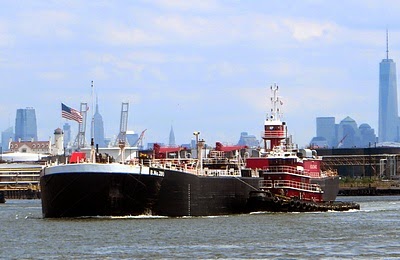 With the New York City skyline as a background, Bouchard's B.No.280, escorted by Charles D. McAllister, headed up the Kill Van Kull.
 Power behind B.No.280 was supplied by Ellen S. Bouchard.
 Then came Manhasset Bay...
 ...which was easily overtaking Paul Andrew pushing a barge.
 ...then Sassafras, ...
 ...then Gulf Dawn.
 We almost overtook MSC Arushi R., which we had passed earlier as we entered Newark Bay, as she left the Kill Van Kull headed for the Narrows and the Atlantic.
 As we left the Kill Van Kull and rounded Constable Hook, we passed the Bayonne Golf Club, with its faux lighthouse club building (2006). The Scottish style links were built atop what previously was a waste disposal landfill.
  The container ship Positano, sitting light with no visible cargo, was docked at Bayonne's Military Ocean Terminal.
 Just past Positano was the U.S. Naval Ship Watkins, undergoing maintenance work at the Bayonne Dry Dock & Repair Corporation's graving dock.
 The cruise ship Explorer of the Seas was moored at the Cape Liberty Cruise Port, Bayonne. The Kirby tug Lincoln Sea and a barge were docked at the end of the pier.
 After passing Bayonne, we saw the majestic skyline of ... Jersey City, with Lady Liberty in the middle.
 Hearing a droning noise overhead, I looked up and saw a World War Two vintage B-17 flying by.
  The Colgate Clock, on the Jersey City shoreline, is a memory from my childhood, when I passed it several times on ships leaving from or arriving at New York. The building on which it once sat has been demolished; fortunately, the clock (Seth Thomas, 1924) has been preserved. We were right on time; our cruse started at 11:00 a.m. and was scheduled to last two hours.
 As we approached our dock, I saw kayaks near Intrepid's stern.
There will be more of these tours, including one this Saturday, July 26. You may get tickets here for it or future tours.


