Saturday, October 18, 2014

iPod log: Brooklyn Heights; Brooklyn Bridge Park; Fulton Ferry; DUMBO; Cadman Plaza Park

Haven't done one of these since January. The idea is: I take a walk, usually around my neighborhood, Brooklyn Heights, as well as through Brooklyn Bridge Park and adjoining areas, but sometimes across the Brooklyn Bridge and back. On my walk, I have my iPod on, set in the "shuffle" mode so that it plays music randomly. At or near the start of each piece of music, I take a photo. The photos are therefore also random, though I do try to shoot whatever looks best or most interesting at the time. What follows is the log of a walk I took on September 16. After each photo I tell what was playing when I took it, giving a link to a site (usually a YouTube clip) where you can listen to it. Where necessary, I also give some explanation of what's in the photo.
The Spinners' "One of a Kind Love Affair" is an excellent example of the Gamble & Huff smooth and danceable Philly soul style from the 1970s. Hear it here.

2. Gin Blossoms, "Miss Disarray." One of many songs Eliot Wagner has turned me on to. Hear it here.

3. Great Speckled Bird, "Trucker's Cafe." In 1969 the Canadian folk duo Ian and Sylvia, who had earlier recorded an album, Nashville, with backing by Nashville studio musicians, decided to go the country rock whole hog, and formed a band, into which they briefly merged their identity, named for a classic country song. The band recorded one, eponymous, album, which I love, and which was Todd Rundgren's maiden production. "Trucker's Cafe" features the voice of Sylvia Fricker Tyson, backed by Buddy Cage on pedal steel, Amos Garrett on guitar, and N.D. Smart on drums. Hear it here.

Photo: This is a view down the "charming cloister like walkway" (Francis Morrone, An Architectural Guidebook to Brooklyn) that leads from Hicks Street to the entrance to the Grace Church Parish House (1931), which also houses the Grace Church School (pre-K and K; hence  the carriages on the walkway). On the right of the photo is the south wall of Grace Church, completed in 1848 and designed by Richard Upjohn, one of the pre-eminent American church architects of the nineteenth century.

4. Sue Foley, "Careless Love." More Canadian content, from another woman singer who knows how to do the blues. Here she does a traditional song of obscure origins, but which was in the repertoire of Buddy Bolden perhaps a century ago or more. Live performance video here.

Photo: This is a portion of "The Fence", which extends most of the length of Brooklyn Bridge Park, and showcases the work of photographers who will be featured in Photoville, an annual event at the Park.

5. Rod Stewart, "Tomorrow is Such a Long Time." Rod covers a Dylan song on Every Picture Tells a Story, one of the best rock albums ever. Hear it here.

Photo: In the foreground, the harbor tanker Patrick Sky (not named for the folk singer) leaves Buttermilk Channel heading into the East River, while a U.S. Army Corps of Engineers debris collection vessel (probably Driftmaster) goes in the opposite direction.

6. Jimmy Crawford with Frank Motley's Crew, "That Ain't Right."  1954 R&B originally recorded by Savoy Records, Newark's pioneer indie label; the linked clip shows the Gem label, which evidently later acquired rights to it. "Don't nobody stay out and drink bad green wine all night." Hear it here. I think of this as the metaphorical flip side of Dolly Cooper's 1953 sparkler "I Wanna Know", from the Savoy archives.

Photo: The former U.S. Navy helicopter training carrier Baylander and the "Fredonia" type fishing schooner Lettie G. Howard, which belongs to the South Street Seaport Museum and is used for educational purposes in conjunction with the New York Harbor School, are moored beside Brooklyn Bridge Park's Pier 5.

7. John Mayall's Bluesbreakers with Eric Clapton, "Steppin' Out." A lively blues instrumental, written by James Bracken and originally recorded by Memphis Slim, featuring a young Eric Clapton on lead guitar. Hear it here.

8. Johnny Cash, "Flushed from the Bathroom of Your Heart." A heart-rending ballad of lost love, from the legendary Live at Folsom Prison album. Hear it here.

Photo: The sculpture is part of Dahn Vo's We the People, in which the sculptor has modeled, in full scale, fragments of the Statue of Liberty, and placed them in locations around the world, including Brooklyn Bridge Park.

9. The Light Crust Doughboys, "Knocky, Knocky." John "Knocky" Parker was a professor in the English department at the University of South Florida when I was a student there in the mid 1960s. He would sometimes give jazz piano performances, and I heard that he had a career as a musician before becoming an academic. I later learned, by dint of acquiring the album OKeh Western Swing, which included "Knocky, Knocky", that he had been a member of the Light Crust Doughboys. You can hear it here. You can also hear Professor Parker playing Scott Joplin rags here.

10. The Rolling Stones, "Sweet Virginia." "Got to scrape that shit right off your shoe." Live performance video here.

11. Neil Young, "Ohio." The version I have on my iPod is his solo acoustical performance, at Massey Hall, Toronto in 1971 of this gut-wrenching song about the unjustified killings of four Kent State University students in May of 1970. This song was originally recorded by Crosby, Stills, Nash and Young and included in their album 4 Way Street. There is no video of the Massey Hall performance, which I think unparalelled for its emotional immediacy, but I found this clip of another performance, with a montage of scenes from the Kent State killings.

12. John Stewart, "Friend of Jesus." This isn't the John Stewart of The Daily Show, of whom I'm a fan, but the singer I loved. "Friend of Jesus" was originally on his album Willard, but I have it as a bonus cut from the CD version of California Bloodlines. You can hear it here.

13. J.S. Bach, Brandenberg Concerto No. 2, 1st Movement, Allegro; Academy of St. Martin in the Fields, Sir Neville Marriner, Cond.  One of the liveliest things Big Daddy Bach wrote. There's no video of the Academy performing this piece, but there's a clip here of an uncredited orchestra (commenter "Chuck Norris" suggests the conductor may be Karl Fischer) playing the piece, accompanied by a "graphical score" made by Stephen Malinowski, which I found fun to watch. It shows you what the various instruments are doing.

14. Saïan Supa Crew, "La Patte." What better to follow German baroque than French hip-hop (with a segment in English by guest rapper and techno-geek Will.I.Am)? Video here.

 
15. The Chieftains, "Jabadaw." My iPod decides to jump the English Channel with this version of a dance tune from Cornwall by Ireland's Chieftains, taken from their album Celtic Wedding. You can hear it here.
16. The Kingston Trio, "Low Bridge." Raise your hand if you didn't sing this song in elementary school music class. You probably knew it as "The Erie Canal," but on the album The Kingston Trio No. 16 it got the title "Low Bridge." The Trio's version is probably a bit more uptempo than the one you knew, and has some extra lyrics. Hear it here.

17.  Jo-El Sonnier, "Jambalaya." Hank Williams made this song a hit. Here it's done in the original Cajun French. Hear it here.

18. Bonnie Raitt, "Love Has No Pride." The "definitive version" (Dave Marsh) of this doleful but lovely Eric Kaz/Libby Titus song. Hear it here.

19. James Cotton, "No Cuttin' Loose." Cotton, a blues musician with an eclectic backgrouund, shows his talents on harmonica and as a singer on this piece. Hear it here.

20. Joan Baez, "Farewell Angelina."  This song takes me back to my third year of law school, and to my friend Tom's dorm room, were he was host to a weekly TGIF. Several of us would gather there to drink cheap Scotch, get high, and listen to tapes on Tom's Akai reel-to-reel. One of these was the Joan Baez album of which this is the title song. Hear it here.

Photo: What we see from the back is the Henry Ward Beecher Monument (1891), by John Quincy Adams Ward. Beecher was the first minister of Plymouth Church in Brooklyn Heights, and is remembered principally for his fierce dedication to the cause of abolishing slavery. Flanking the pedestal of the monument are images of slave children, their arms stretched upward in their struggle for freedom.

21. Robert Johnson, "Sweet Home Chicago." Robert Johnson was a gifted singer and guitarist who is credited with having established the style that became known as Delta blues. There's a clip here where you can hear "Sweet Home Chicago," accompanied by vintage film of life in the City of Broad Shoulders.

Photo: Late summer bounty at the Borough Hall Greenmarket.

22. Warren Zevon, "Mohammed's Radio." "Don't it make you want to rock and roll all night long, Mohammed's radio?" Hear it here.

22. Marlene Dietrich, "Schlittenfahrt." Ever wonder what "The Surrey With the Fringe on Top" from Oklahoma sounds like in German? The Blue Angel will let you know, if you dare.

Photo: This is the south facade of St. Ann & the Holy Trinity Church. It was designed by Minard LaFever, another pre-eminent nineteenth century American church architect, and completed in 1847. It has the first complete set of figural stained glass windows to have been made in North America.

24. Ian & Sylvia, "Maude's Blues." My walk ends with another example of Sylvia's talent for singing the blues. Hear it here.

Photo: These are the facades of two adjoining mid-1880s apartment buildings on Montague Street, the Berkeley at left and its near twin, the Grosvenor at right. Both were designed in a typically Victorian style by the English born architects the Parfitt Brothers.

Friday, October 17, 2014

So, baseball fans, it's down to this...

...the Giants against the Royals in the World Series. Royals vs. Giants; it has an almost legendary sound to it. It's not the Series I was hoping for; still, there are reasons for me to watch it. The two teams have never met in a World Series before. The Royals, an expansion team from 1969, have been in two Series: 1980, when they lost to the Phillies four games to two; and 1985, when they beat the Cardinals in an all-Missouri Series four games to three.
The Giants, by contrast, have been around since 1887 (they were originally the New York Gothams), have been in nineteen World Series, and won seven championships, most recently in 2010 and 2012. As the New York Giants, they won the first World Series I watched, in 1954, against the Cleveland Indians. My parents and I had just returned from three years in England, and I knew nothing of baseball at the time.
 
I have a vague memory of "The Catch" by Willie Mays (see clip above) that was instrumental in the Giants' winning the championship; their last as a New York team--they moved to San Francisco in 1958.

The Giants' New York heritage, and their being in the same league as my Mets--the one that plays real baseball, without the designated hitter--makes me favor them. Still, there are lots of reasons to like the Royals. For me, the best of these is their playing the underdog, team of destiny role. So, whoever wins, I won't be badly disappointed.

Saturday, October 11, 2014

The Tampa Bay Hotel, H.B. Plant, and Kate Jackson

If you aren't familiar with Tampa, you might think this photo was taken somewhere in the Middle East or North Africa. It's the main building of the University of Tampa, situated near the west bank of the Hillsborough River, across from downtown. I took the photo from The Tampa Riverwalk, which follows the river's east bank. The building was originally the Tampa Bay Hotel, designed by the architect J.A. Wood and completed in 1891 for the railroad and steamship magnate Henry B. Plant, who had completed a railroad connecting Tampa to points north and established Port Tampa as a terminal for steamships sailing to Havana, Jamaica, New Orleans, and other destinations. In 1898 the hotel became the headquarters for the U.S. military campaign to liberate Cuba during the Spanish-American War, and Colonel Theodore Roosevelt stayed there before embarking with his Rough Riders at Port Tampa for their voyage to Cuba. The building is now a National Historic Landmark.

Going along the Riverwalk, I found this bust of Plant, with his hotel in the background. Plant was responsible for making Tampa, which before the 1890s was a small town, into a major transportation hub and tourist destination. He died in 1899, and his heirs sold the hotel and surrounding grounds to the City of Tampa in 1905. The hotel continued to operate until the depths of the Great Depression, when the City leased it to the University for 100 years, at an annual rental of one dollar. It now contains classrooms and administrative offices, and a portion of it houses the Henry B. Plant Museum.

A little past the bust of Plant, I came to another, this of a woman. The plaque beneath read:
Kate Victoria Jackson
 1857-1940
An environmentalist before that word was coined, Kate Jackson made many contributions to Tampa. At a time when women could not vote, she led the lobbying for essential public services. 
Parks and playgrounds were her biggest achievement, and the Tampa Civic Association, which she founded in 1910, was a major factor in creating the city's first water and sewage system. This sanitation was key to preventing yellow fever epidemics that had plagued the area.
She was born in Tampa to Irish immigrants who had arrived in 1847. Because Tampa had no good schools at the time, she was educated in a Key West Catholic institution; this led her to recruit the nuns who built the Academy of the Holy Names in the 1870's. An astute businesswoman, she also was a generous philanthropist. Jackson's influence was statewide, especially via the General Federation of Women's Clubs, which was the first organization to preserve the Florida Everglades.
Although I spent my youth in Tampa, I had never heard of Kate Jackson. Her contributions to the city's history, though, rivaled those of H.B. Plant.

Saturday, October 04, 2014

An all-avian Series? It could be in the cards...

...if the Cards keep winning--they're one up on the Dodgers in their NLDS as I write this, with game two tonight--and the Orioles, who are two games up on the Tigers in their ALDS, do the same.
If this comes to pass--and I hope I haven't jinxed both teams by suggesting the possibility--I'll be OK with whichever team wins, though I'll give a slight rooting edge to the O's, despite their being in the Phony Baseball League, since they haven't won a Series since 1983, a ring-dearth even longer than that of the Mets. I also have a soft spot for the O's since they were victors in the first Major League regular season game I attended, in the summer of 1970, when a two run homer off the bat of Boog Powell iced the game against the Yanks.

I've often said, though, that if I had to pick a baseball team on the aesthetics of their play and the competency of their organization I'd pick the Cardinals. Like my Mets, they're in the league that plays real baseball, without the designated hitter. They have a great tradition going back to the "Gas House Gang" of the 1930s, whose spirit seems to have survived through many generations of players. One interesting aspect of a Cards/O's Series is that it would match up two former crosstown rivals. Until 1954, the Orioles were the St. Louis Browns.

Other interesting Series match-ups are also possible. We could have a rematch of the 1985 all-Missouri Series, won by the Royals over the Cards, or the 2002 all-California Series, in which the Angels beat the Giants. Should Detroit come back from their 0-2 deficit and progress from there, we might even have an avian/feline Series, pitting the Cardinals against the Tigers.

Big dinos! Spinosaurus and Dreadnaughtus.

When I first saw an image of Spinosaurus aegyptiacus sometime way back when I was a kid crazy about dinosaurs--the image had no caption indicating the species--I thought it was someone's silly conflation of a Jurassic or Cretaceous theropod with a Permian era sail-backed synapsid like Dimetrodon.  I later learned that it was a real dinosaur, that its fossils had been found in Egypt, but that the only known fossil remains had been destroyed in a bombing raid on Munich during World War II.

Thanks to a nomad in Morocco, who found fossil bones that came to the attention of paleontologist Nizar Ibrahim, a post-doc at the University of Chicago, paleontologists there were able to create a reconstruction of Spinosaurus that strongly indicates that, like a present day crocodile (or duck), it had a semi-aquatic life. It was larger than any other known carnivorous dinosaur, including Giganotosaurus. Indeed, it was likely piscivorous, dining on the large fish that swam in the shallow waters of the coastal region that was North Africa in the Cretaceous.

My last post on dinos was about the smallest dinosaur yet discovered, Ashdown maniraptora. Now there's a new biggest, discovered in Argentina, which now vies with China as the richest source of new dinosaur discoveries. It is, of course, a sauropod, one of those immense, long-necked, long-tailed, big-bodied herbivores we boomers knew in our childhood as Brontosaurus, but later learned was properly named Apatosaurus (the story of how this happened is here).

  This was sad news for the Piltdown Men, who took their name from what may have been the greatest paleontological hoax ever.

As we boomers grew older, we learned of other sauropods, like long, slender Diplodocus and Brachiosaurus, with its towering neck. In recent years a large number of new sauropod species have been found in places like Brazil and Utah. Now, the biggest yet has been found in Argentina, weighing 65 tons, more than twice the weight of Brachiosaurus; indeed, more than an empty Boeing 737. It's been given what I think is a very appropriate name: Dreadnaughtus.

I haven't included an image of Dreadnaughtus because Anne Elk (see clip above) has explained what all sauropods look like. If you still need help, there's a picture of one on the wall behind.

Addendum: I neglected to credit the Spinosaurus image to "Barry's Dinosaur Info" in Dinotopia. "Barry's", in turn, credits the image to Arthur Weasley. Perhaps the same vein, I learned through "Barry's" of a dinosaur called Dracorex hogwartsia.

Sunday, September 28, 2014

Mets finish second!

Yes, only in a division as bad as this year's NL East could a team ending the season five games under .500 earn a second place finish, and yes, they have to share this honor with their frequent nemeses, the Braves. Still, just a few weeks ago I would have been happy to see them equal their third place finish of last year. Indeed, it seemed more likely than not that they'd sink to the dismal fourth of their preceding three seasons.

But unlike so many previous seasons, the Mets sparkled in September, going 15-10. On the 15th of the month, rookie pitcher Jacob deGrom (photo) started against the Marlins and struck out the first eight batters, which tied a Major League record. As a precaution, management took him out of the rotation for the remainder of the season. After that, the Mets were 7-4, including a three game sweep of the Braves and a 2-1 series with the Astros to finish things off.

The Mets also ended the season with a six run advantage in overall scoring, despite their difficulties in bringing in runners in scoring position and their still sketchy bullpen.

Looking ahead, the Mets have a promising set of young arms, including deGrom and Matt Harvey. Some fans are complaining about Harvey's having attended Derek Jeter's final game at Yankee Stadium instead of being with the Mets in their game against the Nats that evening, despite Harvey's being on the DL. I say it was a classy move, although I do wish he'd have worn his Mets cap instead of a Knicks one.

Image: By slgckgc (Jacob deGrom) [CC-BY-2.0 (http://creativecommons.org/licenses/by/2.0)], via Wikimedia Commons

Friday, September 26, 2014

Postscript to Picasso story: a bittersweet conclusion.

Back in February I posted about a threat to La Tricorne (image above), a Picasso curtain that has hung for over 55 years in the Four Seasons Restaurant, located in the Seagram Building on Park Avenue in Manhattan. Aby Rosen, a principal of RFR Holding LLC, which acquired the Seagram Building in 2000, wanted to remove La Tricorne, ostensibly because it was endangered by steam leaking from the wall behind it. After experts testified that there was no possibility of that, because the wall contained no steam pipes, and others testified that removing the curtain could cause irreparable damage to it, a court issued a temporary restraining order. Despite this, Mr. Rosen finally prevailed, and will now be able to fill the space once occupied by La Tricorne with works from his collection by the likes of Damien Hirst and Jeff Koons.

The good news, to the extent there is any, is that La Tricorne was removed without damage, and that the Museum of the City of New York has agreed to take it and to keep it on public display as a part of the city's heritage, now rudely displaced.

Monday, September 22, 2014

Jo Stafford, "Autumn in New York."

Jo Stafford was one of my parents' favorite singers. They owned several 78 RPM records of her songs, one of which was "Autumn in New York." The video clip above has her singing the song, along with a montage of photos of the city in autumn, and of the singer.

Sunday, September 21, 2014

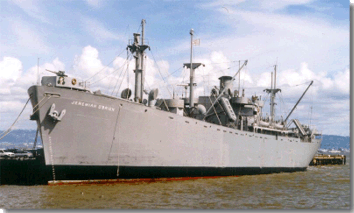
The American Victory floating museum in Tampa.

American Victory is one of three surviving examples of the "victory" class of cargo ships built near the end of World War Two to serve in the Allied war effort. They succeeded the liberty ships, of which 2,710 were built in the early war years; certainly the greatest feat of ship mass production in history. While the liberties were, as FDR called them, "ugly ducklings," the victories were, in my opinion, among the handsomest of twentieth century freighters.

I've known two men who served on American Victory. One was Paul Schiffman, whom I knew over the course of many years when he served as afternoon and early evening bartender at the Lion's Head. Paul was a mate on her maiden voyage in 1945, when American Victory was used to ship cargo to American forces in the Pacific. The other is Mike Wholey, whom I met at a memorial gathering for Paul, and who served as a mate on her final voyage in cargo service, delivering supplies to American forces in Vietnam in 1969.
After that final voyage in 1969, American Victory was mothballed and put into the reserve fleet.  She was kept at anchor in Virginia's James River. In the late 1990s she was due to go for scrap, but in 1999 she was acquired by a private company, The Victory Ship, Inc., and brought to Tampa. She is docked there, at a former commercial dock adjacent to the Florida Aquarium, where she serves as the American Victory Mariners Memorial and Museum Ship. She has been maintained in seaworthy condition, and makes occasional short cruises. She is listed in the National Register of Historic Places. As I approached her from the stern, I saw a laughing gull perched on her rudder.
View of the ship's bridge and funnel from the main deck.
Seen from the main deck, the tug Brendan J. Bouchard and a barge were docked across the channel.
One of American Victory's antiaircraft guns, seen from near the stern, looking forward.
The ship's bridge. Note the wheel at right, the compass and radar screen housings, and the engine room telegraph with the dial face, used to send instructions to the ship's engineers below.
Outside on the bridge.
The galley.
Seamen's stateroom.
Looking down to the engine room, from a catwalk.
Looking aft from American Victory's stern, a  cargo ship is docked further up the channel. Beyond, the tug Sea Eagle is in drydock.

American Victory is one of several victory ships that were named for American colleges and universities. She is named for American University, in Washington, D.C., in recognition of that institution's contributions to the war effort.

Monday, September 01, 2014

Jean Redpath, Scotland's singer, 1937-2014

No, she wasn't the only Scottish singer, but in my opinion she was the finest vocal interpreter of Scotland's traditional ballads, jigs, and reels, as well as music based on the poetry of Robert Burns. I learned yesterday of her death on August 21.

In the video above, made in the 1960s when she was living in Greenwich Village with other young folk singers, she's sitting at a table with Pete Seeger and Roscoe Holcomb (with hat), and sings five songs. "The Beggar Laddie" is a lively ballad about a beggar wooing a pretty woman; it's one of many variations on this theme found throughout Britain and Ireland. "The Skye Fisher's Song" has a slow melody that evokes the landscapes and seascapes in and around the Isle of Skye; on the video it's accompanied by a montage of photos. "I Lost My Love" seems the title of a mournful ballad; actually it's a sprightly dance tune that ends in a port a beul, or Gaelic mouth music. "Miss McLeod's Reel," of which only a short portion is on the video, is another dance tune that's the source of the old-time American song "Hop High Ladies". Redpath does all these songs a capella; on her last number, Robert Burns' best known song, Auld Lang Syne, Holcomb and Seeger accompany her on guitar.

I had the good fortune to see Jean Redpath in performance at a small venue near Washington Square Park sometime in the late 1970s. There were only about twenty of us in the audience. It was a magical evening.

Sunday, August 31, 2014

Happy 69th, Van Morrison.

It was almost exactly forty seven years ago today that I, newly arrived in Cambridge, Massachusetts for my first year of law school, was sitting with my newly made friend Tom McCoy in a little sandwich shop called Hazen's on one of the side streets near Harvard Square. I was biting into my roast beef on a bulkie roll (Boston's analogue to beef on weck, though not as good) when someone dropped a coin into the juke box and played "Brown Eyed Girl." Right then I knew it would be one of those songs, like "Believe Me" and "Uska Dara", that would be engraved on my memory. I didn't have to wait long to hear it again, though; it became a staple on WRKO, the Beantown top forty station to which I tuned my clock radio.
Van and I have come a long way since that day in 1967. He's made lots of splendid music, some of which I've posted here.

Photo by Jarvin via Wikimedia Commons.

Saturday, August 23, 2014

I take the Tim Sommer challenge: here's my top ten.

A few weeks ago Tim Sommer, whose Noise, the Column graces the Brooklyn Bugle, responded to his friend Tim Broun, publisher of the blog Stupefaction, by publishing a playlist of his top ten songs on the Bugle. He concluded the title of his post with, "Now It's Your Turn."

Here's mine. If Tim should read this, he will likely be disappointed by most of my choices being what he calls "'songs' that conform to the verse-chorus-verse-chorus-bridge-chorus virus." My descent into old fart-dom has long been underway, and ingrained habits die hard. Still, I'd like to think I'm not beyond having my notion of how music ought to sound stretched a bit. Thanks to Tim, I'll spend more time listening to the likes of Neu! and Liquid Liquid, though Scott Walker + Sunn O))) is, for me, a difficult stretch (I just listened to "Soused" a second time; it's starting to grow on me). I will even look back and reconsider Van Halen.

1. Neil Young and Crazy Horse, Like a Hurricane. If someone told me I had ten minutes to live, and could choose one piece of music to hear, I'd have a hard few seconds deciding between this and the first movement of Beethoven's "Archduke" Trio.

2. Chuck Berry, Promised Land. I never knew, until I just looked it up, that the tune is based on one of my favorite old-time country songs, Wabash Cannonball. Berry wrote the song in prison in the mid sixties, when L.A. was still the Promised Land. It was also a time when to be young, poor, black, and "stranded in downtown Birmingham" was a scary proposition, but Berry didn't need to dwell on that; he just got his protagonist outta there, pronto.

3. The Astronauts, Baja. A surf guitar band from Colorado--yes, Colorado--got the sound just right.

4. Mahavishnu Orchestra, Open Country Joy. John McLaughlin and company start softly, building into a lovely opening theme that ends abruptly, followed by a ten second silence, then by a frenetic, sometimes dissonant variation that finally resolves itself into a triumphant restatement of the opening theme.

5. The Ramones, Rockaway Beach. Someone once wrote that the Ramones were New York's answer to the Beach Boys. Was "Gabba gabba hey!" our "cowabunga"?

6. The Royal Teens, Believe Me. In 1959 I was thirteen and lovesick when I heard this song, announced as a "pick hit of the week" on WDAE in Tampa. I never heard it again on radio, nor did I find it on my occasional searches through bins of 45s in record stores, but every "ooh-wah-ooh," every tinkling piano note, was indelibly engraved in my memory. Cut to the cusp of the '70s-'80s. I'm in one of those West Village used vinyl emporia and come across a Royal Teens anthology LP. I bought it and dashed home to my then digs on East 11th to play the song I hadn't heard in twenty or so years. The tinkling piano is by Bob Gaudio, who later joined Frankie Valli and the other Jersey Boys in the Four Seasons, and wrote several of their hits. According to this excellent bio by Bruce Eder, Al Kooper played guitar with the group in '59, so may be on this cut.

7. Lou Reed, Coney Island Baby. From doo-wop to an homage to doo-wop. "The glory of love might see you through." Yeah.

8. Eartha Kitt, Uska Dara. One afternoon when I was seven, and my parents and I were living in half of a thatched roof cottage in rural Hertfordshire, my mom had the radio tuned to BBC and the announcer said, "Now, here's some Turkish music." What followed was so hooky that, like "Believe Me" six years later, it got burned onto my mental hard drive--well, not perfectly; the tune I remembered, but not the spoken bridge, nor the sung words, except for the end of the chorus, which sounded to me like "nebrezary on a shoe." Cut to the Bells of Hell, circa 1978. It's four on a Saturday or Sunday morning, the place is closing, and Mike McGovern--if you're a fan of Kinky Friedman's novels, that McGovern--invites the few serious drinkers left, myself included, to his place for a morning-cap. As we sipped Jameson Mike put on an Eartha Kitt LP and there it was, that song I hadn't heard since I was seven. I got my own copy soon after.

9. Southside Johnny and the Asbury Jukes, Take It Inside. The album Hearts of Stone is on my top ten rock albums list; it's the only one I've downloaded wholesale to my iPod. I chose this track for its showing of the group's versatility, from the Beatle-esque opening phrase, "Try to understand," leading into Johnny singing over a basic rock backing ensemble, then the entrance of the horns on the chorus. I also love it for its controlled but still white-hot passion.

So far, things were pretty easy. Tim suffered for his list; mine was a breeze. Then it got down to choosing that last number. I had two songs in mind. Both come from the British--one English, the other Scottish--folk-rock tradition. Well, I thought, it's possible to have a tie for ten. So, I've numbered the next two songs "10."

10. Mike Heron, Warm Heart Pastry.  Mike Heron was a founder of the Scottish acid-folk group Incredible String Band, which I saw in its death throes at the Bottom Line in the mid '70s, on a tour in which they had expanded to about twenty members, mostly by picking up musicians in every place they performed, including my native city. In 1971 Heron made a solo album, Smiling Men With Bad Reputations. "Warm Heart Pastry" is the one straight-ahead rocker on the album, with a hot backing band credited as "Tommy and the Bijoux." I later heard or read somewhere that they were The Who, playing under a pseudonym to avoid contractual problems. That proved to be partly true: they were The Who minus Roger Daltrey, but plus John Cale, who also appears on several other cuts on the album.

10. Richard and Linda Thompson, Wall of Death.  She was pregnant, and they were on the verge of marital breakup, when they recorded Shoot Out the Lights, one of the most emotionally harrowing rock albums ever. Richard was previously a guitarist and singer with Fairport Convention. The song has been described as "joyous," but the underlying tension seems obvious to me.

Top Ten List image: This Old House.

Tuesday, August 12, 2014

Lauren Bacall

The sad news keeps coming. Lauren Bacall, née Betty Joan Perske, a salesman's daughter who became one of the pre-eminent women of Hollywood in the middle to late twentieth century, died today of a massive stroke at the age of 89. As a boy and young man, I was entranced by her combination of toughness and tenderness, which she shared with another favorite of mine, Katherine Hepburn.

The video above shows her displaying both qualities, playing opposite her frequent film partner and later husband, Humphrey Bogart, in To Have and Have Not (Howard Hawks, 1944), based on a novel by Ernest Hemingway. She was nineteen years old when she was cast for this part.

Monday, August 11, 2014

Robin Williams, 1951-2014

As most, if not all, of you know by now, Robin Williams died today. The photo at left, by Photographer's Mate Airman Milosz Reterski (Navy NewsStand) [Public domain], via Wikimedia Commons, was taken while he was "entertain[ing] the crew of USS Enterprise (CVN 65) during a holiday special hosted by the United Service Organization (USO)." His shirt says "I [heart] New York" in Arabic.

I'm late on this sad news, but my friend, fellow Brooklynite, fellow Episcopalian, and fellow blogger John Wirenius has a very good post, with two superb videos. You can read it here.

Addendum: my friend and erstwhile LeBoeuf, Lamb colleague Richard Cole kindly sent me his personal reminiscence of Robin Williams, originally written for his siblings, which he has generously allowed me to share:
In the late '70s or so, Mom came down to NYC, where Doug and I took her to the Improv comedy club on her birthday, December 28. After a few comics, a sudden roar greeted the surprise appearance of Robin Williams, and I believe that during his hilarious set while riffing on birthdays, I pointed to Mom and he acknowledged it.
During the last few years, I had numerous private as well as small group discussions and laughs with Robin, mostly at/near 142 Throckmorton Theatre in Mill Valley, where he often did sets and improv for fun, allowing and encouraging others to shine too. He often sat in back, spurring younger stand ups with his barking laugh. On one such occasion, a couple shyly interrupted our conversation near backstage for a joint photo on their wedding night. Happy to oblige, he told them each: "Pretend to be surprised tonight!". Only a few months ago, Robin and I walked yakking alone for two blocks to a restaurant after the Tuesday Night comedy show, discussing his Broadway show, NYC apartment and so forth. He headed the table of comics and others, and asked me to sit down next to him. For 45 minutes or an hour, we had coffee, a bite to eat and conversation. He had grown up and lived nearby, and had struggled with everything from heart surgery, depression, substance abuse and domestic challenges, usually working frenetically while remaining accessible and friendly. I saw him do a very edgy, riotous set recently and a couple of generous improv sets with rookies; when asked how he would like to be greeted in heaven, he said he hoped that he would have a front row seat and God would say "Two Jews walk into a bar . . .". Etc., etc. Many if not most comics seem to have depressive personalities, from which paradoxically the humor explodes -- think of Jewish comics in the shadow of the Holocaust. He always leapt easily among standup, improv, comic and dramatic, serious acting, with some great movies that were not meant to evoke any mirth. It may be silly to reminisce through my little lens when he knew thousands of more important people better (everybody knew him and vice versa) but he knew my name and always said hello, and it is a good indication of the manner in which Robin affected so many.

Tuesday, July 29, 2014

The 13th Apostle by Dermot McEvoy

One thing about historical fiction: if you know anything about the history, there are no spoilers. When I picked up The 13th Apostle, I knew how it would end. Michael Collins would die by an assassin's bullet. I knew it was because of a dispute that had torn the newborn Irish nation asunder, and that the dispute was over whether to accept the terms of a deal with Britain that would allow six northern counties to remain under the Crown. What I didn't know was Collins' role in negotiating that deal, and that he died defending instead of opposing it. What little I knew of Collins made me think he'd have been on the other side: an all-or-nothing-ist  instead of a pragmatist.

In his conduct of the struggle to free Ireland, in which his efforts were essential to bring about the conditions that brought Britain to the truce table, Collins was, as the book tells, a consummate pragmatist. He knew just what needed to be done, and how, to undermine the foundation of  British power. He was also, however, not averse to taking risk, sometimes with respect to his own safety. The lot of being the confidante who sometimes must try to talk sense to Collins falls, in the novel, on a fictional character, Eoin Kavanagh.*

The 13th Apostle is a novel told from two points of view. One is that of Eoin Kavanagh who, at fourteen, was a resident, along with his parents and three younger siblings, in a dreadful Dublin building called The Piles. The misery of his family--he lost a younger brother to diphtheria and his mother shows signs of the tuberculosis that will end her life early--makes him sympathetic to the Feinian cause. On Easter Monday 1916 he gets caught up in the excitement and joins the rebels. A bullet grazes one of his buttocks. Lying with the wounded he draws the attention of Michael Collins and of a nurse, Róisín O'Mahony, four years his senior, who tends to his bleeding bottom. From this inauspicious beginning he has an improbable but not inconceivable career. He becomes Collins' assistant, adviser, and a supernumerary member of his "Squad" who do the targeted killings necessary to advance the liberation of Ireland. The Squad were called "The Twelve Apostles"; hence, the novel's title. He marries Róisín, and after Collins' death they emigrate to New York. He settles in Greenwich Village, takes American citizenship (without losing the Irish, from the viewpoint of its government), gets into politics, is elected to Congress, and becomes a confidante of FDR (as Róisín becomes one of, and a ghostwriter for, Eleanor), but after the assassination of JFK decides to leave his adopted country and return to Ireland. There he's elected to the Dail (the Irish parliament) and supports the cause of liberating the Six Counties from British rule.

The other viewpoint is that of Eoin's grandson, Eoin Kavanagh III, called "Johnny Three" because Eoin, pronounced "Owen," is the Gaelic equivalent to John. He's a writer, lives in the Village, drinks at the Lion's Head, and is married to Diane, a Presbyterian who loves him dearly but is often amazed, and sometimes dismayed, by his and his family's Irish ways. Actually, Diane, along with Róisín, should probably be added as point of view characters, because their observations are vital to the development of the story.

The story begins with old Eoin's death, in Ireland, at the age of 105. As he was the last surviving veteran of the Easter Rising, as well as a distinguished statesman in his later years, his funeral is a major occasion. Johnny Three and Diane attend, and learn that the old man's legacy to Johnny included a set of diaries, kept from his participation in the Easter Rising through his years as Collins' assistant and Squad member, Collins' death, and its aftermath.

The novel's narrative shifts between Johnny Three and Diane in 2006, and Eoin from Easter Monday, 1916 to August of 1922, with a few snippets of his later life in America, including a meeting with FDR and Churchill on Christmas Eve, 1941, with the U.S. newly allied with Britain against the Axis. It's Eoin's second meeting with Churchill, his first having been during the 1921 treaty negotiations, when he served as Collins' bodyguard. With a little prompting, Churchill remembers this. Churchill and Collins, on whose head Churchill had once put a ten thousand pound reward, came to respect and like each other as men of action. The 13th Apostle includes a true anecdote featuring Churchill's rapier wit that I hadn't known before. I won't spoil it by repeating it here.

While the shifts in locale and time may sound disorienting, they provide a useful perspective. Johnny knew his grandfather had been a rebel, and an associate of Collins, but didn't know he had participated in the executions of British agents and their Irish collaborators. Diane found it hard to believe that the man she knew as a stand-in father-in-law (we learn little of Johnny Two, other than that he evidently abandoned his son) was a killer. When we see it from Eoin's perspective, we find how hard it was for him to square his moral convictions with his duty to Ireland and Collins, even when his first fatal shot is into the head of the man who tortured and killed his father.

I learned much history from reading The 13th Apostle, and got a sense of what it was like to have been in Dublin during the years that the Irish Republic, "a terrible beauty" in Yeats' words, was born. I also learned the words that must be said to make a Perfect Act of Contrition.** This book may yet be my ticket to heaven.
 
The 13th Apostle is published by Skyhorse Publishing, New York City (2014).
_________
*The character of Eoin Kavanagh seemed so realistic to me that I did a web search for the name, just to see if there was someone with that or a similar name who was prominent in the Irish rebellion. I found this article by Owen Kavanagh ("Owen" is an alternative spelling of the Gaelic "Eoin") giving the results of his research into the involvement of members of the Kavanagh clan in the Easter Rising and subsequent struggle for liberation. He mentions the brothers Michael and William Kavanagh as having participated in the Easter Rising and later in the fight for independence, a Sean Kavanagh as having been Collins' intelligence officer in Kildare, and a Seamus Kavanagh as having been among the rebels in the General Post Office on Easter, 1916. Owen Kavanagh's source of information was:
a set of six...CD’s contain[ing] Dublin Castle’s secret surveillance files, known as Personality Files which were compiled by the Special Branch of the Royal Irish Constabulary (RIC) and the Dublin Metropolitan Police (DMP).
His account ends with an "Author's Note" mentioning the execution of Alan Bell, a bank examiner sent by the British government to ferret out the accounts holding Sinn Fein's funds to be used in support of the uprising. In The 13th Apostle, the fictional Eoin Kavanagh is part of the team that captures and kills Bell.  In his Note, Owen Kavanagh describes how Constable Harry Kells of the DMP, who earlier had been tracking the Kavanagh brothers, was assigned to try to find Bell's killers. This brought Kells to the attention of Collins, who had him killed. There's no indication, however, that any of the Kavanaghs were involved in Bell's execution. None of the characters in The 13th Apostle is based on any of these Kavanaghs. There is, however, extensive discussion in the novel about the intelligence operations carried out by the RIC and DMP and the files they kept on actual  and suspected rebels, as well as Collins' ultimately successful effort to gain access to those files.

**"Oh my God!  I am heartily sorry for having offended Thee, and I detest all my sins, because I dread the loss of  heaven and the pains of hell.  But most of all because they offend Thee, my God, Who art all-good and deserving of all my love.  I firmly resolve, with the help of Thy grace, to confess my sins, to do penance, and to amend my life.  Amen."

Sunday, July 27, 2014

Clothes in pop music, part 1, 1955-63.

My friend Moira Redmond has a blog called Clothes in Books. When she started it, I reminded her that Ayn Rand heroines favored high waisted gowns in the 'Empire' style, because she had, during her term as Fray Editor, remarked that any post mentioning Ms. Rand was likely to attract lots of comments.

Thinking about clothes in books led to my remembering the spate of pop songs about clothes, mostly "novelty" songs but a few straight-ahead rockers and sock hop squeeze 'n' shuffles, that crowded the airwaves during the late 1950s and early '60s. One of the most memorable of these was Marty Robbins' (photo above) 1957 ballad "A White Sport Coat and a Pink Carnation."


The clip above is of a 1981 live performance by Robbins, made just a year before the singer's death.

 In 1956, Carl Perkins recorded "Put Your Cat Clothes On," though the record was not released until 1970. Perkins refers to "Blue Suede Shoes" in the lyrics, a nod to another song he wrote in 1955 and recorded in January of '56.

1957 was a big year for songs about clothes. A New Jersey group called the Royal Teens had a hit with "Short Shorts." The piano player is Bob Gaudio, who would later join Frankie Valli in the Four Seasons and write several of their hits, including "Sherry".

'57 also gave us "Black Slacks," by Joe Bennett and the Sparkletones.

1957 was a big year in fashion as well, as couturier Cristobal Balenciaga introduced his shape shrouding sack, or chemise, dress. In 1958, Gerry Granahan expressed his displeasure in "No Chemise, Please."

In 1959 thirteen year old Dodie Stevens (exactly my age then) hit the charts with "Pink Shoelaces."

Bryan Hyland made the top ten and Dick Clark's American Bandstand in 1960 with "Itsy Bitsy Teenie Weenie Yellow Polka Dot Bikini." The woman in high tops and pantaloons who gives the spoken interjections is Trudy Packer.


Another 1960 release was the Coasters' paleo-rap "Shoppin' for Clothes," written by Jerry Leiber and Mike Stoller, who had earlier penned "Hound Dog" for Big Mama Thornton, later covered by Elvis. Coasters member Billy Guy was working with the songwriters, and remembered a similar piece he'd heard on the radio. They searched record stores but couldn't find it. Later they learned it was "Clothes Line," written by Kent Harris and recorded by Boogaloo and his Gallant Crew. Harris was then given co-credit for "Shoppin' for Clothes."


I'll close, as did many a school dance, with Bobby Vinton's 1963 prom belly-rubber "Blue Velvet," which later inspired a David Lynch movie.

I'll do a second installment featuring songs from the late 1960s to the present. If anyone can think of clothes-themed songs from the period covered in this post or later, please let me know.