Thursday, August 25, 2022

A Visit to the Baseball Hall of Fame

Our return to the Glimmerglass Opera Festival put us close to Cooperstown, New York, best known for being the home of the National Baseball Hall of Fame (photo above: Kenneth C. Zirkel, CC BY-SA 4.0 , via Wikimedia Commons). It is also reputed to be the birthplace of the game, though that claim is disputed. Regarding Mr. Chadwick's claim, I can say that during the three years of my childhood spent in an English school, I learned the game of rounders. On returning to the U.S. and learning about baseball (along with re-learning how to be American), I thought it had a strong similarity to rounders.
Martha had a strong reason to visit the HOF. She was celebrating the induction of David "Big Papi" Ortiz, of her beloved Red Sox. Here she is with his induction display.
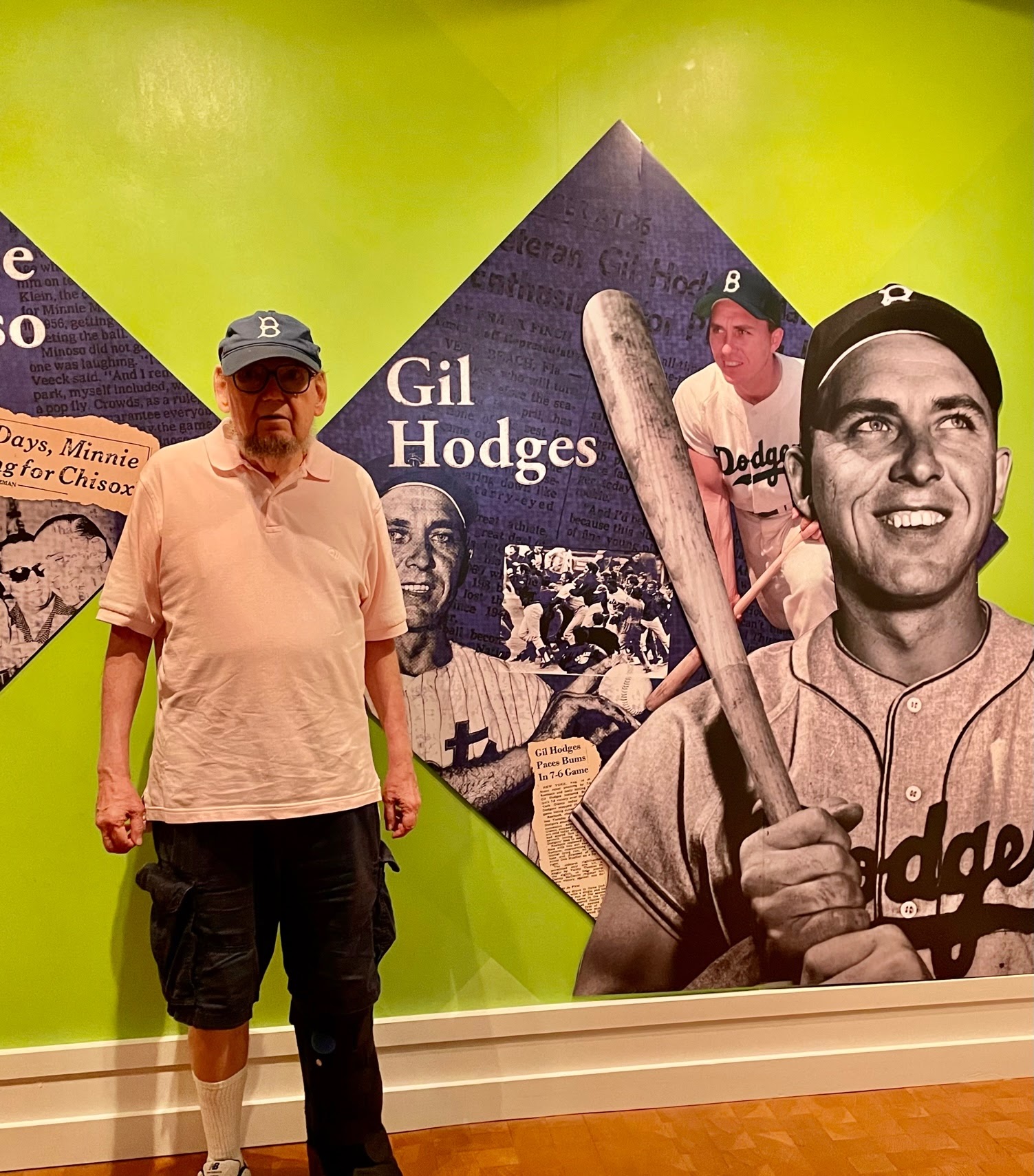
And here I am, surgical boot and all (Thanks to which Martha was able to get Marc's car a handicapped permit that allowed us close in parking at Glimmerglass) with Gil Hodges' induction display. I'm wearing my Brooklyn Dodgers cap, they having been my first love in Baseball. Hodges later managed the Mets, to whom I owe my present loyalty, to their victory in the 1969 World Series. (Photo by Martha).
Our next stop was the art gallery. I've long thought of LeRoy Neiman (1921-2012) as America's, and perhaps the world's, pre-eminent sports artist. He was that, but also more. A graduate of the School of the Art Institute of Chicago, where his schoolmates included Leon Golub and Robert Clark, who became better known as Robert Indiana. Mr. Neiman developed a neo-expressionist style, well suited to paintings of action, whether it be sports or the action at P.J. Clarke's bar. The painting above, displayed in the Hall of Fame gallery, is "The Hall of Famer", his notion of a generic HOF honoree, or perhaps two.
Another painting that got my attention was Joel Libby's portrait of the pitcher Christy Mathewson, whose Major League career lasted from 1901 through 1916, mostly with the New York Giants. He was known for his precise control. Chicago Cubs second baseman Johnny Evers, part of the Tinker to Evers to Chance double play combination, said of Mathewson, "He could pitch into a tin cup." 
Moving on to Monument Hall, I stopped to pay my respects to Gary "The Kid" Carter, the catcher who came to the Mets from Montreal in 1985, the year I became a Mets fan. In 1986 he was an important contributor to the Mets' National League championship and to their second World Series victory, both on defense and with his bat.
Looking out a window I saw this sculpture, by Stanley Bleifield, of Johnny Podres pitching to Roy Campanella, my first baseball hero. This was the battery that lasted the complete Game Seven of the 1955 World Series, won by the Brooklyn Dodgers over the New York Yankees.
“'Millennium,' yes; 'pandemonium'!
Roy Campanella leaps high. Dodgerdom crowned
had Johnny Podres on the mound."

Marianne Moore, "Hometown Piece for Messers Alston and Reese"

Sunday, August 21, 2022

Return to Glimmerglass: Carmen, The Sound of Music, Tenor Overboard, and two new short operas

Two weekends ago, after a two year hiatus, Martha and I joined our friends Marc and Stewart for a return to the Glimmerglass Festival, held in the Alice Busch Opera Theater, on the shore of Lake Otsego near Cooperstown, New York. Our first opera. on Friday evening, was Bizet's Carmen. I had seen several productions of this very popular romantic opera before; indeed, I first heard its highlights on a record album my parents bought when I was about ten. Perhaps my memories of earlier performances had faded, but to me this was the best ever. It was directed by Denyce Graves, who has considerable experience with the role of Carmen. According to the Glimmerglass program,"[s]he made her Metropolitan Opera debut in the title role in 1995 and went on to sing the role at the great opera houses of the world for decades."

The title role was sung brilliantly by the mezzo soprano Briana Elyse Hunter (photo), whom we had seen in 2019 as Mother in the then new opera Blue, which later received the Music Critics Association of North America 2020 Award for Best New Opera. She brought to the role of Carmen an almost unstoppable forcefulness, even in the scene in which she draws fortune telling cards that in each instance predict her death. The program includes the transcript of a dialogue between Ms. Hunter and the director, Ms. Graves. Near the beginning of the conversation Ms. Hunter asked, "Do you feel like you take a little bit of [Carmen] with you each time you play her?" Ms. Graves answered, 
"She made me the woman I am today, without question. I feel like it was no mistake that she came into my life, and I think she's been strengthening me from the moment I met her."

Ms. Hunter responded: "Every time I play her, I leave proclaiming, 'This is how I'm going to be now' . . . and then I realize how hard that really is."

The Don José role elicited another excellent performance, this by tenor Ian Koziara, who skillfully assumed the various emotional states the role demands, from obedient soldier to reluctant suitor to outlaw to enraged jilted lover. During her conversation with Ms. Hunter, Ms. Graves said:
"I have a tremendous amount of sympathy for Don José, for the person he becomes and the trajectory of his experience. . . . By the time we see him in Act Four he's not a priest, he's not a corporal, he's not the lover of Carmen. He's lost his mother, Micaela, his dignity, home, country, everything. Carmen rises in society. . . . That's what I want to show in our production, this incredible elevator effect where he's going down as she's going up."
Richard Ollarsaba, a bass-baritone, was convincing as the bullfighter Escamillo, showing bravado but also a touch of vulnerability. The role of Micaëla, the village girl Don José's dying mother wants him to marry, was played to perfection by soprano Symone Harcum, a member of Glimmerglass's Young Artists Program. Bass baritone Peter Morgan was the model of a martinet as the Army Captain Zuniga. The rest of the cast was superb. Credit must also be given to the Glimmerglass Festival Orchestra, conducted by Joseph Colaneri, for its forceful presentation of Bizet's score.

Glimmerglass presents one musical comedy or operetta each year. This year's selection, The Sound of Music, is far from Martha's or my favorite Broadway show by a long stretch. Still, the performance on Saturday afternoon was very well done. Baritone Michael Mayes was spot on as the intensely disciplined and patriotic Captain Georg Von Trapp, as was soprano Mikaela Bennett playing the talented and flighty Maria. Soprano Alexandra Loutsion was authoritative and compassionate as the Mother Abbess, and Alyson Cambridge did well in the role of the scheming Elsa Schraeder. Among the Von Trapp children, all well played, I'll give special mention to Tori Tedeschi Adams, a member of the Young Artists Program, as Liesl, and to Oliver Horvath as Kurt and Cordelia Dziuban as Brigitta, both members of the Glimmerglass Youth Chorus. The orchestra, conducted by James Lowe, was faultless. Unfortunately, I was left with "Do, Re, Mi" as an earworm for several days, despite hearing some Rossini that evening.

So, to the Rossini. Ken Ludwig has been described, by Barry Edelstein, Artistic Director of The Old Globe, as "America's preeminent comic playwright." (Well, now that Neil Simon is no longer with us.) Mr. Ludwig not only writes plays; he is also an opera librettist. Since he doesn't write music, he needs to use someone else's. In Tenor Overboard that someone else is Gioachino Rossini. Mr. Ludwig assembled a pastiche of music from several Rossini operas to accompany his story. 

The story begins in "1940s New York." Petronio, an Italian immigrant, well voiced by Bass-baritone Stefano de Peppo, has two daughters, Gianna (mezzo soprano Reilly Nelson) and Mimi (soprano Jasmine Habersham). He wants to marry Mimi to the son of a friend, but Mimi has her heart set on a young man she met during a trip to Sicily. 

The sisters attend a performance by the Singing Sicilians, and want to return with them to Italy. They are refused an audition because the group is all male, so they put on drag, audition as Joe and Jerry, and are welcomed. They board a liner bound for Italy, and a series of bizarre adventures follows. Petronio, not knowing his daughters are on board, gets on the same ship, having decided he's had enough of America. A movie actress, Angostura (soprano Keely Futterer; her part named for a kind of cocktail bitters) keeps threatening to expose the sisters as women. Mimi recognizes fellow Sicilian Singer Dante (tenor Fran Daniel Laucerica) as the lad who won her heart in Sicily. Gianna falls in love with another Sicilian, Luca (baritone Armando Contreras). Petronio is thought dead following a blow struck during a storm, but revives just as the Captain (tenor Matthew Pearce) is about to commit his body to the sea. Petronio then recognizes Dante as the friend's son whom he wanted Mimi to marry. Weddings follow. 

It's a thoroughly delightful piece, drawing, as Mr. Ludwig explains in his notes, on such comedic resources as A Midsummer Night's Dream and Some Like It Hot. As for the music, taken from, by my count, seventeen different Rossini scores, it was performed beautifully by the orchestra, conducted as it was for Carmen by Joseph Colinari.

On Sunday afternoon we saw a double bill of new one act operas, both on religious themes. The first was Taking Up Serpents, with music by Kamala Sankaram, Glimmerglass Artist in Residence this year, and libretto by Jerre Dye. A young woman, Kayla (soprano Mary-Hollis Hundley) has left her family, charismatic preacher Daddy (baritone Michael Mayes, also Captain Von Trapp in Sound of Music), and her pious and dour mother Nelda (mezzo soprano Jacquelyn Matava) on a self searching journey that takes her to Gulf Shores, Alabama, where she works in a drug store. She gets a phone call from Nelda telling her Daddy has had a fatal bite while handling a snake during a worship service, and is in hospital dying. Kayla goes home to Birmingham where Nelda, wracked with grief over her husband's condition and guilt for having sought medical treatment in defiance of her and Daddy's beliefs, gives Kayla no comfort. After prayerful consideration, Nelda smothers comatose Daddy in his hospital bed. Kayla, facing contradictory feelings about her parents and upbringing, seeks spiritual reconnection in a potentially striking way. The story places emotional demands on the singers, all of whom met those demands with aplomb.

As the Glimmerglass program tells it, the librettist Mr. Dye drew on his own upbringing in a small Mississippi town where his family belonged to a charismatic church, although one without snake handling. "It completely captured [his] imagination as a child." When his family turned to a more conventional, mainline Protestant church, he was "suddenly left with an empty feeling, a great sadness, a sense of disconnect." He transferred that feeling to Kayla. 

Ms. Sankaram found inspiration for her music in "Christian mysticism" that she used "to create musical ciphers that are hidden throughout the score." It was performed by an ensemble using some unusual instruments, including "whirly tubes, which are plastic percussion instruments that are played by being swung in a circle." These were used to accompany "Kayla's retreat into memory." The ensemble was conducted by Lidya Yankovskaya.

Second in the double bill was the world premiere of Holy Ground, with music by Damien Geter and libretto by Lila Palmer. The story involves a departure from Christian theology. As it is told in Luke 1:26-38, the angel Gabriel appears before Mary, a young woman of Galilee, and tells her she will have a son. She asks how this can happen, as she's a virgin. Gabriel says she will become pregnant by "the power of the Holy Spirit" and that her child "will be called Son of God." Mary isn't asked if she consents to this; she is just told it will happen. 

Holy Ground opens with three archangels listening to signals from earth, hoping to find a woman with a pure soul who will consent to give birth to God's son. Unlike the story in Luke, consent by the prospective mother is required. Their scanning device picks up a promising signal, coming from a young Black American woman named (you guessed it!) Mary (soprano Jasmine Habersham, who also was Mimi in Tenor Overboard). The archangels deputize Cherubiel (tenor Jonathan Pierce Rhodes, a member of the Young Artists Program), newly promoted to their order, to try to convince Mary to accept. He's reluctant, as 849 other women (implicitly including Galilean Mary) have refused. The other archangels convince him that he can do what hasn't yet been done.

Meanwhile, Mary is facing an impending marriage about which she has serious misgivings. Her mother, Ann (soprano Alyson Cambridge, also Elsa Schraeder in Sound of Music), argues that she must go through with it, as a woman without a husband is not safe. (This is evidently some perhaps near future Handmaid's Tale style dystopian America.) Still, Mary thinks she wants something beyond safety with a man. This is when Cherubiel appears with his offer. As the program puts it, Mary "experiences a kaleidoscope of emotions" but concludes that she cannot do it. 

Mary then suffers nightmares in which "[m]ultitudes cry out for help, but there are too many for her to save." Ann tells her that when she became pregnant she initially didn't want to be a mother, but changed her mind and gave birth to Mary. Cherubiel, braced by several (ambrosial?) cocktails with, and encouragement from, the other archangels, returns for a second try. This time Mary says "Yes." Cherubiel concludes with, "Hail Mary, full of grace." 

Mr. Geter's music, conducted as in Taking Up Serpents by Lidya Yankovskaya, complements the story well.

Addendum: Martha tells me that she found Trevor Bowen's costume designs for Holy Ground to be spectacular.

The 2022 Festival is the last under Francesca Zambello, whose twelve years as artistic and general director of the Festival  have been transformative. She has widened the appeal of the Festival, and of opera, to audiences as young as elementary school children, achieved diversity in performers, composers. librettists, and subject matter, and deftly mixed traditional with new material. She will continue serving as artistic director of the Washington National Opera, a position she has held since 2012. Her successor will be Robert Ainsley, who until now has served as director of the Young Artists program at Washington National, "and of the American Opera Initiative where, over a span of six years, he commissioned, developed and premiered more than 30 new operas and other works."

Monday, May 16, 2022

Paradise Square: ten Tony nominations well deserved

If the name Joaquina Kalukango isn't familiar to you, as it wasn't to me until a few days ago when she was nominated for the Tony Award for Best Performance by an Actress in a Leading Role in a Musical, be assured that if you're even mildly interested in Broadway, or theater in general, it will be. In Paradise Square, nominated for Best Musical, she plays Nelly O'Brien, Black wife of Irish immigrant Willie O'Brien (Matt Bogart). Willie and Nelly are owners of a saloon called Paradise Square, situated in what was in the mid nineteenth century a notorious Manhattan slum called Five Points.

When the show begins, Willie has left and joined the Fighting 69th, a U.S. Army regiment formed during the Civil War and made up entirely of Irish immigrants. While Willie is away fighting, Nelly is left to run the saloon. Its customers are a mixture of Black and Irish people, reflecting the neighborhood as as a whole. Their nights at Paradise Square are a joyous outpouring of music and dance, combining Irish and African styles, in which all participate, for which Bill T. Jones has been nominated for the Best Choreography Tony. 

As the story goes on, dark clouds begin to gather over this pleasant landscape. "Lucky" Mike Quinlan (Kevin Dennis) returns from the war missing his right arm, a fate for which he blames his adopted country. Then President Lincoln orders a draft of able bodied White men, non-citizen immigrants included, for which exclusion can be bought for $300, a very large sum at the time. This seems especially unfair to young Irish men, including Willie's newly arrived nephew Owen Duignan (A.J. Shively; nominated, along with Sidney DuPont -- see below -- for Best Performance by an Actor in a Featured Role in a Musical), who sings "Why must I die in springtime?" to save Blacks from slavery. This sets up a conflict involving his aunt, Willie's sister Annie Lewis (Chilina Kennedy), wife of Reverend Samuel Jacob Lewis (Nathaniel Stampley), a Black minister who serves as a stationmaster on the Underground Railroad. Reverend Lewis takes in Washington "Wash" Henry (Sidney DuPont; nominated, along with A.J. Shively, for Best Performance by an Actor in a Featured Role in a Musical) and his beloved Angelina Baker (Gabrielle McClinton), fugitive slaves who are doubly endangered because they are accused of the murder of their slave master in Tennessee. Both Owen and Wash are in desperate need of money; Owen to escape the draft and Wash to finance his and Angelina's escape to Canada and to establish a new life there.

The Draft Riots brought an end to Paradise Square and to the Five Points as it was, but Nelly retains her faith that the harmony that existed there can be restored. Her rendition of "Let it Burn" evoked a standing ovation. Here's an interview with Joaqina Kalukango in which she tells what she learned about history from preparing for her role in Paradise Square:


I was drawn to see Paradise Square because my old friend Larry Kirwan is credited with conceiving the story, and is nominated, along with Christina Anderson and Craig Lucas, for Best Book of a Musical. I got to know Larry in 1978 when he and Pierce Turner, as Turner and Kirwan of Wexford, were the house band at the Bells of Hell. I'll confess that the last time I saw him was in 2011 when, at his invitation, I attended a Bloomsday event and, sufficiently lubricated by Guinness, gave a reading that was videoed by his wife, who also was my daughter's dance teacher at P.S. 150.

Paradise Square is now scheduled to run at the Barrymore Theater through November 27. Update: unfortunately the show just closed. I'm surprised it didn't get better attendance, given at least Ms. Kalukango's best performance award.

Monday, May 09, 2022

The Mets are 20-10; should I be worried?

My wife is a Red Sox fan. I've dealt with this by declaring them my favorite American League team (I can no longer call it the "Phony Baseball League" now that the National League has adopted the execrable Designated Hitter Rule). For my Tampa friends: my excuse is that the Rays didn't exist when I lived there. I root for the Rays when they play anyone except the Mets or -- well, when they play the Red Sox I keep very quiet.

Anyway, Martha believes that when the lads from Fenway get off to a hot start, they are doomed to a late season collapse. Last year at this time I posted that the Mets were first in the NL East. They managed to cling to that position until early August, largely because they were in a weak division. I recall some pundit writing, while the Mets were still cruising, something like "until the inevitable implosion." He was right; they finished third in the division, with a 77-85 record.

This year I again decided to wait until a month had passed since the season opener before trying to get a sense of how good the team is and what its weaknesses might be. As it stands, things are looking good. Two months from now I may regret these words; after all, these are the Mets, a team I once described as having the "ability to rouse hopes, then smash them like cheap china."

I had some trepidation as the Mets opened their season on the road against Washington. Ace starter Jacob deGrom was recovering from surgery and unlikely to pitch until June. New manager Buck Showalter called on Tylor Megill (photo), who began his career in the majors with the Mets last year when he was called up on June 21. He pitched eighteen games in 2021 and had a season record of four wins to six losses, with an earned run average of 4.52, and 99 strikeouts over 89 2/3 innings pitched. Not stellar stats, but he did pitch six scoreless innings in a game against the Blue Jays. Showalter's decision proved good when Megill pitched five scoreless innings in a 5-1 Mets win over the Nationals in the 2022 opener. On April 29, at Citi, Megill would pitch five hitless innings against the Phillies, and the bullpen would continue for a combined no hitter and a 3-0 Mets win.

Looking at the Mets' record to date several things stand out. They have yet to lose a series, although they were tied in a four game series with Atlanta at Citi. They have also not yet swept a series. Their longest winning streaks, of which they have had three, were for three games. They have only once lost two in a row; that was the final game of their season opening series at Washington followed by the opener of their series at Philadelphia. 

Statistically, they look good on all fronts. Mets pitchers have an average ERA of 3.24, second best in the National League. Their starters so far look very good with the exception of Taijuan Walker, whose 4.91 ERA is the result of six earned runs allowed over four innings in a game against the Phils at Citizens Bank Park that the Mets, trailing 7-1 going into the ninth, won 8-7. 

Their team batting average of .255 is also second in the NL. Of their regular starters, second baseman Jeff McNeil has the best average, .323, with ten RBIs and one homer. First baseman Pete Alonso has a .276 average and seven homers. The Mets' total of 25 homers is seventh in the NL, but they're second overall in runs scored, with 136. They haven't been overly reliant on the long ball.

The Mets' stats on defense aren't as reassuring as those for pitching and for offense, but still aren't bad. Twelve errors, four charged to shortstop Lindor, puts them fourth in the NL, but their fielding percentage of .989 ranks third. 

On the upside, we look forward to the return of deGrom to what is already a very effective starting rotation. What's not to like? There is some stiff competition. In the Mets' division there are the defending world champions, the Atlanta Braves, who at present have a 14-16 record and are six games behind the Mets. However, things were similar at this time last year. Then the Braves got hot and the Mets collapsed. On the West Coast are all the pundits' favorites to win the NL crown and perhaps the World Series, the Dodgers. Their 19-8 record is better than the Mets'. Then we can't forget the crosstown rivalry. The Yankees today sport the best record in the majors, 20-8. The Mets have two two game series against the Yanks: at Citi on July 26 and 27, and at Yankee Stadium on August 22 and 23. For some of us Mets fans -- maybe for most -- having a winning record against the Yanks is almost as important as the overall season record. Then there's the prospect, not entirely unlikely, of another Subway Series, in which victory for the Mets would assuage the lingering pain of 2000, but a loss would be unspeakably depressing.

The big question mark hanging over any Mets season is what the pundits call the "injury bug." I once speculated as to why the Mets seemed, season after season, to be plagued by injuries. At the close of my post, I asked if it could be shown statistically that they are more injury prone than most teams. In 2019 a writer for the Lineups website claimed that it's true, but cited anecdotal rather than statistical evidence. In any event, I can only hope it's not a factor this year.

Friday, April 01, 2022

Does time show the wiser? Fairport Convention from 1967 and 2017


Fairport Convention recorded their version of Emitt Rhodes' "Time Will Show the Wiser" in November of 1967, and it was included in the band's self titled debut album. The musicians on the song were Richard Thompson and Simon Nicol on guitar, Ashley "Tyger" Hutchings on bass. Shaun Frater, who left the band shortly after, on drums, Ian MacDonald, later known as Iain Matthews, on lead vocal, and Thompson and Judy Dyble on harmony vocals. Thanks to an earlier blog post Judy and I became connected on line; in time this evolved into a warm and lively trans-Atlantic virtual friendship. In July of 2020 I was devastated by her untimely death at 71

Remarkably, almost the same lineup of musicians -- Thompson, Nicol, Hutchings, Dyble, and Iain Matthews (the former Ian MacDonald), joined by long time Fairport drummer Dave Mattacks -- performed "Time Will Show the Wiser" fifty years later, at the 2017 Cropredy Festival. There's a video; unfortunately it's only available by taking this link to YouTube. Please do, and compare it to the 1967 version. I find the instrumental work in 2017, unsurprisingly, more mellow, but still stirring. What surprised me is that, in the battle of the personae, I found Matthews (2017) more interesting than MacDonald (1967). In his youth -- he was 21 when the song was first recorded -- he was earnest and straightforward, reflecting the plaintiveness of his longing for a friend's girlfriend or wife. At age 71, the earnestness and plaintiveness are still there, but his delivery also evinced some perspective and even -- especially in his ad lib at 2:20 -- a bit of humor.

Let me know what you think.

Monday, March 21, 2022

Happy 337th, Johann Sebastian Bach

Johann Sebastian Bach was born on this date -- the calendar in effect at the time of his birth gave the date as March 31, but by today's calendar it was March 21 -- in 1685.

The clip above is of one of my favorite Bach pieces, the first movement, allegro, of Brandenburg Concerto No. 2 in F major, BWV 1047, by the Chamber Music Society of Lincoln Center. The musicians are identified on the video.

Wednesday, March 16, 2022

Pete Hamill and the Clancy Brothers -- a St. Patrick's Day reflection.

I first met Pete Hamill in 1994, at a Barnes & Noble bookstore on Fifth Avenue in Midtown. He was there signing copies of his newly published autobiography, A Drinking Life. I handed him my copy and said I had started drinking at the Lion's Head, a Greenwich Village saloon Pete had loved, about a year after he had quit drinking, and had gotten to know his brothers Denis and John there. He signed my book, "For Claude, who keeps the flame alive." There was a line behind me, so our conversation was necessarily brief. 

I next saw him several years later, when he was in a panel discussion at Brooklyn Borough Hall on a topic I can't recall. When the talk ended, I went up to him, sure I would have to re-introduce myself. Before I could, he extended a hand and said, "Hello Claude, how are you?" I've mentioned this to several people who knew Pete well; the response was always to the effect of, "Yep, that's Pete."

Two years after our encounter at Barnes & Noble, the Lion's Head closed. Pete noted the occasion with a column in the New York Times, "A Whisky-Golden Time." He declined the opportunity to go there for the Head's final night farewell party, "because I didn't want to spend a night carousing with ghosts."
They would all be there, moving among the living, as if it were just another packed, dense night in the late 1960's. They would reach past shoulders for fresh drinks or curse some politician or wander to the big table in the back room where Tommy Clancy of the Clancy Brothers was singing, ''Castles are sacked in war, chieftains are scattered far/truth is a fixed star, Eileen Aroon . . .''
Pete, his brother John, and the Clancys are all gone now. I'm blessed to have known Pete and John, and cherish the memory of having, at the bar of the Lion's Head, sung a duet with Paddy Clancy without knowing who he was until I was told later. So I pass on to you, my reader, beannachtaí na féile Pádraig, "blessings of St. Patrick."

Sunday, February 13, 2022

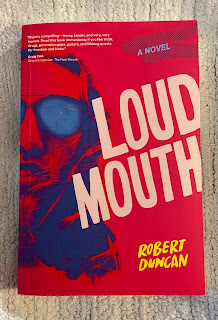
Loudmouth by Robert Duncan

Robert Duncan's Loudmouth was published in October of 2020, and I've had my copy for just over a year. Various things have delayed my reading, and thus this late review, for which I offer Rob an apology. You should know that I consider Rob a friend, more than just of the Facebook variety (although that's been our sole means of communication in recent years) and I'm confident that he returns the favor.

I got to know Rob near the tail end of the 1970s when we were both regulars at the Bells of Hell. We shared a love of rock music, and enjoyed the company of some of the other regulars, two of whom, legendary rock critic Lester Bangs and "The Village Legend" to whom Rob gives the pseudonym Eddie Neil, appear as important characters in Loudmouth. I was invited to Rob's birthday party, held in a Village apartment much spiffier than the Gum Joy Tower flat occupied by Thomas Ransom, protagonist of Loudmouth. When I got there, I saw a long black limo, its engine idling, parked in front. At the party a woman with black hair, wearing a black dress, broke into an upward mezzo soprano glissando. Someone standing next to me said, "That's Liza Minnelli." He then said he understood she and Rob had been in high school together. 

But enough about me; what did I think of the book? First, it's bracketed by rivers. The brief "Chapter 0" at the beginning has the title "Cuyahoga," that being the river that flows through Cleveland and is notorious for having once caught fire. It concerns a tour arranged by Tom Ransom for "Bruce," identified only as such but obviously The Boss, and guided by Charlie, a Cleveland native and friend of Tom's. Charlie shows them a series of dive bars, a record store, and the radio studio where Allen Freed held forth back in the day. At this point I can't resist another personal anecdote. One afternoon in 1970 I was in a law school friend's room when he tried to return a call from his brother, a writer for Cleveland After Dark. When there was no answer at home he called information for Cleveland (remember those days?) and got an operator who, asked for the number of Cleveland After Dark, said something like, "You've got to be kidding." Anyway, at the end of the tour, Charlie takes three 45 caliber bullets, gives one each to Bruce and Tom, then holding his says, "This is how we'll remember."

At the book's end comes "Chapter 00," even shorter than "0," with the title "Hudson." In it, Tom removes the bullet from his Rolodex, in which it's rested for some time. He worries that the gunpowder might be deteriorating in a way that will cause it to discharge spontaneously, with possible fatal consequences. He takes it to a nearby pier and throws it into the Hudson.

Why rivers? One of my teachers, probably my late, beloved twelfth grade English teacher Eleanor Blalock, asserted that rivers, in literature, always signify Life. Loudmouth is a "life," in the sense in which the British use that word where Americans use "biography." Consider W.H. Auden's "A Shilling Life Will Give You All the Facts." in which the poet observes that "all the facts" don't tell the reader what was really important to its subject. Loudmouth is biography. It is a fictional autobiography of Thomas Ransom. Unlike the book mentioned in Auden's "Shilling Life" it lays bare Tom's secret longings, failures, and disappointments, along with his accomplishments.

After I had gotten into Loudmouth, I began to wonder how much of it is fictional. I was led to compare Loudmouth's description of Tom Ransom's life with Rob's, as given in the brief "About the Author" squib at the back of the book. Southern mother; check. Writer for Creem magazine; check. Author of a book about Kiss; check. Singer and songwriter; check. And, as I've mentioned above, hanger out at the Bells; friend of Lester and of The Village Legend. So, is Loudmouth just disguised autobiography? Rob answered that question when he was interviewed by Deborah Kalb:
"Like most debut novels, there's a lot of non- in Loudmouth's fiction. But it's still not an autobiography or memoir. And if only a part of it is fact, all of it is the truth -- perhaps the deeper truth, arrived at by reimagining a life at slightly different times and places, in a slightly different order, with slightly different characters, blurring the physical reality to bring the metaphysical into slightly sharper focus."
I know that when I contemplated writing a novel, I started with my present situation, then tried to imagine how things might be if, at certain junctures, I had - taking a cue from Robert Frost - chosen a different path, or if I were to set off on a different one. Unlike Frost, I took what was, I'm sure, the path more travelled, seeking success in a conventional, bourgeois way. Still, there was that part of me that wanted to be a writer, as well as a corporate lawyer. This had a bad effect on my career in two ways. First, I got into a pattern of missing deadlines because I wanted my memos not only to be legally airtight but also stylistically worthy of consideration for a Pulitzer. Second, as I noted here, the amount of time I was spending in the "Village demimonde," meaning the Bells, and after it closed, the Lion's Head,  contributed to my work woes. The Head had a reputation as a writers' hangout. A woman once came in and said to those assembled at the bar, "I hear this is a place for writers with drinking problems." Village Voice scribe Ace Gillen replied, "No, it's for drinkers with writing problems."

My writing problem was that I never got started, except for a few short pieces in professional journals, at least until I started this blog. Loudmouth gave me a view of what life was like for a music writer in the 1970s. More than that, it gave me a sense of what my life might have been like had I decided to jettison my desire for conventional respectability and indulge that for artistic renown. It wouldn't necessarily have turned out badly; things didn't turn out badly for Rob.

Returning to Rob's interview, Ms. Kalb asked him, "What do you want readers to take away from the novel?" His answer:
"I hope that readers think it's funny, sad, surprising and maybe, in parts, lovely. I hope they enjoy the words, sentences, and paragraphs, the rhythms and music, as much as the characters and scenes. I hope they pick up on what's going on between the lines and among the lines, the wordplay, inside jokes, compulsive allusions to songs, bands and pop culture."

I found it funny, sad, surprising, and, yes, lovely.  I can't say I caught all the inside jokes and allusions, but did get enough to give myself a figurative pat on the back. Then there's this:

"Ultimately, I hope it gives the reader a fresh glimpse of the wonderous/disastrous complexity of life."

That it gave to this reader. I commend Loudmouth without reservation.
Monday, January 17, 2022

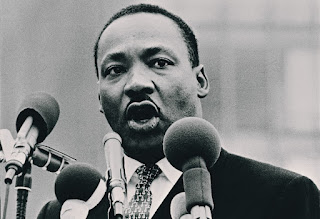
How best do we honor Dr. King today?

On May 15, 1957, on the steps of the Lincoln Memorial, Dr. Martin Luther King, Jr. gave a speech to a group assembled for a Prayer Pilgrimage for Freedom. The theme of that speech was "Give Us the Ballot". Eight years later Congress passed and President Johnson signed the Voting Rights Act of 1965, which banned practices concerning eligibility or ability to vote that disproportionately affected racial or linguistic minorities. 

However, in two decisions the Supreme Court has drastically limited the Act's effectiveness. Shelby County v. Holder, 570 U.S.529 (2013) declared the Act's section 4, which determined which jurisdictions should be subject to the Act's section 5 empowering the federal government to pre-clear any proposed changes to voting regulations in jurisdictions that historically practiced discrimination, unconstitutional on the grounds that the conditions that justified it in 1965 had been eliminated and that it therefore constituted an infringement on the states' power to regulate elections under the Tenth Amendment. There were strong arguments that the Court's decision lacked a factual basis.

Last year the Court delivered an even stronger impediment to the efficacy of the 1965 Act in Brnovich v. Democratic National Committee, 594 U.S. __, 141 S. Ct. 2321 (2021). This decision held that Arizona's statute prohibiting third party collection of ballots and out-of-precinct voting, despite having disparate impact on minority voters, could not be invalidated under the Act's section 2 or the Fifteenth Amendment. In its decision the Court proposed "guidelines" for evaluating voting restrictions that would allow those having disparate impact where the burden imposed is seen as small in comparison to the state's interest in imposing the restriction. The Court's analysis of section 2 has been characterized as "ahistorical and atextual"

The John Lewis Voting Rights Advancement Act, now combined with the Freedom to Vote Act, would effectively overturn Shelby and Brnovich, as well as providing new protections for access to the polls and governing the redistricting process. However, the likelihood of passage is now close to zero, given Sen. Kyrsten Sinema's opposition to changing the filibuster rule. Meanwhile, many states have been busy enacting legislation to restrict access to the polls. As of last July eighteen states had enacted some such legislation. Texas has since enacted its omnibus bill that places many restrictions on voting.

What can be done, given the almost certain unavailability of legislative relief and the Supreme Court's (and many lower courts') hostility to challenges of state voting restrictions? Given the new landscape, the best we can manage - and it will be a challenge - is to do all we can to assure that all prospective voters, minority or not, get whatever assistance they need to jump through whatever hoops are raised between them and access to the ballot, and to get their votes counted accurately. By doing so, we will be honoring Dr. King's legacy.

Monday, January 03, 2022

Remembrances and appreciations, 2021

A year ago I did a separate post to show 2020 the door. I'm sure we can all agree that 2021 has, on balance, been less than delightful. There were many good things that happened, including in our neighborhood. Still, the emergence of Omicron, some severe weather disasters, and inflation driven by, in my view, a combination of manufacturers' misestimation of demand, supply chain problems largely caused by COVID, and concentration of economic power in some important industries, have made it a trying year indeed.

There are plenty of remembrances. Those most personal to me include Ron Jones, who was a valued mentor during my early years of law practice and a friend for years after; Wally Brewer, friend and fellow Grace Church parishioner; friend Leonard Ryan; and Martha's cousin and our friend Alice McFarlane.

2021 saw the passing of many people prominent in matters of government and statecraft; local, national and international. I remembered Colin Powell and Desmond Tutu on this blog. They were joined by F.W. de KlerkBob DoleFrances "Sissy" FarentholdVernon JordanWalter MondaleHarry ReidGeorge Shultz, and John Warner. Special mention goes to Sarah Weddington, the lawyer who, at the age of 26, successfully argued for appellant "Jane Roe" before the U.S. Supreme Court, and who went on to serve as a Texas legislator and, later, advisor to President Jimmy Carter, in which roles she continued to be an effective advocate for women's rights. There are others I've failed to mention, for which I trust you'll forgive me.

Music suffered many losses. Those most keenly felt by me are Don Everly, who joined younger brother Phil among the departed; Maestro James LevineMary Wilson of the Supremes; Nanci GriffithPaddy Moloney of the Chieftains; Stones drummer Charlie WattsMichael Nesmith, best known for having been one of the Monkees but who had a fruitful solo career as a singer and songwriter; and Chick Corea. One musician we lost whom I wish I had known better is the rapper DMX

Straddling the worlds of music and the stage was the magnificent Stephen Sondheim. The worlds of stage and screen lost, among many, Ed AsnerNed BeattyOlympia DukakisHal HolbrookCloris LeachmanChristopher PlummerCicely TysonMelvin Van Peebles, and Michael K. Williams. I wasn't a Betty White fan, not because I disliked her (who could?), but because I rarely watched the TV sitcoms and game shows on which she made many of her appearances. If anything, I associated her with commercials. I'm now delighted to learn that in 1954 she defied demands from Southern viewers that she remove Arthur Duncan, a Black dancer from her variety show. 

The literary world had its share of losses. Those the impact of which I feel most are novelist, essayist, and social critic Joan Didion, poet Lawrence Ferlinghetti (whom I once saw, bent over his manual typewriter, during a visit to his City Lights bookstore in San Francisco), and Larry McMurtry, realistic chronicler of the old and contemporary West.

Space exploration lost Michael Collins. As pilot of the Apollo 11 command module, "Iron Mike" remained aboard while crew members Neil Armstrong and Buzz Aldrin took the Lunar Excursion Module to the moon's surface and back.

Among baseball's losses were Hank Aaron, who broke Babe Ruth's long standing career home run record in 1974 and held it for thirty years; Jim "Mudcat" Grant, the first Black twenty game winning pitcher who enjoyed a post-baseball career as an R&B singer; and Tommy Lasorda, who began as a pitcher for the Brooklyn Dodgers and went on to manage the L.A. Dodgers for twenty years, winning four league championships and two World Series. 

True to form in recent years, the Mets started hot but soon cooled off, again largely thanks to their injury proneness.  Owner Steve Cohen, looking for a quick turnaround next season, said "Fie to you, luxury tax; I'll pay" and opened his wallet to acquire ace pitcher Max Scherzer. The Mets also have a new manager, veteran Buck Showalter, three time American League Manager of the Year: once with the Yankees (1994); once with the Rangers (2004), and once with the Orioles (2014). The best I can say now is, I'm cautiously optimistic.

As always, I must begin my list of appreciations with my wife, Martha Foley, now not just for her encouragement of and suggestions for my blogging, but also for her self sacrificing help as I recover, slowly but surely, from my ankle injury. I also thank our daughter, Liz, and her boyfriend, Drew Rodke, for summoning help to deal with my injury, caring for me for two days - including a sumptuous Thanksgiving dinner - and driving me home to Brooklyn. Thanks to the physicians and nurses at Riddle Hospital in Media, Pennsylvania for stabilizing my fractures, and to the physicians, nurses, and physical therapists at NYU Langone Orthopedic Hospital for surgery, post operative care, and therapy. Finally, thanks to all my friends, too numerous to mention individually, who have provided support and encouragement, either in person, on the phone, or in writing.

Wednesday, December 29, 2021

Rick Danko, Vince Martin, Erik Darling, and Blondie Chaplin: how many names can I drop in one post?

I had the good fortune, during my evenings of hanging out at the Lion's Head in Greenwich Village during the 1980s, to get to know Rick Danko. He had been a member of the Hawks, a Canadian group that became the backup band for Bob Dylan, and later evolved into The Band. Rick died in 1999 at the age of 56.

Rick was unpretentious and welcoming. When I went to hear him and his post-Band group at the Lone Star Cafe, I was invited to join him and the other musicians upstairs during their break. Rather than breaking from singing, Rick picked up an acoustic guitar and sang "Cindy, Oh Cindy", a song that had been popular in 1956, when I was in fifth grade. When Rick finished, I said, "That's a great old Vince Martin song." Vince had done it with the Tarriers, a group that included Erik Darling, whom I had met at a party on the Upper West Side about ten years before, but that's another story. When I mentioned Vince's name, the man next to me turned and said, "Hello; I'm Vince Martin." I told him I loved Tear Down the Walls, a folk album he'd done with Fred Neil. Vince invited me to sing a song from the album with him. Rick handed Vince his guitar and we sang "Dade County Jail", me struggling to try to match Fred's rich baritone.

The clip above has Rick singing and playing bass on "Stage Fright", one of my favorite Band songs. Here he does it with another now deceased musician I admire greatly, but never met, Paul Butterfield. Paul was a veteran of the Chicago blues scene. On this clip he plays harmonica and sings harmony.


This clip features another of my Lion's Head companions, Blondie Chaplin, from the time when he and Rick were playing together, along with Paul Butterfield. On "Semolina" Blondie has the lead vocal and guitar, with Rick and Butter harmonizing and playing bass and harp, respectively. Blondie, a South African, became a member of the Beach Boys in 1972 after Al Jardine and Carl Wilson spotted him performing in London with his band, the Flames. After the time I knew him at the Head, he toured with the Rolling Stones for several years, and more recently has toured with Brian Wilson. He also has a solo album, recorded in 1997, that he plans to have released soon.

Sunday, December 26, 2021

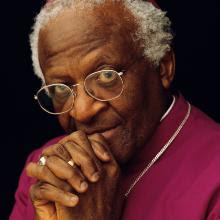
Archbishop Desmond Tutu, 1931-2021

I've said before that the two people I am proudest to have met and with whom I've enjoyed short but inspiring conversation are the late Congressman John Lewis, whom I met at an ecumenical student conference in Atlanta in 1967 when he was head of the Student Non-Violent Coordinating Committee and the prospect of his ever serving in Congress seemed remote, and Archbishop Desmond Tutu, who died today in his beloved homeland, South Africa. I had the good fortune to hear Archbishop Tutu preach at St. James' Church during the early 1980s, and to meet and have conversation with him after the service. I regret that I don't have better recollection of the specifics of my conversations with these two most worthy men, but I know that I came away from them better for the experience.

Perhaps the defining characteristic of Archbishop Tutu was his generosity of spirit, which led him to seek healing and reconciliation following the end of the brutal apartheid regime which he had struggled to overcome. He also showed moral consistency in his opposition to corruption that undermined the government following the transition to full equality of citizenship for all South Africans. I chose the photo above, a profile photo from Prabook.com, because it reflects his intelligence but also hints at his playfulness and sense of humor.

Friday, December 24, 2021

"Once in Royal David's City"

One of my favorite Christmas carols, performed by the choir of King's College, Cambridge. This was one of many hymns written by an Irish woman, Cecil Frances Alexander Humphreys. Most of her compositions, including this, were written with children in mind.

Thursday, December 16, 2021

Beethoven, "Pathetique" Piano Sonata, Op.13, 2nd Movement

In honor of Ludwig Van Beethoven's 251st birthday, here's a brilliant performance by Daniel Barenboim of the ethereal second movement of his "Pathetique" piano sonata.

Tuesday, October 26, 2021

The World Series is underway; I'm casting my lot with the Braves


 It didn't turn out the way I wanted. My Mets had a promising start, then, as has long been their wont, imploded. That left me with two possibilities: my old home town's team (although it didn't exist until long after I left there), the Rays; and my wife's team, the Red Sox. The Sox knocked the Rays out of contention, then were knocked out by the Astros. Meanwhile the Braves won the National League pennant. 

How do I choose? Atlanta and Houston are both cities in which I've spent some time, and like. They're both islands of progressivism in otherwise mostly conservative states, although Texas has a proud liberal tradition (I remember Governor Ann Richards giving the keynote address at a convention I attended in Houston in which she suggested the insurance industry needed more effective regulation and, when only one man clapped, said, "You're a lo-o-onely feller!"). I also remember hearing some great blues at a little place called the Reddi Room on White Oak in Houston. 

I'll forgive Atlanta for having, at the height of the civil rights struggle in the 1960s adopted the most tone-deaf slogan imaginable - "The city too busy to hate." (Sorry, can't make it to the Klan rally; my company has to file a 10-K.) I have fond memories of an "Ecumenical Conference on Urbanization and Technology" I attended in 1966 at the Emory University campus, during which I met and had a short but inspiring conversation with the then head of the Student Non-Violent Coordinating Committee, a young firebrand named John Lewis. Years later, I had my blues experience at Blues Harbor in Underground Atlanta, where I heard Clarence "Gatemouth" Brown and got to meet and talk with him after his set.

So, who do I pick to win the Series? I'm a Mets fan, and they're a National League team, so, despite the Braves' often having been the Mets' nemesis, I'm going with the Braves. For what it's worth (probably not much), as I write this they have a 5-0 lead in the bottom of the third in game one. Oh, and since the Braves started as a Boston team, my wife has some skin in this game, too.

Whoever wins, though, I won't be that disappointed.

Monday, October 18, 2021

Colin Powell, 1937-2021

Some years ago - probably in the fall, winter, or early spring, because I had left work and it was dark - I was walking along Madison Avenue, past the former General Motors building, when I saw a man coming out of it and walking parallel to me. He looked to be maybe five-eight; I was five-ten at the time (age has reduced me to five-seven). I wondered if he might be a partner in a law firm for which I had done some work several years before and had its offices in that building. 

When we got to the corner of 59th Street and Madison, a young cop looked at him and said, "General! I was in the Gulf War." He went on to praise his leadership and say how proud he was to have been on his team. 

I mentally slapped myself for not having recognized Colin Powell in the flesh. As, it seems, often happens, I had expected him to be much taller.

I won't try to add to all that's been written about this son of Jamaican immigrants who became a transformational leader in the military as well as in civilian politics and diplomacy. We've lost a great one.

Tuesday, October 05, 2021

Some pet peeves I can't give up.

"To give" as opposed to "to gift" is still a good and useful verb. Using the past tense "gave" instead of "gifted" saves space, and avoids confusion with an adjective meaning "having great natural ability: talented" (Merriam-Webster). I know I've lost this battle; I'll never forgive you, Jerry Seinfeld.
Apostrophes belong in possessives and contractions; not in plurals. You're going to a show with the Smiths, not the Smith's. Some exceptions: (1)"its" as a possessive doesn't take an apostrophe, to avoid confusion with "it's" as a contraction of "it is"; (2) hers, his, ours, theirs, and yours don't take apostrophes. Mostly it's the misuse of apostrophes in plurals that annoys me. 

If you drop something on the sidewalk and don't pick it up, you lose it. If you deliberately let something go, you loose it. 

Tampa is a city; Tampa Bay is a body of water. If you say "I'm going to Tampa Bay" I'll advise you to pack your SCUBA gear (unless you're a pro baseball, football, or hockey player).

Friday, September 10, 2021

Twenty Years

Here's the poem I posted fifteen years ago: 

It’s five years since the turbofan clatter, 
the sudden silence, the loud report, the screams,
the gashed tower, the smoke, then the flame, 
and the realization… 

I like to imagine a time when you, George and I 
take the heavenly PATH to celestial Hoboken, 
where, at the bar of the cosmic Brass Rail, 
we’ll sip ambrosial Berliner weisse.
This time, Brando will join us.

By way of explanation, George was a friend and Yale Law classmate of Charlie's, and a friend of mine. He died of heart failure a few years before 9/11. One afternoon Charlie, George, and I were having beers at the Lion's Head, and Charlie, a great film buff, said he wanted to go to Hoboken and look for the scenes where On The Waterfront was shot. We took the Port Authority Trans-Hudson ("PATH") subway that connects Manhattan to New Jersey. When we got there, we were able to find some places Charlie recognized as having been in the movie. We then found a great old fashioned bar on Washington Street, Hoboken's main drag. The bar was called the Brass Rail and had lots of brass fixtures and wood paneling. As we took our seats we noticed a man sitting near us sipping what looked like iced tea, and asked the bartender what it was. He said it was Berliner weisse mit schuss, Berlin white  (wheat) beer, flavored with a dollop of raspberry syrup, and garnished with a lemon slice. We each had one, and loved it.

I'm adding to my post to mention two others who weren't close friends but who also perished on 9/11. I enjoyed some conversation with Kristin Gould White at the Lion's Head. She was on Flight 93, which crashed in Pennsylvania. The story at the close of her linked tribute of how her daughter learned of her death is heart-rending. I met Joe Lostrangio at a reinsurance related event less than a week before 9/11, and we had a tentative lunch date for the week after. Having read his linked tribute, I wish I'd had the chance to get to know him better. For those of you who didn't know Charlie McCrann, here's his obituary.

Sunday, September 05, 2021

"Union Maid"; a song for Labor Day

"Union Maid" has lyrics by erstwhile Brooklynite Woody Guthrie, set to the tune of a popular song from 1907, "Red Wing," which had music by Kerry Mills which he adapted from a piano piece by Robert Schumann. This lively rendition is by Jack (guitar) and Joe Sundell (banjo), with Bill Thurman (fiddle). Happy Labor Day!

Saturday, August 07, 2021

The Mets are no longer first in their division.

 I started to write this when they were only a half game behind the Phillies. Now, with a second loss to the Phils, they are a full game and a half behind, and tied with the Braves for second place.

The Mets showed tenacity in holding on to first place through most of the season to date, although for most of the season this has been enabled by their being the only team in the NL Eastern Division with a winning record. The Phils and Braves now have records in the winning column, both thanks in part to the Mets, and the Mets are now a mere two games over .500.

As the All Star Break ended, it was widely believed that the Mets were facing bleak prospects, as both ace pitcher Jacob deGrom and hard hitting shortstop Francisco Lindor had gone onto the disabled list. Coming off the break, they lost two of three to the Pirates, then won two of three from the Reds and two of three from the Blue Jays. Things weren't looking so bad. Then they lost three out of a five game series with the Braves, two out of three to the Reds, then three out of four to the Division's bottom dwellers, the Marlins. During this unhappy period, Taijuan Walker, the pitcher who had shown early promise with seven wins, was tagged with two losses. This brought them to the series with the Phils, in which they have now lost two straight.

Mike Petriello analyzes the Mets' stats for the year, and gets rid of some theories about why they underperform on offense. I've long thought they are particularly bad in "clutch" batting situations, but he shows they aren't especially so compared to other teams this season. What he brings it down to is something that has bedeviled the Mets over the years: injuries. Why are the Mets so prone to injuries? I attempted an answer here.

What are the Mets' chances now? I think they're pretty slim. Things may improve a little when de Grom and Lindor come back. If the Braves and Phils both fade, there's even a possibility the Mets could be divisional winners. If they don't win the division, there's hardly any chance of their being a wild card team, given the records in the other divisions. If they do get to the first round of the playoffs, they will be up against a team, whoever it is, with far better statistics. Do statistics tell all? Not always. 

That all said, I gotta believe!

Update: the Mets are down 3-0 to the Phils in the bottom of the 7th, while the Braves are leading the Nats 5-1 at the top of the 7th. Barring late inning magic in both games, the Mets will be relegated to sole possession of third place in the NL East.

Image: Meet the Matts

Friday, July 30, 2021

The Economist's "Johnson" beckons me off my usage high horse.


 Well, at least a little. This week's issue of The Economist, in its "Johnson" column, a regular feature dealing with usage matters and named in honor of Dictionary of the English Language author Dr. Samuel Johnson, is captioned "Death nails and foul swoops". It so appears in the print edition; the on line edition linked above, which may be fully available only to Economist subscribers, gives the title as "Sometimes solecisms can reveal linguistic ingenuity." Merriam-Webster's first definition of "solecism" is "an ungrammatical combination of words in a sentence: also a minor blunder in speech." 

The particular solecism to which the columnist refers is the "eggcorn," defined as "a particular kind of mishearing of a word or phrase" that "has a logic that makes it alluring." The word "eggcorn," which is a mishearing of "acorn," has such a logic. "Acorns and eggs have similar shapes, and both produce life." The "Johnson" author gives several other examples of eggcorns. "Death nail" for "death knell" makes sense because nails are associated with death, being used to secure coffins. "Knell," meaning the sound of large bell, such as a church bell that would be rung for a funeral, is not now widely familiar, except perhaps to those who have memorized the opening line of Thomas Gray's "Elegy Written in a Country Churchyard": "The curfew tolls the knell of parting day." Similarly, "in one foul swoop" makes more sense to contemporary readers than "fell swoop," as "fell," when used as an adjective, and the fourth entry for that word in Merriam-Webster, meaning "fierce, cruel, terrible"; or "sinister, malevolent"; or "very destructive, deadly"; or (in Scotland) "sharp, pungent"; is not much in use these days, whereas "foul," which fits all of these definitions, is. 

The author mentions several other eggcorns with approval. One is "to change tact" for "to change tack," presumably because most people don't know how to sail. Still, to me, "tact" seems questionable. Again, I resort to Merriam-Webster, which gives two definitions of "tact": the first is "a keen sense of what to do or say in order to maintain good relations with others or avoid offense"; the second is "sensitive mental or aesthetic perception." So, would a "change of tact" mean a loss of the "keen sense" or of sensitivity? That doesn't seem good. Arguably, I suppose, it could mean that the "keen sense" tells you that you should change your approach in order to "maintain good relations" or "avoid offense."

This all makes me reconsider something I posted here twelve years ago, about what I called "the rein vs. reign syndrome." My first objection in that post, to the Wall Street Journal's referring to an effort to "reign in" instead of "rein in" a jury award, is one I stand by. The intended meaning here is to check or decrease the award, as one checks the speed of a horse by pulling on a rein. The problem comes with the expression "to give [or allow] free rein." This is now frequently changed to "free reign." To give a horse free rein is to allow it to proceed at its own chosen pace. To allow a person free rein is a metaphorical way of saying they are free to do as they choose. As for "reign," I resort once again to Merriam-Webster, which gives several definitions of reign, both as a noun and as a verb. I'm more interested in the verb definition, the third of which is "to be predominant or prevalent." The question then becomes whether the giving of "free reign" refers to oneself or to another. In the contexts in which I've seen it, I think it mostly, if not entirely, means the latter. Consequently, I now believe "free reign" for "free rein" is a true eggcorn. 

It occurs to me that the tact vs. tack and rein vs. reign controversies may reflect class or geographical differences. These days, to many Americans sailing is considered an "elite" avocation, so "tack" may seem foreign to them, although I doubt this holds true in some coastal and lakes regions. Similarly, rein is an equestrian term that would be unknown to most of those in urban areas, and to many of the poor in others. It would be interesting to see how these substitutions are distributed geographically and by average income.