Showing posts sorted by relevance for query erie canal. Sort by date Show all posts

Sunday, March 11, 2007

Sal's retired, but the Erie Canal still hauls freight.

I've got a mule, and her name is Sal,
Fifteen miles on the Erie Canal.
She's a good ol' worker an' a good ol' pal,
Fifteen miles on the Erie Canal.
We've hauled some barges in our day,
Filled with lumber, coal, and hay,
And we know every inch of the way
From Albany to Buffalo.


(Lyrics courtesy of Houghton Mifflin Social Studies - "A More Perfect Union")

Last year I posted a piece about Red Hook, Brooklyn, in which I explained how the Erie Basin, an artificial harbor there, got its name from its use in the nineteenth century as a transshipment point for grain from the Midwest that had been carried by barge from the Great Lakes, across the Erie Canal, then down the Hudson to Brooklyn, where it was loaded onto oceangoing ships for far away destinations. I had assumed (yes, I know the derivation) that railroads and trucks had long ago put an end to any carriage of goods on the New York State canal system, and that these historic waterways were now used only by pleasure craft, including the tourist boat on which my wife, daughter and I made our way through the locks at Lockport, New York (see photo below, as the gates of Lock 34 open and the World's Widest Bridge looms ahead) the summer before last.


So, I was delighted to find this NPR piece, which shows that there is still cargo traffic on the canal system, and that it is increasing. Note: I've updated this link to replace one from 2007 that had expired.

Sunday, April 23, 2006

The walk home through Red Hook

This is a postscript to my post on the Queen Mary 2. I mentioned there that her new berth in New York is located in a Brooklyn neighborhood called Red Hook. For many years, the economic focal point of Red Hook was the Erie Basin, an artificial inlet formed by piers and seawalls. My photos of the departing QM2 were taken facing west, toward the Buttermilk Channel. Had I turned around to the east, I would have been facing the piers that form the southern edge of the Erie Basin.

Why Erie? During the nineteenth century, this became the final transshipment point for grain bound overseas; grain from the West that had been shipped across the Great Lakes to Buffalo, loaded onto horse or mule drawn barges and taken via the Erie Canal and Mohawk River to the Hudson at Albany, then transferred to Hudson sailing vessels that brought it to Brooklyn. Here it was unloaded from the Hudson sloops and schooners into elevators that later deposited it into oceangoing square-riggers bound for Europe or other destinations. What made this trade possible was the opening of the Erie Canal.

Red Hook has thus been a busy place for many years. While the canal and riverine grain trade ended long ago, it has remained an active commercial waterfront. For a time, sugar replaced grain as the bulk commodity handled there, this time as an import rather than export. It was also the site of a ship repair facility operated by Todd Shipyards, and a smaller service dock for tugs and barges remains. Below is a photo of part of the Erie Basin as it appears today, taken from the website of the Bridge and Tunnel Club (www.bridgeandtunnelclub.com). The large metal structure is a now derelict sugar silo, and next to the ruined pier in the foreground are the masts of a sunken lightship.

A small container port has operated at the northern edge of Red Hook and along the Columbia Street waterfront for some years, despite the lack of a landside rail connection. A year ago, I got this shot of two small container ships, Maersk Nassau and Industrial Century, docked there.

The continued existence of this cargo operation is threatened by the increase in value of the land it occupies for possible residential development. Nevertheless, Red Hook's continued use as a port seems assured by the addition of the passenger ship terminal at which QM2 now docks.

The inland sections of Red Hook have become an intruiguing variety of building types and uses. Its history is proclaimed by nineteenth century warehouses,

as well as by streets bearing haunting names.

Other interesting nomenclature may reflect a more contemporary mindset:


Buildings along Columbia Street, Red Hook's main commercial thoroughfare, are an odd patchwork. Consider this trio, which likely were identical when built:

The plaster chef holding the list of the day's specials was doing his job well, as the cafe behind me was transacting a lively business.

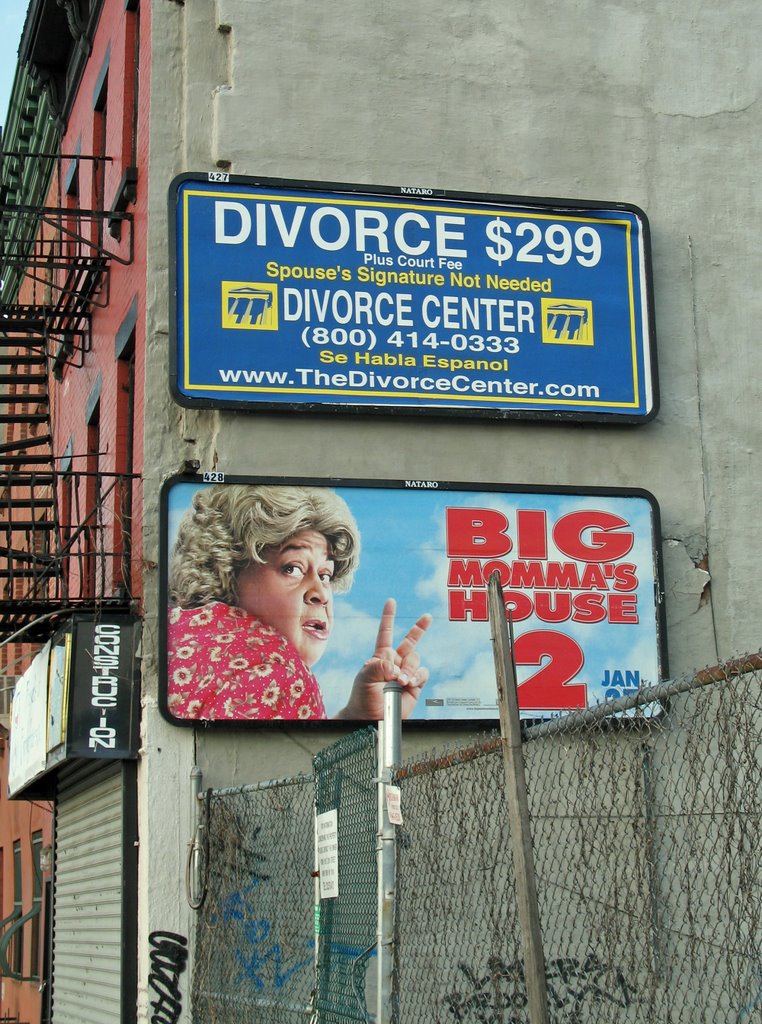
Walking north out of Red Hook on Columbia, I encountered two very contemporary signs attached to the south wall of a nineteenth century row house. The upper one had reassuring words for those contemplating splitsville.

Returning to my own neighborhood, Brooklyn Heights, I passed Our Lady of Lebanon, a Maronite Catholic cathedral at the corner of Henry and Remsen Streets (see photo at left). I've been told that these ornate metal doors were salvaged from the Normandie, the great French liner that burned and capsized at a Manhattan pier during the early part of World War 2 (see below for a photo, taken from www.ocean-liners.com, of Normandie leaving New York during her brief career as one of the queens of the North Atlantic.)

Saturday, June 05, 2021

A Finger Lakes weekend, two train journeys, and lots of wine.

Our friends Chris Bennem and Lisa Moore invited us to spend the long Memorial Day weekend at their house near Canandaigua Lake (photo above), one of New York's glacially carved Finger Lakes, so called because they are long and narrow, and all oriented north to south.
To get there we took Amtrak's Empire Service from New York City's Penn Station to Rochester. The Empire Service follows the former New York Central's "Water Level Route": north along the east bank of the Hudson River to Albany, then westward paralleling the Mohawk River and Erie Canal to Rochester and Buffalo. The scenery along the Hudson is gorgeous. The photo above shows Storm King Mountain, with some cloud cover.
The Hudson is navigable for ocean going ships as far north as Albany. Here's the small tanker Palanca Rio heading southward, having discharged her liquid cargo somewhere upstream.
There are lighthouses along the Hudson to warn navigators away from shoals. This is the Hudson Athens Lighthouse, near the town of Hudson, New York.
Past Albany, we continued on the "Water Level Route," now going westward instead of northward. The tracks paralleled the Mohawk River and Erie Canal, which for some distance, including the stretch near Herkimer shown in the photo above, share the same watercourse.
At the Utica station a New York Central (which later became part of Penn Central, then Conrail, and now CSX) 0-6-0 yard switcher was on display. A family with a very chubby Corgi were waiting to greet someone arriving on an eastbound train.
Chris and Lisa met us at the Rochester station. On the way from Rochester to their house some miles south, Chris took us on a tour of some of the spectacular houses, mostly Victorian, to the south of downtown Rochester. There was also this Frank Lloyd Wright "Prairie Style" house, built for the widower Edward E. Boynton to give to his daughter, Beulah, for a cost in 1908 of about $50,000. (Photo by Martha Foley)
On the way we passed through the small city of Canandaigua, at the north end of the lake. Just past the city's south end there's a club where people have boathouses with small living quarters above the boat storage, for use during times of serious boating. (Photo by Martha Foley)
Here is Glen Hollow, our home for the long weekend. We had the guest cottage in the back.
Here's some information about its history. Humphrey Bogart grew up on the Willowbrook Estate.
Saturday evening was chilly, so Chris lit a fire. Lisa gave us a sumptuous steak dinner.
On Sunday morning I took a walk along this inviting forest path leading westwards from the house.
To the left of the path was this stream, known as the Seneca Point Gully.
The Senecas, or as they call themselves, the Onondowaga, "People of the Great Hill," were here before any European interlopers arrived. Some years ago I did a blog post about, among other things, their creation myth, that had them emerging from Clark's Gully (not their name for it) on the eastern shore of Canandaigua Lake, opposite from where we stayed.
The Finger Lakes are now an established vinicultural region. On Sunday afternoon, we went on a wine tour. These are the Ingle vineyards at Heron Hill, our first winery stop at their satellite location near Glen Hollow. I was especially impressed by Heron Hill's Gewürztraminer, an Alsatian white varietal that does well in the cool Finger Lakes climate. I also liked their Cabernet Franc, a Bordeaux red of which I've had good examples from the North Fork of Long Island and, believe it or not, Cape Cod's Truro Vineyards.
Our second stop was Ravines Wine Cellars, near Geneva on Seneca Lake. Highlights for me were "Cerise," a blend of Pinot Noir and Blaufrankisch, a red grape from Austria and Germany, and their "Agricolae" Pinot Gris, another Alsatian white varietal. 
Our final winery visit was to Domaine Leseurre, on Keuka Lake, which can be seen in the background of the photo above, near Hammondsport. When we arrived the owner, Sebastien Leseurre, showed us into the tasting room and graciously provided us with platters of charcuterie to enjoy with our Cabernet Franc Rose. After the rose, we had glasses of their fine Dry Riesling.
Here are our favorites from the tastings, left to right: Heron Hill's 2017 Gewürztraminer and its 2017 Cabernet Franc; Ravines' 2019 Cerise and its 2017 "Agricolae" Pinot Gris; and Domaine Leseurre's 2017 Dry Riesling and its 2019 Cabernet Franc Rose.
Monday, Memorial Day, was sunny. Here's a view from the window of the guest cottage where we were staying.
Chris and Lisa treated us to a hearty lunch, with a shrimp cocktail platter from Wegman's (members of the Wegman family have houses on the lake shore near Glen Hollow), Zweigle's delicious Rochester hot dogs, and, of course, more wine.
After lunch, Lisa, Martha and I took a walk along Seneca Point Road. We passed this neighborhood amenity.
This fierce gargoyle defends the palatial garage of the estate of the one of the Sands brothers, whose wealth comes from Constellation Brands, which came from "humble beginnings in 1945 as an upstate New York wine producer" to a major consumer package goods company with a "premium portfolio of iconic brands, including Corona Extra, Modelo Especial, Kim Crawford, Meiomi, The Prisoner, SVEDKA Vodka and High West Whiskey."
Another view of Canandaigua Lake, as seen from Seneca Point Road.
Early Tuesday afternoon we boarded Amtrak's Maple Leaf (which now, because of Canada's COVID restrictions, originates in Niagara Falls, New York instead of Toronto) at Rochester station for the return journey to Penn Station and New York City.
Once again we were following the course of the Mohawk River and Erie Canal; their joint waterway is seen here.
We crossed the Hudson River at Albany before turning southward towards New York City.
At the Albany/Rensselaer Station, which is across the river from Albany, another Amtrak train was waiting to head south. In the background is the Empire State Plaza's skyscraper, a monument to Governor Nelson Rockefeller's "edifice complex."
As we headed south along the Hudson I caught this view of the Catskill Mountains from near Hudson, New York.
The sun had set as we passed under this bridge at Rhinecliff, New York.
I had thought the bridge at Rhinecliff would be my final photo of the journey, but there was still enough light to get this picture, taken just south of Poughkeepsie, of a sloop anchored in the Hudson and Pollepel or Bannerman Island and Bannerman Castle beyond. 

We arrived at Penn Station on time, and were home in time to get a good night's rest after a most enjoyable short holiday.

Thursday, August 23, 2007

Erie Canal delineated!

If you survived elementary school music, you can probably remember the line:

From Al-ba-nee to Buf-fa-lo-oh

(If you need your memory refreshed, more of the lyrics are here.)

Anyway, it's good to know that New York State's government, despite its present continued dysfunctional nature, can get something done. According to this AP story:
Ending a dispute over the location of the ends of the Erie Canal, Gov. Eliot Spitzer [NY] said yesterday that Albany and Buffalo are the official eastern and western ends of the historic waterway. Supporters believe the designation will help develop the areas, particularly Buffalo's inner harbor. When the canal was built in 1825 it stretched 363 miles from Albany to Buffalo; an expansion in 1905, which allowed the passage of larger vessels, moved the navigable ends to the Hudson River in Waterford and the Niagara River in Tonawanda.
Thus, the original end-points are established. Woe to you, Waterford. Tough luck, Tonawanda. (Thanks to Johanna Turner of NYCMaritime for the link to the article.)

Update: Twiffer sez: i bet this will help buffalo get, like, a pro football team or even a hockey team. (New dads get excused from having to hit the shift key.) I can't resist recounting my first hockey game, which was a Sabres-Bruins match in Buffalo in 1971. I got to see Bobby Orr set some record -- I think it may have been scoring in a single game by a defenseman.

Meanwhile, August proposes a contest to name the Albany hockey team. He suggests the Pork; I counter with the Impasse.

Saturday, August 26, 2006

Riding Amtrak's Adirondack.

Amtrak's Adirondack runs daily, both ways, between New York City's Penn Station and Montreal. The northbound and southbound trains both leave early in the morning and arrive at their destinations in the evening. This allows passengers to enjoy some impressive scenery along the way. The conductor announced that the train had been named by National Geographic Traveler magazine as having one of the five most scenic routes in the world, which, he noted, put it in the same category as the Orient Express. If only its accomodations were as posh as those on the Direct-Orient, to use (for you persnickety railfans) its proper name. Nevertheless, for Amtrak, this is a pretty good operation. The equipment is standard, i.e. basic aging Amfleet coaches (this route cries for domes; alas, tunnel clearances don't allow them) (Update: According to Trains magazine, a dome car will be added to the train during the fall foliage season, but only for the route between Albany and Montreal, where tunnel clearances are sufficient), but the crew, at least on this run, was top notch. Rating special mention are Pat, the conductor from Albany to points north, whose thirty-eight year career extends back to the days when passenger service on this part of the route was provided by the Delaware & Hudson, and the cafe car attendant, identified by his badge as Mr. Graves, whose limited counter space and food-heating facilities were taxed by a crowded train, but who dealt with the impatient and sometimes cranky passengers with grace and humor.

Subway delays meant I made the Adirondack's 7:45 A.M. departure with seconds to spare, so I was forced to take an aisle seat. Consequently, I wasn't able to get photos of the first stretch of great scenery: the Hudson valley between New York City and Albany. As we approched the Hudson Highlands, the conductor announced that volunteers from the National Park Service would give a narrative about the historical and geological significance of the places we were passing, and that those wishing to hear it should gather at the rear of the cafe car. By the time I got there, all the seats were taken, so I returned to my coach and waited until we reached Albany/Rensselaer, a division point where there's both a crew and engine change, the latter meaning we swapped one GE Genesis type loco for another.
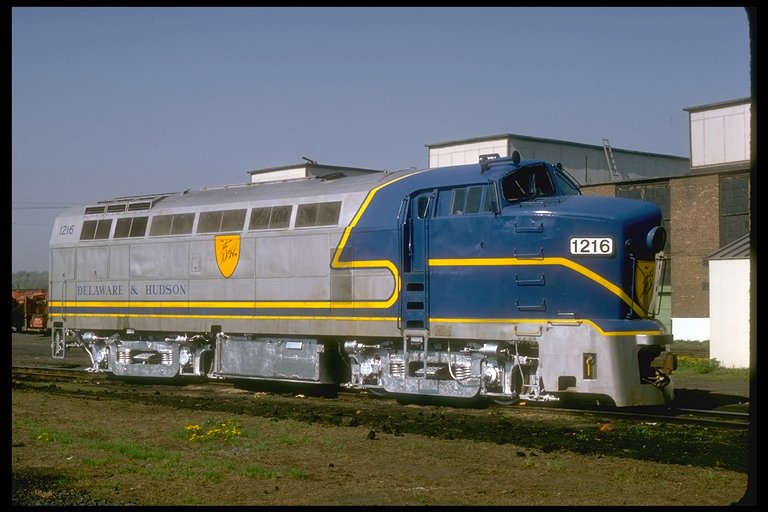
My first visit to this station was in 1970 or '71, when, as a first year associate in a New York City law firm, I was sent to Albany to do research on the legislative history of an obscure tax statute. This was before Amtrak, so the train I rode was operated by Penn Central, then on its last legs. When I got off, I saw across two tracks an A/A pair of Alco PAs in Delaware & Hudson colors, but in livery that was an obvious copy of the Santa Fe's "Warbonnet" scheme (see photo below, by J. Testagrose, which is courtesy of Brent Holt's Exotic Diesel site (the link is to the PA page), sponsored by The Railfan Network.)


I later learned why: D&H's PAs were purchased from Santa Fe, so the paint scheme they bore was basically a matter of putting blue over red. Indeed, I may have seen these same PAs heading AT&SF's Grand Canyon at its terminus when my parents and I visited the Canyon several years before.


The PA is regarded by many railfans as the best looking diesel ever made. To my eye, the Genesis (see left), while not so handsome as the PA, has a similar austere elegance. It's certainly an improvement on the clunky looking FP-40 that preceded it. Its sculptured lines suggest my own favorite of the first generation diesels, the Baldwin "Sharknose" (see photo below, by J. Hunt, again courtesy of Exotic Diesel), minus the nose.


After leaving Albany/Rensellaer station, we crossed the Hudson just north of downtown Albany, then headed west to Schenectady. Following a stop there, we turned north again towards Saratoga. Shortly after, Pat the conductor announced that a National Park Service volunteer would be in the front coach to talk about sights along the way. This time, I was able to find a seat. The volunteer, Dave, was a high school teacher from Schenectady. The first thing he said after I took my seat confirmed what I had suspected, that the abandoned industrial complex we had passed just after leaving Schenectady station was the American Locomotive Works ("Alco"), birthplace of the PA and many other steam and diesel locos.

As we approached Saratoga, Dave talked about the significance of the Revolutionary War battle fought there, in which Benedict Arnold, along with Horatio Gates, got credit for a victory which thwarted the British plan to isolate New England from the colonies to the south. He then discussed theories about Arnold's later turn to treachery, noting that the most plausible was his wife's hatred of their subsequent post at West Point. Arnold had sustained a wound at Saratoga that necessitated the amputation of his right leg, and there is now a monument at the Saratoga Battlefield National Historical Site to that booted leg, the only part of him, as Dave said, that never betrayed the revolutionary cause.


A short time after leaving Saratoga, we re-crossed the Hudson, now running almost west to east after descending soutwestwards from its source in Lake Tear of the Clouds, in the High Peaks region of the Adirondacks. What you see in the photo on the right is just the southern part of the river, as the far bank is Rogers Island, a place steeped in the history of the French and Indian War, as well as the ancestral home of the U.S. Army Rangers.

North of Rogers Island our route was parallel to the Champlain Canal, which connected the Hudson with Lake Champlain. This, along with another short canal bypassing rapids on the Richelieu River, through which Lake Champlain drains into the St. Lawrence, enabled watercraft to travel from New York City (or, later, after completion of the Erie Canal, from Buffalo and points on the Great Lakes to the west) to Montreal, or down the St. Lawrence to Quebec City.

As we continued northward, the canal broadened into what seemed a wide river, but was actually the southern part of Lake Champlain. The woods and green pasture on the opposite bank are in Vermont, which, as Dave noted, was not one of the thirteen rebellious colonies. In fact, it was for a time an independent republic.

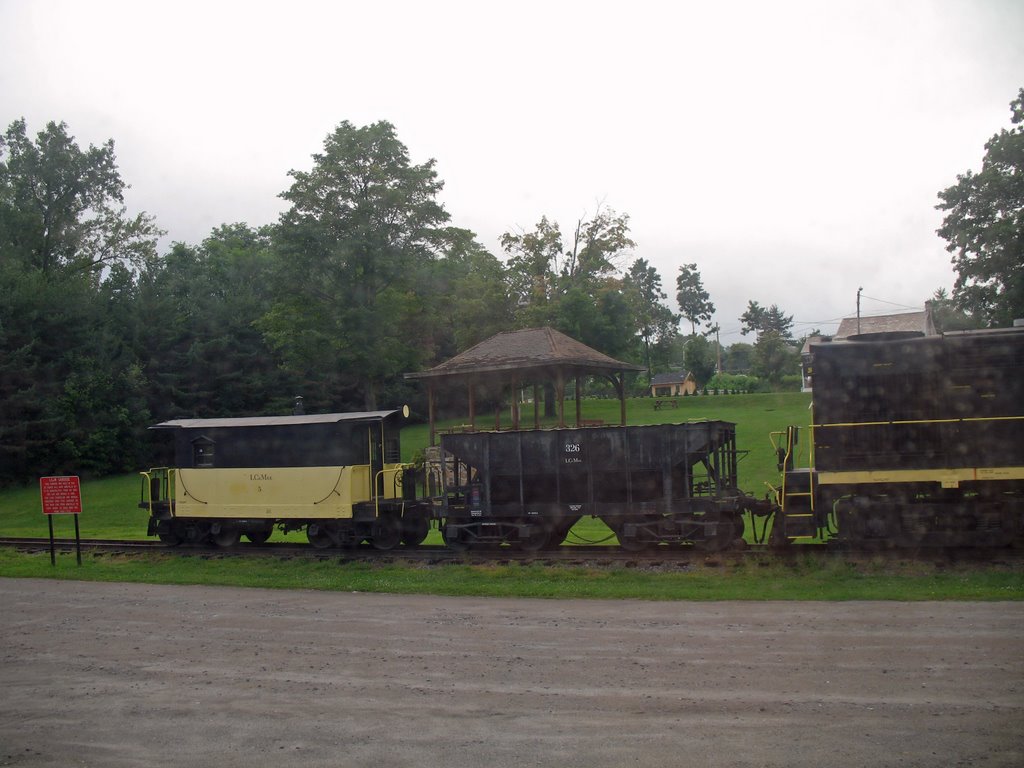
One of our stops on the west bank of Champlain was Port Henry, where there is a museum commemorating the Lake Champlain & Moriah, a mining railroad that hauled iron ore from a mine to the west to the Champlain shore, where it was loaded onto boats for transport north to Canada or south through the canal to the Hudson or the Erie. Below are photos of the rolling stock on display, which include an Alco freight engine, an ore bogey and a caboose; unfortunately, it was raining at the time I took them, and drops on the coach windows affect the quality of the images (there was no time to detrain there). (Update: for better photos, taken the following summer and winter, see here and here.)


At Westport, Pat announced that there would be time to get off and stretch our legs or placate our nicotine cravings. This allowed me to get
a shot of the still functional Victorian depot there.

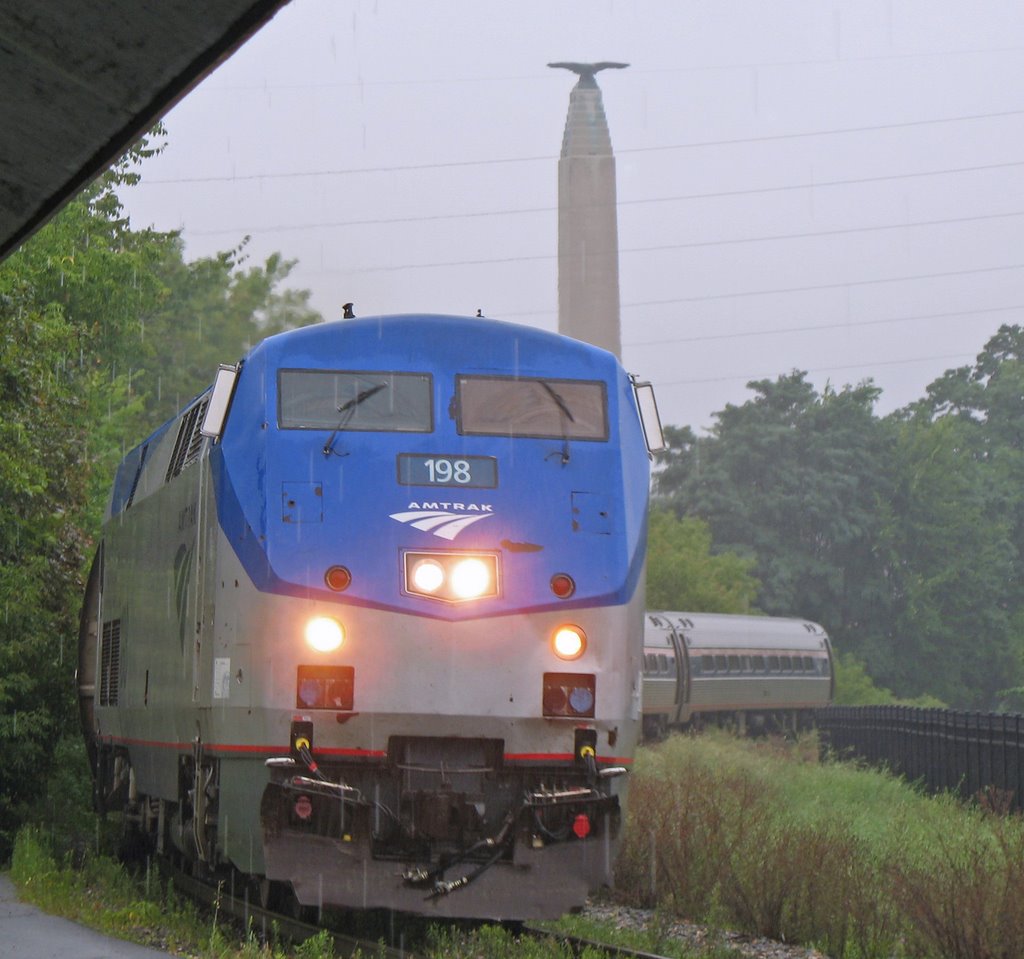
Shortly after Westport, we reached my destination, Plattsburgh. The following afternoon, I got the photo below of the southbound Adirondack arriving at Plattsburgh station. The monument in the background, surmounted by an eagle, commemorates the Revolutionary War capture of Fort Ticonderoga, which lies some seventy miles to the south, and is briefly visible from the train.


Update: for more photos and text from a later journey on the Adirondack, see here For a video showing scenery along the lower Hudson Valley taken from the train, along with an interview of your correspondent by a Wall Street Journal reporter, see here.