There. That should put this buggy in the fast lane.
A big thank-you to Hipparchia, and a friendly shout to our neighbours up north, with special thanks for your air.
Wednesday, August 16, 2006

Tuesday, August 15, 2006
Narrow gauge in Portland, Maine (cont'd).
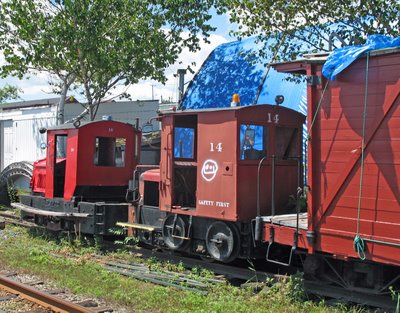
As noted at the close of my previous post on this subject, Maine's narrow gauge railroads had rails only two feet apart. This, I believe, was the narrowest gauge in common use in the U.S. Below are two tiny engines standing on the same siding as the freight cars shown in the earlier post.
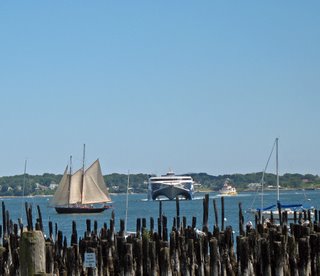
After I took these photos, we began walking back towards the fishermen's wharves to buy some lobsters for our evening meal. We had gone a short way, and were passing a couple going in the opposite direction, when the woman said, "Look! Here comes The Cat." I looked over towards the harbor and saw the big catamaran ferry that runs between Portland and Yarmouth, Nova Scotia entering the mouth of the Fore River.
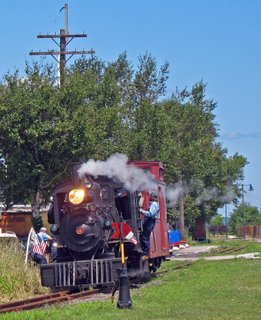
Having photographed The Cat, I rejoined my wife and our friend to continue our walk to the fish market. However, I saw something out of the corner of my eye that made me excuse myself and go running back toward the railroad museum.
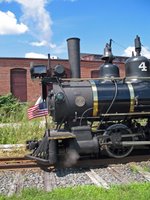
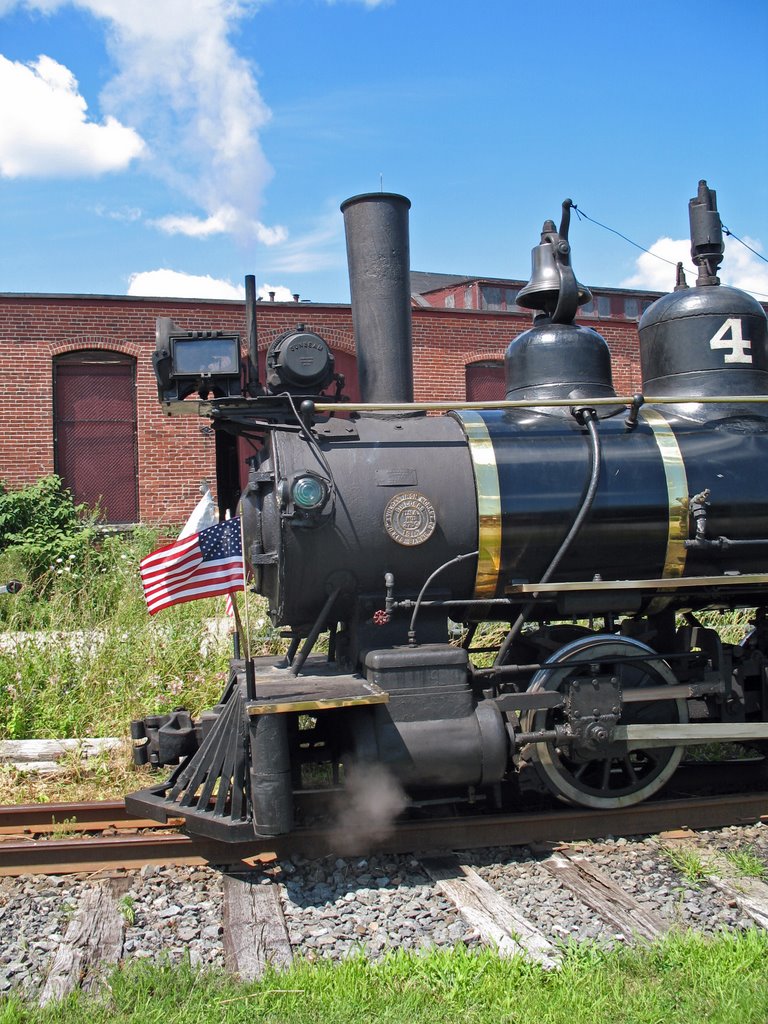
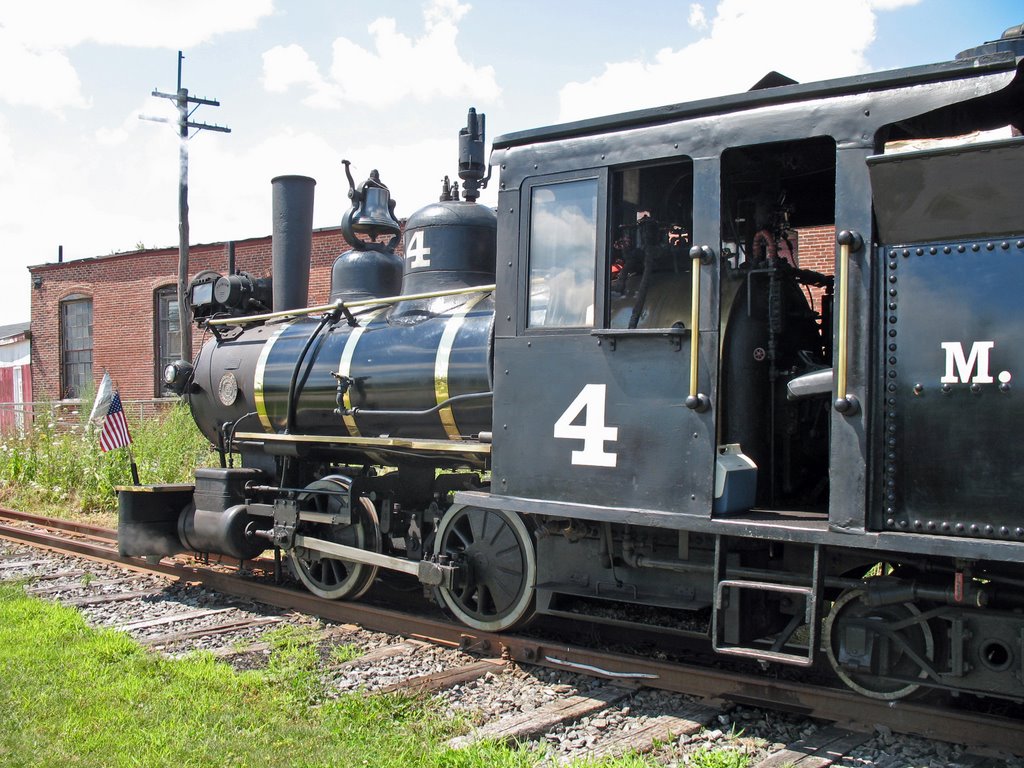
It was old No. 4, a gorgeously preserved 0-4-4 loco, pulling another S.R.& R.L. combine car. A fitting finish to a fine afternoon of train watching.
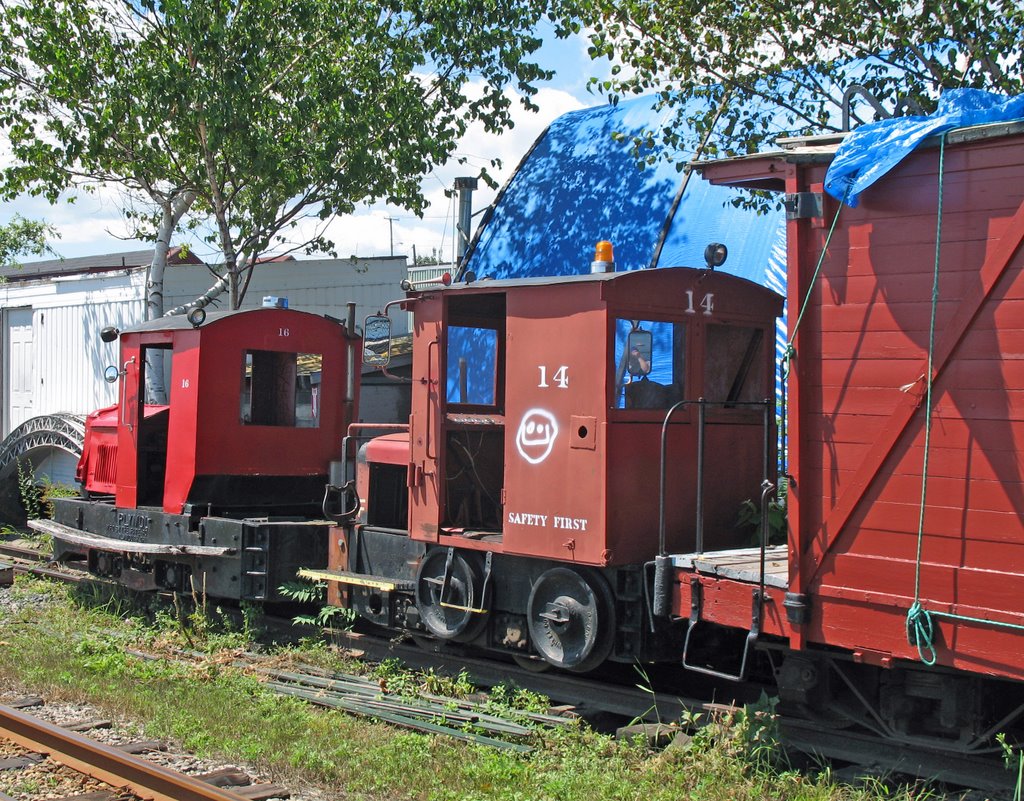

After I took these photos, we began walking back towards the fishermen's wharves to buy some lobsters for our evening meal. We had gone a short way, and were passing a couple going in the opposite direction, when the woman said, "Look! Here comes The Cat." I looked over towards the harbor and saw the big catamaran ferry that runs between Portland and Yarmouth, Nova Scotia entering the mouth of the Fore River.
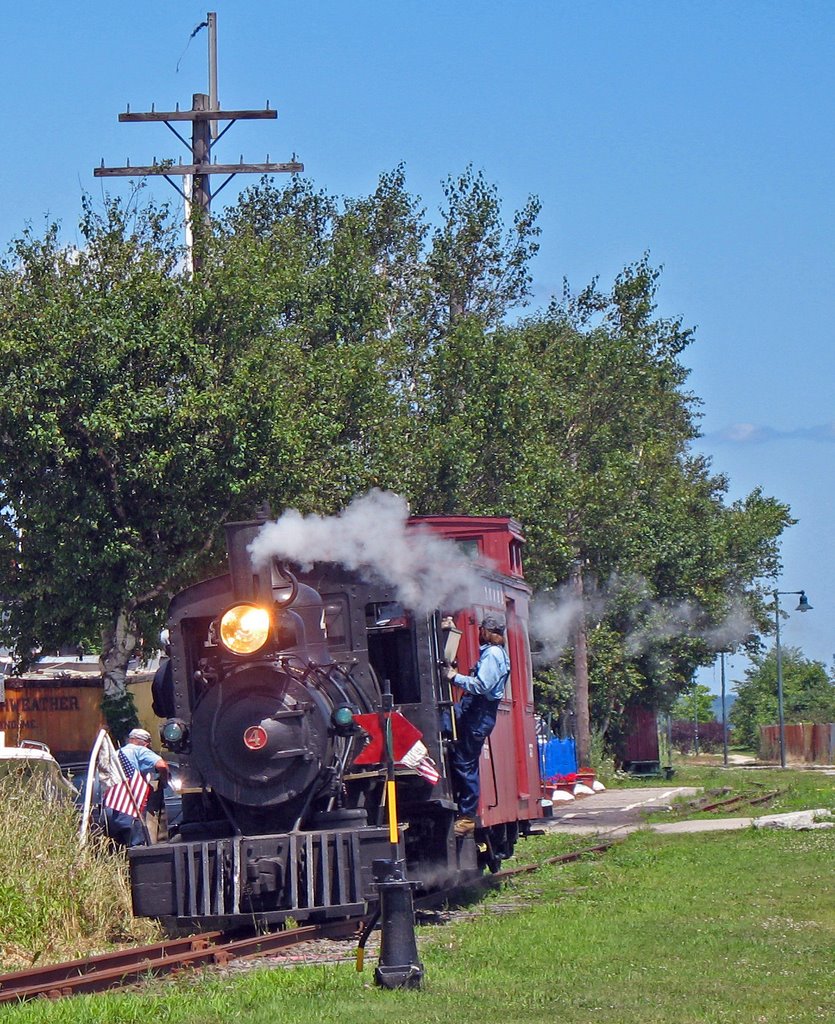
Having photographed The Cat, I rejoined my wife and our friend to continue our walk to the fish market. However, I saw something out of the corner of my eye that made me excuse myself and go running back toward the railroad museum.
It was old No. 4, a gorgeously preserved 0-4-4 loco, pulling another S.R.& R.L. combine car. A fitting finish to a fine afternoon of train watching.
Monday, August 14, 2006
Sometimes, pessimism works.
Especially when you've gotten to the point of discounting it.
Could Pedro Martinez be like The Wonderful One-Hoss Shay?
After all, 'twas a poem writ in Boston.
Could Pedro Martinez be like The Wonderful One-Hoss Shay?
After all, 'twas a poem writ in Boston.
Saturday, August 12, 2006
Narrow gauge in Portland, Maine.
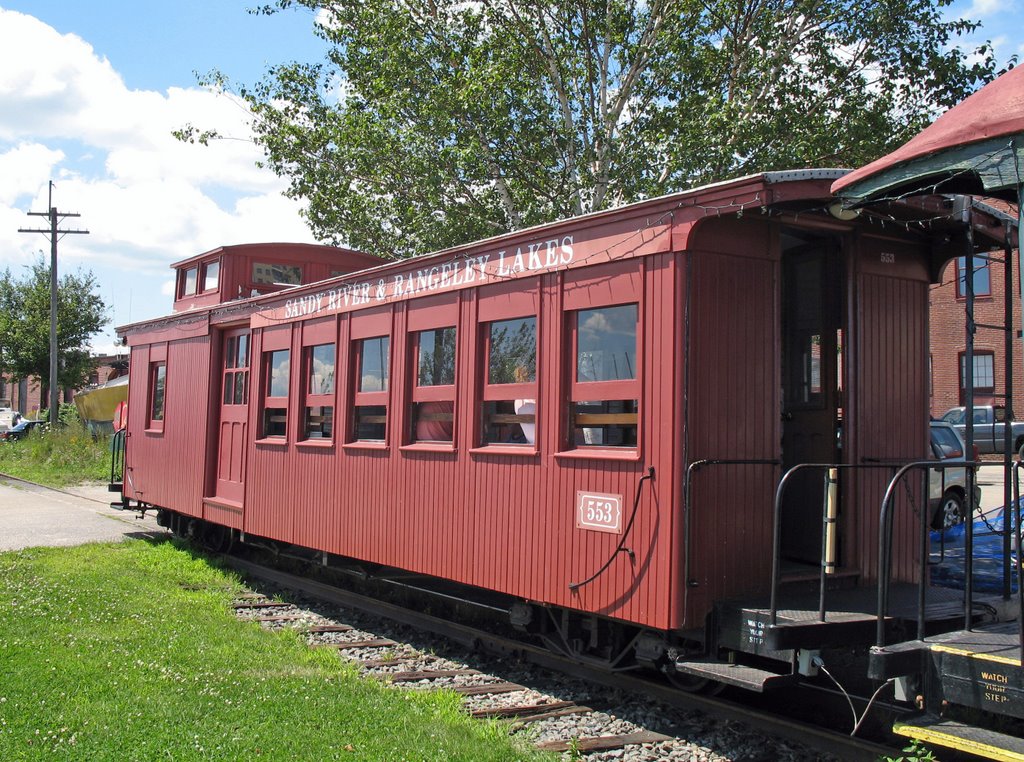 The State of Maine once had an extensive system of narrow gauge railroads; many of them, as in the Pacific Northwest, serving the logging industry. A small part of this system remains on the north side of Portland, preserved under the aegis of the Maine Narrow Gauge Railroad Co. and Museum. The MNGRR runs trains from just outside its museum and headquarters north along the Portland waterfront and back. When we arrived last weekend, a train loaded with tourists was about to leave. At the end was this handsome passenger car - caboose combination that formerly served in northern Maine on the Sandy River & Rangeley Lakes.

I walked to the front of the train, where I found this small steeple-cab diesel about to be coupled for departure. Note the formidable looking cluster of airhorns on this little engine. We then went into the museum, located in the red brick building in the background at the right. After we had looked at the many exhibits there, we came out to find that the train had departed.
 On a side track were these well-preserved freight cars. The tanker evidently dates to before the merger of Standard Oil Company of New York ("SOCONY") with Vacuum Oil Company to form the awkwardly named Socony-Vacuum, which later sensibly became Mobil. This later merged with Exxon, the lineal descendent of Standard Oil Company of New Jersey, to form Exxon-Mobil. Thus was the work of trust-busters of almost a century ago partially undone.
If you look at the empty track in the foreground, you can get a feel for how narrow it is: only two feet separate the rails.
Continued here.
Postscript to "When good things ... "
The suggestion in Fred Kaplan's Slate article, to which I linked a couple of posts below, that the blanket refusal of the current administration to engage in discussions with the Syrians is dysfunctional, is echoed, and extended to the Iranians, by Richard Holbrooke in this Washington Post column.
Interestingly, Holbrooke's WaPo column was reprinted in the neocon organ, The New York Sun, which is where I first saw it. If Slate and the Sun can agree on something, well, ...
Interestingly, Holbrooke's WaPo column was reprinted in the neocon organ, The New York Sun, which is where I first saw it. If Slate and the Sun can agree on something, well, ...
Friday, August 11, 2006

The Curse explained.
Back at the All-Star break, I bemoaned the appearance of five Mets on the cover of Sports Illustrated, predicting "dire consequences." My prediction has, so far, been off the mark, much to my delight. Now, with typical acuity, Tim Marchman explains the SI cover curse, in a way that makes me say "D'oh!"
This leads to another question: are the Mets, as the saying goes, the exception that proves the rule? I've never understood that one. How can an exception "prove" a rule?
This leads to another question: are the Mets, as the saying goes, the exception that proves the rule? I've never understood that one. How can an exception "prove" a rule?
Thursday, August 10, 2006
When good things happen because of bad people.
There's an interesting article by Fred Kaplan in yesterday's Slate that reveals the source of at least much of the information Britain's MI5 relied on to thwart the transatlantic airliner bombing plot as being the Pakistani military intelligence agency. Kaplan also refers to a New Yorker piece by Seymour Hersh, which I somehow missed, that described Syria as a valuable source of information about al-Qaeda in the period following the September 11 attacks. However, this helpful connection was cut after the invasion of Iraq, and a Syrian offer to rein in Hezbollah in return for continued exchanges of intelligence was allowed to expire.
Of course, the government of Bashar Assad wasn't being munificent out of sympathy with this country over the September 11 tragedy. The Baathists who rule Syria, as Kaplan explains, are no friends of al-Qaeda, which is allied with their principal internal opposition, the Muslim Brotherhood. It was simply a case of the enemy of my enemy being, perforce, if not my friend, at least someone with whom I'll cooperate. Similarly, Pervez Musharraf's military regime is, no doubt, less concerned about loss of innocent life than the consequences concerning substantial U.S. and British aid likely to ensue from massive loss of life caused by a plot hatched at least partially in Pakistan.
Kaplan's point is that an excessively Manichaean world view, which he ascribes to the Bush administration, can be unhelpful in coping with real world problems. This is something any fan of noir fiction can appreciate. To put it another way, the real lesson of Munich is not "Don't do deals with bad people", it's "Don't do bad deals with bad people."
Monday, July 31, 2006
Pessimism never works.
That's the slogan on a t-shirt I'm thinking of buying. Yes, I was convinced that the Mets would go to Atlanta carefree and cocky, and leave saddened and swept. I just knew that the Ray Gliers of the world would pound their keyboards, proclaiming the resurgence of the rightful NL East champs and lauding the unsurpassable genius of Schuerholz and Cox.
Well, it kinda went the other way. Yes, Braves fans, I'll grant that your DL resembled the Roll of Honor from the Battle of the Somme while ours was a mere four names, one of whom, Victor Zambrano, arguably constituted addition by subtraction. Nevertheless, it does feel good.
Ah, but the life of a Mets fan has few stretches of unrelieved joy. In the process of moving the road show to Miami, ace setup man Duaner Sanchez boarded a cab that promptly got into a smash-up, separating Sanchez's shoulder. To plug this breach in their bullpen, the Mets gave up Xavier Nady, who has done yeoman service in right field and at the plate. In return, the Pirates gave back to the Mets (who let him go in the off-season) Roberto Hernandez, who comes with a respectable 2.93 ERA and some experience of pitching at Shea, as well as 41 years under his belt. Oh, yes, we also got a starter, Oliver Perez, who had a great season two years ago, has since collapsed, and is optioned to Norfolk.
As for right field, Lastings Milledge will return from the minors to share that space with Endy Chavez, another of the Mets' surprising yeomen of the season. (I can recall seeing Endy's brother, Ender, playing center field for the Brooklyn Cyclones a couple of seasons ago. Endy, Ender. What is it with the name game in Venezuela, the country that also gave us siblings Edgardo and Edgar Alfonso?) Anyway, it looks like we'll get to see this season whether Tim Marchman's misgivings about young Milledge's potential are well founded.
Tuesday, July 25, 2006
Little Toot goes psychedelic.

While walking along the Battery Park Esplanade, I saw this unusually decorated tug sailing past Ellis Island.
Monday, July 24, 2006
"[T]ruly, deeply, tragically inconvenient."
I've been loath to post about the Middle East. I tell myself this is because I'm no expert, but I know it's really because, whatever opinion one may express on the subject, no matter how apparently anodyne, someone is going to find it mightily offensive. Moral cowardice? I prefer to think it's just that my thoughts on the matter, ill-informed as they may be, are - how you say? - nuanced.
So I'm glad to find a link in Eric Alterman's MSNBC blog to an essay in, of all places, New York magazine, which I dismissed years ago as lightweight fare for superficial yups - a kind of upscale People - that I think I can recommend almost (Okay, I have problems with the first paragraph. I agree that global warming is a serious problem. I'm not sure that any solution "doesn't look that onerous.") unreservedly. It's by Kurt Andersen, and you can find it here.
So I'm glad to find a link in Eric Alterman's MSNBC blog to an essay in, of all places, New York magazine, which I dismissed years ago as lightweight fare for superficial yups - a kind of upscale People - that I think I can recommend almost (Okay, I have problems with the first paragraph. I agree that global warming is a serious problem. I'm not sure that any solution "doesn't look that onerous.") unreservedly. It's by Kurt Andersen, and you can find it here.
Walter Benjamin on Proust
"He is filled with the insight that none of us has time to to live the true dramas of the life that we are destined for. This is what ages us -- this and nothing else. The wrinkles and creases on our faces are the registrations of the great passions, vices, insights that called on us; but we, the masters, were not at home."
Illuminations, (Trans. Harry Zohn, Schocken, 1969), 211-212; quoted in Michael D. Jackson, "In the Footsteps of Walter Benjamin", Harvard Divinity Bulletin, Spring, 2006, at p.44.
Illuminations, (Trans. Harry Zohn, Schocken, 1969), 211-212; quoted in Michael D. Jackson, "In the Footsteps of Walter Benjamin", Harvard Divinity Bulletin, Spring, 2006, at p.44.
Friday, July 21, 2006
Monday, July 17, 2006
Postcard from Maine

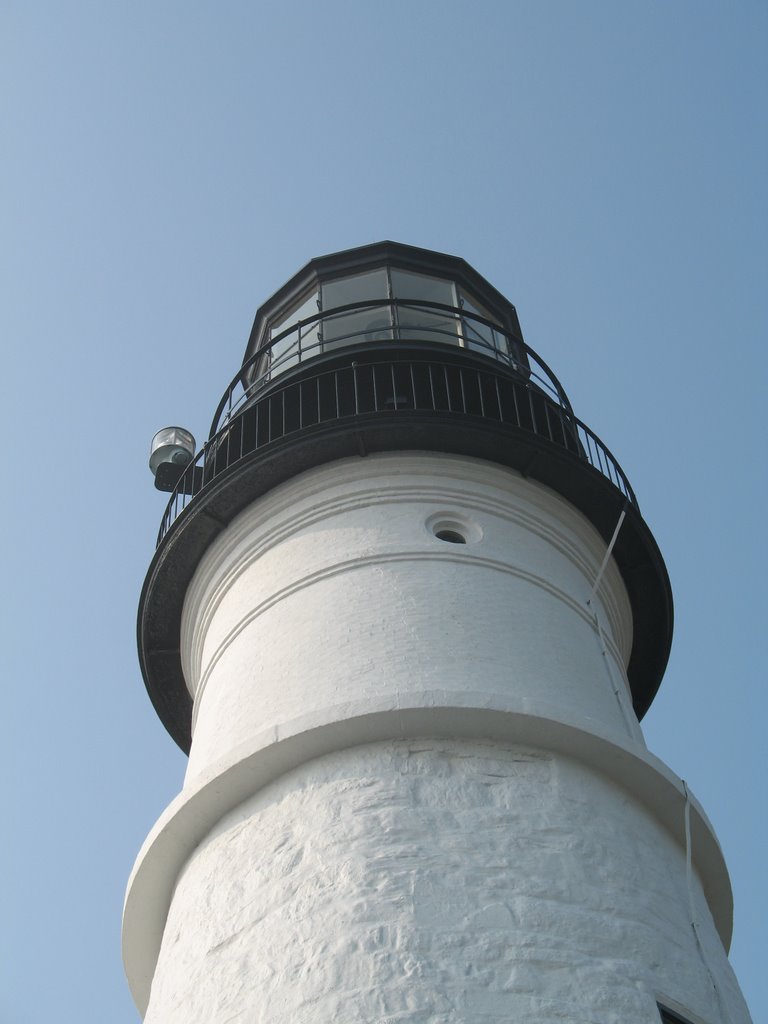 Portland Head Light was commissioned by President Washington to guide mariners entering Portland harbor, and was put into service in 1791. It remains in use today. Several years ago, it was converted to computer-controlled operation, and the position of lighthouse keeper was eliminated. The handsome keeper's house, to the right of the lighthouse tower in the scene above, is now a museum.
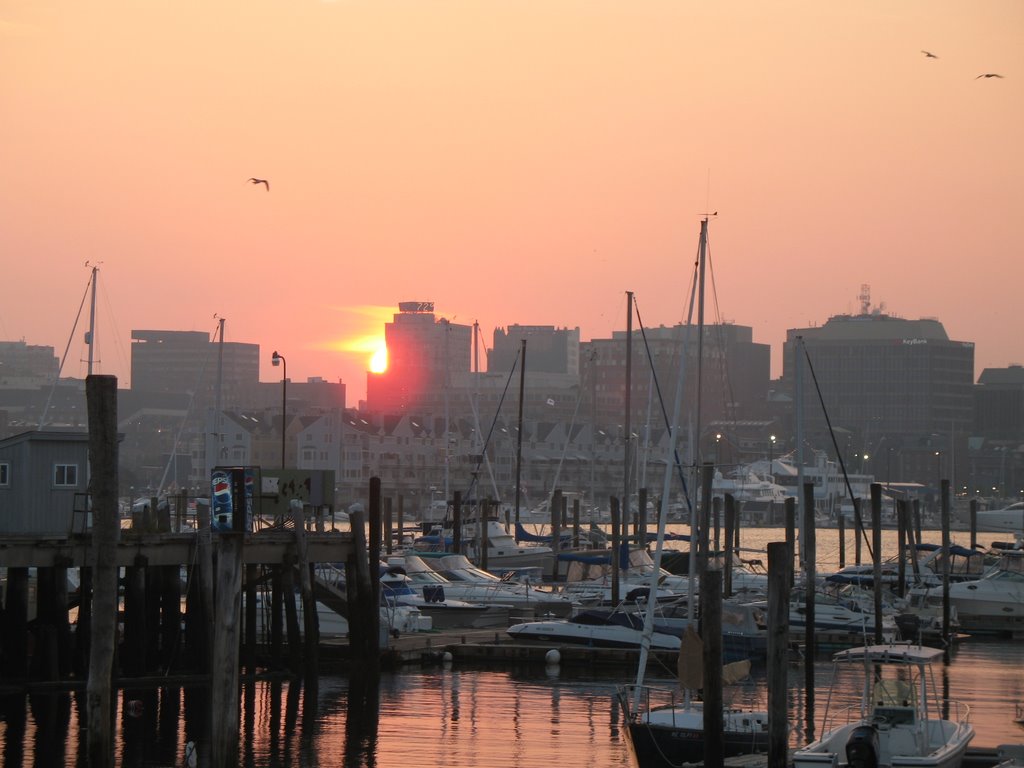
Below is a view of Portland harbor and downtown, taken from the deck of the Saltwater Grill in South Portland, at sundown.
Friday, July 14, 2006
Wednesday, July 12, 2006
Whoa, David!
I read somewhere that, before the All-Star Game, David Wright said it was to determine whether the Mets would get home field advantage in the World Series. I'm surprised, to say the least, that the usually circumspect Mr. Wright would be so presumptuous. After all, there are the small matters of (1) winning the division pennant or the wild card, (2) surviving the first round of playoffs and (3) winning the NLCS, to be taken care of before home field advantage in the series (which, in the event, now belongs to the Designated Hitter League) becomes an issue.
Okay, I'll grant that, even at the All-Star break, the likelihood of (1) seems more than 50-50. Still, being a Mets fan accustomed to catastrophe and collapse, I envision, say, Pedro's hip problem being a more than transient thing. I won't be convinced until the magic number reaches zero. (I know, "Ya gotta believe!", and all that. Sorry, Mets, but you've made me a skeptic.)
Meanwhile, Tom Van Riper of Forbes pleases me by including the 1986 Mets in his list of the top ten major league teams of all time, but disappoints me by failing to include the 1962 Mets in his list of the ten worst. He notes that they mananged to lose 120 games "supposedly in a humorous way." Come on, Tom, haven't you ever read Jimmy Breslin's Can't Anybody Here Play This Game? "Supposedly"?
Thursday, June 29, 2006
Sox sweep Mets
I'll rerain from complaining, if only to ensure domestic tranquility. After all, the Mets could afford to lose three, and every Sox win is another nail in the Yanks' coffin.
Sunday, June 25, 2006
iPod log 2
I had to visit the office this afternoon to take care of some unfinished business, and on the way there and back I heard the following:
1. Otis Redding: "Can't Turn You Loose." From Live in Europe, one of the best live albums, and best R&B albums, ever.
2. Planxty, "As I Roved Out." A folk song on which there are many variations. Am I right in thinking that "the lassie who had the land" is Victoria R.? The last verse seems to confirm it.
3. The Yardbirds with Sonny Boy Williamson, "Pontiac Blues." Choice fruit of one of several collaborations between British bands and great Chicago bluesmen that happened in the late 1960s.
4. Jimmy Cliff, "Sitting in Limbo." From the magnificent The Harder They Come soundtrack.
5. East Village Opera Company, Ebben? Ne Andro Lontana. My wife turned me on to this group, who set opera arias to rock instrumentation and arrangements. If you're heavily invested in how this music ought to sound, you'll probably hate it. I like it.
6. John Stewart, "Never Goin' Back." The final cut on California Bloodlines (see iPod log 1), in which he gives the credits aurally.
7. The Kingston Trio, "Run the Ridges." I told you the iPod can be uncanny at times. Here, it follows John Stewart on his first solo album with John Stewart as lead singer for the Trio, several years before, in a stirring song about two former Confederate soldiers on the outlaw trail.
8. Rod Stewart, "Mandolin Wind." Egad! Another Stewart. This time it's Rod the Mod, from Every Picture Tells a Story, my nominee for Greatest Rock Album Ever.
9. Beausoliel, "Eunice Two Step." I defy you to stay still while listening to this Cajun dance tune par excellence.
10. Dire Straits, "Walk of Life." A sign at Radio City Music Hall tells me Mark Knopfler and Emmylou Harris are in some sort of collaboration. That bears watching.
11. Blondie, "Sunday Girl." Late '70s post-punk ironists embrace early '60s teen romanticism, with no visible tongues in cheeks.
12. Fairport Convention, "John the Gun." From their Fairport Live album, released in the U.K. as A Moveable Feast, and recorded in London and Sydney during the same 1975 world tour in which I saw them at Carnegie Hall. When the curtain went up, I was surprised to see Sandy Denny, who had left the group several years before, seated in front of a grand piano. A man several rows away yelled "Welcome back!", and Sandy, with crisp British precision, chirped back, "Thenk you!"
13. Paul Butterfield Blues Band, "Spoonful." This racially integrated Chicago group provided my introduction to the blues during my college years.
14. Martha and the Vandellas, "Heat Wave." It was typing speed and telephone manners that got Ms. Reeves her job at Motown Records, but she proved to have other talents.
15. The Beatles, "I Feel Fine." I first heard this blasting from a neighbor's dorm room in the spring of 1965, and it had its intended effect.
16. The Lovin' Spoonful, "Searchin'." NYC guys cover LA R&B. Not bad.
17. Johnny and the Hurricanes, "Red River Rock." Pumping organ, driving guitar. Rock instrumental music at its best. (Someday I'll have to find a download of their "Beatnik Fly.")
18. Toots and the Maytals, "Pressure Drop." Wonderful chugging reggae rhythm.
19. The Byrds, "Time Between." From Younger Than Yesterday, the album on which they started to go seriously country.
20. The Byrds, "You Don't Miss Your Water." From Sweetheart of the Rodeo, the album on which Gram Parsons joined them, they went completely country, and Roger McGuinn had his doubts.
21. Planxty, "Pat Reilly." A cautionary tale about the consequences of having one drink too many in the company of a military recruiter.
22. Bruce Springsteen, "Open All Night." A song in which The Boss describes his native state as "like a lunar landscape."
23. Dr. John, "Iko Iko." "My spyboy an' yo' spyboy, sittin' by the fy-o, my spypoy say to yo' spyboy, gonna set yo' flag on fy-o." Go figure.
24. Planxty, "Merrily Kissed the Quaker." A lively instrumental piece featuring, along with uillean pipes and bodhran, that quintessentially Irish instrument, the bouzouki.
25. Flaco Jimenez, "Marina." A bouncy love song by El Jefe del Norteno squeeze-box.
The final suburb.
A few weeks ago, my wife took a tour of Woodlawn Cemetery, where many of New York's prominent citizens of yore are interred. Woodlawn is in the northern Bronx, next to Van Cortlandt Park, and therefore at the northern edge of New York City. At the time that most of its inhabitants took up residence, however, it was part of New York County (which today consists of Manhattan and a tiny bit of the mainland cut off from Manhattan when the Harlem River's course was changed by blasting to improve navigation) but not part of the City. In other words, it was suburban. A Scarsdale for stiffs, Bronxville for bones, Pelham for the perished.
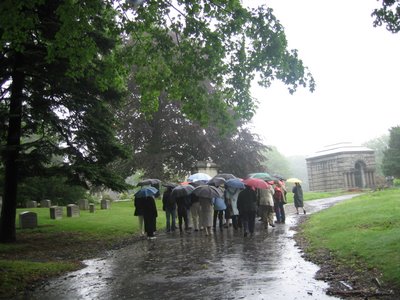
The day of the tour, the weather gods cooperated by providing a suitably gloomy overcast and light but steady rain. Fortunately, my wife had her camera to record the tour. Here's the group entering the cemetery:
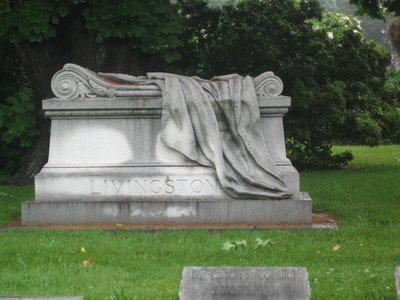
The gravestones, as you might expect, are classical in style and quite elegant. Consider this, which may belong to the family of an early steamboat enterpreneur:
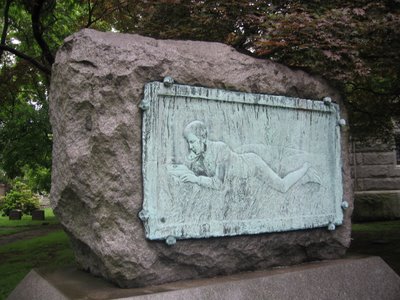
Or this bronze frieze, in a romantic style, of a recumbent youth:
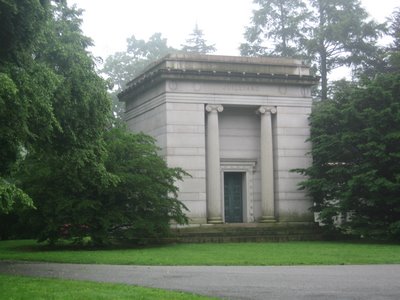
Many of the prominent families have mausoleums. This classical temple houses the remains of the Julliards, remembered principally for their patronage of the great music school that bears their name:
Today, the fashion for elaborate crypts seems gone. Perhaps that's a good thing. Still, Woodlawn is something to behold.
The day of the tour, the weather gods cooperated by providing a suitably gloomy overcast and light but steady rain. Fortunately, my wife had her camera to record the tour. Here's the group entering the cemetery:

The gravestones, as you might expect, are classical in style and quite elegant. Consider this, which may belong to the family of an early steamboat enterpreneur:
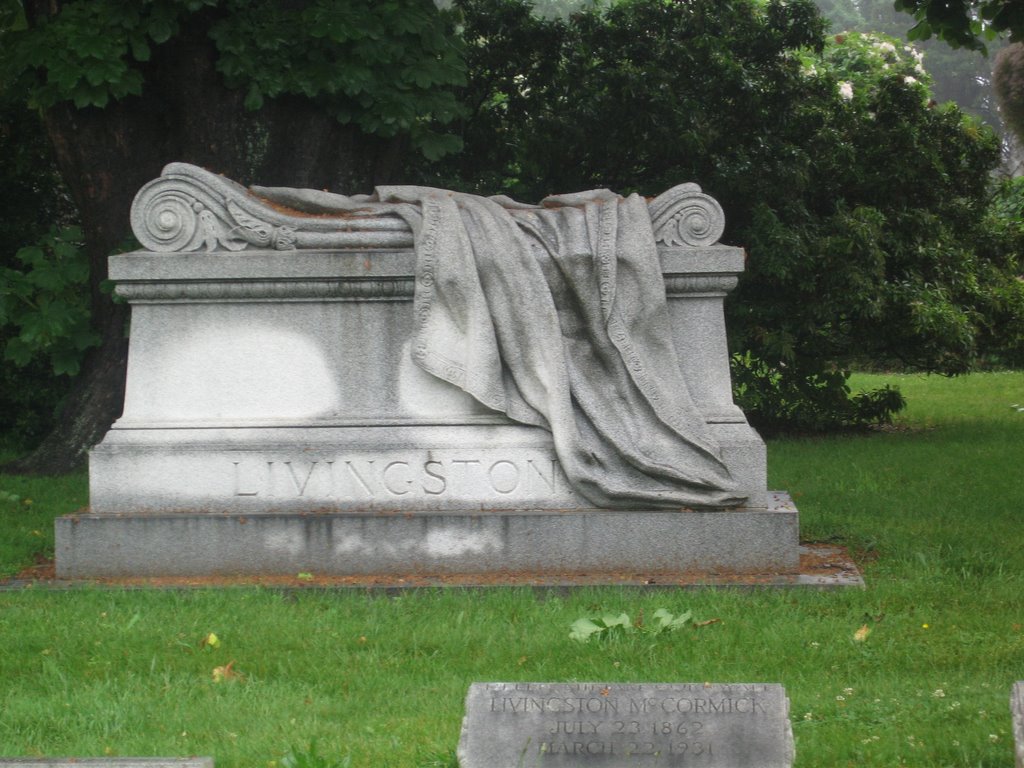
Or this bronze frieze, in a romantic style, of a recumbent youth:

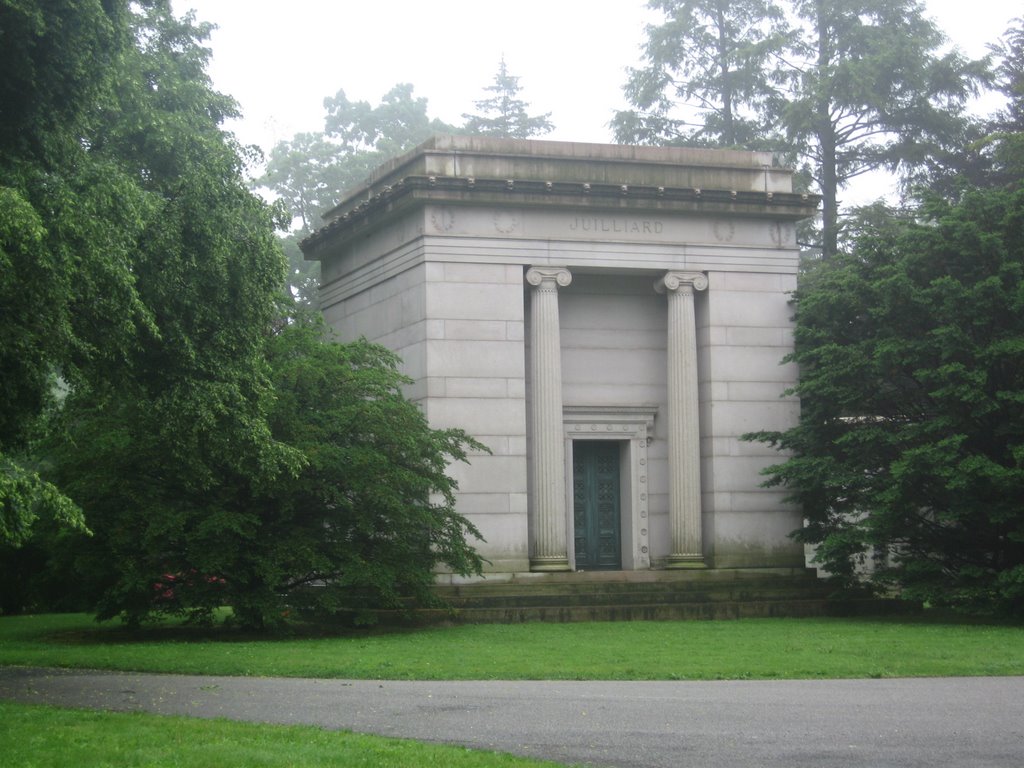
Many of the prominent families have mausoleums. This classical temple houses the remains of the Julliards, remembered principally for their patronage of the great music school that bears their name:
Today, the fashion for elaborate crypts seems gone. Perhaps that's a good thing. Still, Woodlawn is something to behold.
Thursday, June 22, 2006
iPod log 1
You've been asking yourselves, "When does the really self-absorbed stuff begin?" Relax. Here we go.
My wife gave me an iPod nano for my 60th birthday. I spent several weeks loading 566 pieces of music onto it. Some early choices were rejected and others added to stay within its 2GB capacity. For now, it holds as nearly as possible (some favorites of mine couldn't be copied off CDs or bought through iTunes) a definitive collection of music I like. I have it set to play in random order, and shuffle the order after each recharge. I've noticed that the iPod seems to have some sort of internal intelligence, choosing pieces to follow others in an order that seems to make sense.
I've decided to keep an occasional log of what my iPod plays as I go to and from work, and to share that log, with some observations on my musical choices, with you, my readers. So, here's my log for Friday, June 23:
1. Beach Boys, "Good Vibrations." It's on there to remind me of the adrenaline rush I got from falling in love many years ago.
2. T. Rex, "Ride a White Swan." What can I say? I'm an Anglophile, and almost as big a Tolkien fan as my daughter. Besides, the song mentions Beltane, a Celtic holiday on which I once gave a particularly wild party during my bachelor Village days. (Had Marc Bolan not died in a car crash, I'm sure he'd be playing some part in the Harry Potter movies.)
3. The Who, "Pinball Wizard." We're really in a late '60s groove here. OK, early '70s -- to me, the '60s didn't end until Nixon resigned, or maybe until the fall of Saigon.
4. Link Wray and the Wray-Men, "Raw-Hide." A break back to the 1950s, and to the pioneer of heavy metal guitar, who figured out how to create reverb using rusty garbage cans.
5. Bill Monroe and the Bluegrass Boys, "Footprints in the Snow." Eleven years ago this summer, my wife and I attended a free outdoor concert by Bill Monroe at Damrosch Park, next to Lincoln Center. After several numbers, Bill, then 83, said, "Clap louder, y'all. You want us to be invited back next year, don't you?" Next year, he was gone.
6. John Stewart, "July, You're a Woman." Stewart first came to fame when he replaced Dave Guard in the Kingston Trio. After he left the Trio, he made a magnificent solo album, California Bloodlines. This is one of my favorite cuts from that album. "And I have not been known/ As the saint of San Joaquin,/ And I'd just as soon, right now,/ Pull on over to the side of the road,/ And show you what I mean."
7. Doc Watson, "Wabash Cannonball." I love trains. I love this song. Some serious railfans don't like it because it has the train going lots of places the real Cannonball never even got near. I just enjoy the ride.
8. Grateful Dead, "Friend of the Devil." Rock critics hate this band. Typical rock critic joke: "What did one Deadhead say to the other after they ran out of dope? 'This music sucks!'" I like some of their stuff, even without chemical augmentation.
9. Woody Guthrie, "This Land is Your Land." The Smithsonian/Folkways recording, without the "Commie" verse.
10. Poco, "Here We Go Again." From Crazy Eyes, one of three albums (the others are the Emmylou Harris/Dolly Parton/Linda Ronstadt Trio and U2's The Joshua Tree) said to have been made as memorials to Gram Parsons. (The Stones' "Wild Horses" is a memento vivendi, as it was written and released before Gram's fatal encounter with a speedball.)
11. Bob Marley, "Trench Town Rock." Vintage Marley, before fame and overproduction ruined him. "You reap what you sow."
12. Beach Boys, "I'd Love Just Once to See You." From the underrated Wild Honey album. "When was the last time you baked me a pie?" Splendiferous.
13. The Chieftains, "The Morning Dew." A frequently played fixture on the Bells of Hell's jukebox, and, therefore, part of the soundtrack of many of my Village bachelor evenings.
14. Bruce Springsteen, "Johnny 99." From Nebraska, his dark, acoustic foray into Charlie Starkweather territory.
15. The Contours, "Do You Love Me?" I'll never forget my high school friend, Bill Broach, telling me how, whenever his band got to the line, "Watch me now, hey!", he'd do a rim shot and break his drumstick.
16. Little Feat, "Oh, Atlanta!" I loved this band, and still light a candle for Lowell George every year. A George-less version of the group is doing a free outdoor concert at Battery Park City later this summer. If I can, I'll check it out, but my hopes aren't high.
17. The Who, "Magic Bus." The studio version, which I may decide to replace with the version from Live at Leeds.
18. John Fogerty, "Centerfield." The epitome of American can-do spirit. "Put me in, Coach!"
19. Fotheringay, "Peace in the End." A prayer for peace in Northern Ireland, performed by three Brits, an Aussie and a New York City native. Great harmonies by wife and husband team Sandy Denny and Trevor Lucas. "I've seen them stand at the top of the hill,/ And none of them coming down,/ But who will be the last one to kill,/ And who will be the clown?"
20. George Jones, "I Can't Get Over What Loving You Has Done." He was the unrivaled master of the agony-of-divorce song and the blighted-love-has-driven-me-to-drink song. This is a song of sublime joy, and he did it so well.
21. Dirty Dozen Band, "Li'l Liza Jane." From a Rhino anthology called New Orleans Party Classics. Hot Dixieland with great scat singing.
22. Fairport Convention, "Percy's Song." I discovered this during my last year of law school. I was walking past my classmate John Lovett's dorm room when I first heard Sandy Denny's voice. The door was open, and I called out to John, "Who's that?" "Fairport Convention," he said. There began my many years' love affair with this group, which climaxed with my attendance at their Carnegie Hall concert in 1975. Here, they take a little-known Dylan song -- one that I've never heard Dylan perform -- and turn it into something akin to Anglican chant. Awesome.
23. The Tarriers, "The Banana Boat Song." Long before there was reggae, there was calypso. This is from 1957, when a bunch of white guys from New York did a credible job of singing about loading bunches of bananas. Personal aside -- I met Erik Darling, who was with this group and later with the Rooftop Singers of "Walk Right In" fame, at a party in 1975 (a big year for me musically), and got to harmonize with him to the accompaniment of his twelve string guitar.
24. Nitty Gritty Dirt Band, "Flint Hill Special." In 1972, NGDB, a bunch of L.A. hippies, went to Nashville and recorded with some of country's greats, including Roy Acuff, Mother Maybelle Carter, Jimmy Martin, Earl Scruggs, Merle Travis and Doc Watson. The resulting double album, Will the Circle be Unbroken, is breathtaking. This cut, a slashing bluegrass instrumental, features Earl Scruggs on banjo, his son Randy on guitar, Norman Blake on dobro, Vassar Clements on fiddle and Junior Huskey on bass, along with Dirt Band members Jimmie Fadden on harp, Les Thompson on mandolin and Jim Ibbotson on snare.
25. Gene Vincent and the Blue Caps, "Cruisin'." Bad boy rockabilly from Norfolk, VA, about 1957. "Cruisin' for a bruisin' ...".
26. Great Speckled Bird, "Flies in the Bottle." In 1968-69, iconic Canadian folkies Ian and Sylvia joined with some young rock musicians from Ohio and formed a group named for a country music classic. I saw them perform in Boston in the fall of '69, while in the company of a pretty lass from Vancouver whose name, alas, I've forgotten. This cut features a nice vocal by Ian, jazzy in a north-of-the-border kind of way.
Sunday, June 18, 2006
Queen Mary 2 again.
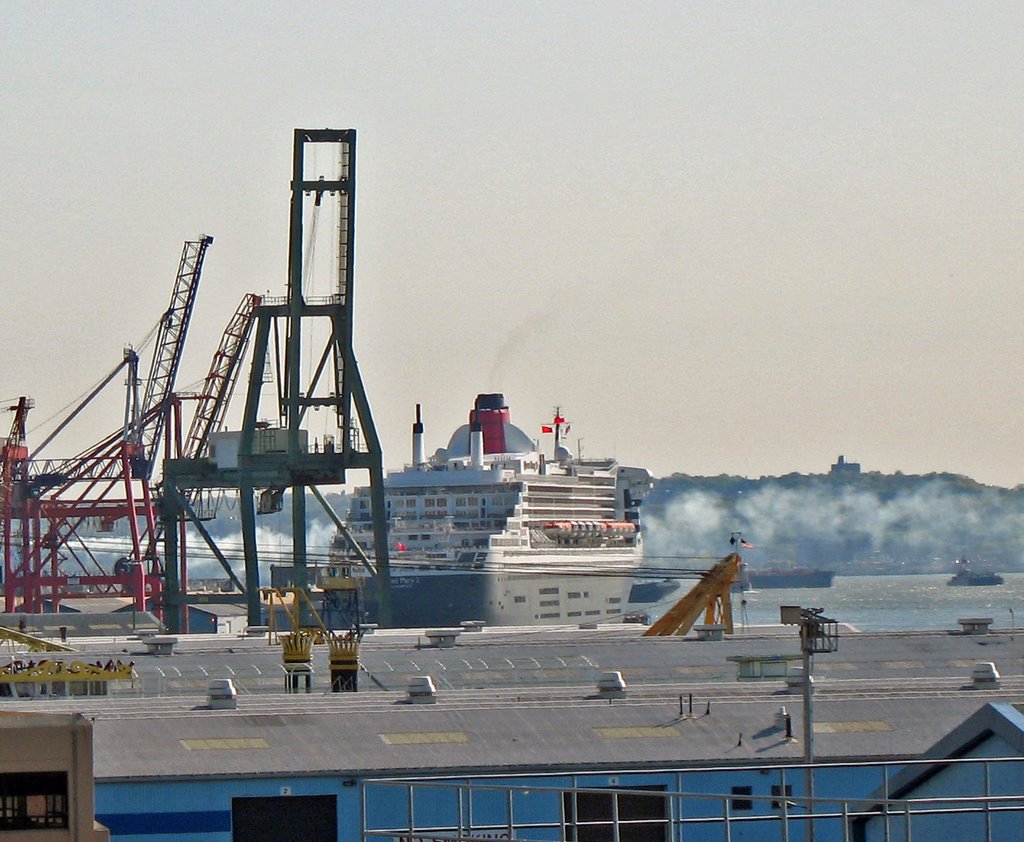
Here she is as she appears, while at her berth, from the Brooklyn Heights Promenade.
Saturday, June 17, 2006
Another New York harbor scene.

On May 31, I took a walk along the promenade at Battery Park City and got this view of the Manhattan Sailing Club's J-24 fleet arrayed in front of the Statue of Liberty.
Friday, June 16, 2006
A Bloomsday survey.
Choose your answer; give your reason:
James Joyce has had a (A) good (B) bad (C) indifferent effect on the course of literature.
My mind is open on this subject. Best response wins my frayed, dog-eared paperback copy of Portrait of the Artist that I read for Humanities 101 at the University of South Florida in 1965 (if I can find it).
Beware the agenbite of inwit.
Sunday, June 11, 2006
Friday, June 02, 2006
Rove chums, Hevesi bites?
Coverage of the Homeland Security funding flap focuses on allegations of intent to give GOP incumbents in tight races some pork to brag about. There's a more subtle, and to me troubling, interpretation that seems sneakily Rovian. Perhaps the real intent was to cause coastal elites to go berserk, thereby confirming to heartlanders our overwrought sense of entitlement. In other words, to energize the base, not by gratitude but by the much more effective means of resentment.
If so, it seems to be working. Someone was reading choice bits from the tabs on NY1 this morning, and I heard something about ear-to-ear grins in "Podunk America"; and, of course, New York State Comptroller Alan Hevesi's howler, in front of a college graduating class, no less, about Chuck Schumer wanting to put a bullet in an unfortunate place, couldn't have been scripted better by Ol' Karl himself.
If so, it seems to be working. Someone was reading choice bits from the tabs on NY1 this morning, and I heard something about ear-to-ear grins in "Podunk America"; and, of course, New York State Comptroller Alan Hevesi's howler, in front of a college graduating class, no less, about Chuck Schumer wanting to put a bullet in an unfortunate place, couldn't have been scripted better by Ol' Karl himself.
Tuesday, May 30, 2006
An aging beauty comes to town.
Last September, I posted about ship watching from the Brooklyn Heights Promenade, and concluded my essay with a photo of a very pretty and shipshape vessel heading up the Hudson towards the midtown cruise ship terminal. You can find it here. On Sunday, while crossing the Brooklyn Bridge in a cab, I was delighted to see that same ship docked at the Brooklyn cruise terminal. Monday being a holiday, I was free to take my camera to Red Ho ok to get a closer shot of her, and to try to ascertain her identity.
Here she is, looking fine, despite the addition of two unsightly domes that, no doubt, protect electronic devices of considerable value in enhancing the safety of her passengers and crew. Note the Brooklyn Bridge in the distance.
The gantry next to her bow obscured her name, though I could make out that it started with an "S". When I got home, it took a few minutes on Google to identify her as Saga Ruby, of Saga Holidays, U.K. She began her career as Vistafjord, of Norwegian-American Lines, having been completed in 1973 (her classic lines fooled me in my earlier post into thinking she was ten of fifteen years older) at the great Wallsend shipyard of Swan Hunter.
In her early years at NAL, she may have been among the last ships to maintain a transatlantic liner service, at least during the summer months. She was later acquired by Cunard, which operated her under her original name for several years before renaming her Caronia, after an earlier ship that had the distinction of being the first Cunarder to be purpose-built for cruising. During my first months in New York, in the summer of 1970, I spent many hours studying for the bar exam on the Morton Street Pier, which extends into the Hudson from Greenwich Village. When I looked to the south, I could see the older Caronia (actually the second Cunarder to bear that name) anchored in Upper New York Bay just a couple of miles away. She had left Cunard ownership some time before, and instead of having her original sea-green hull with white superstructure and Cunard's red and black funnel, she was a solid dull white with blue funnel. After a month or so of riding at anchor, she was towed up the Hudson to an unoccupied pier and docked; when her bankrupt owners couldn't pay the fee to keep her there, she suffered the ignominy of being given a parking ticket. In 1974, she was stripped of her fittings, some of which later became decorations at a bar near the Village apartment where I lived in the late '70's. She was then sold to Taiwanese breakers, but ended her days enroute to the blowtorch when she struck a seawall off Guam and broke up in heavy weather.
Saga Ruby, along with her near sister Saga Rose (formerly Sagafjord), has the distinction of being one of the last of the survivors of the liner era still in service. Long may she sail!
 ok to get a closer shot of her, and to try to ascertain her identity.
Here she is, looking fine, despite the addition of two unsightly domes that, no doubt, protect electronic devices of considerable value in enhancing the safety of her passengers and crew. Note the Brooklyn Bridge in the distance.
The gantry next to her bow obscured her name, though I could make out that it started with an "S". When I got home, it took a few minutes on Google to identify her as Saga Ruby, of Saga Holidays, U.K. She began her career as Vistafjord, of Norwegian-American Lines, having been completed in 1973 (her classic lines fooled me in my earlier post into thinking she was ten of fifteen years older) at the great Wallsend shipyard of Swan Hunter.
In her early years at NAL, she may have been among the last ships to maintain a transatlantic liner service, at least during the summer months. She was later acquired by Cunard, which operated her under her original name for several years before renaming her Caronia, after an earlier ship that had the distinction of being the first Cunarder to be purpose-built for cruising. During my first months in New York, in the summer of 1970, I spent many hours studying for the bar exam on the Morton Street Pier, which extends into the Hudson from Greenwich Village. When I looked to the south, I could see the older Caronia (actually the second Cunarder to bear that name) anchored in Upper New York Bay just a couple of miles away. She had left Cunard ownership some time before, and instead of having her original sea-green hull with white superstructure and Cunard's red and black funnel, she was a solid dull white with blue funnel. After a month or so of riding at anchor, she was towed up the Hudson to an unoccupied pier and docked; when her bankrupt owners couldn't pay the fee to keep her there, she suffered the ignominy of being given a parking ticket. In 1974, she was stripped of her fittings, some of which later became decorations at a bar near the Village apartment where I lived in the late '70's. She was then sold to Taiwanese breakers, but ended her days enroute to the blowtorch when she struck a seawall off Guam and broke up in heavy weather.
Saga Ruby, along with her near sister Saga Rose (formerly Sagafjord), has the distinction of being one of the last of the survivors of the liner era still in service. Long may she sail!
Wednesday, May 24, 2006
Julio for El Duque?
It seems an all so typical Mets trade: an up-and-comer for a veteran with a glittering past, but lately on the skids. Julio, of course, is not Kazmir. Indeed, he was one of those vets-on-the-skids when the Mets acquired him. Lately, though, he'd turned things around, and was becoming a reliable reliever.
Much is made of Hernandez's late season success. Let's hope it continues, and that the Mets prove to be in a position to benefit by it.
Much is made of Hernandez's late season success. Let's hope it continues, and that the Mets prove to be in a position to benefit by it.
Monday, May 15, 2006
Bye, bye Flutie
One of the highlights of college football in 1984 was the victory of Boston College, with quarterback Doug Flutie, over Miami in a regular season game. Today, almost 22 years later, Flutie announced his retirement from professional football at the age of 43.
He will not go down in any NFL record books, or even be remembered as one of that League's heroes. His comparatively short stature and proclivity towards a wide-open, scrambling game made him better suited for Canadian football, and a large, and by far the most active, part of his pro career was spent in the CFL. He spent his last season back at home with the New England Patriots and, on his last play, used a drop kick for a TD conversion. This hadn't been done in the NFL since 1941.
I'll look forward to his next career as a college football analyst and commentator.
Sunday, April 30, 2006
In honor of her 75th birthday ...
 ... here is Shreve, Lamb & Harmon's masterpiece catching the rays of the setting sun.
Ken, I hardly knew ye.
John Kenneth Galbraith died yesterday, at the age of 97. I saw him once, during my law school sojourn in Cambridge, walking across Harvard Yard. There was no doubt; the six foot eight inch frame and angular face were unmistakeable. I read only one book of his cover-to-cover. It wasn't his best-selling critique of post-World War 2 American capitalism, The Affluent Society. Nor was I one of the fifty or so people (in his estimation, according to his obituary in today's New York Times) who read his one book-length attempt (successful, again in his estimation, as well as that of the Times writers) at technical economic analysis, A Theory of Price Control.
The book I did read was The Scotch, a memoir of his coming of age among the farmers of Southern Ontario, of whom his parents were exemplary. I suspect this little book is typical of Galbraith's ostensibly non-economic writings (he has also written three novels and was co-author of a study of Indian art) in that it is laden with implications concerning what used to be called (and what Galbraith might most accurately be described as having taught and written about) "political economy". The one that sticks with me from The Scotch is that a requisite of a liberal political and economic dispensation - using "liberal" in the contemporary American sense of "generous" as well as in the classic European sense of "characterized by individual liberty" - is the ascendancy of people of "substance". By "substance" he didn't mean wealth (though the Calvinist beliefs of these descendants of Scottish Presbyterian emigrants made them see worldly success as indicative of divine grace), but personal integrity.
The Scotch included an anecdote Galbraith told on himself that was illustrative of the local character. He was, he recalled, sitting on a rail fence beside his family's cow pasture. Next to him was "a compact, honey-haired girl" on whom he had a high school crush. As they watched, OAC Pride, a prize bull his father had bought from the Ontario Agricultural College, gave his attention to one of the cows. "I'd like to try that sometime," said young Ken wistfully. "Well," the girl answered," it's your cow."
Subscribe to:
Posts (Atom)