The Mets are one away from falling out of the wild-card race. Of course, they're giving fans a great tease, going on a bit of a tear as the season winds down.
Realistic goals:
1. Finish above .500.
2. Finish 4th, not 5th in division (may need to sweep this series with the Nats to accomplish).
Meanwhile, with a Yank loss and a Red Sox win today, the AL East is tied going into the stretch.
In the immortal words of Louise Day Hicks: "You know weah I stand!"
9/25 update: Mets swept Nats, so hope remains they won't finish in the cellar. Nevertheless, while their elimination number remains at one, they're effectively out of wild card contention. Being thus relieved of expectations, they'll probably do well over their few remaining games, and finish above .500. A three game series in Philly starting tonight means they may also affect the outcome of the NL wild card race.
Red Sox and Yanks both won, and so stay tied in the AL East.
Saturday, September 24, 2005

Thursday, September 22, 2005
"Floating Island"
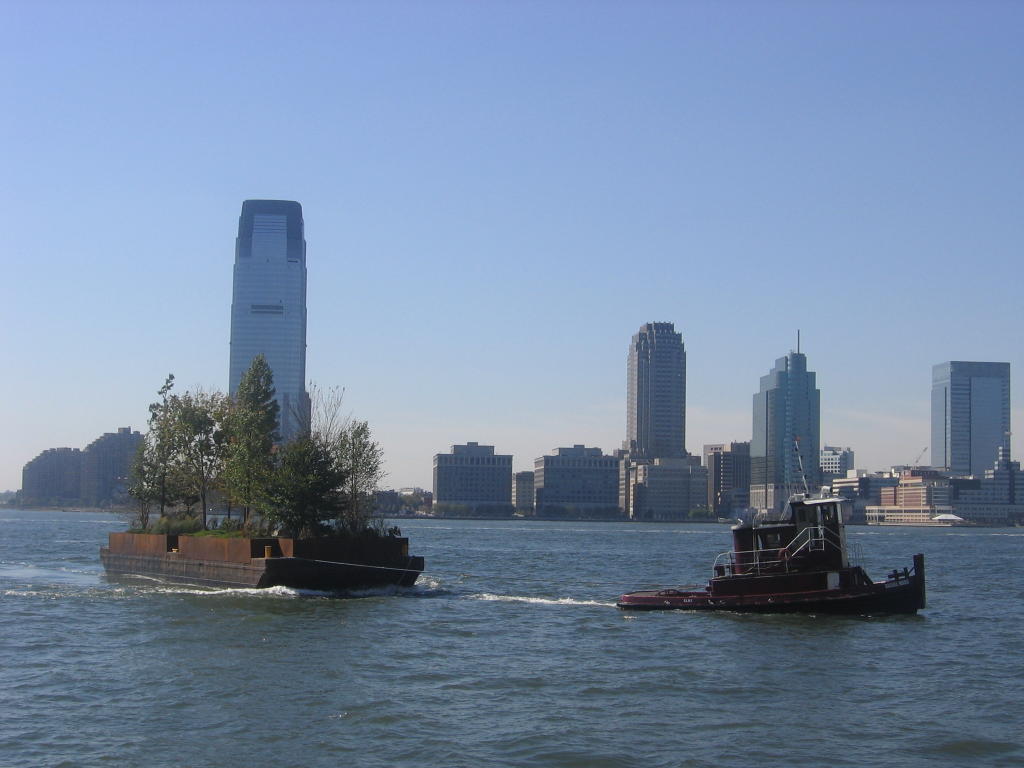
No, it isn't a dessert. It's a water-borne work of art. (Click on photo for enlargement.)
Since they're now effectively out of contention, ...
... the Mets have come back to life, winning a series from the Braves and assuring themselves of another from the Marlins.
Perhaps they'll get the satisfaction of helping to deny Carlos Delgado the post-season action for which he spurned them.
Perhaps they'll get the satisfaction of helping to deny Carlos Delgado the post-season action for which he spurned them.
Wednesday, September 21, 2005
Update on slur against Katrina victims.
Snopes.com now has an update on this story, including the doctor's statement disavowing the contents of the piece and pointing out that he was not at the convention center in Houston where these alleged incidents occurred. The Snopes piece also quotes relief volunteers from that site and others to the effect that evacuees did not behave in the manner described. You can find it here .
Tuesday, September 20, 2005
Don't be fooled by "doctor's" slur on Katrina victims.
There's a blatantly racist rant about the "arrogance" of Katrina victims, allegedly by an M.D. affiliated with the Mississippi university system, that's been circulating by e-mail. A couple of right wing websites have picked it up, but a British conservative site has questioned its provenance and accuracy. Someone also posted it on the Denver Craigslist, but it has since been removed. The good folks at Snopes.com tracked down the truth, which is that the piece was not written by the doctor. It was instead posted on the website of an unnamed 23 year old male Texan, the doctor saw it and forwarded it to some friends (why isn't clear, but his subsequent reaction indicates it was likely because he didn't agree with it), and at least one of those friends sent it on with the doctor's name attached, though probably inadvertently. The doctor is now appalled by what has happened. You can find the discussion here.
Monday, September 19, 2005
Cynicism analyzed.
Tyler Cowen, in Marginal Revolution, finds gold in Robin Hanson's The Cynic's Conundrum. Here's a choice nugget:
Interpreted as extreme claims, such as that people only care about low motives, or that high functions have no influence on social institutions, cynicism is clearly false. But interpreted in a more graded fashion, such as the fraction of behavior explained by low motives or functions, or the difference between claimed motives and real motives, cynical beliefs clearly tend to contain a lot of truth.
The conclusion:
... while hypocrisy and low motives probably are in fact much more widespread than most people acknowledge, most people are well-advised to pretend that they believe otherwise.
Interpreted as extreme claims, such as that people only care about low motives, or that high functions have no influence on social institutions, cynicism is clearly false. But interpreted in a more graded fashion, such as the fraction of behavior explained by low motives or functions, or the difference between claimed motives and real motives, cynical beliefs clearly tend to contain a lot of truth.
The conclusion:
... while hypocrisy and low motives probably are in fact much more widespread than most people acknowledge, most people are well-advised to pretend that they believe otherwise.
Taking what satisfaction we can.
A colleague, who is a Yankee fan but a thoroughly decent fellow nevertheless, expressed his wonderment about a group of Mets fans he had seen late yesterday, apparently enjoying themselves very much despite their team's being effectively out of contention. I explained that they were celebrating two events: a series victory over the Braves, and Tom Glavine's first victory over his old team this season (and only his second since becoming a Met). Sparkling defensive play by recently called-up second baseman Anderson Hernandez aided Glavine's cause, and gave more reason to hope for better things in 2006.
Addendum 9/20: Today's NYT has a piece on Carlos Beltran, in which Ben Shpigel quotes him as saying he regards Roberto Alomar as a model for his offensive game. Of course, he means the Cleveland Alomar, not the Mets Alomar ... we hope.
Addendum 9/20: Today's NYT has a piece on Carlos Beltran, in which Ben Shpigel quotes him as saying he regards Roberto Alomar as a model for his offensive game. Of course, he means the Cleveland Alomar, not the Mets Alomar ... we hope.
Sunday, September 18, 2005
Saturday, September 17, 2005
Has anyone noticed ...
... that Paul Simon, at least in a baseball cap, has come to resemble Michael Bloomberg?
9/20 Addendum: For proof, go to http://www.paulsimon.com/index_main.html, and scroll to the right of the row of photographs at the top of the page.
9/20 Addendum: For proof, go to http://www.paulsimon.com/index_main.html, and scroll to the right of the row of photographs at the top of the page.
Sir Hermann Bondi, 1919-2005
I first read of Hermann Bondi when I was about twelve, probably in George Gamow's One, Two, Three ... Infinity, a book that helped to convince me I wanted to be an astrophysicist. (It took Jane Reed, my Calculus I instructor, to dissuade me from this ambition.) Bondi, I learned, was one of a triumvirate of cosmologists (the others were Thomas Gold and Fred Hoyle) who championed the "steady state" theory of the universe. I later wondered how it came to be that a beach in Australia was named for him.
"Steady state" was posited in 1948 as an explanation for the condition of the universe as it was known at that time. Some years earlier, Edwin Hubble had shown that the universe is expanding. One possible reason was that it had started out very small, and exploded outward. This became known as the "big bang" theory. It implied that there was a finite amount of matter in the universe, and that, if the universe continued expanding, eventually it would become mostly empty, and dead. Alternatively, if there was sufficient matter that gravity would eventually overcome the expansive force, the universe would ultimately collapse back to the point from which it originated. Bondi, Gold and Hoyle, however, argued that, while the universe was expanding from a single point, matter is continuously being created at that point and expanding outward to replenish the void left behind earlier matter that had gone before it. Always has been, and always will.
Given that comparison, it seems that steady state is a much more optimistic theory than big bang. It's interesting, however, to consider that, in a way, steady state, which, according to the New York Times' obituary of Bondi today, "still has its adherents" (although evidence of residual microwave radiation from the big bang led Bondi himself to renounce it) is much more of a challenge to Biblical literalism even than Darwin's theory of evolution. After all, it squarely contradicts the first three words of Genesis, "In the beginning", positing, instead, that there was no beginning.
Bondi, who was born an Austrian Jew and emigrated to Britain when the Nazis occupied his homeland, had in common with many great British scientists a commitment to practical affairs along with theoretical work. He was among those who designed the Thames Barrier, which is meant to protect London from a disaster like that of New Orleans.
"Steady state" was posited in 1948 as an explanation for the condition of the universe as it was known at that time. Some years earlier, Edwin Hubble had shown that the universe is expanding. One possible reason was that it had started out very small, and exploded outward. This became known as the "big bang" theory. It implied that there was a finite amount of matter in the universe, and that, if the universe continued expanding, eventually it would become mostly empty, and dead. Alternatively, if there was sufficient matter that gravity would eventually overcome the expansive force, the universe would ultimately collapse back to the point from which it originated. Bondi, Gold and Hoyle, however, argued that, while the universe was expanding from a single point, matter is continuously being created at that point and expanding outward to replenish the void left behind earlier matter that had gone before it. Always has been, and always will.
Given that comparison, it seems that steady state is a much more optimistic theory than big bang. It's interesting, however, to consider that, in a way, steady state, which, according to the New York Times' obituary of Bondi today, "still has its adherents" (although evidence of residual microwave radiation from the big bang led Bondi himself to renounce it) is much more of a challenge to Biblical literalism even than Darwin's theory of evolution. After all, it squarely contradicts the first three words of Genesis, "In the beginning", positing, instead, that there was no beginning.
Bondi, who was born an Austrian Jew and emigrated to Britain when the Nazis occupied his homeland, had in common with many great British scientists a commitment to practical affairs along with theoretical work. He was among those who designed the Thames Barrier, which is meant to protect London from a disaster like that of New Orleans.
Will the Vols give Meyer's tailor some business?
The NYT's Pete Thamel tells us, on page one of today's sports section, that Florida's new coach, Urban Meyer, loses ten pounds after every loss. So far this season, his girth has faced no challenge, as the Gators easily beat Wyoming and Louisiana Tech. Tonight they face their first serious challenge, Tennessee. These teams have a history. Back in the mid 1960's, Florida snatched Steve Spurrier, then the nation's top high school QB prospect, from Johnson City, barely a stone's throw from the UT campus. They later lured Tennessee coach Doug Dickey south, where he went from kudos in Knoxville to groans in Gainesville. In recent years, they've usually been the top contenders for the SEC East title.
It's hard to call this one. The Vols had trouble with Alabama-Birmingham, but Fullmer is the kind of coach who can build off of trouble. The Gators have a history of going belly-up in big games with lots of attention focused on them. But we haven't seen a Meyer-coached team in the Swamp in a big one yet. Meyer's tailor should be looking for his measuring tape, but not counting on the cash yet.
It's hard to call this one. The Vols had trouble with Alabama-Birmingham, but Fullmer is the kind of coach who can build off of trouble. The Gators have a history of going belly-up in big games with lots of attention focused on them. But we haven't seen a Meyer-coached team in the Swamp in a big one yet. Meyer's tailor should be looking for his measuring tape, but not counting on the cash yet.
Friday, September 16, 2005
Postscript on culture war.
It's not the big one I promised earlier - I'll try to get that done this weekend - but Meghan O'Rourke thinks reading Faulkner can help.
Thursday, September 15, 2005
This blog needs more of these.
 According to the plaque on the sidewalk, this is "Eyes", by Louise Bourgeois.
Oh, give me a break!
Braves Cited For Abuse Of Mets. Y'all just love kicking us when we're down, don'tcha?
"Mathematical elimination fever: Catch it!"
Someone suggested that as a slogan for the Atlanta Braves, back in the early 1990's, not too long before they were transformed into the beast of the N.L. East. So, with a bit of hopefulness, I offer it to my beloved Mets, described in a headline in today's New York Times as "flatlining".
A sharp-eyed colleague called my attention to an item in the fine print near the bottom of today's Times sports section, under the heading "this date in baseball":
1946 - The Brooklyn Dodgers beat the Chicago Cubs 2-0 in five innings when the game was called because of gnats.
Would that the Mets could catch such a break now and then.
A sharp-eyed colleague called my attention to an item in the fine print near the bottom of today's Times sports section, under the heading "this date in baseball":
1946 - The Brooklyn Dodgers beat the Chicago Cubs 2-0 in five innings when the game was called because of gnats.
Would that the Mets could catch such a break now and then.
Will Weiner's class act be nullified by bureaucracy?
Magnanimity and self-sacrifice aren't words usually associated with New York City politics, on either the Democratic or GOP side. So it comes as a pleasant surprise to see Representative Anthony Weiner conceding the Democratic mayoral primary to Fernando Ferrer, despite Ferrer's falling just short, before absentee ballots have been counted, of the required forty per cent of the vote needed to avoid a run-off. Weiner cited the need for party unity in the face of a re-election campaign by a fabulously wealthy incumbent. A cynic might argue that, since Weiner retains his seat in Congress, his "gracious" concession enhances his prospects for re-election (though I suspect that the odds of his being unseated, like those of most Congressional incumbents, are slim in any event), that it may help his chances of some day attaining higher office, and that it is therefore a worthwhile trade-off for an uncertain one-on-one shot at Ferrer. Nevertheless, one must recall that in the last mayoral election, Ferrer lost a Democratic primary run-off to Mark Green (who then went on to lose to Bloomberg in an election overshadowed by the attack on the World Trade Center).
Another nice thing about Wiener's concession is that it stands to eliminate the need for any city-wide run-off, as the only other candidate for city-wide office, Public Advocate Betsy Gotbaum, cleared the forty per cent margin (as did Manhattan Borough President candidate Scott Stringer and the incumbent Manhattan and Brooklyn District Attorneys, the only borough-wide candidates facing primary challenges). This would, I heared on WQXR this morning, probably save the City something on the order of $10 million. Not a huge amount, as compared to the overall City budget, but not exactly chump change, either. But wait! According to New York 1,
Election officials say after all the absentee ballots are calculated, which could take until next week, there may still be a runoff by law if Ferrer does not get that 40 percent.
In other words, we must continue counting those absentee ballots and, should Ferrer not reach the magic number, blow a big wad of cash to learn the answer to the question, "What if they had an election and nobody came?" (The prospect of die-hard Weiner loyalists trooping to the polls despite his wishes seems slim, especially as the unions supporting him in the primary have endorsed his withdrawal and thrown their support to Ferrer).
I'm all for the rule of law, but, sometimes, adherence to rules becomes nonsensical. What dread precedent would be established by ignoring the forty per cent rule when the second place candidate willingly concedes?
9/21 addendum: The ballots have all been counted, and Ferrer has his 40%. Joel Kotkin has a piece on today's NYT op-ed page arguing that this is a Bad Thing, because it lets the Democrats escape a needed fight between what he sees as Ferrer's old school tax-and-spend, identity politics liberalism, and Weiner's more centrist approch that seeks to "cut taxes and streamline bureaucracy". Of course, if this is an accurate description of Weiner's policies, it's hard to see how he's much different from Bloomberg.
Another nice thing about Wiener's concession is that it stands to eliminate the need for any city-wide run-off, as the only other candidate for city-wide office, Public Advocate Betsy Gotbaum, cleared the forty per cent margin (as did Manhattan Borough President candidate Scott Stringer and the incumbent Manhattan and Brooklyn District Attorneys, the only borough-wide candidates facing primary challenges). This would, I heared on WQXR this morning, probably save the City something on the order of $10 million. Not a huge amount, as compared to the overall City budget, but not exactly chump change, either. But wait! According to New York 1,
Election officials say after all the absentee ballots are calculated, which could take until next week, there may still be a runoff by law if Ferrer does not get that 40 percent.
In other words, we must continue counting those absentee ballots and, should Ferrer not reach the magic number, blow a big wad of cash to learn the answer to the question, "What if they had an election and nobody came?" (The prospect of die-hard Weiner loyalists trooping to the polls despite his wishes seems slim, especially as the unions supporting him in the primary have endorsed his withdrawal and thrown their support to Ferrer).
I'm all for the rule of law, but, sometimes, adherence to rules becomes nonsensical. What dread precedent would be established by ignoring the forty per cent rule when the second place candidate willingly concedes?
9/21 addendum: The ballots have all been counted, and Ferrer has his 40%. Joel Kotkin has a piece on today's NYT op-ed page arguing that this is a Bad Thing, because it lets the Democrats escape a needed fight between what he sees as Ferrer's old school tax-and-spend, identity politics liberalism, and Weiner's more centrist approch that seeks to "cut taxes and streamline bureaucracy". Of course, if this is an accurate description of Weiner's policies, it's hard to see how he's much different from Bloomberg.
Wednesday, September 14, 2005
Can the culture war end in anything but scorched earth?
Digby has a scary take (these posts are from November, 2004, but are linked to a recent post of his; follow my link and scroll down to the posts headed "More Culture War" dated November 10 and "It Won't Work" dated November 9) on the origin and nature of the "culture war". It's not just a reaction to the sexual and pharmaceutical excesses of my generation in the 1960's. It's not, as one Ralph Keyes argued in his book, published in the 1970's, Is There Life After High School?, about whether we were "innies" or "outies" (in the social, not the navel, sense) in our teens. It's not even, as I've suspected, mostly about parents fearing baleful cultural influnces that will lead their children to grow up (in the words of the Austin Lounge Lizards) "stoned, left-leaning and gay."
No, according to Digby, its origins are pre-Revolutionary and rooted in slavery and race. It began with prickly defensiveness on the part of Southerners, that led to bellicose defiance and secession, and, following defeat on the battlefield, morphed into resentful vengefulness that "metastasized" throughout middle America. It can't be mollified, he argues, by any concessions on the issues of the day (abortion, school prayer, gay marriage and so on), because it can only be satisfied by a total victory that would entail trashing the Bill of Rights and instituting a theocracy.
But this won't happen, he argues, because the real (as opposed to the liberal, intellectual, academic and media) elite, which Digby identifies with "the church, the government and the corporations" will, much as Tom Frank contends, use these issues to manipulate the electorate for its own ends (presumably ever-lower taxes, leading to more money in collection plates, re-election for incumbents, and free rein for usurers, polluters and purveyors of unsafe products).
I think that, like many over-arching explanations, this has some truth to it, but fails to explain everything. I have my own overly-ambitious theory, which I'll set out in a later post. For now, as Samuel Pepys was wont to say, "and so to bed."
No, according to Digby, its origins are pre-Revolutionary and rooted in slavery and race. It began with prickly defensiveness on the part of Southerners, that led to bellicose defiance and secession, and, following defeat on the battlefield, morphed into resentful vengefulness that "metastasized" throughout middle America. It can't be mollified, he argues, by any concessions on the issues of the day (abortion, school prayer, gay marriage and so on), because it can only be satisfied by a total victory that would entail trashing the Bill of Rights and instituting a theocracy.
But this won't happen, he argues, because the real (as opposed to the liberal, intellectual, academic and media) elite, which Digby identifies with "the church, the government and the corporations" will, much as Tom Frank contends, use these issues to manipulate the electorate for its own ends (presumably ever-lower taxes, leading to more money in collection plates, re-election for incumbents, and free rein for usurers, polluters and purveyors of unsafe products).
I think that, like many over-arching explanations, this has some truth to it, but fails to explain everything. I have my own overly-ambitious theory, which I'll set out in a later post. For now, as Samuel Pepys was wont to say, "and so to bed."
Monday, September 12, 2005
Targeted Katrina relief.
In a post below ("Sometimes, bureaucracy works"), I mentioned a friend who is working with the Louisiana Insurance Department and others to provide targeted, cost-effective relief to those displaced by Katrina. Her name is Mary Lanning, and she has been providing assistance to the homeless, the home-bound and the gravely ill for many years through a non-profit organization called YES! Solutions, Inc., which is qualified under I.R.C. Section 501(C)3.
At present, Mary has positioned YES! to link donors directly to those who are providing housing and board to people displaced by the hurricane. If you contact YES!, you will be provided with the name of a host, the address of the household, and a list of items needed by those being sheltered by the host. You may then send a box of needed items directly to the host. As an option, of course, you may choose simply to make a cash donation to YES!
If interested, please contact:
Mary Lanning
YES! Solutions, Inc.
549 West 123rd Street, Suite MF
New York, NY 10027
Phone: 212-866-5500
E-mail: ml-g-associates@worldnet.att.net
At present, Mary has positioned YES! to link donors directly to those who are providing housing and board to people displaced by the hurricane. If you contact YES!, you will be provided with the name of a host, the address of the household, and a list of items needed by those being sheltered by the host. You may then send a box of needed items directly to the host. As an option, of course, you may choose simply to make a cash donation to YES!
If interested, please contact:
Mary Lanning
YES! Solutions, Inc.
549 West 123rd Street, Suite MF
New York, NY 10027
Phone: 212-866-5500
E-mail: ml-g-associates@worldnet.att.net
Alas, it's too late for Gate.
Following up on my post below about aid for musicians, I'm saddened to pass on this report of the death of Clarence 'Gatemouth' Brown. He had been ill for some time, but if his death wasn't caused, it was at least hastened by the effects of Katrina.
I had the pleasure of hearing Gate perform, and of meeting him after the show, about ten years ago at Blues Harbor, in Atlanta. He was an artist blessed with the ability to meld many styles and produce something of surpassing impact.
"So Long For Now", Gate. You'll be missed.
I had the pleasure of hearing Gate perform, and of meeting him after the show, about ten years ago at Blues Harbor, in Atlanta. He was an artist blessed with the ability to meld many styles and produce something of surpassing impact.
"So Long For Now", Gate. You'll be missed.
Help for New Orleans and Gulf Coast musicians
Those of you, who, like me, are music buffs, and want to help the many musicians whose lives and art have been uprooted by Katrina should go to The Jazz Foundation of America - Helping Musicians In Need.
Shades of Grantland Rice.
Ray Glier of the New York Times uses "albeit" in his Sunday sports section story about Saturday's gridiron clash between Georgia and South Carolina, won narrowly by the Dawgs only after they "resorted to rock-'em, sock-'em football." No mention of Spurrier visor tosses.
The big story, of course, is Notre Dame's upset of Michigan. I used to dislike the Irish with almost the intensity with which I loathe the Yankees, and for pretty much the same reason: they were the "establishment" team, about whom the Beano Cooks of the world would blather like a minyan of Reb Tevyes, "Knut Rockne, tradition! Four Horsemen, tradition! The Gippah, tradition! Subway alumni, tradition!" Their recent travails made me re-evaluate my position. So long as they only upend other establishment teams, I'll root for them.
The big story, of course, is Notre Dame's upset of Michigan. I used to dislike the Irish with almost the intensity with which I loathe the Yankees, and for pretty much the same reason: they were the "establishment" team, about whom the Beano Cooks of the world would blather like a minyan of Reb Tevyes, "Knut Rockne, tradition! Four Horsemen, tradition! The Gippah, tradition! Subway alumni, tradition!" Their recent travails made me re-evaluate my position. So long as they only upend other establishment teams, I'll root for them.
A view from afar.
Here's more from our man in Beijing . Well worth reading, it includes helpful links to another expat blog and, for hard-core Sinophiles (or -phobes), a site that gives translations of Chinese news articles.
Sunday, September 11, 2005
Sometimes, bureaucracy works.
We've all read and heard much in the past week about the failures of bureaucracy in the face, and aftemath, of Katrina. So it's good to know about one agency, the Louisiana Insurance Department, that is performing admirably. A few days ago, the New York Times reported on Commissioner Robetrt Wooley's convocation of a meeting in Atlanta with representatives of insurance companies that covered properties affected by the storm. Now I've heard from a friend who has had extensive dealings with the Department over the years, and who is helping to coordinate a partnership with Department personnel to provide direct relief for displaced hurricane victims. Here's the story, in her own words:
We're launching a Katrina relief partnership with host families in Baton Rouge and outer-New Orleans and surrounding parishes who have taken-in displaced families ... working directly with 270 members of the Louisiana Insurance Department to provide customized parcels of needed personal hygiene items, towels, sheets, toilet paper to help host families stretch their household budgets for the duration. Our ... donors will send these goods at intervals directly to the homes of host families who sign up. Host families are not in line for any help at all from the major relief agencies, and the many truckloads of clothing and household furnishings that arrive daily exceed the capacity of local people to unload, warehouse, and redistribute. Basic comforts and necessities such as toilet paper and shampoo, however, are a manageable and appreciated support that self-depletes, so recurring gifts are appropriate, allowing supportive relationships to grow between donor and host that could extend to other exchanges of help. ... Meantime, Commissioner Robert Wooley has invited me to come to Baton Rouge to help his department coordinate their own internal relief efforts. Everyone wants to help; they just need someone to organize their effort. His staff already has identified 50+ of their colleagues who lost family, or property, or are housing displaced elders from nursing homes and hospices, or otherwise housing evacuees. One secretary has 32 people living in her 3-bedroom home!
We're launching a Katrina relief partnership with host families in Baton Rouge and outer-New Orleans and surrounding parishes who have taken-in displaced families ... working directly with 270 members of the Louisiana Insurance Department to provide customized parcels of needed personal hygiene items, towels, sheets, toilet paper to help host families stretch their household budgets for the duration. Our ... donors will send these goods at intervals directly to the homes of host families who sign up. Host families are not in line for any help at all from the major relief agencies, and the many truckloads of clothing and household furnishings that arrive daily exceed the capacity of local people to unload, warehouse, and redistribute. Basic comforts and necessities such as toilet paper and shampoo, however, are a manageable and appreciated support that self-depletes, so recurring gifts are appropriate, allowing supportive relationships to grow between donor and host that could extend to other exchanges of help. ... Meantime, Commissioner Robert Wooley has invited me to come to Baton Rouge to help his department coordinate their own internal relief efforts. Everyone wants to help; they just need someone to organize their effort. His staff already has identified 50+ of their colleagues who lost family, or property, or are housing displaced elders from nursing homes and hospices, or otherwise housing evacuees. One secretary has 32 people living in her 3-bedroom home!
Thursday, September 08, 2005
Ship watching from Brooklyn Heights
When I moved to Brooklyn Heights in 1983, one of the principal attractions the neighborhood held for me was that it sat atop a bluff overlooking what were then working piers serving breakbulk cargo ships, mostly in the South American trade, where ports were just beginning to develop container facilities. At the crest of the bluff, cantilevered over the Brooklyn-Queens Expressway, is the Promenade, a walkway extending for about half a mile, shown below.
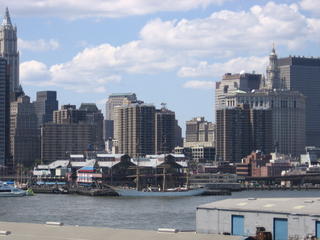
 The Promenade commands a view of the piers below, the East River (actually a strait connecting upper New York harbor to Long Island Sound), and beyond, the Statue of Liberty, Lower Manhattan and the Brooklyn Bridge. Here is a view from the Promenade looking toward the South Street Seaport on the Manhattan side, with the Woolworth Building on the left and the Municipal Building (once described as "the most outstanding example of Stalinist Gothic architecture in America") to the right. Note the Danish sail training ship docked at the end of Pier 17.
 Unfortunately, shipping economics scotched my dream of living in a place overlooking working docks, as, shortly after I moved, the neighborhood paper announced the closing of the piers below the Heights. The triumph of containerization meant that piers without many acres of storage space in front of them were obsolete. For several years, the piers were used as parking spaces for ships awaiting sale to new owners or for scrap, including a former Matson liner that ended its years of service as part of the Chandris cruise fleet, a World War II vintage C-4 type freighter that had been converted to a container ship, and the battleship Iowa, which had been reactivated and was awaiting permanent port facilities on Staten Island (Iowa was later withdrawn from service and the Staten Island base canceled). After a few years, buildup of silt around the piers precluded even their being used for this purpose. The City now intends to turn the piers, and the land between them and the Heights, into a waterfront park.
Despite the loss of the piers, the Promenade is still a good location for ship watching. On Saturday mornings and evenings through late spring, summer and early fall, a parade of cruise ships can be seen entering and leaving port. On occasion, cargo vessels sail right by the Heights, entering or leaving the East River en route to docks at the former Brooklyn Navy Yard, or to ports on Long Island Sound. A couple of mornings ago, I rose early and decided to walk on the Promenade before breakfast. As I was returning, I spotted a small cruise ship emerging from behind Governors Island, which lies below the tip of Manhattan, preparing to sail up the Hudson.
 This vessel has the typically motor yacht-like look of today's cruise ships, but is trimmer and more attractive to my eye than the much larger vessels that now dominate that trade. After getting this photo, I returned to my apartment and was just sitting down for breakfast when I glanced out the window and saw something that made me dash out the door, camera in hand, and back down to the Promenade. Another small cruiser was coming in, but this was a much older vessel, of a type seldom seen here.
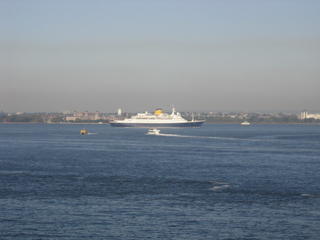 Note the much more "shipshape" lines of this vessel, which I would guess to be of late 1950's or early '60's vintage. Alas, most of its kind are now gone. Update: I now know she was either Saga Rose or Saga Ruby.
 The Promenade commands a view of the piers below, the East River (actually a strait connecting upper New York harbor to Long Island Sound), and beyond, the Statue of Liberty, Lower Manhattan and the Brooklyn Bridge. Here is a view from the Promenade looking toward the South Street Seaport on the Manhattan side, with the Woolworth Building on the left and the Municipal Building (once described as "the most outstanding example of Stalinist Gothic architecture in America") to the right. Note the Danish sail training ship docked at the end of Pier 17.
 Unfortunately, shipping economics scotched my dream of living in a place overlooking working docks, as, shortly after I moved, the neighborhood paper announced the closing of the piers below the Heights. The triumph of containerization meant that piers without many acres of storage space in front of them were obsolete. For several years, the piers were used as parking spaces for ships awaiting sale to new owners or for scrap, including a former Matson liner that ended its years of service as part of the Chandris cruise fleet, a World War II vintage C-4 type freighter that had been converted to a container ship, and the battleship Iowa, which had been reactivated and was awaiting permanent port facilities on Staten Island (Iowa was later withdrawn from service and the Staten Island base canceled). After a few years, buildup of silt around the piers precluded even their being used for this purpose. The City now intends to turn the piers, and the land between them and the Heights, into a waterfront park.
Despite the loss of the piers, the Promenade is still a good location for ship watching. On Saturday mornings and evenings through late spring, summer and early fall, a parade of cruise ships can be seen entering and leaving port. On occasion, cargo vessels sail right by the Heights, entering or leaving the East River en route to docks at the former Brooklyn Navy Yard, or to ports on Long Island Sound. A couple of mornings ago, I rose early and decided to walk on the Promenade before breakfast. As I was returning, I spotted a small cruise ship emerging from behind Governors Island, which lies below the tip of Manhattan, preparing to sail up the Hudson.
 This vessel has the typically motor yacht-like look of today's cruise ships, but is trimmer and more attractive to my eye than the much larger vessels that now dominate that trade. After getting this photo, I returned to my apartment and was just sitting down for breakfast when I glanced out the window and saw something that made me dash out the door, camera in hand, and back down to the Promenade. Another small cruiser was coming in, but this was a much older vessel, of a type seldom seen here.
 Note the much more "shipshape" lines of this vessel, which I would guess to be of late 1950's or early '60's vintage. Alas, most of its kind are now gone. Update: I now know she was either Saga Rose or Saga Ruby.
Wednesday, September 07, 2005
Another blog worth visiting.
This time, it's an Englishman living in semi-retirement in France. I discovered him because Blogger identified us as the only two users of their service with an interest in "ships and the sea". On going to his site, I found we had much else in the way of common interests. His thoughts and poetry can be found at A Layman's Analyses in France.
Do I have a particular affinity for blogs by expatriates? Perhaps it's because I was one during several very formative years.
Do I have a particular affinity for blogs by expatriates? Perhaps it's because I was one during several very formative years.
A visit to Beijing
I've discovered an excellent blog by an American living in Beijing. A fascinating account of life in that city, with incisive views on the Chinese legal system and reflections on the status of foreigners there, can be found at Two Wheels Bad, Four Wheels Good?
Tuesday, September 06, 2005
Back to things nautical, ...
... or, at least, riverine. Another Fray friend, Raprap, with whom I share (at least on my father's side) an Ohio valley heritage, has posted a comment in response to my initial "Welcome" post below, in which he gives the happy news that at least twenty old-style tall stack sternwheel river boats still are in sailing condition. He also quotes one of my favorite musicians:
John Hartford, in a river song, once described a riverboat as an engine surrounded by someone with a fetish for a scroll saw. He was right. It isn’t unusual to see a new hull built around 75 year old engines. A hull with these beautiful Victorian filigreed scroll sawn gussets on all three decks.
Despite my paternal connection to the river, I've not spent enough time along the banks of the O-hi-o (as the old song goes, which I first heard at about age ten on the radio in my parents' Chevy while riding across southern Ohio en route from my mother's home in Pennsylvania to my dad's in Indiana) to see one of the grand old boats steam by. I have seen many a stick of barges pushed by a massive diesel-powered towboat. So, tell me, Rap, or anybody, why is it called a "towboat" if all it does is push, not pull?
John Hartford, in a river song, once described a riverboat as an engine surrounded by someone with a fetish for a scroll saw. He was right. It isn’t unusual to see a new hull built around 75 year old engines. A hull with these beautiful Victorian filigreed scroll sawn gussets on all three decks.
Despite my paternal connection to the river, I've not spent enough time along the banks of the O-hi-o (as the old song goes, which I first heard at about age ten on the radio in my parents' Chevy while riding across southern Ohio en route from my mother's home in Pennsylvania to my dad's in Indiana) to see one of the grand old boats steam by. I have seen many a stick of barges pushed by a massive diesel-powered towboat. So, tell me, Rap, or anybody, why is it called a "towboat" if all it does is push, not pull?
Monday, September 05, 2005
More on Katrina, and a note on the Fray
As the enormity of the tragedy has become apparent, I've felt compelled to add to my earlier, brief comments. However, as so often happens, I find that my Fray friend Demosthenes2 has said pretty much what I would have, but more eloquently, and probably more succinctly, at http://fray.slate.msn.com/?id=3936&m=15634963 .
For anyone reading this who's unfamiliar with the Fray (which I've now referred to in two posts, and certainly will again), there's a good description in Wikipedia at http://en.wikipedia.org/wiki/The_Fray_%28Internet_forum%29 , written, I believe, largely by Fray stalwarts Deej and Betty the Crow.
I don't mean for this Blog to be a site exclusively for Fraysters. To the contrary, I encourage participation by everyone. If you're unfamiliar with the Fray, or with Slate Magazine, and decide to join in there, too, then so much the better. But, if you don't, that's fine by me, too.
For anyone reading this who's unfamiliar with the Fray (which I've now referred to in two posts, and certainly will again), there's a good description in Wikipedia at http://en.wikipedia.org/wiki/The_Fray_%28Internet_forum%29 , written, I believe, largely by Fray stalwarts Deej and Betty the Crow.
I don't mean for this Blog to be a site exclusively for Fraysters. To the contrary, I encourage participation by everyone. If you're unfamiliar with the Fray, or with Slate Magazine, and decide to join in there, too, then so much the better. But, if you don't, that's fine by me, too.
Sunday, September 04, 2005
Ship watching at Eisenhower Lock
One of Massena's fine points is that it's located close to the Eisenhower Lock on the St. Lawrence Seaway. The Seaway is a system of canals, locks and dams that allows ships of up to almost 700' length to traverse the St. Lawrence River and Great Lakes, from the Atlantic to Lake Superior. The Seaway was built in the 1950's, and replaced an older system of smaller locks and narrower, shallower canals that limited navigation to uneconomically small vessels.
When completed, the Seaway locks were large enough to accomodate most cargo ships, excepting the largest tankers and bulk carriers. Today, many container ships and bulkers are too large for it, but it still carries an impressive amount of ocean-borne cargo to and from ports ranging from Ogdensburg, New York west to Duluth, Minnesota. An even greater volume consists of cargo carried to and from U.S. and Canadian ports along the Lakes and the St. Lawrence to other such ports. Most of this cargo is carried on "lakers", specialized vessels built for Great Lakes navigation. The classic laker design had the wheelhouse atop a tall superstructure at the bow of the ship, and the engine room and funnel at the stern, leaving a long open deck with cargo hatches between. Recently, lakers have tended toward the arrangement standard for oceangoing freighters of having both the wheelhouse and engine aft. Still, they can usually be distinguished from "salties" by an overall blunter, more bargelike hull shape.
Whenever we visit Massena, I get on line and visit the Seaway's web site, which provides a handy map showing the location of ships on the Seaway. From this, I can tell when to drive up to the Eisenhower Lock visitor center, which has a platform overlooking the lock, and see a ship or two locking through. This past Friday, I saw that two ships, one a laker and the other a salty, were due to lock through in the late afternoon. The first through was the Frontenac, of Canada Steamship Lines (note that, despite the company name, this vessel, as almost all now active, is diesel powered), a laker built to the maximum dimesions allowing transit of the Seaway locks. Here is Frontenac entering the lock.

Update: For more photos and text about Eisenhower Lock, see here and here. For more about classic lake boats, see here.
When completed, the Seaway locks were large enough to accomodate most cargo ships, excepting the largest tankers and bulk carriers. Today, many container ships and bulkers are too large for it, but it still carries an impressive amount of ocean-borne cargo to and from ports ranging from Ogdensburg, New York west to Duluth, Minnesota. An even greater volume consists of cargo carried to and from U.S. and Canadian ports along the Lakes and the St. Lawrence to other such ports. Most of this cargo is carried on "lakers", specialized vessels built for Great Lakes navigation. The classic laker design had the wheelhouse atop a tall superstructure at the bow of the ship, and the engine room and funnel at the stern, leaving a long open deck with cargo hatches between. Recently, lakers have tended toward the arrangement standard for oceangoing freighters of having both the wheelhouse and engine aft. Still, they can usually be distinguished from "salties" by an overall blunter, more bargelike hull shape.
Whenever we visit Massena, I get on line and visit the Seaway's web site, which provides a handy map showing the location of ships on the Seaway. From this, I can tell when to drive up to the Eisenhower Lock visitor center, which has a platform overlooking the lock, and see a ship or two locking through. This past Friday, I saw that two ships, one a laker and the other a salty, were due to lock through in the late afternoon. The first through was the Frontenac, of Canada Steamship Lines (note that, despite the company name, this vessel, as almost all now active, is diesel powered), a laker built to the maximum dimesions allowing transit of the Seaway locks. Here is Frontenac entering the lock.

You can see the classic, wheelhouse-forward laker design. Below is Frontenac in the lock, looking aft from behind her wheelhouse. The enormous boom is for unloading cargo (typically grain or pelletized ore) at ports that lack unloading facilities.

Finally, we see Frontenac, having locked through, heading downstream toward her home port of Montreal.
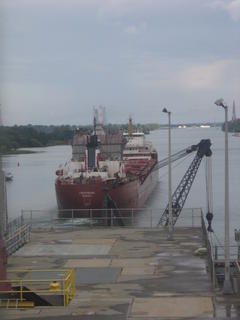
By the time Frontenac was gone, and the lock refilled, the Russian freighter Aleksandr Suvorov was waiting its turn. Here's the Suvorov entering the lock.

Unfortunately, after this shot the batteries in my camera expired, preventing me from recording the Russian vessel's progress through the lock. A very tanned, weather-beaten looking man and a woman with coppery red hair were lounging atop the wheelhouse. From the stern, I read Suvorov's hailing port as Murmansk, on Russia's north coast. This explained the logo of a white polar bear emblazoned on the ship's black funnel.
Update: For more photos and text about Eisenhower Lock, see here and here. For more about classic lake boats, see here.
Subscribe to:
Posts (Atom)