I'd have guessed that, since my father's death, I was the last Claude Scales left on earth, much less the U.S. Thanks to a site called "How Many of Me?", I know there are likely to be six in this country. Try it and find out how many Americans probably share your name.
(I thought I got this link off Instapundit, but now I can't find it there. If, as my wife says, it's a case of its being right in front of me and my not being able to see it, my apologies, Glenn.)
Tuesday, October 24, 2006

Monday, October 23, 2006
Another rousing cheer for Stephenie Hollyman
I'm very impressed by this slide show of McAllister tugs, and their crews, docking ships in the Port of New York/New Jersey.
The ship named Patagonian Mystic, seen in the slide show, brings to mind a comment by a friend who grew up in Detroit and used to watch ships sailing by on the river there. He observed that a typical name for a Greek-owned, Liberian-registered "salty" (an oceangoing ship that sails into the Great Lakes through the St. Lawrence Seaway) might be Unicorn Slaughterhouse. (Come to think of it, I've seen Beluga Indication among the names of vessels in transit on the Seaway's vessel transit map.)
Does anyone have any other amusing or interesting ship names to offer?
The ship named Patagonian Mystic, seen in the slide show, brings to mind a comment by a friend who grew up in Detroit and used to watch ships sailing by on the river there. He observed that a typical name for a Greek-owned, Liberian-registered "salty" (an oceangoing ship that sails into the Great Lakes through the St. Lawrence Seaway) might be Unicorn Slaughterhouse. (Come to think of it, I've seen Beluga Indication among the names of vessels in transit on the Seaway's vessel transit map.)
Does anyone have any other amusing or interesting ship names to offer?
Sunday, October 22, 2006
The walk home from the parking lot.
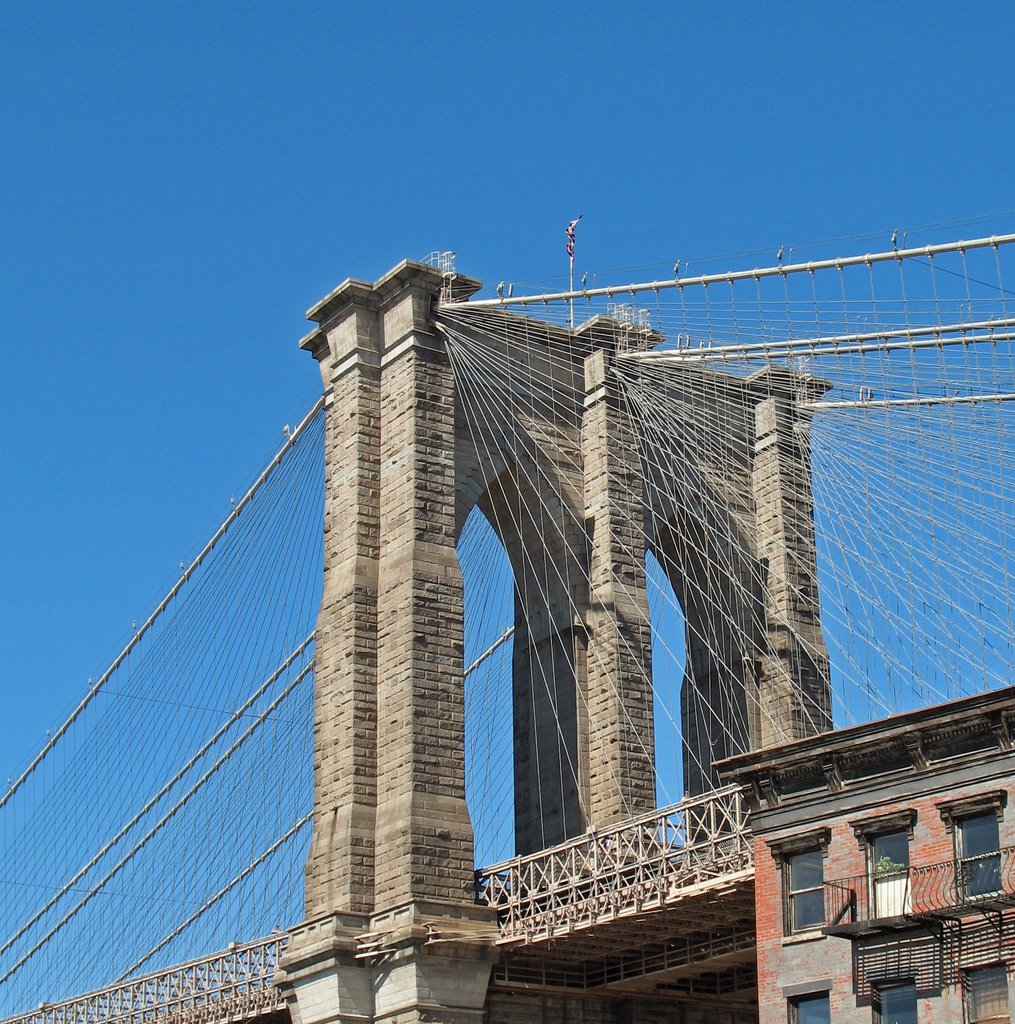
We park our car in a lot nestled next to the abutment of the Brooklyn Bridge. Yesterday I took a few pictures walking home from the lot, going a slightly roundabout way via Old Fulton Street and the Brooklyn Heights Promenade.
The Bridge

Great God, the only bridge of power, life and joy, the bridge that was a span, a cry, an ecstasy - that was America.
- Thomas Wolfe, Of Time and the River.
(Quote courtesy of Stephenie Hollyman's magnificent blog, Crossing Media. Groucho Marx observed of Lydia, the tattooed lady, You can loin a lot from Lydia. Just so, I think I'll probably learn much from Stephenie's blog. God bless the electronic frontier.)
Squibb Hill Dog Park

A rare urban free range for canines. The cantilevered Brooklyn-Queens Expressway is in the background.
Autumn comes to Brooklyn
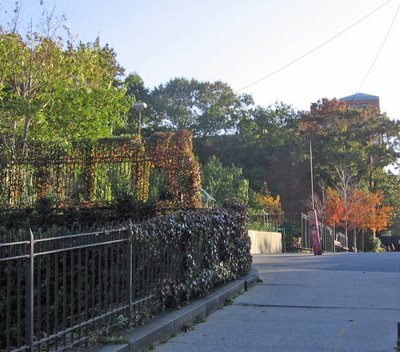
It comes here late, and without the spectacle of New England or Upstate. Still, it has a subtle beauty, as seen in this view along Columbia Heights, looking toward the Harry Chapin Playground.
A harbor workhorse
 Small tankers like this are common in New York Harbor, mostly carrying bunker fuel to ocean-going ships docked here. One of them, the Q Boys, was featured in the original version of Madonna's "True Blue" video (impossible to find on line now, as it's been completely supplanted by a later version). This one was headed up the East River fully loaded, probably delivering fuel from New Jersey to a ship docked somewhere upriver or on Long Island Sound, or perhaps carrying heating oil to a supplier in that direction.
The Bridge
Great God, the only bridge of power, life and joy, the bridge that was a span, a cry, an ecstasy - that was America.
- Thomas Wolfe, Of Time and the River.
(Quote courtesy of Stephenie Hollyman's magnificent blog, Crossing Media. Groucho Marx observed of Lydia, the tattooed lady, You can loin a lot from Lydia. Just so, I think I'll probably learn much from Stephenie's blog. God bless the electronic frontier.)
Squibb Hill Dog Park

A rare urban free range for canines. The cantilevered Brooklyn-Queens Expressway is in the background.
Autumn comes to Brooklyn
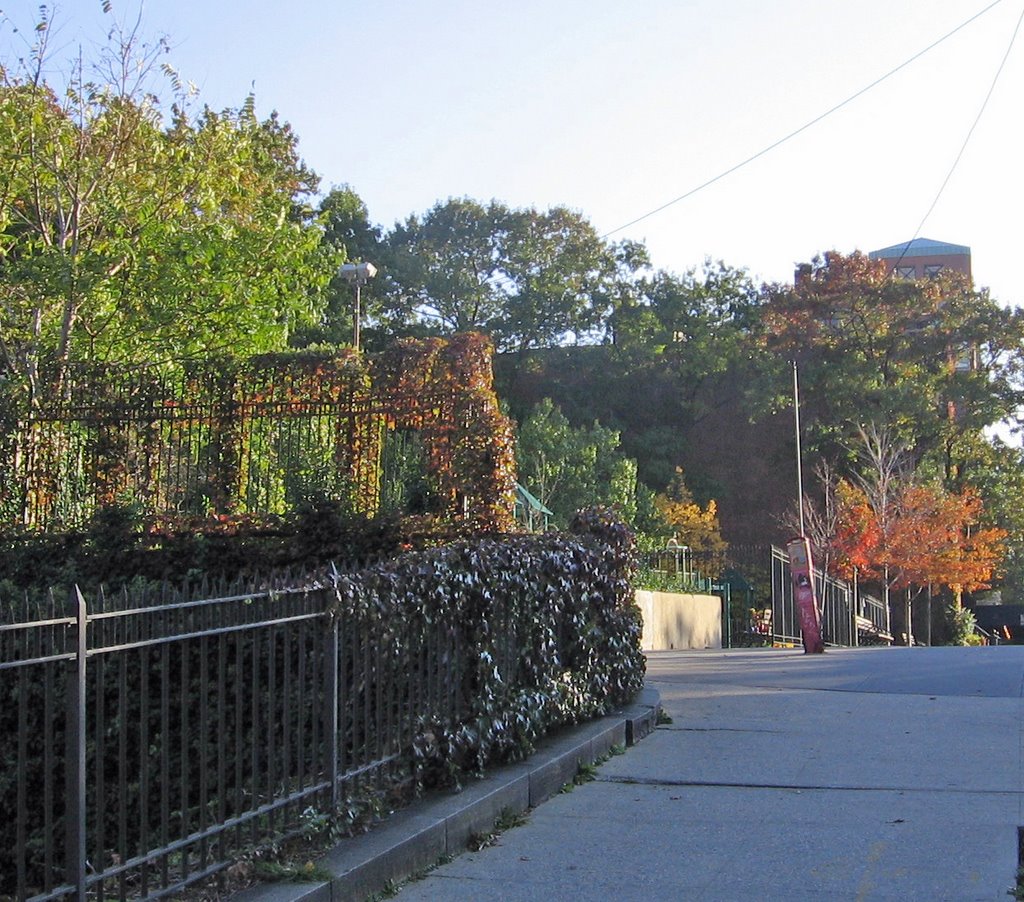
It comes here late, and without the spectacle of New England or Upstate. Still, it has a subtle beauty, as seen in this view along Columbia Heights, looking toward the Harry Chapin Playground.
A harbor workhorse
 Small tankers like this are common in New York Harbor, mostly carrying bunker fuel to ocean-going ships docked here. One of them, the Q Boys, was featured in the original version of Madonna's "True Blue" video (impossible to find on line now, as it's been completely supplanted by a later version). This one was headed up the East River fully loaded, probably delivering fuel from New Jersey to a ship docked somewhere upriver or on Long Island Sound, or perhaps carrying heating oil to a supplier in that direction.
How baseball history was made on my street.
Brooklyn Heights Blog ran a piece a few days ago on Jackie Robinson's signing with the Brooklyn Dodgers in 1945 at what was then Dodger headquarters, 215 Montague Street (four blocks from where I live).
I was amused by the look on Branch Rickey's face in the photograph, but then read in this bio that The Mahatma, like Tony LaRussa, was a law school grad. He's obviously taking the opportunity to give Mr. Robinson a bit of free legal advice.
I was amused by the look on Branch Rickey's face in the photograph, but then read in this bio that The Mahatma, like Tony LaRussa, was a law school grad. He's obviously taking the opportunity to give Mr. Robinson a bit of free legal advice.
Friday, October 20, 2006
"The Catch"
Endy Chavez's spectacular, leaping catch in the final NLCS game, doomed to be a footnote because of the Mets' loss, is compared in this Slate article to Willie Mays' magnificent running, reaching and pivoting catch in game one of the 1954 World Series.
I must have watched the '54 Series. My parents and I had just returned from England, where my dad had been stationed in the Air Force, and I was in third grade at Eglin Air Force Base Elementary School, where, during the World Series, we were excused from class to go to the "cafetorium" where a TV was set up (all Series games were played in the afternoon, then). However, I don't remember anything about it. I was just learning about baseball, while unlearning cricket and rounders. Neither the Giants nor the Indians captured my fancy.
The first Series I remember came the following year. By then I knew that the Yankees were the big, bad bullies, and the Dodgers the scrappy underdogs the Yanks had always slapped down. Besides, Brooklyn was the first place I'd touched U.S. soil after our return. So, I rooted for the Dodgers, and was rewarded. For me, "The Catch" will always be the one Sandy Amoros made in game seven of the '55 Series. (I love the Bob Gibson quote that starts the article.) The poet and Brooklynite Marianne Moore gave it a prominent mention in her celebratory "Hometown Piece for Messrs. Alston and Reese."
As a Mets fan - I consider them the Brooklyn Dodgers continued by other means - I am saddened that Molina's homer erased the prospect of Endy's catch becoming as iconic (if not as artful) as Sandy's.
I must have watched the '54 Series. My parents and I had just returned from England, where my dad had been stationed in the Air Force, and I was in third grade at Eglin Air Force Base Elementary School, where, during the World Series, we were excused from class to go to the "cafetorium" where a TV was set up (all Series games were played in the afternoon, then). However, I don't remember anything about it. I was just learning about baseball, while unlearning cricket and rounders. Neither the Giants nor the Indians captured my fancy.
The first Series I remember came the following year. By then I knew that the Yankees were the big, bad bullies, and the Dodgers the scrappy underdogs the Yanks had always slapped down. Besides, Brooklyn was the first place I'd touched U.S. soil after our return. So, I rooted for the Dodgers, and was rewarded. For me, "The Catch" will always be the one Sandy Amoros made in game seven of the '55 Series. (I love the Bob Gibson quote that starts the article.) The poet and Brooklynite Marianne Moore gave it a prominent mention in her celebratory "Hometown Piece for Messrs. Alston and Reese."
As a Mets fan - I consider them the Brooklyn Dodgers continued by other means - I am saddened that Molina's homer erased the prospect of Endy's catch becoming as iconic (if not as artful) as Sandy's.
Go Cardinals!
Not that I have anything against Detroit. It's just that they're in the league that plays a debased version of the game; one in which strategy has been sacrificed to short attention spans.
Update: The Cards got off to a good start last night, which was particularly important because they started a rookie pitcher with a questionable record, but who happened to have the only fully rested arm available.
Fray colleague JMB weighs in on my side in the DH rule contoversy, but backs the Tigers because he's Detroit born and raised. Fair enough. I give my wife a pass to support an AL team because she's from Massachusetts.
Update-update: Unfortunately, there are bad precedents concerning winning the first and losing the second game of a series in this post-season. Just ask Joe Torre and Willie Randolph. I hope Tony LaRussa's law degree will help him distinguish the Cards' case.
As for Twiff's (scroll down) arguments in favor of the DH, I have these replies: (1) it makes the game more interesting; and (2) there's something wrong with a low ERA?
Update-update-update: Twiff (scroll down s'more) comes right back at me. OK, I'll freely admit that the AL game is, as a general proposition, tougher on pitchers than the NL version. By the same token, though, it's got to be easier on batters. I haven't seen a comparison of batting averages of players who switch leagues, but I'd be willing to wager that those going American to National see their averages decline more often than not. As anecdotal evidence, I can think of Roberto Alomar, who batted in the high .200s his first three years at San Diego, then, after moving to the AL, batted .300 or better for nine of eleven seasons (the other two he batted .295 and .282), but whose average plummeted to .266 when he returned to the NL in 2001. Then there's Eddie Murray, whose average bounced around the .300 mark over his twelve years in Baltimore, then plunged to .247 his first year with the Dodgers. (He did bounce back and have a career high average of .330 his second year in LA; I guess the sunshine did him good. But the following year he was back down to .260.)
When all is said and done, I guess it comes down to whether you prefer a game with lots of hitting and scoring or one with lots of subtleties and strategy. I'm in that camp that enjoys "little ball"; for example, seeing a pitcher lay down a perfect bunt with one out (there are many pitchers who can do it), or seeing a manager having to decide whether to pinch hit for a pitcher who's been throwing well with a tie game in the sixth or seventh. I even enjoy seeing a pitcher surprise everyone by hitting a home run, as Bronson Arroyo, new to the NL, showed he could do twice this year.
Update: The Cards got off to a good start last night, which was particularly important because they started a rookie pitcher with a questionable record, but who happened to have the only fully rested arm available.
Fray colleague JMB weighs in on my side in the DH rule contoversy, but backs the Tigers because he's Detroit born and raised. Fair enough. I give my wife a pass to support an AL team because she's from Massachusetts.
Update-update: Unfortunately, there are bad precedents concerning winning the first and losing the second game of a series in this post-season. Just ask Joe Torre and Willie Randolph. I hope Tony LaRussa's law degree will help him distinguish the Cards' case.
As for Twiff's (scroll down) arguments in favor of the DH, I have these replies: (1) it makes the game more interesting; and (2) there's something wrong with a low ERA?
Update-update-update: Twiff (scroll down s'more) comes right back at me. OK, I'll freely admit that the AL game is, as a general proposition, tougher on pitchers than the NL version. By the same token, though, it's got to be easier on batters. I haven't seen a comparison of batting averages of players who switch leagues, but I'd be willing to wager that those going American to National see their averages decline more often than not. As anecdotal evidence, I can think of Roberto Alomar, who batted in the high .200s his first three years at San Diego, then, after moving to the AL, batted .300 or better for nine of eleven seasons (the other two he batted .295 and .282), but whose average plummeted to .266 when he returned to the NL in 2001. Then there's Eddie Murray, whose average bounced around the .300 mark over his twelve years in Baltimore, then plunged to .247 his first year with the Dodgers. (He did bounce back and have a career high average of .330 his second year in LA; I guess the sunshine did him good. But the following year he was back down to .260.)
When all is said and done, I guess it comes down to whether you prefer a game with lots of hitting and scoring or one with lots of subtleties and strategy. I'm in that camp that enjoys "little ball"; for example, seeing a pitcher lay down a perfect bunt with one out (there are many pitchers who can do it), or seeing a manager having to decide whether to pinch hit for a pitcher who's been throwing well with a tie game in the sixth or seventh. I even enjoy seeing a pitcher surprise everyone by hitting a home run, as Bronson Arroyo, new to the NL, showed he could do twice this year.
Wednesday, October 18, 2006
The beauty of New Jersey in the morning.
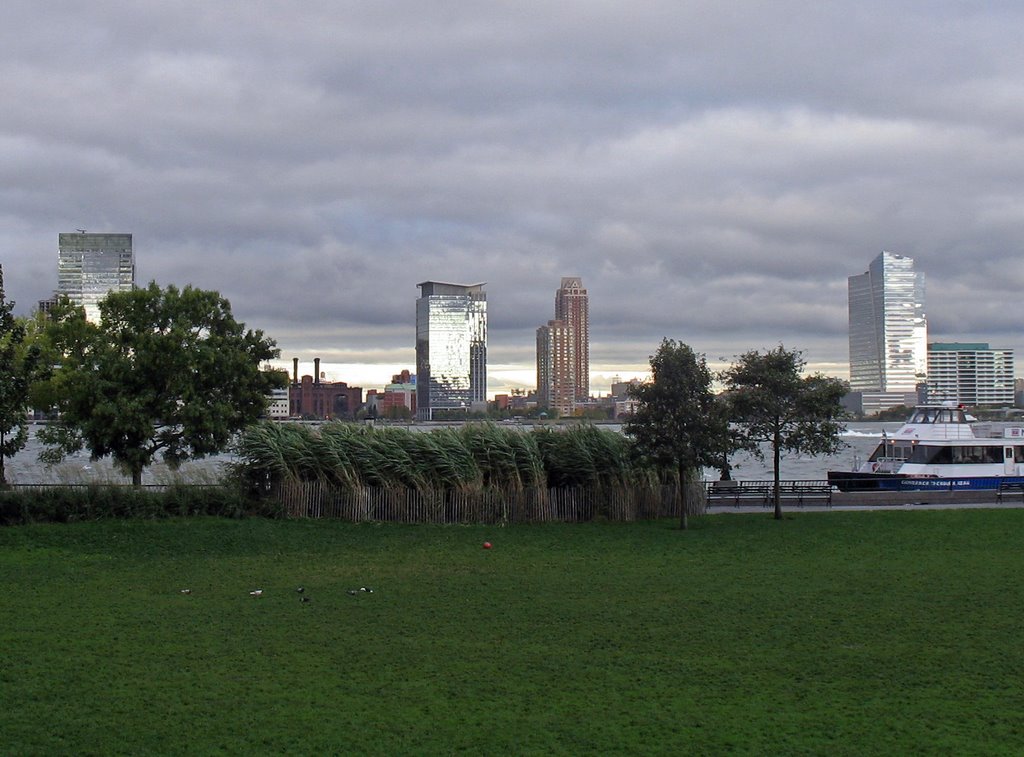
A few days ago I was taking my customary weekday morning walk from my daughter's school at the south end of Battery Park City to my office at 45 Broadway, near Bowling Green, by way of the pedestrian esplanade on the Hudson River shore. There was a solid overcast of high clouds and, off to the east, the rays of the rising sun were coming through unimpeded below those clouds. They were then reflcting off the buildings in the Newport section of Jersey City, creating this striking scene.
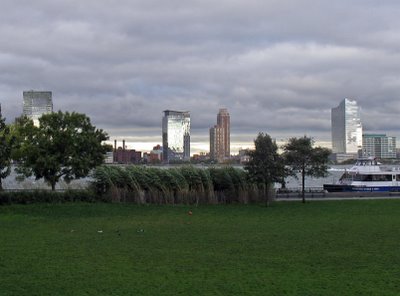
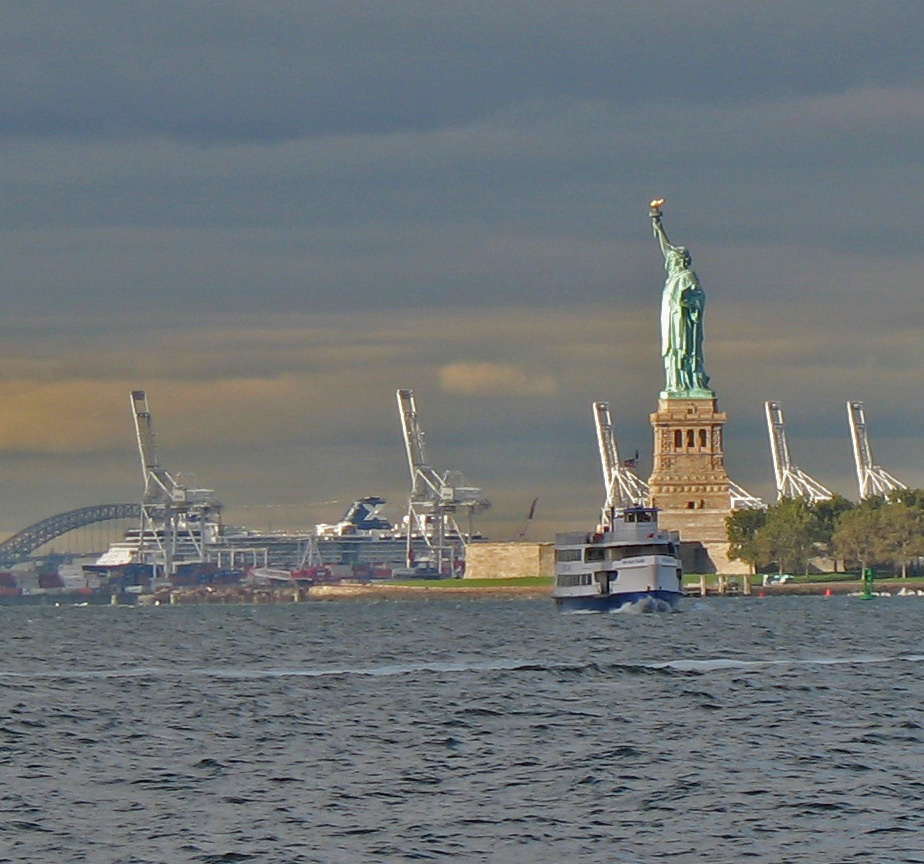
As I walked further south, I got this view of the Statue of Liberty, with a Chandris cruise ship docked beyond her in Bayonne, the arch of the Bayonne-Staten Island bridge in the distance, and, in the foreground, a Circle Line tour boat returning from Liberty Island to her dock at the Battery.

As I walked further south, I got this view of the Statue of Liberty, with a Chandris cruise ship docked beyond her in Bayonne, the arch of the Bayonne-Staten Island bridge in the distance, and, in the foreground, a Circle Line tour boat returning from Liberty Island to her dock at the Battery.
Friday, October 13, 2006
CBGB & OMFUG, 1973-2006(?)
The name stood for "Country Blue Grass Blues and Other Music For Uplifting Gourmandisers", though the music that the place helped make famous, and that made it famous, didn't fit the "CBGB" categories, and any "gourmandising" that went on there had nothing to do with food. Indeed, owner Hilly Kristal admits, in his history on the official website, that he wanted the acronym to end in "FUG" because he wanted it to be "a little uncouth, or crude".
That's how many would describe the music that came from there, especially the raw, three-chord punk of perhaps the best-known band to take its stage, the Ramones. It also hosted the more cerebral, but still aesthetically stripped-down, music of Talking Heads. (I never heard them at CBGB - indeed, I don't think I was ever in CBGB more than three times - but I did catch a Talking Heads concert around 1978 in the old Entermedia Theater on Second Avenue. I went with some British computer jocks I'd met pub-crawling in the Village. The warm-up act was the Jamaican dub artist The Mighty Dillinger. Shortly after Talking Heads took the stage, one of our group excused himself and didn't return. After the concert, we found him outside. "I just couldn't bear to listen to some young Americans singing about their head trips after hearing Dillinger," he said.)
There were thousands of bands that played CBGB during its thirty three year run (usually three every night). Most of these bands never became famous, though a few achieved a kind of second tier status, with maybe one album getting some airplay on indie stations. There's a piece in today's Slate that mentions several of these groups, including on of which I have a fond memory: the Shirts. They were playing on one of the rare nights in the late '70s that I went to CBGB. They got on stage, played one very loud, very frenetic song (which I enjoyed), then, after the applause, the singer said, "We're da Shoits." She added, as if it were necessary, "From Brooklyn." Mink DeVille was also on the bill that night; I can't remember the third act.
My most memorable performance there was when my friends Pierce Turner (now a solo artist) on synth and Larry Kirwan (who now fronts the trad-Irish techno hip-hop group Black 47) on guitar (I got to know Pierce and Larry when they were, as Turner and Kirwan of Wexford, the house band at the Bells of Hell) provided the backing music for a poetry reading by a crazy, notoriously belligerent East Village slumlord who called himself Copernicus. When Copernicus started bellowing his verse, which sounded sort of like Walt Whitman filtered through Captain Beefheart, the room quickly got less crowded. I still have, and cherish, a poster advertising this event.
I also have, buried behind my daughter's now unused toys that, on the edge of thirteen, she still can't bear to discard, a double vinyl album called Live at CBGB that includes cuts by the aforementioned Shirts, Mink deVille and a number of other second tier bands that used to perform there.
According to the home page of the official website, the last show will be this Sunday, October 15. It also says "the club will reopen soon." The question is: where? There's some speculation Hilly means to have the whole shebang recreated in Las Vegas, with perhaps some "original fabric", as my archivist wife would say. This seems appropriate. Vegas has become the ultimate adult theme park where, along with gambling, you can experience replicated and denatured versions of things that once seemed dangerous and subversive. Maybe it's the only place CBGB can go, now.
That's how many would describe the music that came from there, especially the raw, three-chord punk of perhaps the best-known band to take its stage, the Ramones. It also hosted the more cerebral, but still aesthetically stripped-down, music of Talking Heads. (I never heard them at CBGB - indeed, I don't think I was ever in CBGB more than three times - but I did catch a Talking Heads concert around 1978 in the old Entermedia Theater on Second Avenue. I went with some British computer jocks I'd met pub-crawling in the Village. The warm-up act was the Jamaican dub artist The Mighty Dillinger. Shortly after Talking Heads took the stage, one of our group excused himself and didn't return. After the concert, we found him outside. "I just couldn't bear to listen to some young Americans singing about their head trips after hearing Dillinger," he said.)
There were thousands of bands that played CBGB during its thirty three year run (usually three every night). Most of these bands never became famous, though a few achieved a kind of second tier status, with maybe one album getting some airplay on indie stations. There's a piece in today's Slate that mentions several of these groups, including on of which I have a fond memory: the Shirts. They were playing on one of the rare nights in the late '70s that I went to CBGB. They got on stage, played one very loud, very frenetic song (which I enjoyed), then, after the applause, the singer said, "We're da Shoits." She added, as if it were necessary, "From Brooklyn." Mink DeVille was also on the bill that night; I can't remember the third act.
My most memorable performance there was when my friends Pierce Turner (now a solo artist) on synth and Larry Kirwan (who now fronts the trad-Irish techno hip-hop group Black 47) on guitar (I got to know Pierce and Larry when they were, as Turner and Kirwan of Wexford, the house band at the Bells of Hell) provided the backing music for a poetry reading by a crazy, notoriously belligerent East Village slumlord who called himself Copernicus. When Copernicus started bellowing his verse, which sounded sort of like Walt Whitman filtered through Captain Beefheart, the room quickly got less crowded. I still have, and cherish, a poster advertising this event.
I also have, buried behind my daughter's now unused toys that, on the edge of thirteen, she still can't bear to discard, a double vinyl album called Live at CBGB that includes cuts by the aforementioned Shirts, Mink deVille and a number of other second tier bands that used to perform there.
According to the home page of the official website, the last show will be this Sunday, October 15. It also says "the club will reopen soon." The question is: where? There's some speculation Hilly means to have the whole shebang recreated in Las Vegas, with perhaps some "original fabric", as my archivist wife would say. This seems appropriate. Vegas has become the ultimate adult theme park where, along with gambling, you can experience replicated and denatured versions of things that once seemed dangerous and subversive. Maybe it's the only place CBGB can go, now.
College football pre-game update.
I thought I was being bold by picking Auburn over Florida, but now I find MSNBC's John Allen in agreement.
Allen makes his call based on the Gators' relatively anemic offensive performance to date. I'm sticking with my theory of swelled heads along with Florida's historic poll acrophobia.
All you fellow Gator-choppers, please understand: I really hope I'm wrong.
Update-update: Dammit, I was right.
The Mets are going down, too. It's a very bad day for teams wearing orange and blue, Auburn excepted. (Yes, Syracuse lost, too.)
My consolation: USF Bulls beat UNC Tarheels.
Allen makes his call based on the Gators' relatively anemic offensive performance to date. I'm sticking with my theory of swelled heads along with Florida's historic poll acrophobia.
All you fellow Gator-choppers, please understand: I really hope I'm wrong.
Update-update: Dammit, I was right.
The Mets are going down, too. It's a very bad day for teams wearing orange and blue, Auburn excepted. (Yes, Syracuse lost, too.)
My consolation: USF Bulls beat UNC Tarheels.
Tuesday, October 10, 2006
Red Hook container port in Indian summer.
Not far from where I live is a small port for container ships. In an era of larger and larger cargo vessels (although this trend may have reached a limit, at least for now, with Emma Maersk and her planned sisters), little facilities like Red Hook are at some disadvantage, though there are enough smaller ships serving less heavily trafficked routes to provide a market for them. Red Hook has the additional problems of not having a vast expanse of landside storage space and lacking a direct rail connection. Trucks handle many of the containers there, though some are transshipped to barges for delivery to railheads in New Jersey or elsewhere.
Despite these handicaps, much to my delight the little port thrived for a number of years after I moved to Brooklyn. I made it an at least daily routine, weather allowing, to walk across the street and down a short path to the Brooklyn Heights Promenade, from which I could (in addition to seeing the Statue of Liberty, the lower Manhattan skyline, and the Brooklyn Bridge with the Empire State Building and Midtown beyond) check on the activity at Red Hook. I even developed a private superstition: that the Mets were more likely to win if there was a ship docked at Red Hook. One night, I was watching a game in which the Mets had a one run lead going into the seventh. As the visiting team came to bat, I heard three blasts of a ship's horn. I walked outside to see the only vessel that had been docked at Red Hook pulling out into the Buttermilk Channel. When I got back to my TV, the visitors had scored a two run homer that put them ahead for good.
A couple of years ago, I noticed that the likelihood of there being a ship or two docked there when I made one of my Promenade strolls had gotten smaller. At first, I put this down to greater cargo-handling efficiency meaning shorter turn-around times. Then I began seeing hints in the local press that developers were eying this stretch of waterfront for residential development. I noted this in an earlier post; now, it seems confirmed by stories to the effect that the Port Authority, which owns the land and piers that the port uses, is encouraging shipping companies to use other facilities in New Jersey, and is preparing to evict the stevedoring firm that operates the port so as to sell the land at a considerable profit.
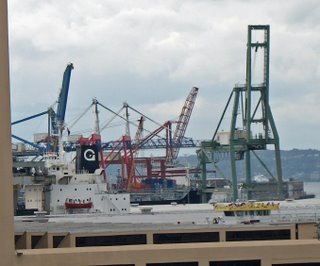 I was delighted, therefore, on one of my Promenade excursions a few days ago to see three ships docked at Red Hook. In the photograph to the left, taken from the Promenade, you can see the superstrucure and funnel of the nearest ship, the forecastle and prow of one docked beyond it, and, above that, the superstructure of a third vessel docked at an angle almost perpendicular to the closer two.
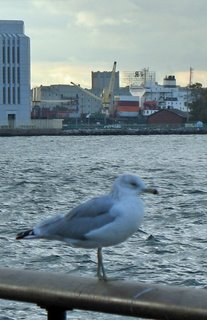
In the photo to the right, you see Red Hook from the vantage of the Battery Park Esplanade, at the southern tip of Manhattan, where the gull is resting on the railing. Beyond the bird is the channel between lower Manhattan and Governor's Island, and beyond it the northern tip of the Island, with the ventilating tower for the Brooklyn-Battery Tunnel to the left. Beyond that is Buttermilk Channel, and on its far side is a container ship docked at Red Hook.
Below is another view from the Brooklyn Heights Promenade. Beyond the cargo vessel, a cruise ship is docked at the new passenger terminal just south of the container port. My consolation prize, should the container port close, is that the cruise ship terminal will remain, and even likely expand. I am no great enthusiast for contemporary cruise ships, with the exception of Queen Mary 2 and a few others, which maintain a modicum of shipshapeness and don't try to disguise themeselves as floating Morris Lapidus hotels, not that I have anything against his hotels, so long as they're on land.
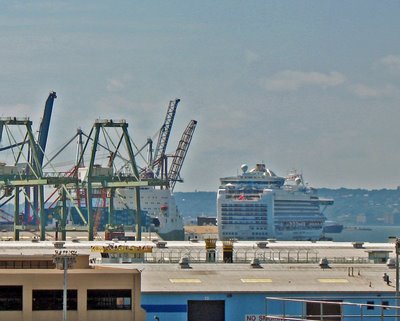
At least my hypothesized connection between Red Hook traffic and the Mets' success has been disproved.
Update: Twiffer gives me a link to H.P. Lovecraft's The Horror at Red Hook, which is set in a lurid version of the neighborhood as it might have been in the early twentieth century. While I'm sure it then had the raffish character common to dockside communities, I doubt it was quite the squalid sinkhole of depravity Lovecraft depicts (and I seriously doubt it was ever likely to become a Little Kurdistan). Warning: Lovecraft's writing is permeated with the casual racism charcteristic of his time. He uses "swarthy" as a virtual synonym for "sinister", refers to "squinting Orientals", and contrasts the "squat" denizens of Red Hook (consisting of "Syrian, Spanish, Italian, and Negro elements impinging upon one another") with the "sturdy Vikings" of a nearby Norwegian neighborhood (remnants of which remain today).
I'm intrigued by the cover illustration on the issue of Weird Tales in which "The Horror" was published. It shows what looks like a giant version of one of the Wicked Witch of the West's flying monkeys swooping down on a cape-clad woman who appears to be making her way on a path through a glacier. If you click on the cover, you get a link to the table of contents; unfortunately, there's no link to to the text of instalment one of John Martin Leahy's serial novel Drome, which this is supposed to illustrate. However, a bit of Google research got me this quote:
1927 Drome by John Martin Leahy. An inner world, hideous monsters, a wicked priest, a beautiful princess and apparently, absolutely terrible writing.
The quote comes from this amusing page in an Edgar Rice Burroughs tribute site. According to the author, Drome, along with Burroughs' Pellucidar, Jules Verne's Journey to the Center of the Earth, and many others, exemplifies speculative fiction based on the "hollow earth" theory (now pretty much put paid by plate tectonics) that posited inhabited worlds in vast caverns honeycombing earth's interior.
Mets augury update: Twiffer (scroll down to second comment) may have been right about the efficacy of the augury continuing. Late yesterday afternoon, I was delighted to see three ships docked at Red Hook: a hulking, ungainly Lapidus-hotel style cruise ship; a not-so-hulking but still ungainly National Shipping Company of Saudi Arabia container ship, and a trim little tramp freighter. As game time approached, the cruiser and the Arab departed, but the little tramp remained as the Mets managed to stay alive. I just checked, and she's still there (photo taken at 3:10 PM):
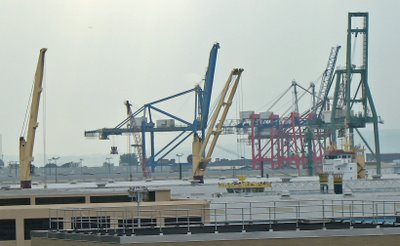
The fate of the Mets' season may rest on her remaining at her berth until tonight's game is over. It's a tough, lonely job. I hope she's up to it.
Case disproved: the ship's still there, but they lost, anyway.
Congrats, Twiff. Now I get to root for the Cards.
Despite these handicaps, much to my delight the little port thrived for a number of years after I moved to Brooklyn. I made it an at least daily routine, weather allowing, to walk across the street and down a short path to the Brooklyn Heights Promenade, from which I could (in addition to seeing the Statue of Liberty, the lower Manhattan skyline, and the Brooklyn Bridge with the Empire State Building and Midtown beyond) check on the activity at Red Hook. I even developed a private superstition: that the Mets were more likely to win if there was a ship docked at Red Hook. One night, I was watching a game in which the Mets had a one run lead going into the seventh. As the visiting team came to bat, I heard three blasts of a ship's horn. I walked outside to see the only vessel that had been docked at Red Hook pulling out into the Buttermilk Channel. When I got back to my TV, the visitors had scored a two run homer that put them ahead for good.
A couple of years ago, I noticed that the likelihood of there being a ship or two docked there when I made one of my Promenade strolls had gotten smaller. At first, I put this down to greater cargo-handling efficiency meaning shorter turn-around times. Then I began seeing hints in the local press that developers were eying this stretch of waterfront for residential development. I noted this in an earlier post; now, it seems confirmed by stories to the effect that the Port Authority, which owns the land and piers that the port uses, is encouraging shipping companies to use other facilities in New Jersey, and is preparing to evict the stevedoring firm that operates the port so as to sell the land at a considerable profit.
 I was delighted, therefore, on one of my Promenade excursions a few days ago to see three ships docked at Red Hook. In the photograph to the left, taken from the Promenade, you can see the superstrucure and funnel of the nearest ship, the forecastle and prow of one docked beyond it, and, above that, the superstructure of a third vessel docked at an angle almost perpendicular to the closer two.
In the photo to the right, you see Red Hook from the vantage of the Battery Park Esplanade, at the southern tip of Manhattan, where the gull is resting on the railing. Beyond the bird is the channel between lower Manhattan and Governor's Island, and beyond it the northern tip of the Island, with the ventilating tower for the Brooklyn-Battery Tunnel to the left. Beyond that is Buttermilk Channel, and on its far side is a container ship docked at Red Hook.
Below is another view from the Brooklyn Heights Promenade. Beyond the cargo vessel, a cruise ship is docked at the new passenger terminal just south of the container port. My consolation prize, should the container port close, is that the cruise ship terminal will remain, and even likely expand. I am no great enthusiast for contemporary cruise ships, with the exception of Queen Mary 2 and a few others, which maintain a modicum of shipshapeness and don't try to disguise themeselves as floating Morris Lapidus hotels, not that I have anything against his hotels, so long as they're on land.

At least my hypothesized connection between Red Hook traffic and the Mets' success has been disproved.
Update: Twiffer gives me a link to H.P. Lovecraft's The Horror at Red Hook, which is set in a lurid version of the neighborhood as it might have been in the early twentieth century. While I'm sure it then had the raffish character common to dockside communities, I doubt it was quite the squalid sinkhole of depravity Lovecraft depicts (and I seriously doubt it was ever likely to become a Little Kurdistan). Warning: Lovecraft's writing is permeated with the casual racism charcteristic of his time. He uses "swarthy" as a virtual synonym for "sinister", refers to "squinting Orientals", and contrasts the "squat" denizens of Red Hook (consisting of "Syrian, Spanish, Italian, and Negro elements impinging upon one another") with the "sturdy Vikings" of a nearby Norwegian neighborhood (remnants of which remain today).
I'm intrigued by the cover illustration on the issue of Weird Tales in which "The Horror" was published. It shows what looks like a giant version of one of the Wicked Witch of the West's flying monkeys swooping down on a cape-clad woman who appears to be making her way on a path through a glacier. If you click on the cover, you get a link to the table of contents; unfortunately, there's no link to to the text of instalment one of John Martin Leahy's serial novel Drome, which this is supposed to illustrate. However, a bit of Google research got me this quote:
1927 Drome by John Martin Leahy. An inner world, hideous monsters, a wicked priest, a beautiful princess and apparently, absolutely terrible writing.
The quote comes from this amusing page in an Edgar Rice Burroughs tribute site. According to the author, Drome, along with Burroughs' Pellucidar, Jules Verne's Journey to the Center of the Earth, and many others, exemplifies speculative fiction based on the "hollow earth" theory (now pretty much put paid by plate tectonics) that posited inhabited worlds in vast caverns honeycombing earth's interior.
Mets augury update: Twiffer (scroll down to second comment) may have been right about the efficacy of the augury continuing. Late yesterday afternoon, I was delighted to see three ships docked at Red Hook: a hulking, ungainly Lapidus-hotel style cruise ship; a not-so-hulking but still ungainly National Shipping Company of Saudi Arabia container ship, and a trim little tramp freighter. As game time approached, the cruiser and the Arab departed, but the little tramp remained as the Mets managed to stay alive. I just checked, and she's still there (photo taken at 3:10 PM):
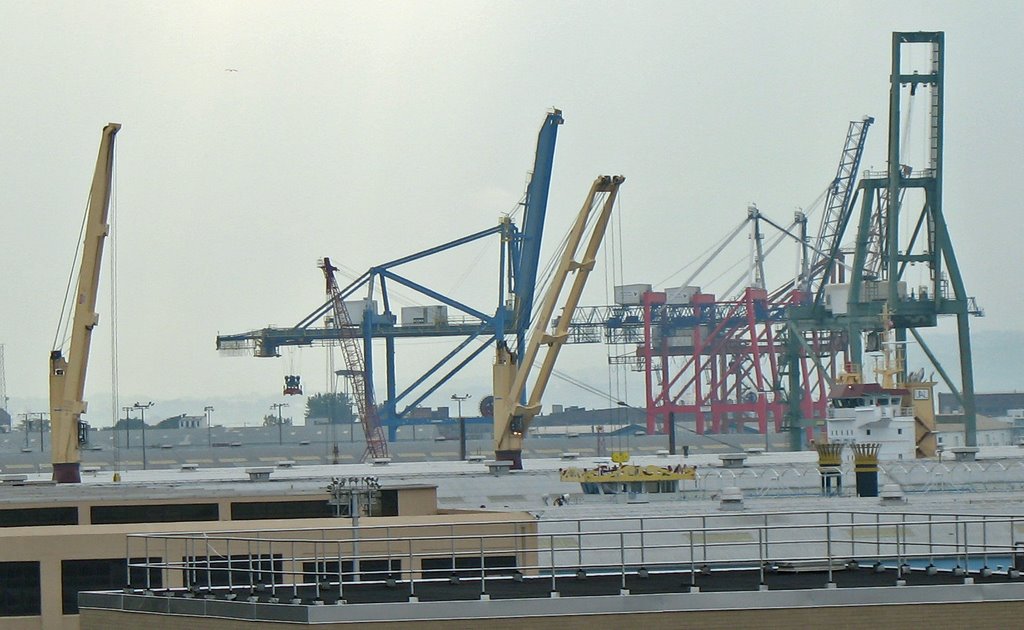
The fate of the Mets' season may rest on her remaining at her berth until tonight's game is over. It's a tough, lonely job. I hope she's up to it.
Case disproved: the ship's still there, but they lost, anyway.
Congrats, Twiff. Now I get to root for the Cards.
Monday, October 09, 2006
Good news for Augustinians.
IOZ interrupts my dogmatic slumbers to correct my (well, not my, personally, but I know I've done it; I'm just too lazy now to search for the link) use of the term "Manichean" as denoting a black-and-white, simplistic view of moral issues. I'm joining la Rana in her(?) friendly demi-demurrer (scroll down from the linked post), protesting that the Manichees, complex and syncretic as their beliefs may have been, were, at bottom, dualists. They did draw a sharp distinction between light (good) and matter (bad).
This article, describing the result of a recent experiment by some Danish physicists, however, puts things in a new (ahem) light. While the ability to teleport light to matter doesn't negate their difference, it does underline their complimentary roles; that is, light as carrier of information and matter as its storage medium. So, if the carrier is good, how can the repository be bad? (Thanks to Keifus for the link.)
This article, describing the result of a recent experiment by some Danish physicists, however, puts things in a new (ahem) light. While the ability to teleport light to matter doesn't negate their difference, it does underline their complimentary roles; that is, light as carrier of information and matter as its storage medium. So, if the carrier is good, how can the repository be bad? (Thanks to Keifus for the link.)
Sunday, October 08, 2006

MLB playoff confession.
I fell for the conventional wisdom that the Mets, without Pedro, and especially without Pedro and El Duque, were doomed to fall to the Dodgers in the NLDS. My hope was that they could at least make it a five game series. That they could sweep it seemed (here I'm picturing Wallace Shawn in The Princess Bride) inconceivable.
Ah, well, it's still inconceivable that they could win it all. Or is it? (At least they won't have to deal with the Yanks' batting order, though they'll miss the opportunity to feast on Bronx pitching.)
Update: Twiffer sends me a slightly stale slice of The Onion.
Ah, well, it's still inconceivable that they could win it all. Or is it? (At least they won't have to deal with the Yanks' batting order, though they'll miss the opportunity to feast on Bronx pitching.)
Update: Twiffer sends me a slightly stale slice of The Onion.
Saturday, October 07, 2006
College football confession.
My prowess as a Gator prognosticator (two weeks ago, I predicted they would fall to LSU) took a hit today. I'm sticking with my forecast of a loss to Auburn next week, especially because Auburn was upset badly by Arkansas today (ergo the Tigers will be hungry and primed for revenge, while the Gators will be cocky and overconfident); also, it's at Auburn and they have often been a nemesis for Florida.
USF gets by UConn to even up their Big East record at one.
Update: Gators are ranked No. 2? Y'all War Eagle fans can relax. The Florida players' heads will be swelled so big they won't even be able to get their helmets on.
USF gets by UConn to even up their Big East record at one.
Update: Gators are ranked No. 2? Y'all War Eagle fans can relax. The Florida players' heads will be swelled so big they won't even be able to get their helmets on.
Wetlands at the Florida Aquarium
In an earlier post I mentioned that my daughter's favorite place in Tampa is the Florida Aquarium. Her favorite part of the Aquarium is the Wetlands exhibit.
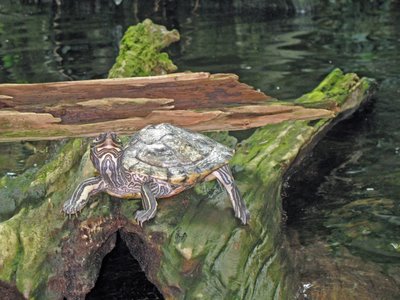
On our visit last Monday, in the Springs portion of the exhibit we found this peninsula cooter resting, but with head up and alert, on a fallen limb.
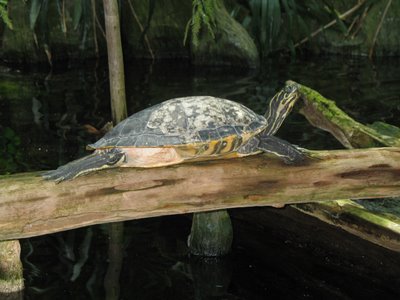
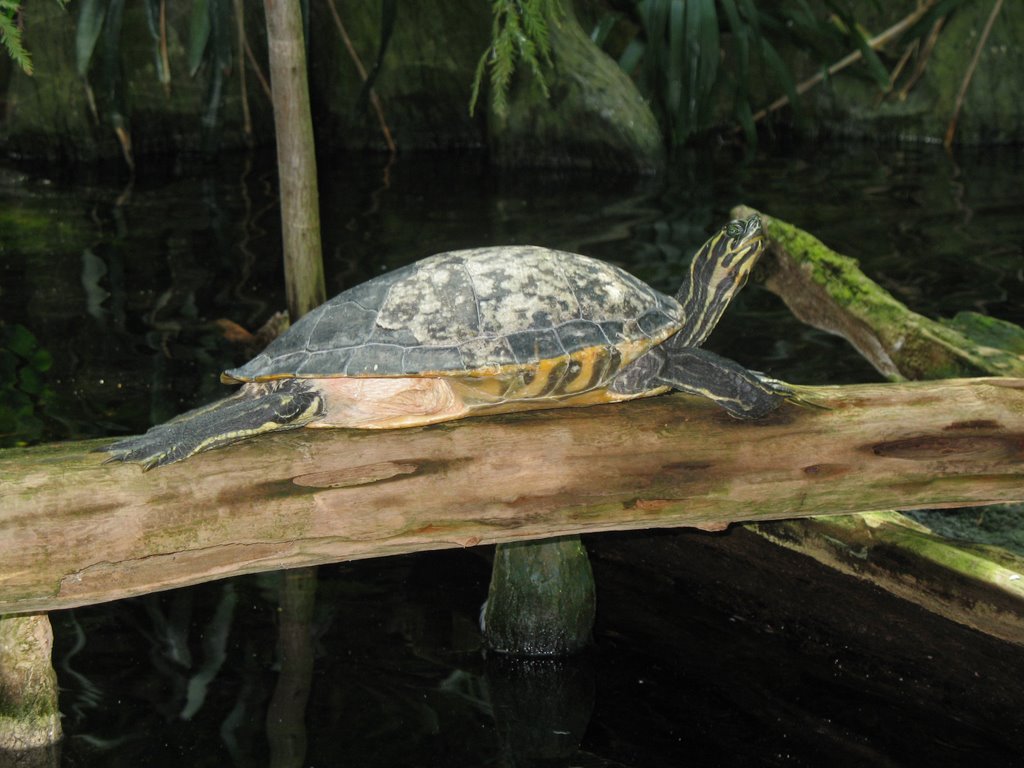
On a log below, this Barbour's map turtle seemed less than thrilled to be photographed.
Note that, in the linked article about Barbour's, the writer describes the Apalachicola River basin as "heaven", which is interesting considering Elvy Calloway's conjecture that it was the site of the Garden of Eden (see my post on Senecas, etc., below, linked at the beginning of this post).
A little futher along, Liz found and photographed this roseate spoonbill perched at the edge of the Mangrove Swamp sector.
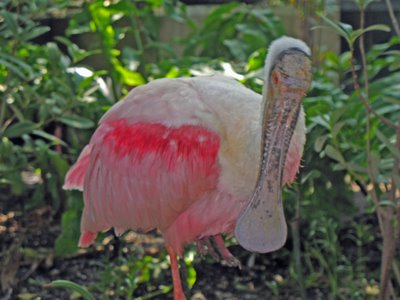
The plumage trade of the late nineteenth century put some stress on the spoonbill population, but these birds are, fortunately, now fairly common around parts of the Gulf of Mexico coastline.
Unfortunately, the otters were snoozing in some dark recess of the exhibit. The gators were out, but difficult to photograph because of the high plexiglass walls separating them from visitors' fingers.
On our visit last Monday, in the Springs portion of the exhibit we found this peninsula cooter resting, but with head up and alert, on a fallen limb.
On a log below, this Barbour's map turtle seemed less than thrilled to be photographed.

Note that, in the linked article about Barbour's, the writer describes the Apalachicola River basin as "heaven", which is interesting considering Elvy Calloway's conjecture that it was the site of the Garden of Eden (see my post on Senecas, etc., below, linked at the beginning of this post).
A little futher along, Liz found and photographed this roseate spoonbill perched at the edge of the Mangrove Swamp sector.
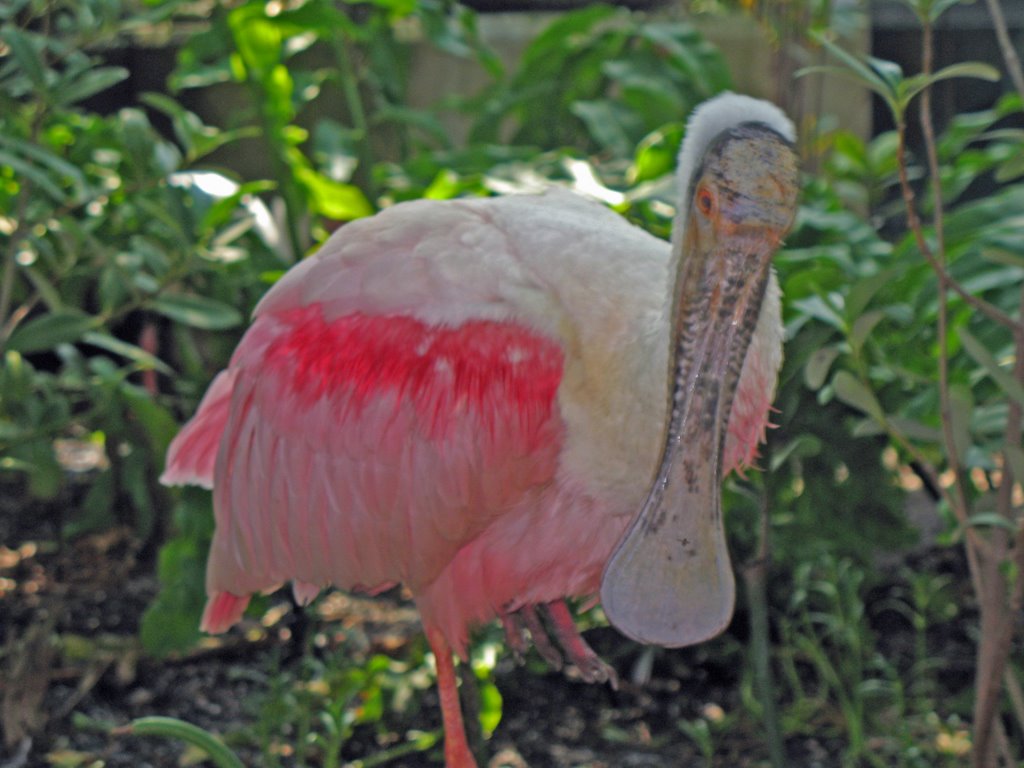
The plumage trade of the late nineteenth century put some stress on the spoonbill population, but these birds are, fortunately, now fairly common around parts of the Gulf of Mexico coastline.
Unfortunately, the otters were snoozing in some dark recess of the exhibit. The gators were out, but difficult to photograph because of the high plexiglass walls separating them from visitors' fingers.
Si Waitzman, ? - 2006
Si and I were neighbors for many years. When I moved to Brooklyn Heights in 1983, he was living in my building. Si was an architect, and designed the rooftop deck on which my family, friends and I enjoyed many sunsets and Fourth of July fireworks displays. He was an outgoing, friendly man with a winning smile.
Besides an interest in architecture, something Si and I had in common was smoking. Some years ago, he began to lose his voice. Then I learned he had been diagnosed with throat cancer, and would need surgery. A month or so later, I was standing in front of our building having a cigarette when Si walked up to me and whispered, "You've got to quit that if you don't want to end up like me." His larynx had been removed, and with it his voice.
Si's advice weighed heavily with me: I quit cold turkey a few months later.
For the past few years, I would see him now and then (he had moved, but stayed in the neighborhood), and occasionally have a short chat - the most he seemed able to manage, as even whispering was evidently a strain on his throat. He was delighted when I told him I'd stopped smoking. Usually, I would see him on nice days, sitting at a table outside Starbucks on Montague Street. He would always give me a smile and a wave.
Today I heard from a neighbor that Si died. I'll miss him very much, and always be grateful for his advice.
Besides an interest in architecture, something Si and I had in common was smoking. Some years ago, he began to lose his voice. Then I learned he had been diagnosed with throat cancer, and would need surgery. A month or so later, I was standing in front of our building having a cigarette when Si walked up to me and whispered, "You've got to quit that if you don't want to end up like me." His larynx had been removed, and with it his voice.
Si's advice weighed heavily with me: I quit cold turkey a few months later.
For the past few years, I would see him now and then (he had moved, but stayed in the neighborhood), and occasionally have a short chat - the most he seemed able to manage, as even whispering was evidently a strain on his throat. He was delighted when I told him I'd stopped smoking. Usually, I would see him on nice days, sitting at a table outside Starbucks on Montague Street. He would always give me a smile and a wave.
Today I heard from a neighbor that Si died. I'll miss him very much, and always be grateful for his advice.
Thursday, October 05, 2006
A terrible beauty.
Walking from my daughter's school to my office this morning, I took the long way, by the Battery Park City esplanade. When I got to the North Cove yacht basin, I saw an antique-looking vessel docked at the southwest corner. She proved to be a replica of the slave ship Amistad, probably the one used in the movie of the same name.

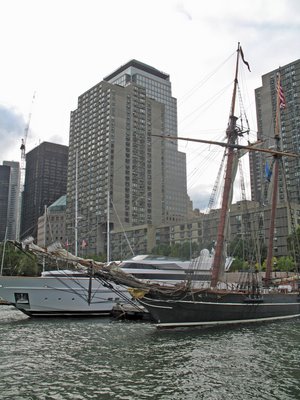
Ironically, slavers were among the most beautiful of ships, as this view of Amistad's long bowsprit, graceful hull and aftward-raked masts shows. Those built after the slave trade was outlawed were made small and speedy so as to evade detection by, and outrun if necessary, patrolling warships. Speed was also of the essence because their human "cargo", chained below decks, was altogether too perishable.


Ironically, slavers were among the most beautiful of ships, as this view of Amistad's long bowsprit, graceful hull and aftward-raked masts shows. Those built after the slave trade was outlawed were made small and speedy so as to evade detection by, and outrun if necessary, patrolling warships. Speed was also of the essence because their human "cargo", chained below decks, was altogether too perishable.
Tuesday, October 03, 2006
Senecas, spiritualism and Weird Florida
Every now and then, I'll encounter several things in my reading that are connected in some odd way, despite having been published at different times and in differing contexts. On Saturday, we flew to Tampa to be with my mother as she celebrated her 90th birthday. Early that morning, gathering reading material for the flight, I saw on the front page of the Sunday New York Times travel section (which is delivered on our doorstep with our Saturday paper) a teaser for an article on page 13 by Beth Quinn Barnard, headed "Seneca Folklore And Forest Trails - A ravine near Canandaigua, N.Y., is called the world's birthplace."
I stuck the travel section in my carry-on bag because I spent a good deal of time in the early part of my career in Seneca country, Western New York, and I'm interested in the creation myths of various cultures. According to the article, the Senecas, or Onondowaga ("People of the Great Hill") as they call themselves, believe their progenitors to have emerged from the earth at a place now called Clark's Gully, a ravine at the base of South Hill ("Nundawao" to the Senecas), an eleven hundred foot eminence at the southern end of Canandaigua Lake .
Thinking about Seneca legends made me recall conversations I'd had many years ago during my travels in Western New York. One of these had concerned a Spiritualist community called Lily Dale, near the village of Cassadaga in Chautauqua County, southwest of Buffalo. (There's a song called "Lilydale" on The Wishing Chair, the magnificent first album by 10,000 Maniacs, who came from nearby Jamestown, New York; you can hear it here.) During this conversation, I was told about a young man from Jamestown who had Seneca ancestry, and who visited one of the mediums at Lily Dale. When he entered the room where the medium sat, she seemed to look over one of his shoulders, and said, "Hello! I haven't seen you in a while. How are you?" Realizing this wasn't addressed to him, the young man remained silent for a minute while the medium seemed to listen to an inaudible reply. Finally, she looked him in the eye, and he said, "Who were you talking with?" "It's Cornplanter," she answered. "He says you're one of his favorite grandsons, and he keeps a close watch on you."
The Seneca creation myth also made me recall that, when my parents and I were moving from Eglin Air Force Base, in the western panhandle of Florida, to Tampa, we passed billboards on the highway west of Tallahassee urging us to turn off and see "The Original Garden of Eden". I later did some research on this, and found that an eccentric resident of that area, Elvy Calloway, had declared that a ravine on the Apalachicola River had to be the Biblical Eden. He reached this conclusion for various reasons, including the fact that the River splits into four branches nearby, and that various plants mentioned in Genesis can all be found growing there.
On Monday, I took my daughter to her favorite place in Tampa, the Florida Aquarium. (At age 12, she aspires to be a marine biologist. Oddly enough, I had exactly that ambition when I was her age. I'm hoping she'll stick with it.) As we surveyed the gift shop after our tour, I spotted a book with the title Weird Florida, by Charlie Carson (Sterling Press, New York, 2005). I opened it to see if it had an account of the "Garden of Eden". It did, and, to my surprise, a few pages away had a piece about a spiritualist community in Volusia County (near Daytona Beach) called Cassadaga. I assumed Cassadaga, Florida was founded by people who moved south from Lily Dale, since it bears the name of the New York village nearest to there. However, according to Weird Florida, the founder was a spiritualist from Iowa who, in 1875, contacted a Native American spirit. This spirit first directed him to visit another spiritualist in Wisconsin, then told them both that they were to found a spiritualist community in Florida. They traveled to Florida, where the spirit gave them precise directions as to where to establish the settlement.
So, nothing to do with Western New York, except that the spirit guide's name was "Seneca".
Update: I looked up the website for the Cassadaga, Florida spiritualist community, and found that George Colby, the founder, although he may have come there from Iowa, was "from New York". So, perhaps he grew up in or near the original Cassadaga.
I stuck the travel section in my carry-on bag because I spent a good deal of time in the early part of my career in Seneca country, Western New York, and I'm interested in the creation myths of various cultures. According to the article, the Senecas, or Onondowaga ("People of the Great Hill") as they call themselves, believe their progenitors to have emerged from the earth at a place now called Clark's Gully, a ravine at the base of South Hill ("Nundawao" to the Senecas), an eleven hundred foot eminence at the southern end of Canandaigua Lake .
Thinking about Seneca legends made me recall conversations I'd had many years ago during my travels in Western New York. One of these had concerned a Spiritualist community called Lily Dale, near the village of Cassadaga in Chautauqua County, southwest of Buffalo. (There's a song called "Lilydale" on The Wishing Chair, the magnificent first album by 10,000 Maniacs, who came from nearby Jamestown, New York; you can hear it here.) During this conversation, I was told about a young man from Jamestown who had Seneca ancestry, and who visited one of the mediums at Lily Dale. When he entered the room where the medium sat, she seemed to look over one of his shoulders, and said, "Hello! I haven't seen you in a while. How are you?" Realizing this wasn't addressed to him, the young man remained silent for a minute while the medium seemed to listen to an inaudible reply. Finally, she looked him in the eye, and he said, "Who were you talking with?" "It's Cornplanter," she answered. "He says you're one of his favorite grandsons, and he keeps a close watch on you."
The Seneca creation myth also made me recall that, when my parents and I were moving from Eglin Air Force Base, in the western panhandle of Florida, to Tampa, we passed billboards on the highway west of Tallahassee urging us to turn off and see "The Original Garden of Eden". I later did some research on this, and found that an eccentric resident of that area, Elvy Calloway, had declared that a ravine on the Apalachicola River had to be the Biblical Eden. He reached this conclusion for various reasons, including the fact that the River splits into four branches nearby, and that various plants mentioned in Genesis can all be found growing there.
On Monday, I took my daughter to her favorite place in Tampa, the Florida Aquarium. (At age 12, she aspires to be a marine biologist. Oddly enough, I had exactly that ambition when I was her age. I'm hoping she'll stick with it.) As we surveyed the gift shop after our tour, I spotted a book with the title Weird Florida, by Charlie Carson (Sterling Press, New York, 2005). I opened it to see if it had an account of the "Garden of Eden". It did, and, to my surprise, a few pages away had a piece about a spiritualist community in Volusia County (near Daytona Beach) called Cassadaga. I assumed Cassadaga, Florida was founded by people who moved south from Lily Dale, since it bears the name of the New York village nearest to there. However, according to Weird Florida, the founder was a spiritualist from Iowa who, in 1875, contacted a Native American spirit. This spirit first directed him to visit another spiritualist in Wisconsin, then told them both that they were to found a spiritualist community in Florida. They traveled to Florida, where the spirit gave them precise directions as to where to establish the settlement.
So, nothing to do with Western New York, except that the spirit guide's name was "Seneca".
Update: I looked up the website for the Cassadaga, Florida spiritualist community, and found that George Colby, the founder, although he may have come there from Iowa, was "from New York". So, perhaps he grew up in or near the original Cassadaga.
Friday, September 29, 2006
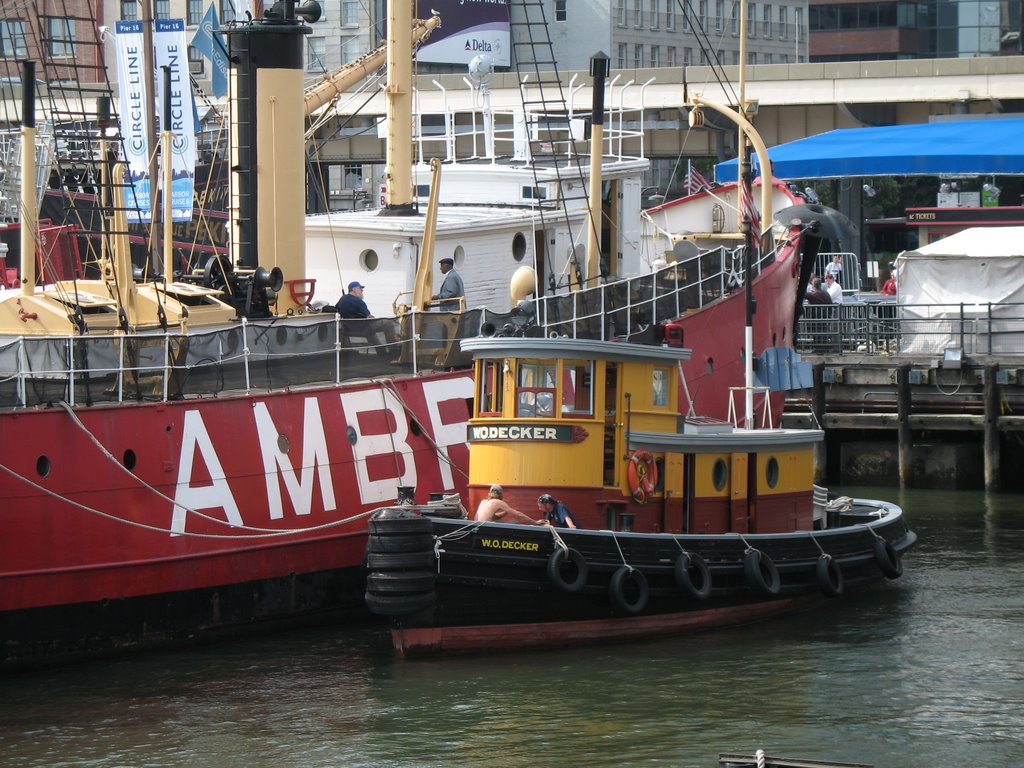
Welcome back, Decker.
The handsome little tug W.O. Decker, having had some needed maintenance work, has rejoined the small fleet of historic vessels on display at the South Street Seaport Museum. Here she is, tied up to the Ambrose lightship.

College football quickie.
Unholy exit 9! Rutgers stays undefeated, and probably keeps its place in the top 25, but at the expense of my alma mater.
Thursday, September 28, 2006
Goodbye, Pedro.
No complaints. You were vital to our getting here. Now we have to see if we can go on without you. I'm not giving up, yet.
Tuesday, September 26, 2006
Days of Awe
Hm . . . Memorable . . . what? (He peers closer.) Equinox, memorable equinox. (He raises his head, stares blankly front. Puzzled.) Memorable equinox? . . . (Pause. He shrugs his head shoulders, peers again at ledger, reads.) Farewell to--(he turns the page)--love.
-- Samuel Beckett, Krapp’s Last Tape
In Florida, autumn came
as a change in the light
in late afternoon,
around mid-October.
I hardly noticed it
until I was nineteen.
A girlfriend left me.
I wrote a poem, ephemeral
as the love it mourned.
At sixty, autumn seems
like that last song
by Dave Guard’s Trio,
vocal by Nick Reynolds,
later covered by Sinatra:
vintage wine, days decreasing.
And now, in Brooklyn
(I’ve lived life backwards:
Florida, Manhattan, Brooklyn),
an older voice whispers
gently, to my gentile ears,
L’shanah tovah.
-- Samuel Beckett, Krapp’s Last Tape
In Florida, autumn came
as a change in the light
in late afternoon,
around mid-October.
I hardly noticed it
until I was nineteen.
A girlfriend left me.
I wrote a poem, ephemeral
as the love it mourned.
At sixty, autumn seems
like that last song
by Dave Guard’s Trio,
vocal by Nick Reynolds,
later covered by Sinatra:
vintage wine, days decreasing.
And now, in Brooklyn
(I’ve lived life backwards:
Florida, Manhattan, Brooklyn),
an older voice whispers
gently, to my gentile ears,
L’shanah tovah.
Saturday, September 23, 2006
College football yawn.
Everything turned out pretty much as I predicted.
The Gators had a scare. My South Florida Bulls lost to a mediocre Big 12 team. At least some other Bulls, Buffalo, managed to play Auburn tough for three quarters.
Penn State failed to keep a narrow halftime lead, and fell to the Buckeyes. I've always had a soft spot for the Nittany Lions, as I was born, and my mother grew up, less than fifty miles from Happy Valley.
The other, local, Lions, Columbia, opened their season with a win over Georgetown. Of course, Georgetown football has been an afterthought since the days when they were called the Stonewalls.
Update: Holy Exit 9! Rutgers is ranked.
The Gators had a scare. My South Florida Bulls lost to a mediocre Big 12 team. At least some other Bulls, Buffalo, managed to play Auburn tough for three quarters.
Penn State failed to keep a narrow halftime lead, and fell to the Buckeyes. I've always had a soft spot for the Nittany Lions, as I was born, and my mother grew up, less than fifty miles from Happy Valley.
The other, local, Lions, Columbia, opened their season with a win over Georgetown. Of course, Georgetown football has been an afterthought since the days when they were called the Stonewalls.
Update: Holy Exit 9! Rutgers is ranked.
Friday, September 22, 2006
Penn's Landing
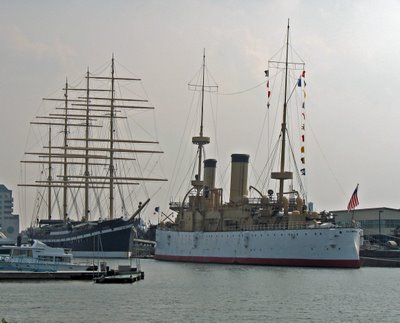
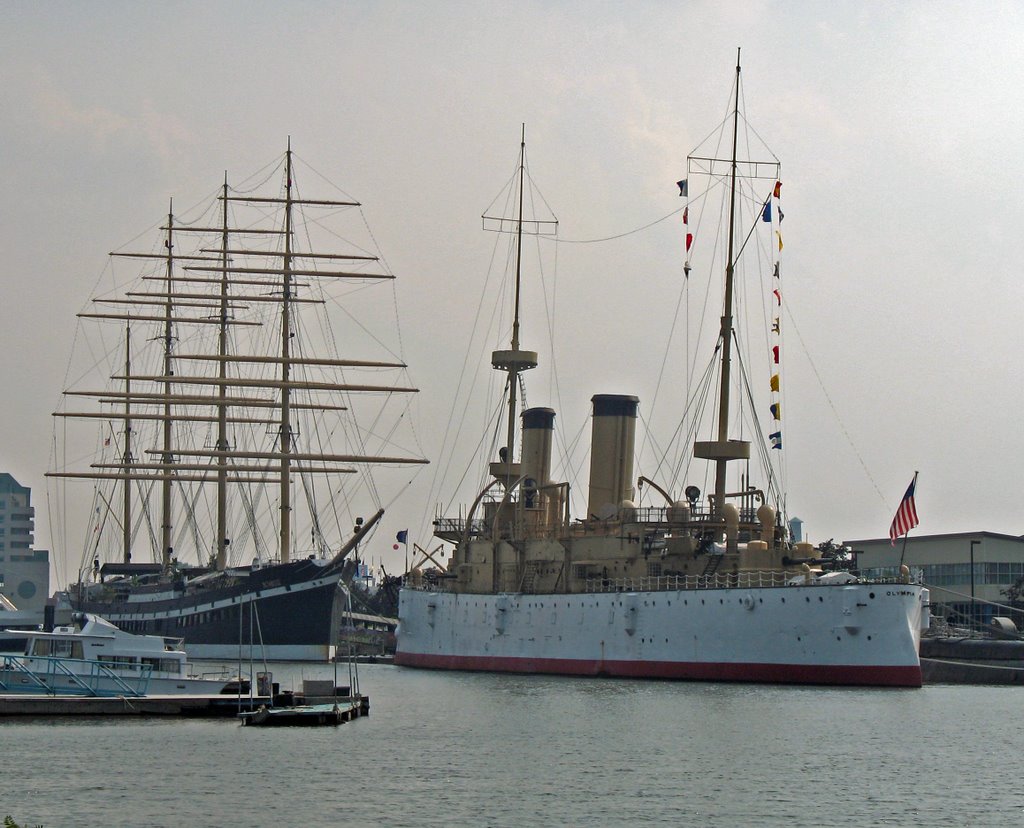
My hotel in Philadelphia was just a couple of blocks from Penn's Landing, a stretch of riverfront just south of the Ben Franklin Bridge that has been made into a waterside promenade and entertainment venue, as well as a permanent dock for a couple of historic ships, the cruiser U.S.S. Olympia, flagship of Admiral Dewey's "Great White Fleet" in the Spanish-American War, and the square rigger Mosholu, now made into a restaurant at the cost of having picture windows cut into her hull (see below):
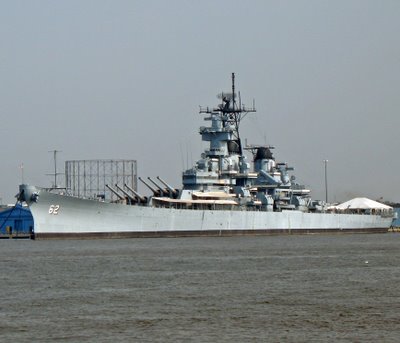
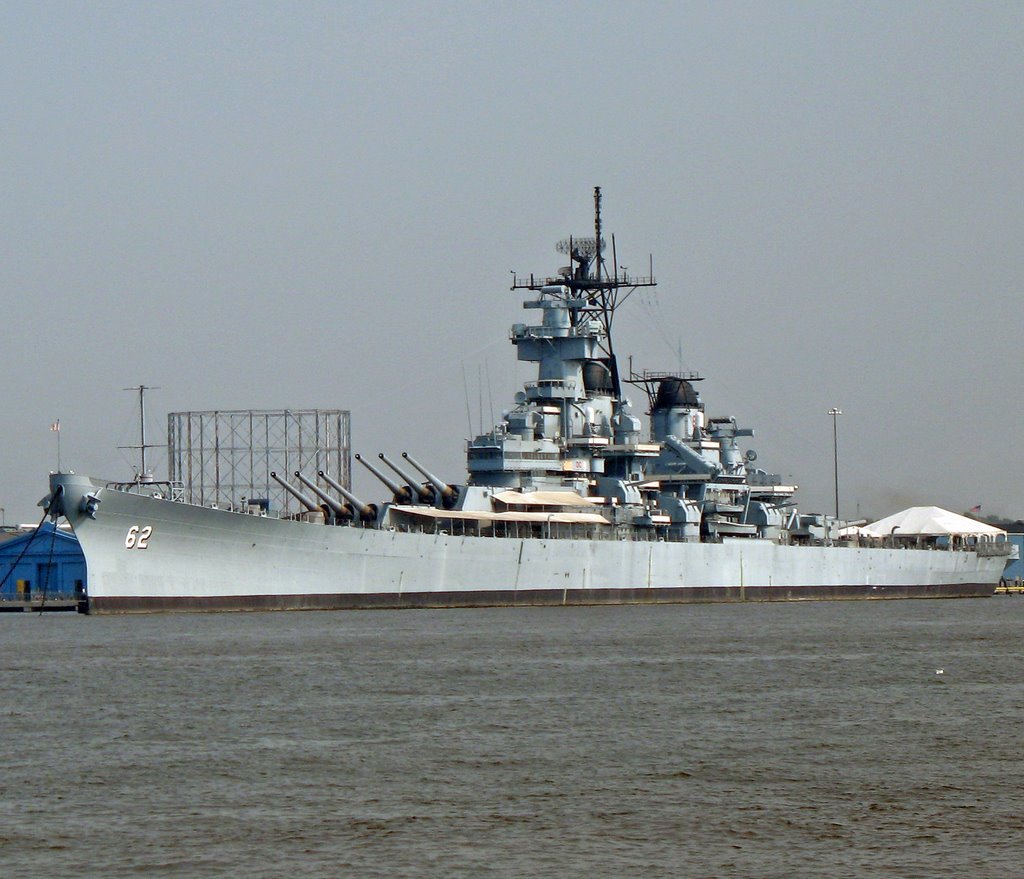
Across the Delaware, at Camden, the World War II veteran battleship U.S.S. New Jersey entertains visitors to her namesake state.
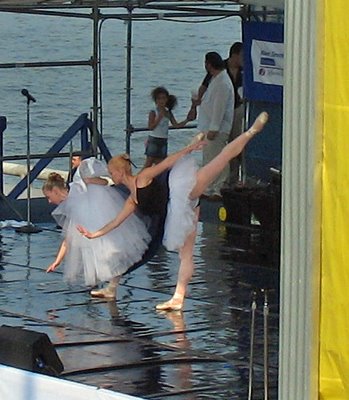
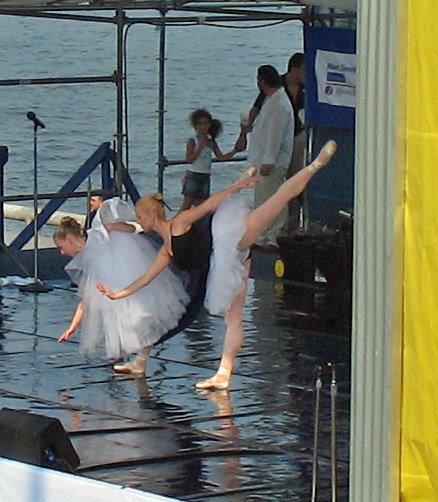
When I visited the Landing, the outdoor theater was presenting a festival of Russian culture.
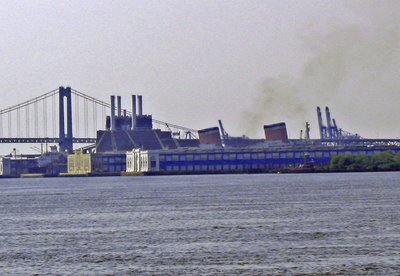
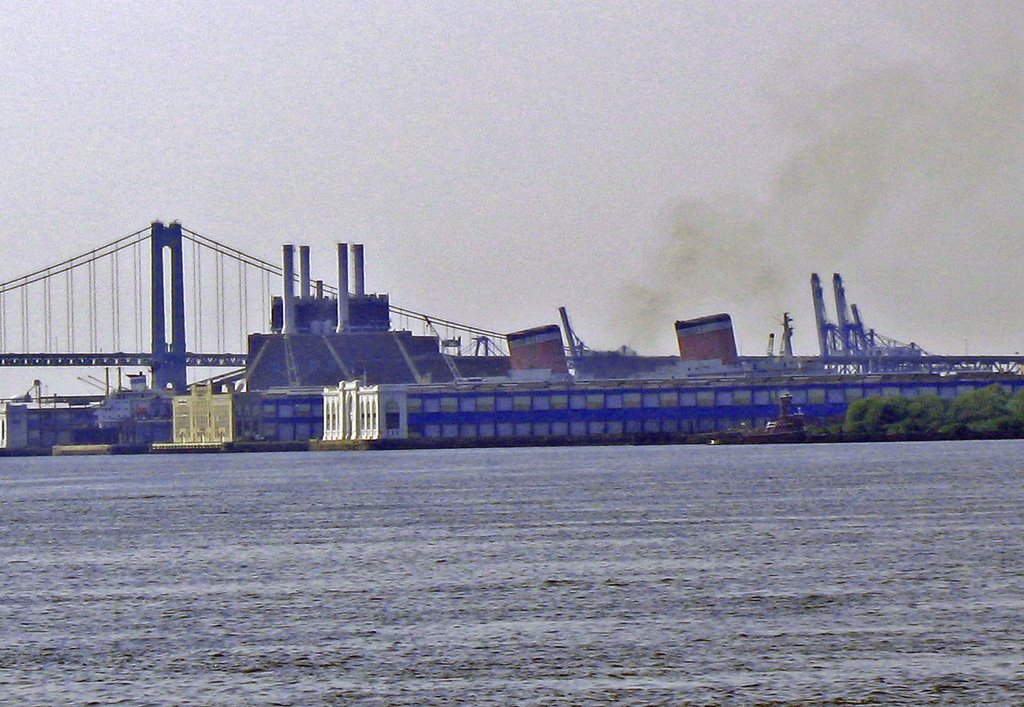
Looking downriver, I could see the distinctive funnels and upper superstructure of the S.S. United States, last holder of the Blue Riband of the North Atlantic, docked at an otherwise disused pier. As explained in this fan website, her present owners, NCL America, hope to restore her to service as a cruise ship.
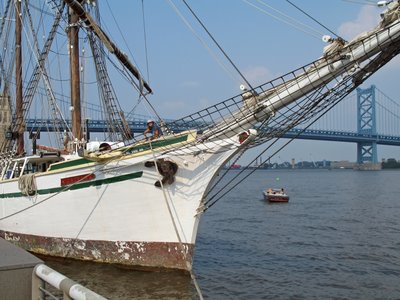
Near the upriver end of the Landing, the pretty barquentine Gazela was docked.
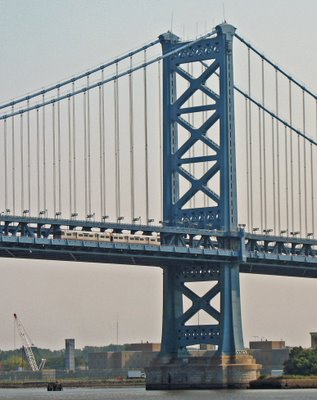
A rushing sound made me look up and see this commuter train going eastward across the Ben Franklin Bridge.
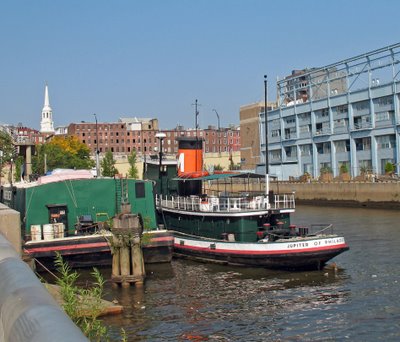
On the Landing's North bulwark, the old tug Jupiter, nicely preserved, sat tied to a barge.
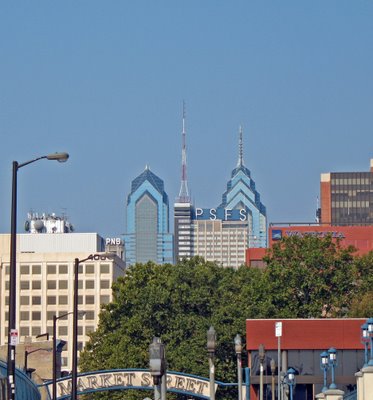
Crossing the bridge that connects the Landing to Market Street, I got this shot of the Center City skyline.
Update: Topazz demands that I provide my account of the Philly Fraymeet itself, so here goes: The food and drinks were sublime, the ambience divine, the conversation scintillating, Chango looks just like his photographs on FrayMates, and Topazz's hair shimmers like a Magellanic cloud.
But seriously, folks -- I can't thank Rundeep and Topazz enough for putting together a superb event.
Across the Delaware, at Camden, the World War II veteran battleship U.S.S. New Jersey entertains visitors to her namesake state.
When I visited the Landing, the outdoor theater was presenting a festival of Russian culture.
Looking downriver, I could see the distinctive funnels and upper superstructure of the S.S. United States, last holder of the Blue Riband of the North Atlantic, docked at an otherwise disused pier. As explained in this fan website, her present owners, NCL America, hope to restore her to service as a cruise ship.
Near the upriver end of the Landing, the pretty barquentine Gazela was docked.

A rushing sound made me look up and see this commuter train going eastward across the Ben Franklin Bridge.

On the Landing's North bulwark, the old tug Jupiter, nicely preserved, sat tied to a barge.

Crossing the bridge that connects the Landing to Market Street, I got this shot of the Center City skyline.

Update: Topazz demands that I provide my account of the Philly Fraymeet itself, so here goes: The food and drinks were sublime, the ambience divine, the conversation scintillating, Chango looks just like his photographs on FrayMates, and Topazz's hair shimmers like a Magellanic cloud.
But seriously, folks -- I can't thank Rundeep and Topazz enough for putting together a superb event.
Thursday, September 21, 2006
Believe!
So says Ron Borges of the Boston Globe and MSNBC.
Pedro's performance tonight - four shutout innings before a shaky fifth - gives reason for optimism.
Did I really use the "O" word?
Pedro's performance tonight - four shutout innings before a shaky fifth - gives reason for optimism.
Did I really use the "O" word?
Sunday, September 17, 2006
College football wrap-up.
Gators survive (by the skin of their teeth), but 'Noles don't, losing the Battle of the Bowdens. I didn't check the odds, but I'd guess the latter was considered an upset, what with Clemson coming off a loss to Boston College, and FSU having beaten Miami (even though it could barely get by Troy State last week). But the rout of the 'Canes by Louisville shows that Miami was overrated in preseason polls; so, also, may have been the lads from Tallahassee.
Next week, the Gators host Kentucky. Even though it's in the Swamp, I'm predicting an early scare, perhaps with the Wildcats ahead at the half. Florida always comes off a big game flat, win or lose. After Kentucky, they face the gauntlet of 'Bama, LSU, Auburn and Georgia. My guess is, they crest the Tide this year, but the Bayou Bengals ruin their homecoming. The other Tigers then make it two losses in a row, but the Gators regroup to continue their recent ownership of the Ur-rival Dawgs. Bookmark this, and we'll see.
My South Florida Bulls stay undefeated, thanks to an upset of their Interstate 4 rivals, the Central Florida Knights. Alas, I see their run ending next week in Lawrence, Kansas. The Jayhawks are no great shakes these days, but they are a team with a history, tra-di-shon (remember Gayle Sayers?) and all that, so, of course, they'll prevail. (Hey! Wait a minute. USF beat Pitt a couple of years ago. Yeah, but that was just one of those exceptions that prove a rule.)
Big news is Michigan's upset of Notre Dame. Yawn. One establishment team over another. I guess I like Michigan marginally better because they aren't lionized in quite the obnoxoius way ND is, what with "subway alumni", their own "Notre Dame Central" on the MSNBC college grid page, ad nauseam.
One reason to like ND: I remember seeing a painting (Neiman?) of an early 1970s Irish vs. Southern Cal game, in which ND fans had hung a banner reading "Trojans burst under pressure".
Next week, the Gators host Kentucky. Even though it's in the Swamp, I'm predicting an early scare, perhaps with the Wildcats ahead at the half. Florida always comes off a big game flat, win or lose. After Kentucky, they face the gauntlet of 'Bama, LSU, Auburn and Georgia. My guess is, they crest the Tide this year, but the Bayou Bengals ruin their homecoming. The other Tigers then make it two losses in a row, but the Gators regroup to continue their recent ownership of the Ur-rival Dawgs. Bookmark this, and we'll see.
My South Florida Bulls stay undefeated, thanks to an upset of their Interstate 4 rivals, the Central Florida Knights. Alas, I see their run ending next week in Lawrence, Kansas. The Jayhawks are no great shakes these days, but they are a team with a history, tra-di-shon (remember Gayle Sayers?) and all that, so, of course, they'll prevail. (Hey! Wait a minute. USF beat Pitt a couple of years ago. Yeah, but that was just one of those exceptions that prove a rule.)
Big news is Michigan's upset of Notre Dame. Yawn. One establishment team over another. I guess I like Michigan marginally better because they aren't lionized in quite the obnoxoius way ND is, what with "subway alumni", their own "Notre Dame Central" on the MSNBC college grid page, ad nauseam.
One reason to like ND: I remember seeing a painting (Neiman?) of an early 1970s Irish vs. Southern Cal game, in which ND fans had hung a banner reading "Trojans burst under pressure".
Saturday, September 16, 2006
The Philly cheesesteak quest.
As I noted before, last weekend I went to Philadelphia for a meeting of Fray particpants from across the country. After arriving at 30th Street Station around 11:45 A.M., I took a cab to my hotel at Arch and 4th Streets, in the historic district. Once I had unpacked, I was ready for lunch. Not any lunch. I wanted the real Philly cheesesteak sandwich. Fray friend Topazz had recommended Pat's for the quintessential version. I consulted a tourist guide and map, and determined that Pat's was a good 45 minute walk away. Being as keen to see the city as I was to fill my belly, I decided to take the walk.
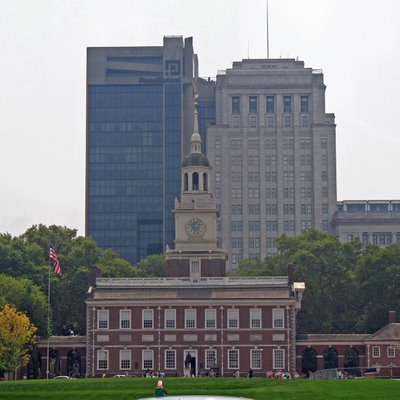
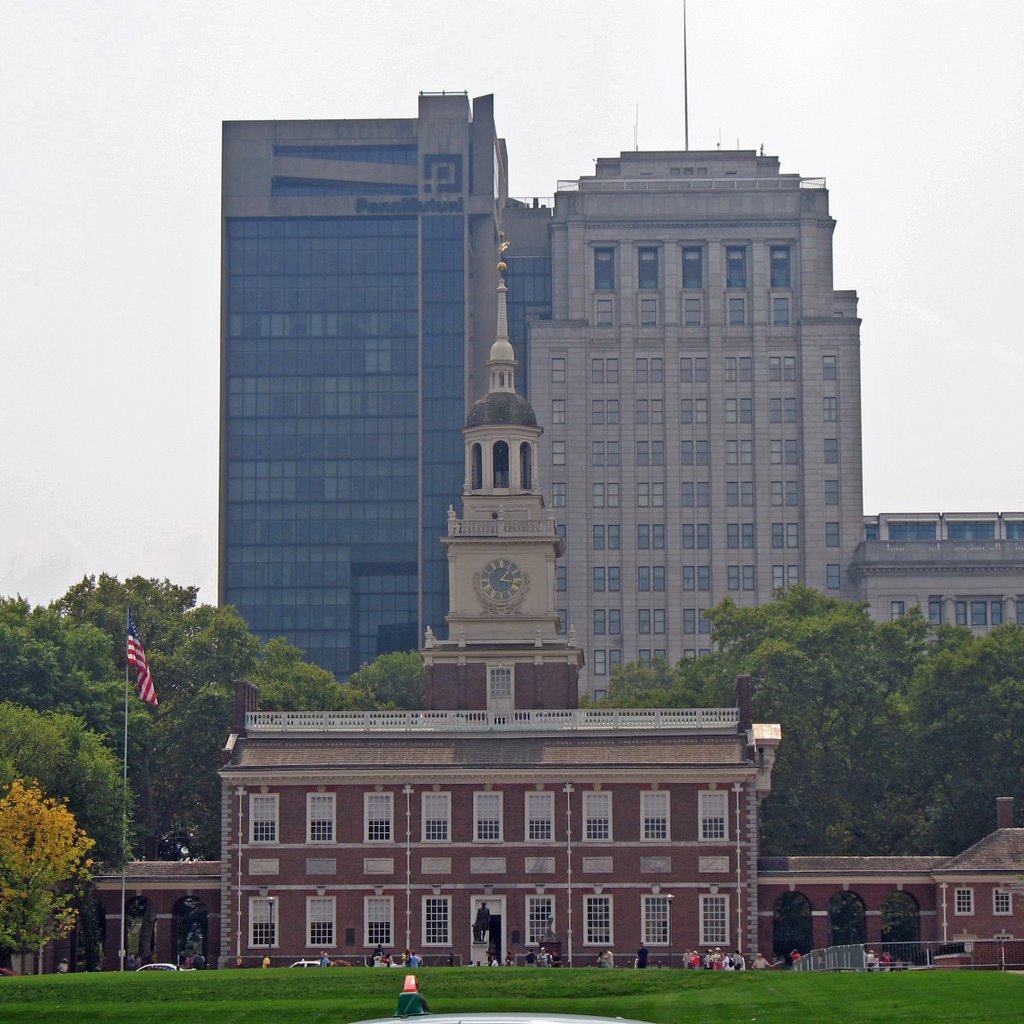
I walked westward across 4th to Market, then turned right to head towards 9th. After a couple of blocks, I paused to get my obligatory shot of Independence Hall.
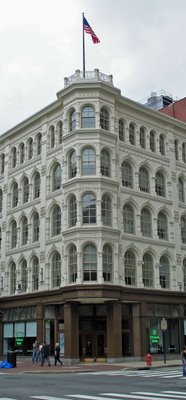
Continuing across Market, I came to a magnificent example of late 19th century cast iron department store architecture. There are many buildings in this style in the "Ladies' Mile" section of New York, but I reckoned this an especially fine specimen. It is the former Lit Bros. store, now subdivided into a few street level chain shops and offices above.
Fortunately, the building has been preserved.
To the right of the "Lit's" sign facing the intersection is a sign that reads, "Hats trimmed free of charge." I wonder if Carmen Miranda ever came to Philly to take advantage of that offer.
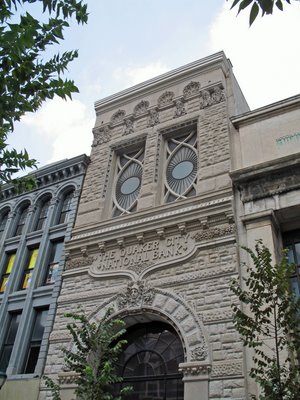
I'm not sure why, but smaller cities like Philadelphia seem to have much more exuberant vernacular architecture than New York. Perhaps it's because architects working in cities with less critical oversight felt less inhibited.
In any event, note the "eyes" on The Quaker City National Bank Building. Revel in the playful texture of the facade, and the "thought balloon" containing the institutional name, suspended above the helmet of the figure on the keystone of the arch.
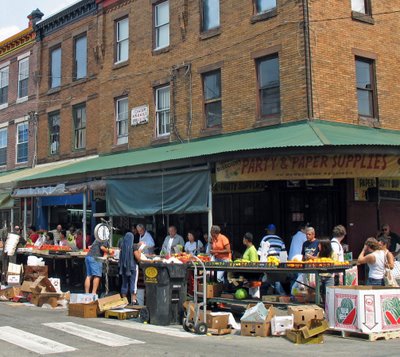
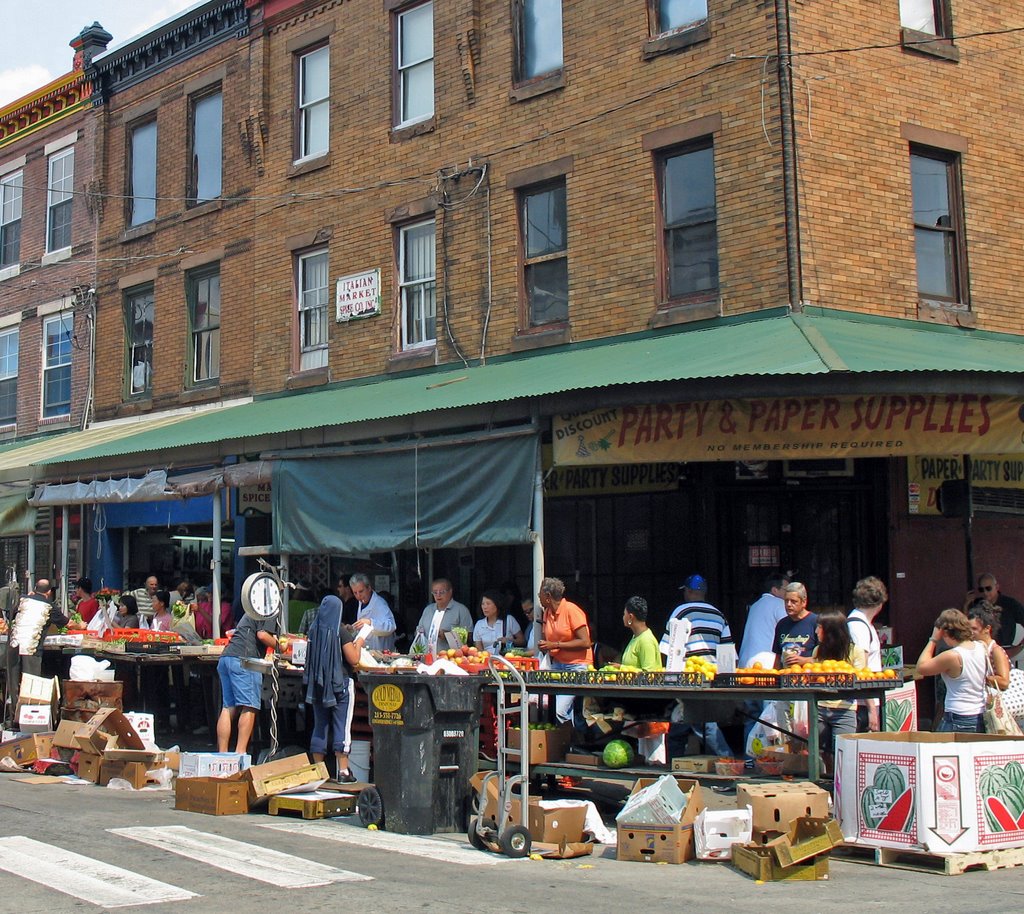
I turned left off Market onto 9th and walked southward. After a few blocks, I started to get into the heart of old Italian South Philly. Several blocks were taken over by outdoor market stalls selling produce of all descriptions.
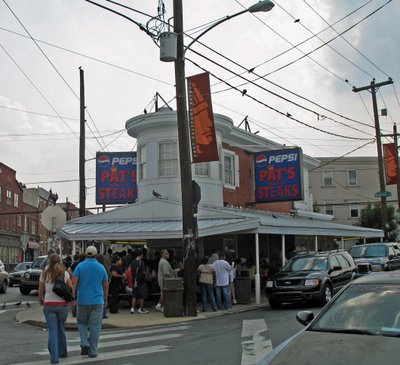
Finally, I arrived at my destination, and found the end of a long, but fairly rapidly moving line.
The questions of the moment were Cheez-Whiz or Provolone, and "with" (or, as Topazz had coached me, "wit") or "without". (The last refers to onions.) I had read that cheesesteak cognoscienti prefer "Whiz"; the issue of onions is left to individual taste. When I got to the window, and a little, brush-cut pitbull of a man barked "Next!", I said, "One Whiz wit, please." (The last word probably gave me away as a tourist.)
The sandwich proved worth the walk and the seven bucks. The meat was sliced thin and a bit overdone for my taste. The logic of "Whiz" was readily apparent; its semiliquid state allows it to permeate every crevice, and its unsubtle flavor perked up the beef nicely. The bread was an ideal companion for these ingredients; soft and spongy, but still firm enough to keep its shape and hold the filling, while absorbing the cheese and the meat juice. The onions were a bit of a letdown -- heavily sauteed and droopy, like those you get from hot dog carts. Next time, I may try a "Whiz witout". Nevertheless, I was more than satisfied.
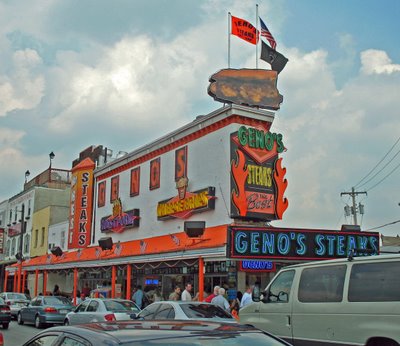
As I started back to my hotel, I noticed Passyunk Avenue heading off at a northeastward angle, forming a hypoteneuse to the triangle whose legs of Market and 9th I had walked to get here. At the apex of the triangle sat Pat's gaudy competitor, Geno's.
I decided to take the Passyunk shortcut, which would afford me the opportunity to see some different things on the way back. After walking a few blocks, I became very thirsty. I was sure I'd soon come to a little deli where I could get a bottle of water, but all I could find were residences and auto supply stores.
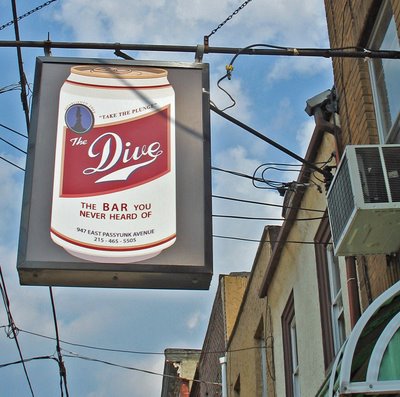
Finally, after many blocks, I saw this sign. I was ready to "take the plunge", but the plunge wasn't ready for me, as a sign on the door said the place didn't open until 5:00 P.M., and it was only 2:15.
Fortunately, after another couple of blocks, I found this angel of mercy, attended by two cherubs (one of whom is visible just inside the door) at the corner of Passyunk and Catherine.
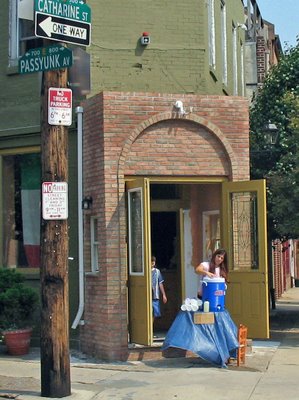 The lemonade they vended was a perfect chaser to a Pat's cheesesteak, having a crisp tartness that banished the lingering salinity of the Cheez-Whiz and onions.
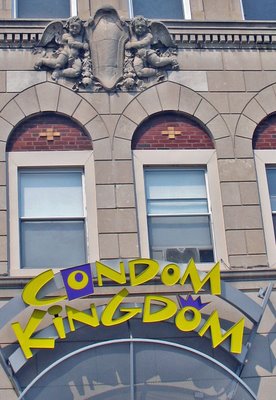
Passyunk Avenue came to an end a few blocks later, near this building, on which two more cherubs fluttered in attendance on an unlikely monarchy.
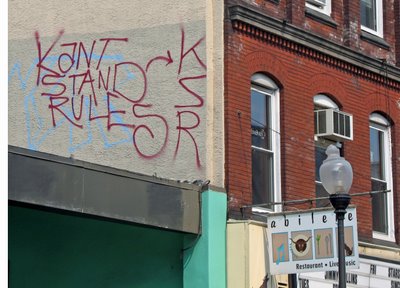
Just beyond that building, an unknown philosopher proclaimed dislike of any Categorical Imperative.
I walked westward across 4th to Market, then turned right to head towards 9th. After a couple of blocks, I paused to get my obligatory shot of Independence Hall.
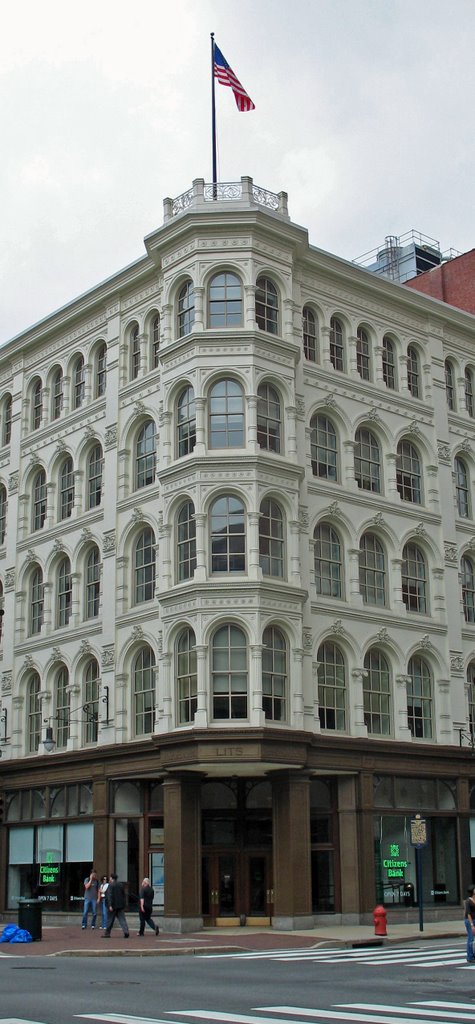
Continuing across Market, I came to a magnificent example of late 19th century cast iron department store architecture. There are many buildings in this style in the "Ladies' Mile" section of New York, but I reckoned this an especially fine specimen. It is the former Lit Bros. store, now subdivided into a few street level chain shops and offices above.
Fortunately, the building has been preserved.
To the right of the "Lit's" sign facing the intersection is a sign that reads, "Hats trimmed free of charge." I wonder if Carmen Miranda ever came to Philly to take advantage of that offer.
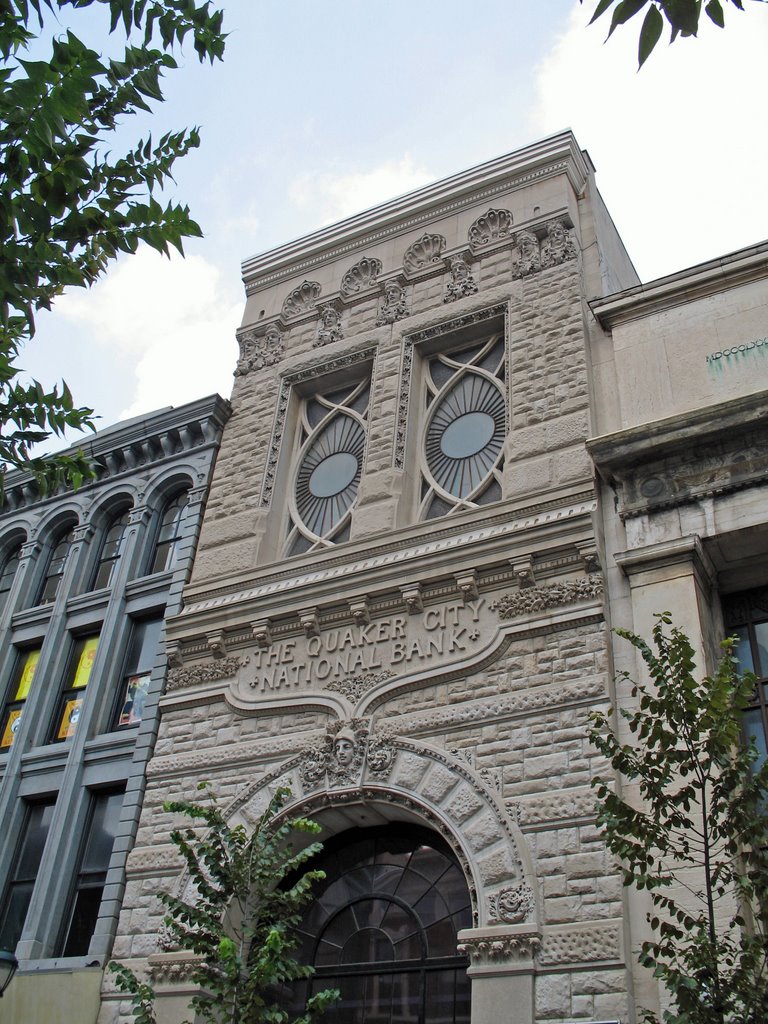
I'm not sure why, but smaller cities like Philadelphia seem to have much more exuberant vernacular architecture than New York. Perhaps it's because architects working in cities with less critical oversight felt less inhibited.
In any event, note the "eyes" on The Quaker City National Bank Building. Revel in the playful texture of the facade, and the "thought balloon" containing the institutional name, suspended above the helmet of the figure on the keystone of the arch.
I turned left off Market onto 9th and walked southward. After a few blocks, I started to get into the heart of old Italian South Philly. Several blocks were taken over by outdoor market stalls selling produce of all descriptions.
Finally, I arrived at my destination, and found the end of a long, but fairly rapidly moving line.

The questions of the moment were Cheez-Whiz or Provolone, and "with" (or, as Topazz had coached me, "wit") or "without". (The last refers to onions.) I had read that cheesesteak cognoscienti prefer "Whiz"; the issue of onions is left to individual taste. When I got to the window, and a little, brush-cut pitbull of a man barked "Next!", I said, "One Whiz wit, please." (The last word probably gave me away as a tourist.)
The sandwich proved worth the walk and the seven bucks. The meat was sliced thin and a bit overdone for my taste. The logic of "Whiz" was readily apparent; its semiliquid state allows it to permeate every crevice, and its unsubtle flavor perked up the beef nicely. The bread was an ideal companion for these ingredients; soft and spongy, but still firm enough to keep its shape and hold the filling, while absorbing the cheese and the meat juice. The onions were a bit of a letdown -- heavily sauteed and droopy, like those you get from hot dog carts. Next time, I may try a "Whiz witout". Nevertheless, I was more than satisfied.
As I started back to my hotel, I noticed Passyunk Avenue heading off at a northeastward angle, forming a hypoteneuse to the triangle whose legs of Market and 9th I had walked to get here. At the apex of the triangle sat Pat's gaudy competitor, Geno's.

I decided to take the Passyunk shortcut, which would afford me the opportunity to see some different things on the way back. After walking a few blocks, I became very thirsty. I was sure I'd soon come to a little deli where I could get a bottle of water, but all I could find were residences and auto supply stores.
Finally, after many blocks, I saw this sign. I was ready to "take the plunge", but the plunge wasn't ready for me, as a sign on the door said the place didn't open until 5:00 P.M., and it was only 2:15.

Fortunately, after another couple of blocks, I found this angel of mercy, attended by two cherubs (one of whom is visible just inside the door) at the corner of Passyunk and Catherine.
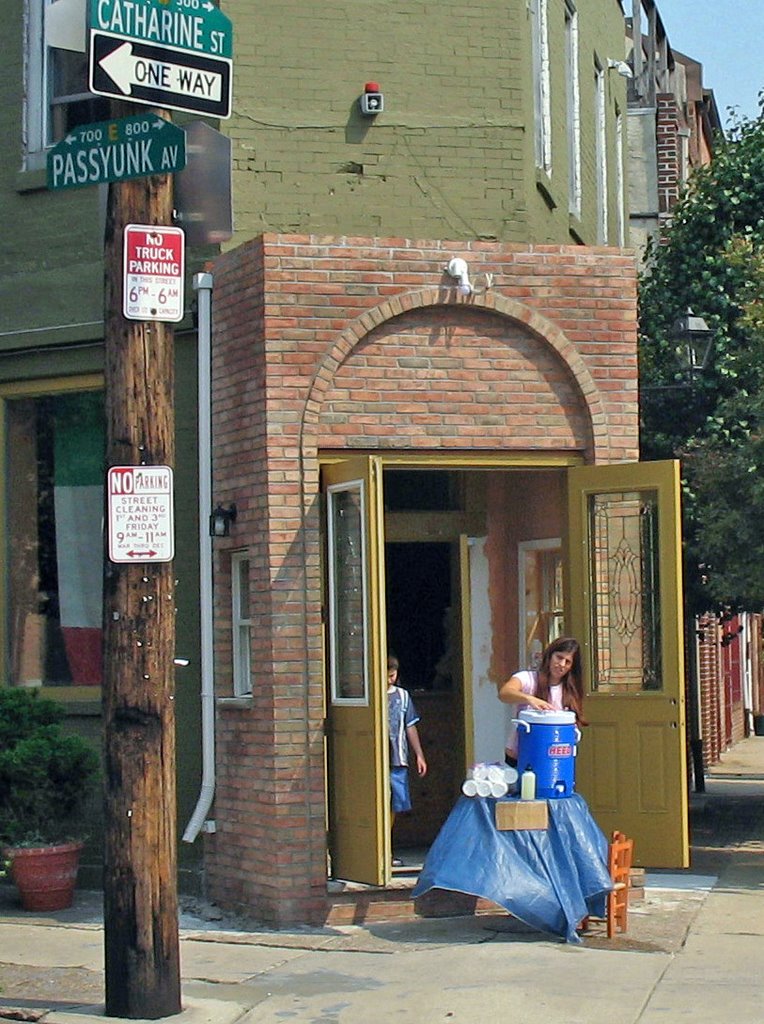 The lemonade they vended was a perfect chaser to a Pat's cheesesteak, having a crisp tartness that banished the lingering salinity of the Cheez-Whiz and onions.
Passyunk Avenue came to an end a few blocks later, near this building, on which two more cherubs fluttered in attendance on an unlikely monarchy.

Just beyond that building, an unknown philosopher proclaimed dislike of any Categorical Imperative.

Thursday, September 14, 2006
Ann Richards, 1933-2006
Back when she was governor, Ann Richards had the duty of speaking to a group of state insurance regulators who were meeting in Houston. Also in the audience were many representatives of the insurance industry and their lawyers, myself included in the last category. It was, I suppose, a fairly standard Ann Richards speech, laced with Texan expansiveness but leavened by self-deprecating humor. At one point, she suggested the need for greater government oversight of some aspect of the business. There was a moment of dead silence, then one man started clapping loudly. "You're a lo-o-o-nely fellow," she said.
Given the drift of Texas politics over the years since she left office, one might suppose she spent her later years as a lonely woman. But the progressive tradition in Texas is still very much alive. Ann Richards embodied much of what is great about a great state.
9/18 update: Interesting and amusing reminisences of Ann's post-gubernatorial days by a man who served as her personal assistant, in a blog called In the Pink Texas.
Given the drift of Texas politics over the years since she left office, one might suppose she spent her later years as a lonely woman. But the progressive tradition in Texas is still very much alive. Ann Richards embodied much of what is great about a great state.
9/18 update: Interesting and amusing reminisences of Ann's post-gubernatorial days by a man who served as her personal assistant, in a blog called In the Pink Texas.
Monday, September 11, 2006
September 11 commemoration photos.
I was going to post a few quick shots I got this morning on the way from my daughter's school at West Street and Murray to my office at 45 Broadway, But those on Gowanus Lounge are so compelling that the best I can do is direct you to them.
Subscribe to:
Posts (Atom)