First, we didn't see an abrupt end-of-season collapse. The lads had the good grace to tank immediately after the All Star break, sparing us fans any unduly prolonged, then cruelly smashed, expectations. Indeed, now that any hopes of a post-season are safely gone, they seem to be having a bit of a late season rally. Playing the Pirates helps.
Second, we have, for the first time since Frank Viola did it 22 years ago, a twenty game winner in the unlikely (I like the word "unlikely" in connection with the Mets: the first Mets game I attended, in the summer of 1985, was won by a two run homer off the "unlikely bat" of Howard Johnson) guise of knuckleballer R.A. Dickey. His is an unusual story for the Mets: instead of a star free agent who, upon donning the blue and orange, quickly did an impersonation of the Wonderful One-Hoss Shay on the centenary of Earthquake Day, he was a much traveled journeyman pitcher who found his stride--or should I say his sling?--with the Amazins.
I'm tempted to fall back on the comforting mantra--"Wait'll next year!"--of Brooklyn Dodger fans a half century plus a decade ago. But I know it ain't gonna be so. Nevertheless, I'll remain loyal.
We think of blues as sad, and associate sadness with music in a minor key. Truth is, almost all blues is in a major key. I suspect the reason is that, while blues addresses life's hardships, it typically has a "we shall overcome" undercurrent; a sense that the singer is up to the challenge. An exception is "Last Kind Words Blues", recorded in 1930 by Geeshie Wiley, about whose life, according to this Wikipedia entry, little is known.
This video was made in the late 1980s by a band that broke up in 1990, so I may fairly be accused of exhuming a dead horse to flay it. In defense I offer first, it's so screechingly awful (I've never liked the Heartland Records/ Sonic Youth/ "noise metal" genre) that I couldn't resist sharing it (OK, call me a sadist); and second, it unfairly maligns a small city (technically a "town") with which my admittedly tenuous connections are all pleasant. The only time I ever spent there, apart from traversing its outskirts on the Mass Pike, was when I had Thanksgiving dinner in 1969 thanks to a delightful young woman, then a Harvard senior, who worked on floor staff at the now lamented Lincoln's Inn, and her parents, who shared their table with me and several of my law school friends. My continuing connection is through two friends, one of whom grew up entirely (the one who introduced me to Dogfish Head 90 Minute Imperial IPA), and the other partly (the one who introduced me to the Brooklyn Bridge cactus), there.
Framingham, Massachusetts (population 68,318 as of the 2010 census) sits roughly halfway between Boston and Worcester (a city with which my connection is even more tenuous). It's been designated one of America's 100 best small cities by CNN. It has its normal share of annoying inhabitants, both human and animal, but it's certainly no hellhole. It was at least for a time the home of Crispus Attucks, considered by some the first casualty of the American Revolution. In the years leading up to the Civil War it was, in common with my adopted home, Brooklyn Heights, a center of the antislavery movement. It has a large Brazilian immigrant community, so you can probably get goodbacalhauand feijoada there.
The video starts, over a portentous repeated strum, with an aerial view of a treeless suburban spread of Malvina Reynolds' ticky-tacky houses, evidently somewhere in the high plains or desert, certainly not New England. Then, with a hissing snare crescendo, we're transported down to one of these houses, where the protagonist lies asleep, at first still, then agitated. Cut to the band, shot in near darkness, appearing to be the spectral figures who disturb his sleep. A voice begins a droning chant:
He was a company man, on the lifetime plan, He gave them forty years; they gave him a watch...
What follows are evidently stock scenes from 1950s movies or Father Knows Best style TV sitcoms, as our protagonist has breakfast with his pretty wife and adorable toddlers, then leaves for work. We then get, as the droning voice continues, scenes of factory workers lining up to punch their time cards and views of huge industrial plants, mostly of kinds that never existed in or anywhere near Framingham. As we shift to the interiors of these plants and see workers doing repetitive tasks, and the voice drones on, we do get one glance of what appears to be an auto assembly line, something that Framingham actually had for a time. The voice shifts out of its monotonous drone into a shriek, then a bellow:
This is what I DO! This is what I AM! I want to LIVE FOREVER, in FRAMINGHAM!
What, no retirement home in Florida? No, Framinghamforever! Then the yelling ends, and we get keening guitar as the workers leave the plant, our protagonist arrives home, his darling daughter removes his shoes and puts on slippers as he reads the paper, and the family goes to the dinner table. There, Dad seems glum as he picks at his food, perhaps contemplating the Meaninglessness Of It All, or mulling over the gambling debts he's run up without his wife's knowledge, or both. The kids are excused, and Mom looks concerned. Cut to exterior, where we see the bedroom light going out. Nothing like a roll in the hay to chase away those existential blues, but we suspect it ain't in the cards.
What seems odd about this product of the late 1980s is that it mocks an America that was, if not entirely a thing of the past at that time, well on its way out: an America of plentiful manufacturing jobs that paid well enough to provide middle class comfort, and gave a reasonable expectation of lifetime employment.
Nice Strong Arm came from Austin, and moved to New York after the success of their first album, Reality Bath ("Framingham" is from their second, Mind Furnace). What made them pick on Framingham? I suspect they just needed a three syllable name to fill out the measure of those last shouted lines. Allentown would have done as well, but Billy Joel had already claimed it.
Jamestown, New York is a city about half the size of Framingham (2010 population 31,146). I got to know it well in the 1970s when, as a LeBoeuf associate, I did work for a client there. Jamestown was a furniture manufacturing center, and Maddox Table was one of its largest employers. If you follow the link immediately above to the first installment of my LeBoeuf saga, you can read about my first visit to Jamestown and find the "Maddox Table" video embedded there as well.
"Maddox Table" is from 10,000 Maniacs' first album, The Wishing Chair, which was produced by Joe Boyd, who had produced albums by several English folk-rock groups, including Fairport Convention. This should tell you we're a long way from noise metal. The lyrics, by Natalie Merchant, tell of the drudgery of factory labor ("The legs of Maddox kitchen tables/ My whole life twisted on a lathe") by an immigrant worker ("My first English was/ 'Faster, boy, if you want your pay'"). As in "Framingham" we have a contrast with after work life, but here it's a tale of courtship, with Vaudeville, movies, and Sunday trolley rides to Bemus Point, then an amusement park, now a more upscale attraction. Ms. Merchant does give us some inscrutable lyrics: whatever does "Oh, my Dolly was a weak/ Not a burdened girl" mean?
Perhaps the most important contrast with "Framingham" is that "Maddox Table" recognizes the role of unions in factory workers' lives:
To your benefit we strike or bargain, With the waving fist a union man, Not just for Smokes, spirits, candy, and cologne, But for Automobile keys, Cash in the bank, And the deed On a place called home.
Then, there's the video. Instead of stock stuff from various repositories, we have scenes from the real Jamestown, from 1940 according to the text accompanying the video, though apart from the vehicles it looks as if it could as easily be from the 1950s. It shows the people of Jamestown at work and at play, and some of the scenes (particularly of the shirtless guy in the newspaper printing plant) show people who actually seem to be enjoying their work. I'm guessing this was a Chamber of Commerce production, intended to display the city's best side.
"Maddox Table" is a song about a real place, made by people who knew it well. It doesn't shy from the hardships of factory work, nor overly idealize what's to be enjoyed outside of work. The accompanying video may present an airbrushed version of Jamestown as it was, but at least it takes us there.
GO Brooklyn was a borough-wide celebration of local artists, many of whom opened their studios to visitors over the past weekend.
My first stop was the studio of my friend Adam Suerte, painter, graphic designer, and tattoo artist (note his arms) which is in the basement of his Brooklyn Tattoo at 101 Smith Street, to which I plan to repair some day soon to get his Brooklyn Bridge design inked on my arm. 101 Smith also houses his Urban Folk Art gallery.
Hovey Brock is a painter I got to know when our daughters were in preschool together. His studio is at 104 Montgomery Street, near the Brooklyn Museum and Brooklyn Botanic Garden. Hovey's technique is to stretch a fine plastic grid across the canvas, apply acrylic paint, then remove the grid. This leaves a finely textured image. He describes his work on his website thus:
My paintings and works on paper are made up of many transparent layers that create an indeterminate space. The colors are intense, yet nuanced. They mimic light, but have density.
I first met Michael Sorgatz through his then girlfirend, now wife, Eleanor Traubman, publisher of the blog Creative Times. I used his painting Jazz Band at the Park to head my post on "Jazz and the Visual Arts". Mike's style is impressionistic, but in an edgy, urban way rather than a soft, pastoral one. You can see more of his works on his website. He is also the founder of the website Art in Brooklyn.
Mike's studio is in a location called Screwball Spaces, a complete floor in a self-storage warehouse building, located at 183 Lorraine Street in the Red Hook section of Brooklyn, that has been leased for use as artists' studios. On the way out, I saw a photographer's studio that caught my eye.
The photographer is Kamau Ware, who is engaged in a project to photograph his friends without showing their faces. By an odd coincidence, when I looked him up on the web, I got a link to Newvine Growing, the blog of Colleen Newvine Tebeau, wife of painter John Tebeau, who is a close friend of, and shares studio space with, Mike Sorgatz.
From Red Hook, I made my way on foot to Park Slope. This involved taking the Third Street Bridge across the infamous Gowanus Canal, now (despite Mayor Bloomberg's wishes) a federal Superfund site. Known in its polluted heyday as "Lavender Lake", it looked quite innocuous as I crossed the bridge, reflecting sky, clouds, and trees. But, see that greenish tinge at the bottom of the image.
My next stop was at the Park Slope home of photographer Hugh Crawford, whom I first got to know through his wife, Louise, publisher of Only the Blog Knows Brooklyn, and through his regular feature, "No Words, Daily Pix", on her blog. You can see more of his work on his website.
I had planned to make Hugh's place my last stop on this artistic pilgrimage, but Louise reminded me that Simon Dinnerstein was a mere two blocks away. I had met Mr. Dinnerstein briefly following a discussion of his work The Fulbright Triptych at the Brooklyn Historical Society last year. His Park Slope brownstone contained many examples of his complex and fascinating paintings and drawings. You can take a guided gallery tour of his work here.
On my way to the subway, I saw another "GO Brooklyn" poster outside a garage space, which housed the workshops of several sculptors. One of these, Reina Kubota, does works inspired by living and anatomical forms; for example, the brain (at left and in the background of the photo above), the heart (at the right), and either a tree or a part of the nervous system (center). On the wall behind is a convoluted figure roughly depicting a brain cross-section, made of objects attached to the wall.
"Heartbreak Hotel" is one of the first rock and roll songs I can remember hearing. I was ten years old, riding in my parents' 1955 Chevy from Eglin Air Force Base, where we lived, to Pensacola for some shopping. My reaction at the time was that Elvis' staccato delivery of "You-make-me-so-lone-ly-ba-by" sounded like a broken-down helicopter. Later, as my scope of musical appreciation expanded to include the blues, I came to like the song.
One thing I didn't notice was the piano accompaniment. The two quick instrumental notes that follow the opening line, "Well, since my baby left me," and subsequent sung lines seem, on careful listening, to be guitar and piano chords struck simultaneously. The piano is first heard by itself starting at about 0.50 in the audio track above, doing rapid arpeggios in a high register, but softly. At about 1.32, during the short instrumental bridge, the piano comes through more boldly. If you listen to the song attentively, you hear the piano clearly, but if you're using it as background music, it's almost subliminal. Even if you do hear it, it doesn't command your attention, even though it's played very well. This is the mark of a first-rate studio musician.
The musician in question here was Floyd Cramer, who backed up Elvis and other stars for years. In 1960, though, he became known on his own because of the success of "The Last Date", which reached number two on the Billboard pop survey.
"The Last Date" featured a style of piano playing that Cramer may have invented, called "slip note." A finger lightly touches a key one note off the intended one, producing a soft sound, then slides onto the intended key and hits it with normal force. This subtle glissando imparts a quality of eeriness to an otherwise pretty but forgettable tune. This brings to mind the kerfuffle over Auto-Tune, a software program used by some pop artists to correct notes in their singing, generating a finished product in perfect pitch. As David Hadju has sagely pointed out in The New Republic, the real problem with Auto-Tune, to the extent that there is a problem, is not that it gives an artificial boost to the untalented, but that it could smother what is often best in music, that is, the slight imperfections that make it memorable. "Bessie Smith, processed through Auto-Tune, would have all the soul of Siri."
This was the winner of "the first ever cat video film festival". Unlike the star of this show, my cats don't seem to suffer existential angst. It's more like, "Hey! It's ten minutes since you last fed me, and the food in the dish is stale."
Congratulations to Will Braden, who made the video, and thanks to Geoff Abrams for bringing it to my attention.
Thanks for all the music over the years, beginning with "Brown Eyed Girl" on the jukebox of a little sandwich shop in Cambridge, Massachusetts on my first day there almost exactly 45 years ago. Keep on.
When I started this blog on August 30, 2005, I think I would have been surprised to know it would still be going on that date in 2012. Never underestimate the force of dogged narcissism.
What I didn't anticipate was that it would make me world famous. I'm typing this with tongue firmly in cheek, but my Site Meter tells me that I've had visits from just about every nation on earth. Most of these have been the result of web searches for images of Grace Slick (my all time top draw), paintings by Pierre Bonnard, and such. Few, I think, have led to repeat visits, although I suspect I do have some regular readers in far-flung places. Last night I had visits from Barcelona, from a search for "Michael Simmons on Dylan's Tempest"; Lisbon off a search for the tall ship Kalmar Nyckel, which led to my "Sail on Cape Cod Bay" post; Szczecin, Poland (formerly called Stettin, and made famous in Winston Churchill's "Iron Curtain" speech: "From Stettin on the Baltic to Trieste on the Adriatic...") from a search for "old small tug," resulting in a hit on my "Tugboats galore"; and Surabaya, Indonesia (made famous by Bertholt Brecht and Kurt Weill in their musical Happy End with the song "Surabaya Johnny") off an unspecified search that led to my "iPod log 8: long morning walk".
My daily visits and page views have grown steadily if not spectacularly over the years, mostly because the more things I post about, the more likely I am to attract hits off web searches. Still, I think I've gained some steady readers. Linking to Facebook helped, though I now get most of my comments there instead of on the blog itself. I might do better if I gave up being, as one friend put it, "relentlessly eclectic," and instead stuck to baseball, or music, or some other topic. Still, I hope there are a few of you out there who can appreciate, if not the full range of my interests, at least enough of them to keep looking in from time to time. Let me know, though, if you think there's any way I can improve the blog, and thanks for your loyalty.
I have a weakness for India pale ales, or "IPAs". On our recent visit to Cape Cod our host, whose brew judgment I've come to appreciate, offered me a Dogfish Head 90 Minute Imperial IPA. I'd had Dogfish Head's (a brewery located in Milton, Delaware) regular IPA before, and liked it, so I was delighted to try their premium version.
So, you're asking (as I was), what's this "90 minute" thing? Here's what it says on the label:
What you have here is an Imperial India Pale Ale featuring a single constant 90 minute hop addition. It's balanced by a ridiculous amount of British Two-row Barley. Then we dry hop it in every tank.
On reading this, you might think that "a single constant 90 minute hop addition" with dry hopping on top of that would produce an ale that's the brigadier of bitterness; something to make Sierra Nevada's "Torpedo" seem like Corona Light. Not so. The most important word in that quotation from the label is "balanced." Here are my tasting notes:
Color: deep amber (see photo).
Head: generous and long-lasting.
Aroma: hops predominate, with a cinnamon-y flourish, but malt richness comes through in a subtle way.
Flavor: malt announces itself first, but with restraint. The hop finish is not assertively bitter, but pleasantly so, with hints of apple and, as in the nose, cinnamon. All in all, well balanced and thoroughly pleasing.
Watch out, though. This ale doesn't taste strong, but it packs a punch at nine percent alcohol by volume.
According to the Dogfish Head website (see link above), the brewery also makes a "120 Minute IPA." Look for a follow-up to this post.
It was a rainy night in eastern Pennsylvania on July 20, 1969, and I was prone on the ground, next to some shrubbery, a poncho draped over my back and head, with my right arm resting on the stock of an M-60 machine gun. It was the last week of my ROTC summer camp at Indiantown Gap Military Reservation ("Say it loud and say it clear/ IG-MAR takes it in the ear" was one of the cleaner of our marching songs), and we were on the field exercise that capped our six week immersion in Army life. I was waiting for an "enemy" patrol I was supposed to ambush, but they never showed. I knew this was the night the Apollo 8 lunar lander was supposed to touch down, but I was far from any TV or radio, apart from my walkie-talkie, and couldn't even look up wistfully at the moon, which was hidden by clouds. It was a few days later that I first heard Neil Armstrong say,“That’s one small step for man, one giant leap for mankind.”
As his New York Times obituary notes, after the round of public adulation and ticker tape parades, Neil Armstrong reverted to being what he always had been, a very private man. He retired from NASA, taught engineering classes at the University of Cincinnati for a time, then took up farming. In this respect he was unlike his fellow Ohioan and space pioneer John Glenn, who plunged into public life and became a U.S. Senator. Armstrong, Glenn, the Wright brothers: what is it about Ohio that engenders a desire to escape the surly bonds of earth?
Well, I know Kris and Rita, and Marty Mull
Are meeting at the Troubadour,
We'll get it on with the Joy of Cooking
While the crowd cries out for more
--Peter Rowan, "Lonesome L.A. Cowboy"
In my last post I mentioned Joy of Cooking, the cookbook. This made me think of the band with that name, which emerged from the Berkeley scene in the early 1970s with a sound rooted in blues, funk, and country. I still have, somewhere, a vinyl disc of their second album Closer to the Ground. You can hear the title song from that album through the link above.
On our recent visit to Cape Cod (also see here) we shopped at Main Street Wine & Gourmet in Orleans. While there, I noticed a display of wines from Truro Vineyards, on the Cape. One of these was a Cabernet Franc. This is a grape varietal grown in Bordeaux (where it is often blended with the better known Cabernet Sauvignon as well as Merlot, and Petit Verdot to make the renowned wines of that region) and in the Loire Valley of France. Used alone, it produces wines that usually are more intensely flavorful, and so less subtle, than those made with Cabernet Sauvignon and other Bordeaux varietals.
I'd recently had a Cab Franc from Long Island that I thought quite good, and reckoned that a grape that grows well in the cool climate and sandy soil of the North Fork might also succeed on the Cape. This, and the bottle's reasonable price, convinced me to give it a try. I took it to the roof of our building to open it and take my first taste, posing the bottle against the lower Manhattan skyline and the harbor. The label bears a reproduction of Lois Griffel's impressionist painting, Truro Lighthouse.
I poured a glass about a third full and let it sit for a minute to breathe. The color was a true ruby red. When I held it to my nose and sniffed, I had the impression of standing next to a cherry pie fresh from the oven. The fruit aroma was combined with a warm, toasty scent. My first taste seemed intensely tart. After leaving it in the glass for another minute and swirling it around a bit, I found the initial tartness mellowed, followed by a full-bodied cherry flavor ("Cherry without the cough syrup!" was my wife's later observation), and a slightly, but pleasantly, bitter finish.
I took the bottle downstairs and let the wine breathe some more before dinner, which featured one of my favorites of my wife's extensive culinary repertoire, beef stew Gaston. It's a recipe that can't be found, she said, in any post 1980 edition of Joy of Cooking, because it's not considered "modern." To her consternation, I always add some hot paprika, cayenne pepper, or Louisiana hot sauce. After more breathing, the wine had opened up gloriously, and easily stood up to savory, spicy stew.
I'm a fan of Alice Feiring and her love of subtle, nuanced wines, and not impressed by what Robert Parker calls "hedonistic fruit bombs." Truro's Cab Franc is "big" and has pronounced fruit flavor, but it's also complex and balanced. It goes well with flavorful food. I may have to try it with Thanksgiving turkey and cranberry sauce; this would be appropriate, as it comes from near where the Mayflower first dropped anchor in the New World.
Above is a video of the song "Duquesne Whistle" from Bob Dylan's new album Tempest,. My friend Michael Simmons has this comment on the song:
It starts like some Bob Wills & His Texas Playboys' 1930s Western Swing thing, like an old song emanating from ancient radio ether, reminding us of Dylan's love for the roots of American music. But after a verse, it hits ramming speed, kicking into a ferocious romping rocker propelled by Tony Garnier's walking bass. The conceit belongs to that grand tradition of long gone train line songs (think City Of New Orleans), representing older, more soulful values that get lost when progress mows down everything in its path. "Listen to that Duquesne whistle blow/Sounds like it's on a final run." A helluva an opener.
Michael has much more to say about the album, and about each song. He sums it up with: "Yes, Dylan delivers."
My wife gave me a scare a few days ago by announcing that the Oxford comma had been dropped from the Oxford Style Manual. As it turns out, this was a false alarm caused by the failure of the University Press's P.R. firm to use one in their announcement of the Manual's latest edition. Silly monkeys.
So, what is this Oxford comma, and why does it matter? (Hint: there's one in the caption of this post.) You won't get the answer by watching the video above, and listening to the lyrics of a song called "Oxford Comma" by Vampire Weekend, one of my favorite twee bands (the other is Belle & Sebastian). You will by reading this NPR piece by Linda Holmes, whose views on language issues appear virtually congruent with mine (although I do hyphenate "e-mail"). She concludes by noting that all of us who care about such things have our pet peeves. If you've been following this blog for a while--and if you have, God bless you--you know mine.
Update: reader Quin, in a comment below: "A battle rages in my firm over this--it's AP v. Oxford." I'm guessing you're on the Oxford side, Quin, so you may cite the Chicago Manual of Style (16th ed., 2010) 6.18 as support:
When a conjunction joins the last two elements in a series of three or more, a comma--known as the serial or series comma or the Oxford comma--should appear before the conjunction. Chicago strongly recommends this widely practiced usage, blessed by Fowler and other authorities (see bibliog. 1.2), since it prevents ambiguity.
The newest, biggest, and best ever Mars rover, Curiosity, will be landing on Mars tonight at 1:31 a.m. EDT. Read about it and watch a video of its intricate landing process here.
Update:Curiosity survived its "seven minutes of terror" and landed safely. .
In the crush of a hectic schedule last week, I missed the sad news of Sally Ride's death, at 61, from pancreatic cancer. She wasn't the first woman in space. That honor belongs to Valentina Tereshkova. Still, I admired Ride's easygoing charm, and commend her double major in English and physics, perhaps a personal attempt to transcend the divide described by C.P. Snow in The Two Cultures. (Photo: NASA)
Happier news is the discovery of a fifth moon of Pluto. Six years ago I noted, a bit wistfully, Pluto's demotion from tenth ninth (thanks paulo1 for catching my error) planet to "dwarf planet" status. While its having an additional satellite doesn't change that classification, it does show that the little devil still has a surprise or two in store.
Last weekend we were guests of our friends at whose Cape Cod house we welcomed the New Year. On Sunday, we drove from our friends' place in Orleans, just past the Cape's "elbow," out to Provincetown, at the far end of the peninsula. "P-town," once a quiet fishing port and artists' colony that attracted a large gay community, a New England analogue to Key West, has, like Key West, become a tourist destination with lots of shops selling t-shirts and souvenirs made far away. Still, there are some places worth visiting, as our friends showed us, including an almost claustrophobia-inducing used book store, and a little tavern called The Squealing Pig, where we all started our lunch with bewitchingly briny Wellfleet oysters, which I followed with a heaping platter of haddock and chips, washed down, serially, with a Whale's Tail Pale Ale from Nantucket, and a Fisherman's Ale from Gloucester, not far from my wife's home on Massachusetts' North Shore.
After lunch we took a walk on one of the long piers that extend into Provincetown harbor. Our friends recommended a sail on the two masted schooner Bay Lady II (photo above), to which we eagerly agreed.
Your correspondent looks pensive as the crew prepares to cast off (photo by M. Foley).
We left the pier under auxiliary motor power, and headed out of the harbor behind the high speed Provincetown to Boston ferry and a sport fishing boat.
Moored at the end of the pier was Kalmar Nyckel, the official tall ship of Delaware, a replica of the ship that brought the first European settlers--Swedes and Finns--to the Delaware Valley, where, arriving in 1638, they established a colony called New Sweden at the site of what is now Wilmington. Their leader in this venture was the Dutchman Peter Minuit who, on an earlier visit to North America as an agent of the Dutch East India Company, was credited with purchasing Manhattan from the indigenous Native Americans. Kalmar Nyckel is visiting Provincetown, and will return to her home port of Lewes, Delaware after August 4.
After we cleared the breakwater, the sails went up and the engine was shut down. Here's the foresail being raised (photo by M. Foley).
Looking landward, I could see the Pilgrim Monument, an Italian style campanile that commemorates the arrival of English venturers (only later called "Pilgrims") aboard the Mayflower in 1620. Mayflower's first New World anchorage was in what is now Provincetown harbor, and the Mayflower Compact was signed there.
As we left Provincetown harbor, the trawler Sao Jacinto was coming in. Many fishing vessels based at southern New England ports have Portuguese names, reflecting substantial immigration from Portugal proper, the Azores, the Cape Verde Islands, and Brazil into the region, beginning in colonial times.
Off to our starboard, a small sloop was coming about on a tack.
The view from the bow, looking forward. There was about a twenty knot breeze coming from the east, towards our bow on the outward leg of the voyage, and I got wet a few times as we plowed into approaching seas.
The view from the bow, looking aft.
The view at the stern; Captain Bob Burns is at the wheel.
Returning, we passed this green bouy. The bluffs behind are in Truro.
On our way back into Provincetown harbor, we passed Long Point Light.
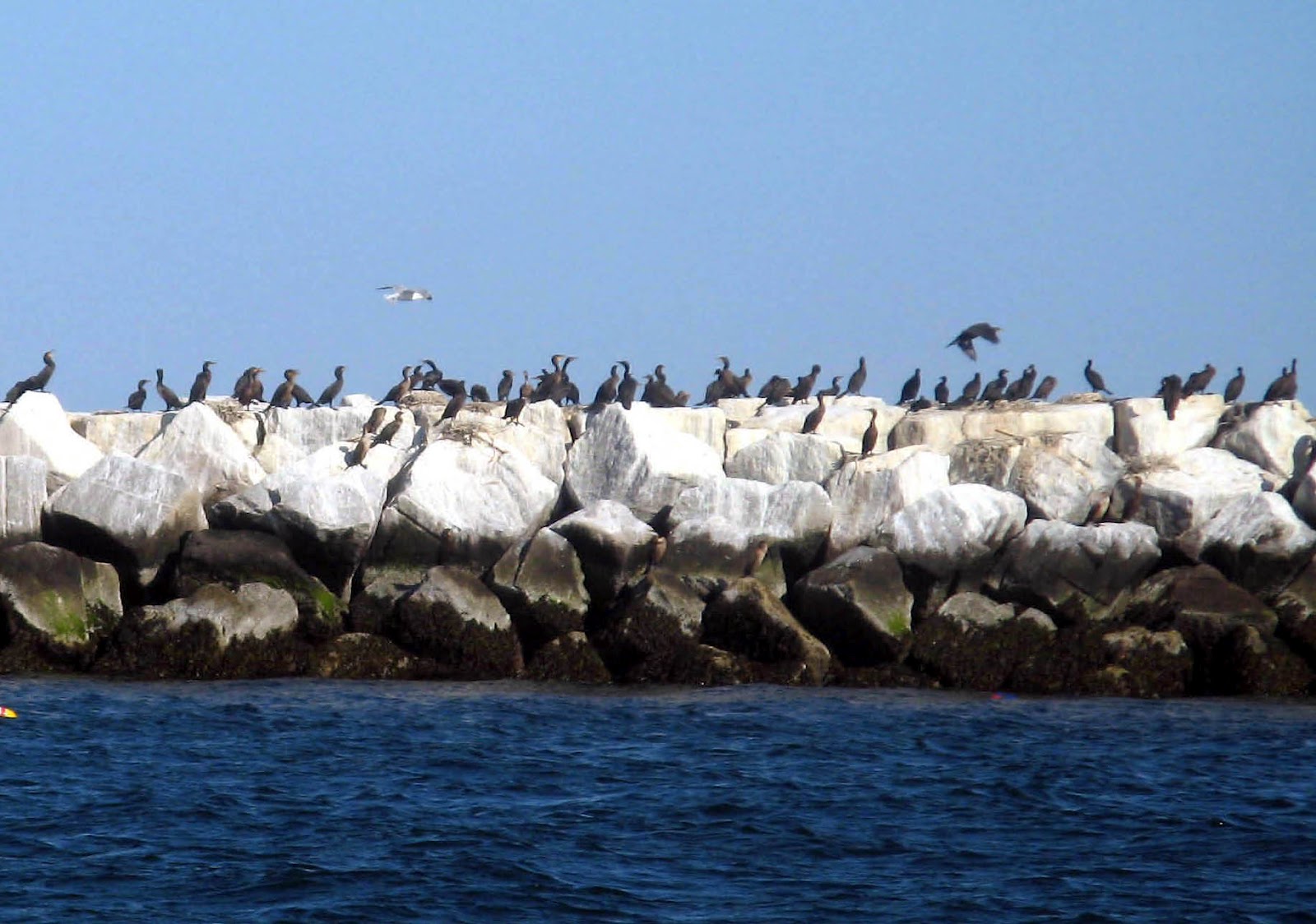
Cormorants were resting on the breakwater, while a gull glided above. I got a close-up of a cormorant four years ago in what is now part of Brooklyn Bridge Park.
Approaching the pier, we got another view of Kalmar Nyckel. All in all, a delightful afternoon's voyage.
Admit it: you've long wanted to hear a bluegrass rendition of Pink Floyd's "Brain Damage", from Dark Side of the Moon. This is it. (Thanks to vegasdaddy17 for the excellent montage of Lizards album covers, band photos, and images of other public figures that accompanies the audio.)
My first taste of the "Connecticut style" lobster roll was two summers ago, when I sampled Red Hook Lobster Pound's offering on Brooklyn's Fulton Ferry Pier. It differs from the better known "Maine style," which features cold lobster in herbed mayonnaise sauce, in having warm, freshly cooked meat drenched in drawn butter. At the time I liked it, but thought the Maine variety still my favorite.
On our way to visit friends on Cape Cod last weekend, my wife suggested that we have lunch at a little seafood restaurant in Madison, Connecticut that she and a friend had discovered. "Delicious lobster rolls," she said, which easily convinced me.
The restaurant proved to be the Clam Castle, an unprepossessing looking place next to a Mobil station (which, according to Matthew Yglesias, may explain why its lobster rolls are so good). My wife (who took the photo above while I pumped gas) asked if I wanted the Connecticut or Maine style; being in the Constitution/Nutmeg State (take your choice), and having not had one since my maiden experience two years past, I chose Connecticut. I was not disappointed. As the photo at the top shows, the New England style split-at-the-top roll was loaded with succulent, fresh meat, including both knuckle and claw pieces. The rolls were accompanied by cups of cole slaw, the tartness of which nicely complimented the sweet, buttery lobster.
I'm now a convert to Connecticut, though I'll still enjoy the Maine style where it's the only option. Now that I'm back in Brooklyn, I'll have to re-visit the Lobster Pound and re-try theirs.
She was "The Queen of Country Music." Born and raised in Nashville, Ellen Muriel Deason found her voice in church. She married Johnnie Wright, a musician, and got her professional start singing with him. He gave her the name "Kitty Wells" for the heroine of an old favorite song. When she started singing on her own, she was something of a pioneer. Mother Maybelle Carter was an early woman country music star, but she stayed in the context of The Carter Family. Kitty was the first to make it big solo. She was an inspiration for the next generation of women in country music, including Patsy Cline, Loretta Lynn, and Dolly Parton. She was also known for her duets with male stars like Red Foley and Webb Pierce.
The video above, courtesy of academic51, has audio of her singing one of my favorite songs of hers, "Will Your Lawyer Talk to God?", with a montage of still photos. Kitty Wells died on Monday, at the age of 92.
A year ago this past February, I posted about the S.S. United States getting at least a temporary reprieve from the threat of going for scrap. Since then, the S.S. United States Conservancy has been busy publicizing the efforts to save the ship and raising funds for her preservation. You can contribute on the Conservancy's website.
The video above is of a movie newsreel (if you're my age you probably can remember these; they were shown at movie theaters, along with previews of coming attractions and cartoon shorts, before the featured film) announcing the "Big U's" setting of a new transatlantic speed record, which entitled her to the Blue Riband, an award that retired with her. The broom seen in the foreground in the still above is to be attached to her mainmast for the next voyage as an acknowledgement of her record setting run.
Thanks to Carl R. Weber for the link to the video.
This is the conclusion of a story that begins here and was continued here.
For a time, I occupied an office next door to that of Charles P. Sifton (photo at left by Tyrone Dukes for The NY Times), later to become a Federal District Judge. He was known to all as "Tony".*
Tony had a strong sense of decorum that I sometimes tested. In the mid 1970s Cameron F. MacRae, III, son of the then senior active partner, was brought into the firm laterally. This started some mutterings about nepotism. "Young Cam" had previously been the chief lawyer in the New York State Banking Department. His immediate predecessor in that job, Mike Iovenko, had also come to the firm as a partner. At the time, I was the host of the "Associates' Lunches," periodic gatherings of the firm's lawyers at which one partner would be called on to talk about a case or deal he or she had worked on, or an area of practice generally. Before announcing the speaker, I would introduce any new lawyers who had come to the firm since the last lunch. At Cam's first, I said this:
I know that all of us associates have our pet theories about how to become a partner in this firm, but perhaps many of you, like me, have now come to the conclusion that there is only one absolutely certain route to partnership...and that is, of course, to first become deputy superintendent and general counsel of the New York State Banking Department, which is by way of introducing Cam MacRae.
Cam stood up, chuckled, and said, "Wait'll you see my successor!" After the lunch, a junior partner (the same one who had, in the previous instalment, abandoned me to the fleshpots of Baltimore) said to me, "You handled that beautifully; it really de-fused the situation." But the next day, I heard a rapping and, looking up, saw Tony Sifton at my office door. "Uh, Claude, how long have you been host of the Associates' Lunches?" "About a year and a half, " I answered. "Well, uh," Tony said, "don't you think it's about time to let someone else do it?" I readily assented. ("Young Cam" proved to be a valuable addition to the firm; some time after his father's death he became chair of its corporate and finance department and later the firm's Vice Chairman.)
LeBoeuf produced my first marriage. Joanna was a paralegal in trusts and estates. When I first met her, I was puzzled by this tall Midwestern woman with a gentile Dutch surname who wore a gold Star of David on a chain. I learned that she had converted to Judaism after the breakup of her marriage, while a student at Vanderbilt, to a graduate student who she said proved to be a physically abusive beast. She was now living with a boyfriend named Leon who was studying to be a cantor. One night, I threw a party to which she came. As others left, she hung around, offering to help clean up. She stayed the night. She and Leon had parted; "Not Jewish enough" was his verdict on her. Within a month, Joanna and her two cats had moved in. When I asked her why someone who had gone to the trouble to convert to Judaism wanted to marry a goy, she said, "You may raise the children however you want."
Our engagement raised a few eyebrows at the firm, but it was agreed that it was technically OK since I didn't do T&E work and therefore wasn't her supervisor. The morning after we returned from our honeymoon she said, "By the way, we're never having children." It later became apparent that, for reasons seeming to have little if anything to do with me, she had come to regret her decision to marry. On my thirtieth birthday we had a big party, and I got thoroughly drunk. When all the guests had left, I told her I wanted a divorce. She agreed.
After we separated, Joanna moved to Chicago to be closer to her family. We remained friends and stayed in touch by phone. She even gave the ultimate compliment of naming a cat for me. After a few years, when I tried to reach her at her office several times and was repeatedly told she was out sick, I called her at home, and she said she had been diagnosed with multiple sclerosis. Several years later, after she had gone through a third brief, unhappy marriage, she called, told me she had decided to move back to New York, and asked if she could sleep on my couch while she looked for an apartment. I said I'd be delighted. She found a place to live, and a job. One day, as I was walking across Sheridan Square in the Village with Martha, then my girlfriend and now my wife, we ran into Joanna, and I introduced them. The next day Joanna called me and said she thought Martha and I "looked good together." A couple of years later I got a call from Joanna's sister; Joanna had died the day before, evidently of congestive heart failure.
After the divorce I moved from what had been our floor-through on Bank Street in the far West Village to a one bedroom pad in the newly renovated Van Rensselaer, formerly a notorious hot pillow hotel, on Eleventh Street just east of Fifth Avenue. It has since been renamed The Alabama and is used as a residence for Cardozo Law School students (photo at right), though Mr. Van Rensselaer continues to glower down through rectangular spectacles from under his broad-brimmed hat at the apex of the arch over the front door
In the process of moving, I had occasion to walk the block of Thirteenth Street between Sixth and Seventh avenues, and there discovered the Bells of Hell, which was to become my home away from home during non-working hours. These non-working hours began to expand, though on occasion I tried to combine them with work. I wrote a section of a brief in a proceeding before the Massachusetts Department of Public Utilities while sitting at the bar of the Bells. It was on a tricky economic question, one on which I thought our client had a reasonable argument but would probably lose given some language in earlier decisions. We did lose, but the DPU's decision on this point included the words "Counsel for the Company ably argued..." I could only wonder what they would have thought had they known where I was when I so argued.
Now it's time for a musical interlude. The house band at the Bells for much of the time I spent there was Turner and Kirwan of Wexford. You can read more about them, and see a video of Pierce Turner as a solo artist, here. Larry Kirwan went on to front Black 47; here's a video of them doing "Funky Céilí":
The video ends abruptly, like Larry's career at the Bank of Ireland, but unlike mine at LeBoeuf.
During 1975 and '76 I had experienced two of what psychologists consider among the most wrenching life changes: marriage and divorce. My divorce, as such things go, hadn't been traumatic, but I entered the final stretch of the seventies feeling itchy and introspective. My life since high school had been a rapid progression through college, which I completed in three years by dint of taking overloads and summer courses, then law school, then to the firm, with a break for military service, then back. I was wondering if I might have been happier had I followed a different path. Like Charlie McCrann (see the previous installment) I had artistic pretensions, though mine were of the Great American Novel instead of the Academy Award kind.
Unfortunately, my turn toward introspection and the Village demimonde came as LeBoeuf was getting substantial amounts of new business and associates were facing greater demands. One night I was working in the library during the wee hours, not because I was overburdened but because I had procrastinated, when the phone rang. I picked it up, and a woman said "Who is this?"
"This is Claude Scales."
"Claude, oh my God! This is terrible. Why are you working at this hour?"
"I just have to get something done. Who are you?"
She identified herself as a third year associate I knew, though not very well. She continued to bewail my late night labors, then giggled and said "Michael, cut it out!" Finally, I said I had to get back to work. She said "OK" and hung up. Later that morning I went to the office of Susan, an associate I knew was a friend of my late night caller. I told her what had happened; she sighed and said, "She's been working on a deal that kept her in the office for several days and nights straight." I told Susan about the giggling and "Michael." She rolled her eyes, and said Michael was a senior litigation associate I knew fairly well who had been through a bitter divorce and a breakdown. "The blind leading the blind," I said. Susan smiled wryly.
Charlie and I were moved from our shared office on the firm's main floor to adjoining small offices in a portion of the floor below that the firm had leased as expansion space. In Lions in the Street, his book about the great Wall Street law firms, Paul Hoffman wrote about how, when Simpson Thacher & Bartlett had its offices in the old Equitable Building at 120 Broadway, an associate getting his (they were all male at the time) first individual office could tell if he was on partnership track by whether his window faced the street or an air shaft. Of those who suffered the latter fate it was said, "He got the shaft." I soon concluded that being assigned to one of the small associate offices in this isolated section, not connected to the rest of the firm by a stairway, was the equivalent of getting the shaft. This was confirmed at my next annual review when Don Greene told me I was not destined to be one of the elect. Nevertheless, he said, I should not "rush away" from the firm. He would try to find something for me.
Shortly after that, a younger partner who was regarded as a rising star invited me to dinner at what was then one of Manhattan's most trendy restaurants, followed by drinks at a members only** night spot. The purpose of this sybaritic night on the town was for him to let me know that a client of the firm, a utility company headquartered in the suburbs, was looking for an in-house lawyer. I was diffident; I didn't want to leave my Village digs for a place in the 'burbs, and reverse commuting seemed like a chore. Over the next few weeks, this partner and several others, including a senior partner for whom I had great respect, kept pressing me to consider the job. I met Ken, vice president and secretary of the client (the firm held the title of "general counsel"), who would be my supervisor, and we both had favorable first impressions. I was offered a deal: I would work for the client at its offices full time for a trial period while remaining on LeBoeuf's payroll. If either the client or I was dissatisfied, I would return to work at LeBoeuf.
At first, it worked out well. I found that I could make the run up the FDR Drive, over the George Washington Bridge, and up the Palisades Parkway to the company's office in about 45 minutes. The return trip was usually a bit slower, as there was some traffic going into the city for the evening. I had to leave the Bells earlier on week nights to be able to get up at 6:30 the following morning, but I was seldom required to work late or on weekends. After about a month, Ken called me into his office, said he and his colleagues were pleased with my work, and offered me the job. I accepted.
After a while, though, I felt the sense of restlessness returning. I didn't want to spend the remainder of my career working in the suburbs. Ken hired another lawyer, Steve, to share our growing workload. Unlike me at the time, Steve was focused and ambitious. He found that the officer in charge of purchasing had made a hash of hedging against fluctuations in the cost of oil and, with Ken's support, took this to top management. This made Steve unpopular with some people, but feared and respected by others. Meanwhile, I was taking long weekends to work on Charlie's movie (see previous installment) and finding it hard to concentrate on my work. When a project I was assigned, in which the company's president took an interest, became overdue, Ken's limited supply of patience was exhausted. He called me into his office. Steve was there. Ken said that henceforth I would report to Steve. I felt like quitting on the spot, but I couldn't take the immediate financial hit.
I considered my options. Jobs were not widely available; these were the "stagflation" years. My work on regulatory matters had kindled an interest in economics. I had taken one undergraduate course in that subject, which I liked and aced. The New York University Graduate School of Business Administration (now called the Stern School) offered an M.B.A. degree with a major in economics. I had G.I. Bill educational benefits available. Going back to school was an attractive prospect. I could look for part-time work, and my parents agreed to help as necessary. My application to N.Y.U. was accepted, and I left my in-house job in June of 1979.
In the fall of that year, I was invited to a black tie dinner dance to celebrate LeBoeuf's fiftieth anniversary. Everyone was cordial, and after dessert had been eaten and the band struck up, Sheila, the firm's first woman partner, came over to where I was sitting and said, "Ask me to dance." I managed not to step on her toes, and my date was impressed. It was a delightful evening.
One afternoon around that time, I was sitting at the bar of the Lion's Head, which had again become my principal watering spot since the Bells closed a few months before, and got into a conversation with a Weil, Gotshal partner who frequented the place. When he found out I had been doing public utility work, he said, "I could use you. We have this strange antitrust case where our client is a public utility holding company suing other public utilities under the Sherman Act, and we don't have anybody who knows the industry." He said I should mail him my resume with a cover letter claiming I had been given his name by a common acquaintance of ours, and swear in blood that I would never disclose to anyone at the firm how we met, or even mention the Lion's Head. I got the job, working on an hourly basis, and this led to further projects that sustained me through the time I was taking classes at N.Y.U.
By 1982, I was ready to re-join the full time work force, and got an in-house job with an insurance company. Being in that business meant that I was able to keep up my contacts with LeBoeuf, at NAIC meetings and also, from time to time, as a client. I was proud to see my old mentor Taylor, who had become the firm's chairman, profiled in The American Lawyer as "LeBoeuf's Gentle Expansionist". Later, after Don Greene had succeeded Taylor at the firm's helm, I was surprised to see an associate, anonymously quoted, describing Don as "like the great flaming head in The Wizard of Oz." This didn't seem like the Don I remembered, and still saw on occasion. I was deeply saddened to see Peter Demmerle, a very smart and personable lawyer and former Notre Dame football star who seemed to be Don's heir apparent, fall victim to, and eventually die from, Lou Gehrig's disease. At the same time, I was glad to see Jim Woods, who had been one of my associate friends in the early '70s, and who had become the head of LeBoeuf's San Francisco office, rise to a position of prominence in the firm by developing a thriving insurance practice on the West Coast and in East Asia.***
My friendship with Charlie, and several other former LeBoeuf associates, had continued from the time we left the firm. Charlie and I both got married and became fathers, which somewhat dampened our Bohemian inclinations (although we made it a tradition to meet once a year with the sound man from his movie at a Bohemian beer garden in Queens). He became a senior executive with Marsh & McLennan, the world's largest insurance brokerage, and had an office on the 100th floor of One World Trade Center.
On the morning of September 11, 2001, I had just dropped off my daughter at P.S. 150 in lower Manhattan, about a quarter mile north of the World Trade Center, and had turned off of Greenwich Street, where I had a clear view of the WTC towers, onto Reade Street, when I heard the sound of a plane overhead, seeming much closer than it should be. A few seconds later, the noise abruptly stopped. There was a brief silence, followed by a very loud explosion. People behind me on Greenwich Street started screaming. I ran back, looked up, and saw a gash in the side of One WTC right about where I knew Charlie's office was. A moment later, a fireball emerged from the gash. In 2003, I posted this on Charlie's page in Marsh's memorial website for those lost in the September 11 attack:
Two years ago today, on a crisp, clear morning just like this, I lost someone very dear to me. Charlie's and my friendship took root in the early 1970's in a shared office at LeBoeuf's, was watered during bachelor hours at the Lion's Head and the Spring Street Bar, flowered in exotic locales at NAIC meetings, endured and strengthened through his and my marriages and the births and growth of our children. He was responsible for my brief, less than glorious but delightfiul movie career. I miss him very much.
I later learned that Cameron F. MacRae, III lost a daughter, who worked for Fred Alger Management, Inc., a few floors away from Charlie's office.
After I moved to Brooklyn Heights, Tony Sifton and I were neighbors, and would occasionally see each other on the street or in the bank or a shop. He would sometimes stop to chat, and was keen to hear how my life was progressing. The last time I saw him, we were both in line to buy bread at Almondine. He looked frail and was wearing a ventilator. Not long after, I saw his obituary. This past February I had the pleasure of meeting his son Sam, who had recently been appointed National Editor of The New York Times, when he spoke at a Brooklyn Heights Association meeting.
I had mixed feelings about the Dewey-LeBoeuf merger. I was sorry to see the LeBoeuf name lose precedence to the more prestigious Dewey, but hoped this would enable the firm to thrive in the increasingly competitive, globalized market of the megafirms. Every once in a while I would see an announcement that a highly regarded lawyer in some lucrative area of practice had left another firm to join Dewey LeBoeuf. While I assumed they were doing so because they thought they could make more money, I knew nothing of the lavish guarantees they were given. Perhaps Steve Davis, the firm's chairman, was hearing the words of Brutus:
We at the height are ready to decline.
There is a tide in the affairs of men
Which, taken at the flood, leads on to fortune.
Omitted, all the voyage of their life
Is bound in shallows and miseries.
On such a full sea are we now afloat,
And we must take the current when it serves
Or else lose our ventures.****
Maybe these same words echoed in the head of the "London Whale". For some, no doubt, they have inspired great deeds; for others, including Brutus and Cassius, they have pointed the way to disaster.
Erratum: I erroneously wrote that Cameron MacRae's daughter worked for Cantor Fitzgerald. LeBoeuf alum Peter Smedresman, whom I saw yesterday evening for the first time in about thirty years, told me she worked for Fred Alger Management. I've made the necessary correction to the text.
___________
* It is evidently an haut WASP tic for a man to have a nickname commonly associated with a given name other than his own. I never asked Tony how he came by his nickname, but I did later find the origin of a similar one. After leaving LeBoeuf, I worked for a time for Whitney North Seymour, Jr., former U.S. Attorney for Manhattan, and learned that he was known as "Mike." After one of my friends asked how "a guy with three last names" could be so called, I made a discreet inquiry and was told that when Whitney Jr. was in utero his mother called him "Microcosm." Update: I've since learned that "Tony" had a similar origin. When he was a baby, his older brother called him "Bunny", which later got changed to Tony.
**Note: no apostrophe. I get lots of hits off web searches by people wondering if "members only" takes an apostrophe.
***At the outset of this series I mentioned how my infatuation with a law school classmate who had been a summer associate at LeBoeuf led to my interviewing for a job there. This woman also indirectly and unwittingly caused Jim to go to work at the firm. For a time she dated Larry, a classmate of ours, and told him she had enjoyed her time at LeBoeuf. Larry later met Jim when they both had summer jobs at the United Nations. Jim, a native Californian, was impressed by New York City, and asked Larry what law firms he would recommend as prospective employers. Larry, remembering his former girlfriend's praise, told Jim he should check out LeBoeuf. The rest, as they say, is history.
"The National League Gets Serious" is the headline on Lynn Zinser's New York Times piece about yesterday's All Star Game. As one whose NL loyalty extends back to 1955 when, as a fourth grader living in the loblolly pine clad Florida Panhandle, I cemented my allegiance to the Brooklyn Dodgers as they proceeded to beat the big bad bully Yanks in that year's Series, all I could think was, "Get serious? We've now won the thing three years straight, and we've done it all three times playing the AL's debased version of the game."
It turns out, though, that Ms. Zinser was bemoaning the overall level of seriousness afforded to this "exhibition game" exemplified by "Tony La Russa['s] scowl." She allowed that it has been afforded seriousness because of MLB's decision, a few years back, to make its outcome determine home field advantage in the World Series. Fun, she said, is what we need. She saw her fellow pundits saying things like: "How dare anyone suggest it would have been more fun to watch Buster Posey try to catch R.A. Dickey's knuckleball at the start of the game?", or criticizing AL starter Justin Verlander for having a little fun by trying to throw the hottest stuff ever and getting "hit like a pinata". Like many Mets fans, I would have liked to see Dickey honored as the starter. Still, I think 8-0 was fun.
Why is it called the Higgs? It was named for Peter Higgs (see video above), a theoretical physicist now retired from the faculty of the University of Edinburgh, who predicted its existence. Around the same time, two other physicists, François Englert of the Free University of Brussels and Tom Kibble of Imperial College London, independently came to a similar conclusion. Had the last of these published first, we might now be celebrating the discovery of the Kibble boson.
So, what is a theoretical physicist? A theoretical physicist is someone who, using mathematics, tries to find solutions to as yet unexplained issues in physics. An experimental physicist tests these solutions in experiments using equipment such as the enormous CERN Large Hadron Collider in which the Higgs Boson has evidently now been found. Richard Feynman, one of the great theoretical physicists of the last century, who played an important role in defining what physicists call the "Standard Model" in which the Higgs plays a vital role, once described the difference by recalling a talk he gave to some experimental physicists at the Lawrence Livermore Laboratory in California. Referring to a recently discovered particle, he said, "Let's suppose its spin [a quality all particles have, which can always be expressed as an integer or an integer plus one half] is two and a half." A voice with a heavy Brooklyn accent called out from the audience, "Hey! It ain't two and a half, it's tree. Dey measured it."
This isn't to say that experimental physicists are all down-to-earth types; far from it. The Guardian's Sample describes Fabiola Gianotti, a leader of the CERN team that may have discovered the Higgs, as having "an education steeped in ancient Greek, philosophy and the history of art--she had also trained as a pianist at the Milan conservatory." Sample also quotes her as saying: "physics is art, aesthetics, beauty and symmetry."