Showing posts sorted by date for query lion's head. Sort by relevance Show all posts

Thursday, April 02, 2026

Emmylou Harris, "Red Dirt Girl"; happy birthday Emmylou!

In the clip above she sings her song "Red Dirt Girl"  at the 2005 Farm Aid Concert in Tinley Park, Illinois. She was accompanied on guitar and harmony vocals by Buddy Miller, whom I'm delighted to see was wearing a t-shirt promoting the Texas gubernatorial run of my now late Lion's Head drinking companion Kinky Friedman. 

I first became aware of Emmylou Harris as the harmony vocalist on Gram Parsons' solo albums GP and the posthumously released Grievous Angel, on which Linda Ronstadt joins Emmylou on harmony on the track "In My Hour Of Darkness". On the cut "We'll Sweep Out the Ashes in the Morning", on GP, Emmylou got a turn as lead vocalist on one verse.

Sometime in 1976 I got my first Emmylou Harris album, her third to be released, Elite Hotel. It includes three Gram Parsons songs done beautifully: "Sin City", "Ooh Las Vegas", and "Wheels". The cut that moved me most, though, was her version of Rodney Crowell's heart tugging "Till I Gain Control Again", on which Linda Ronstadt does harmony, along with Jonathan Edwards and Fayssoux Starling.

Elite Hotel confirmed me as a fan of Emmylou in her own right, and I continued to collect her albums. I saw her in live performance once, at the short lived Lone Star Cafe outpost in Midtown. Happy birthday, Emmylou; thank you for all the enjoyment you've given me over fifty plus years. May you continue to enchant.


Sunday, April 27, 2025

The Mets have the best record in the Majors. Can we stop the season now? A fan's notes and remembrances.


 Last year the Mets had a slow start, but things improved. They went on to get a wild card slot, won the wild card playoff, then beat the Eastern Division leading Phils and so advanced to the NLCS, where they fell to the Dodgers. This set up a replay of the first World Series in which I'd taken a rooting interest, 1955, Dodgers versus Yankees, when I backed the underdog Dodgers, and they won. This time I wanted the Yanks to win.

I used to hate the Yanks. For years it was because, as I first saw them in '55, they were the Big Bad Bullies. I lost interest in the Dodgers when they left Brooklyn in 1957, and for some years I didn't follow baseball closely. As best I remember, for a time I had some liking for the then Milwaukee Braves, although I was living in Florida at the time and had no family connections to Wisconsin. I remember having a dream that a girl I had a crush on in ninth grade was actually Warren Spahn's daughter. In 1960 I got a brief thrill when a traditionally hard luck team, the Pittsburgh Pirates, with whom I could identify because my mother grew up and I was born about one hundred miles east of Steeltown, beat the Yanks in the World Series. 

When the Mets arrived as an expansion team in 1962, they quickly became a laughingstock. I remember TV ads featuring their loveable old manager Casey Stengel extolling the efficacy of Rolaids as the Mets' blooper reel played in the background. They were custom made for my proclivity toward the downtrodden, but like many of my fellow Floridians I was more interested in football than in baseball. I was happy to see the Mets rise from the ashes - an apt metaphor as their home, Shea Stadium, stood on what had been the "valley of ashes" described in F. Scott Fitzgerald's The Great Gatsby - and win the 1969 Series, but I was more thrilled by the 1970 Super Bowl victory by another upstart team, the New York Jets. I was in law school at the time, and about ten of us crowded Mike Vaccaro's dorm room, he having the only TV on our floor, to watch the game. The moment the final buzzer sounded Mike jumped up and turned the TV off. Asked why, he said, "I couldn't stand to hear Howard Cosell say, 'Broadway Joe Namath, the New York Jets, AND the American Football League, all came of age today.'"

I finally got to attend an MLB game after I moved to New York in 1970. My roommate, Mario Diaz-Cruz, was an associate at the law firm White & Case, which had a box of seats at Yankee Stadium. That summer I saw the Yanks lose to the Orioles largely by virtue of Boog Powell's bat. Powell went on to be the American League MVP, and the Orioles to win the World Series. For a while, thanks to Mario and to other friends, I became a Yankees fan and attended a fair number of games. I saw them, on TV, win the Series in '77 and in '78, beating the Dodgers twice. By the early '80s, though, I was losing my enthusiasm for the Bronx Bombers. In '81 they did something they hadn't done since '55, losing the World Series to the Dodgers. After that they had several disappointing seasons. I also developed a distate for their owner, George Steinbrenner. My father had instilled in me an aversion to people with "overinflated egos," and Steinbrenner's was up to near bursting point.

Sometime during the late summer of 1985 I was in my favorite Greenwich Village pub, the Lion's Head, sitting next to Pat Carroll, a Brooklyn native who had moved to London and was back for a visit. Pat said he had two tickets to a Mets game but his mother couldn't go, so would I be interested? "Sure," I said. The Mets won, beating the Cardinals thanks to a two run homer off what was then called the "unlikely bat" of  Howard Johnson. During the game Pat said, "What you have to know is that the Mets are really the Brooklyn Dodgers continued by other means." This was an "Aha!" moment for me; I could return to my first baseball love.  (I have some friends, like Dermot McEvoy, who consider the Mets to be the New York Giants continued by other means. I'm glad for their fellow fandom.)

1985 was a propitious year to become a Mets fan. Gary Carter, whom the Mets had acquired by trade from the Expos the previous winter, led the Mets in home runs and RBI and provided solid defense behind the plate. Dwight Gooden won 24 games, with an ERA of 1.03 and 268 strikeouts. Darryl Strawberry was out with an injury from May 11 to June 28, but still managed 29 homers and 79 RBI, along with sparkling defense in right field. The Mets finished three games behind the Cards in the NL East.

My reward for Mets fandom came the following year. The 1986 Mets were a juggernaut. Deftly managed by Davey Johnson, they won 108 games; twice as many as the 54 they lost. They finished 21 and a half games ahead of the Phillies in the NL East, then beat the Astros for the league championship. The World Series though, against the Red Sox, proved to be a seven game struggle. The Sox had a three games to two lead going into game six, which I was watching on TV at home. Boston had a 5-4 lead going into the bottom of the tenth and I felt convinced they would go on to win the game and the Series, so I decided to go to a local bar where I knew my friend Bill, a Springfield, Massachusetts native and Red Sox fan, would be, and congratulate him.  On the way I heard cheering coming from an apartment window. When I got to the bar I could see lots of people smiling and clapping, and Bill looking dejected.  I asked him what had happened and he gestured at the TV, which showed a replay of Mookie Wilson's grounder skittering past Bill Buckner's glove and between his legs. Earlier in Mookie's at bat, a wild pitch by Bob Stanley had allowed the tying run to score, which probably occasioned the cheering I'd heard on the way. Buckner's error allowed the winning run and a walk-off victory for the Mets, who went on to win game seven and their second MLB championship. Buckner, who otherwise had a long and distinguished baseball career, and Wilson became friends, and appeared together at fan events.

After 1986 came a long period of frustration for Mets fans. The remainder of the 80's, through 1990, were an "often a bridesmaid" period in which the Mets regularly finished second in their division. In '88 they finished first but lost to the Dodgers in a league chamopionship series from which I have memories of Davey Lopes rounding the bases with his right thumb pointed upward. The early 1990s were dismal, with the Mets often finishing at the bottom of their division. It was in 1991 that I got married, to a Red Sox fan, and in 1993 I became a father. This cut into the time I spent at the Lion's Head, which is where I watched Mets games. I did attend several games with Charlie McCrann, an executive at Marsh & McLennan, which had a private box at Shea. Despite this, Charlie was a Yankees fan. He was also a Republican. Despite our being on opposite sides of both baseball and politics, our friendship was strong, and lasted until the morning of September 11, 2001 when Charlie was in his office at One World Trade Center, an event memorialized here.

In 2000 the Mets won the NL title, which set up a longed for "subway series" against the Yankees. Unfortunately, it would not satisfy the longings of Mets fans, as the Bombers prevailed in five games. It's a Series best (or worst) remembered for when, in game two, Mike Piazza broke his bat fouling off a pitch from Roger Clemens. A piece of the bat flew toward the mound. Clemens grabbed it and threw it to his left, where it almost hit Piazza, who was trotting toward first. This incited a bench clearing brawl. Clemens denied having intended to hit Piazza. 

The Mets returned to the World Series in 2015, and the result was no better than in 2000. The Kansas City Royals, as had the Yanks, won in five. The following year the Mets made the playoffs, but were eliminated by the Giants. In 2019 they had an 86-76 record, but failed to make the playoffs. I characterized that season here. The 2020 season was shortened by COVID and the Mets had a sickly 26-34 record, finishing fourth. Before the 2021 season Steve Cohen became the Mets' principal owner (the Wilpon family retained a five percent stake). 

Cohen's first significant move was acquiring shortstop Francisco Lindor, who continues to be a vital part of the team. The Mets started the 2021 season hot, then collapsed, finishing third in the division. In 2022 they had a 101-61 record, their best other than 1986's, and tied with the Braves for the division lead. Since the Braves had a winning season against the Mets, they were awarded the division championship, and the Mets had a wild card playoff against the Padres, which they lost 3-0. 2023 saw the Mets reverting to losing ways, finishing fourth in the East. 2024; well, we've covered that.

Now it's 2025 and the Mets are off to a blazing start. A day short of one month into the season they have a 19-8 record, the best in the majors. In their division they have a five game lead over the Phils. Turning to intracity rivalry, the Yankees' record is 15-11. MLB's Anthony DiComo thinks part of the Mets' early success stems from Tylor Megill's (photo at top) improvement of his "stuff." According to DiComo, "[t]he zip on a fastball, the snap on a slider, the tumble on a changeup -- these are all examples of stuff." It's done Megill well so far; despite a 3-2 win-loss record, he has a 1.09 ERA and thirty strikeouts. The starter in today's win over the Nationals, former Yankee Clay Holmes, showed some good stuff, allowing four hits and no runs over five innings, with two strikeouts. He could have gone seven innings but for his time on the mound having been interrupted by a rain delay. 

On the offensive side much optimism was engendered by the signing, for $765 million, the largest contract in baseball history, of the former Yankee star Juan Soto. It seemed worth it when he hit a home run in his first at bat of the season. Since then he has added only two more, and his average is a pallid .235 with twelve RBI. He also missed a catch in Friday's game that set the scene for the Nationals' ninth inning walk off victory. Mike Lupica, on MLB.com, writes of Pete Alonso, who was a free agent last year but stayed with the Mets with a lucrative two year contract, "[n]o one in the league has been more valuable so far than the Polar Bear [Alonso's nickname]." As of now he has a .333 average, with six homers and 26 RBI.

Can the Mets sustain this success? Is it 1986 again? Or will it be another 2021 in which they start flaming hot, then go freezing cold? Or perhaps another 2022, when a splendid regular season is followed by a playoff collapse? There are reasons, I believe, for optimism. Apart from Soto the core of the team has been together for a while, and the chemistry seems good. The unknown factor is how injuries may affect the team. I once speculated about why the Mets seem to suffer from this so much. Nevertheless, my hopes now are high.

I made "a fan's notes" part of the title of this post as an homage to Frederick Exley, whose first novel had that title, and with whom I once had a close encounter at the Lion's Head.

Photo: D. Benjamin Miller, CC0, via Wikimedia Commons

Sunday, July 30, 2023

Sinead O'Connor - Oro Se do Bheatha Bhaile, an Irish Rebel Song

Thanks to my long time friend Dermot McEvoy for sharing with me and many more of the old Lion's Head crew this clip of Sinead O'Connor singing Óró Sé do Beatha ‘Bhaile. Dermot noted that the song was written by Padraig Pearse. one of the leaders of the 1916 Easter Rising. In a post in 2012 I gave a link to Sinead singing "The Foggy Dew," a song about the 1916 Rising, In the post, I told how Pearse, and thirteen other of the leaders of the Rising, were executed by firing squad in the courtyard of Kilmainham Gaol.

Looking for an English trnslation of Óró Sé do Beatha ‘Bhaile, I found there are two versions. of which Pearse's is the second. Pearse's version, written just before the Easter Rising, imagines an Irish army, led by the "pirate queen" Grace O'Malley (also known as "Grainne," 1530-1603), coming to free Ireland from British rule. The earlier Jacobite version evidently expresses a desire for "young Charles," grandson of the deposed Stuart (and Catholic) King James II, to come to Ireland "[w]ith French and Spanish volunteers" to overthrow British rule. Unfortunately for the Irish nationalists, Bonnie Prince Charlie's 1745-46 campaign ended in Scotland with his army's defeat at Culloden.

In my email to Dermot thanking him for the link to Sinead's version of Óró Sé do Beatha ‘Bhaile, I called it "poweful" and noted that it brought to my mind the concluding line of William Butler Yeats' "Easter, 1916": "A terrible beauty is born."


Sunday, May 14, 2023

Another friend gone: Anne Hagman McDermott


The photo above shows Anne Hagman McDermott as I most remember her, in the company of a group of friends. I'm at the right, in my Mets cap (Annie was a Mets fan); she is behind me and to my left in the photo, with a hand on Jeanine Flaherty's shoulder. Her husband, Joe McDermott, is to her left. Others in the photo are, left to right photo-wise, Jack Deacy, Barry Murphy, and Ethan Eldon. The occasion was a gathering of Lion's Head alums  several years ago at the White Horse Tavern, a Greenwich Village fixture known in its heyday, like the Head, for attracting writers and artists.

I was introduced to Annie by my friend Allen Sack sometime around the cusp of the 1970s and '80s and we maintained a friendship that was a steady source of joy for me. We were with friends at the Head watching a Mets game when she proposed a version of West Side Story featuring the Mets instead of the Jets. She suggested,"When you're a Met, you're a Met all the way, from your first training camp to your last ball in play." Allen came up with "Ojeda, I just met a lefty, Ojeda!" My contribution was to have the players' wives and girlfriends get together during preparations for the World Series and having them sing, "They don't know how to play in the American, pitchers don't bat in the American, etc." That's now obsolete with the unfortunate universalization of the designated hitter rule.

Annie once unwittingly almost got me into a fight at the Head. It was a bitterly cold night. I came in and took the only vacant stool, at the corner of the bar nearest the door. To my left was a man I'd never seen before. Annie was around the corner, seated next to the wall. The stranger kept giving Annie, who was single at the time, pick-up lines, to which she responded politely but noncommitally. After a while, Annie said good night to all around her and went out the door. The stranger followed her and held the door open while he implored her to stay or to go with him. Annie continued to respond politely, though negatively, while freezing air billowed into the bar. Someone, probably the bartender, yelled, "Close the goddamned door!" Annie, hearing this, skedaddled. The stranger slammed the door shut and confronted me with "F--- you!" I was about to give a response along the lines of, "Sir, I'm not the one who complained, but I'm grateful to whoever did." Just then Nancy Duggan, a tough as nails redhead, came in and took the seat Annie had vacated. It was a classic instance of drawing fire. The guy turned from me to Nancy and deployed a line of breathtaking sophistication: "Hey, babe, you ever think about using your equipment?" Nancy shot back, in a voice approaching a snarl, "Ye-e-eah, I use it ALL the TIME." I decided this was a terrific time to visit the men's room. When I came out two minutes or so later, the guy was gone.

Yes, Annie could be, as the saying goes, kind to a fault. I don't doubt that, if she or someone for whom she cared (which was just about anyone) was in danger, she would have responded appropriately. She was a vital component of the Lion's Head scene, which proved vital to her in that she met her husband, Joe McDermott, there.

Goodbye, Annie. You are sorely missed.


Saturday, March 11, 2023

Malachy McCourt beats the Reaper


Laurie Gwen Shapiro, in this New York Times story, tells how Malachy McCourt, at age 91, was "kicked out of hospice for not dying quickly enough." He now looks forward to marching on St. Patrick's Day in his electric wheelchair. He also has, post hospice, "resumed his role as a co-host of a Sunday morning radio show on WBAI."

Ms. Shapiro tells of Malachy's long career as a bartender, bar owner, radio show host, actor, playwright, and autobiographical author. She doesn't mention his ownership, in the mid 1970s, of the Bells of Hell, which was my regular hangout from the summer of 1976, shortly after Malachy had sold it, until the fall of 1979, when it closed. I was told that during Malachy's ownership Con Ed had shut off the Bells' electricity several times because of overdue bills, which is why the Bells had an antiquated  mechanical cash register and a copious supply of candles. 

For many years, Malachy was an almost mythical figure to me. During my post Bells years of hanging out at the Lion's Head I got to know his brother Frank, from whom I heard, while we were sitting at the bar, some of the stories that later appeared in Angela's Ashes. I finally met Malachy, and enjoyed some pleasant conversation with him, about fifteen years ago at a party hosted by another Lion's Head alum, Jack Deacy, and his wife, Bonnie Stone.

In her reply to Dermot McEvoy's email yesterday to the listserv he maintains for Lion's Head alums, Mary Breasted Smyth told of how she met Malachy in 1972 at the Lion's Head when she and Malachy were being interviewed, on different subjects, by Ken Auletta. Mary's first book was Oh! Sex Education. Read the linked review and see how her book anticipated, from 1970, the controversies that political figures like Florida Governor Ron DeSantis are exploiting today. In her reply to Dermot's email Mary mentions how Malachy lost his job as host of a radio program on WMCA when a listener called and asked Malachy's opinion about President Nixon's firing of Watergate Special Prosecutor Archibald Cox (who was my Constitutional Law professor in 1968-69). Malachy's response was, "I'd say he's a right Cox-sacker!"

 Photo: David Shankbone, CC BY-SA 3.0 , via Wikimedia Commons

Sunday, January 08, 2023

Remembrances and appreciations, 2022

 On June 2, 1953, Coronation Day, I was with my parents and Rex, the bull terrier mix puppy I had been given as a seventh birthday present, at Stile End, a cottage built, if you believed what was on the doorpost, in 1597. We occupied half of the cottage, located at the edge of the village of Rushden in Hertfordshire. The other half belonged to its owners, a farm family named Warner. They were lovely people, and their daughter, Peggy, single and in her thirties, was my caretaker whenever my parents were out for a play in London or an event at the Officers' Club at Chicksands, the small outpost in Bedfordshire where my father, a U.S. Air Force captain, was stationed. 

In 1953 BBC television's signal didn't extend beyond metropolitan London, so we listened to the coronation of Queen Elizabeth II on our radio. She had been Queen since February 6, 1952, the day her father, King George VI, died. Her ascension to the monarchy took place while she and Prince Phillip were on tour in Kenya. In the almost year and a half from then until the coronation I saw many newspaper and magazine articles with photos of the, I thought, beautiful young Queen. She was also a prominent subject of conversation at the Sandon County Council School, where I was the only American but, in the course of two and a half years, became thoroughly anglicized in habits and speech.

I would no doubt have been surprised to know, at age seven, that her reign would last until I was almost seventy seven. Indeed, I would have been surprised to know I would live that long. I was a military brat, and thought that my destiny was to die gloriously in battle, after uttering some phrase that would later resound in history. The Queen was not known for stirring quotes, but this one seems very characteristic: "It’s worth remembering that it is often the small steps, not the giant leaps, that bring about the most lasting change." 

As I've noted before, with my advancing age, every year brings a larger number of contemporaries and admired or influential elders who have died. This year I won't try to make a comprehensive list; I'll stick to those who were most important to me, either because I knew them personally or found them especially impressive or influential. Besides the Queen, among those who were influential worldwide that we lost were Mikhail Gorbachev and Madeleine Albright. Although I'm not a soccer fan, I can't not mention Pelé.

F. Donald Logan was Martha's professor, mentor, and history major adviser at Emmanuel College. I got to know him when Martha and I visited Boston on several occasions, and enjoyed his hospitality, cooking, and love for Bailey's Irish Cream. He was a superb raconteur with a great depth of knowledge about medieval Europe, Church politics, and contemporary controversies. I enjoyed reading his The Vikings in History. Once, when I was attending a convention in Boston and Martha was unable to join me, Don let me stay in his Brookline apartment alone while he was on one of his annual trips to London, thereby saving my clients a hotel bill.

Clark Green schooled me in the fine art of church ushering during his term as Head Usher at Grace Church. Another Grace parishioner I will miss is the always delightful Shirley Baldwin. A neighbor missed by Martha, me, and many is Lesley Carter, a charming Scottish woman whom I would often encounter during my daily walks as she walked Bear, her massive and placid brown Labrador. Whenever we stopped to chat, Bear would attract kids who would shower him with attention, which he received gladly. I lost a Facebook friend whom I never met in the flesh, Walter William Milner, whose intelligence and wry English wit I'll never forget.

Among the ever dwindling roster of Lion's Head alumni, ones I will keenly miss are former co-owner Al Koblin (the Kettle of Fish, which Al mentions in the linked interview, later moved into the spot at 59 Christopher Street previously occupied by the Head), Cheryl Floyd, Jules Kohn, Marie Murphy, and Virginia Lucy Zox, known to all as "Sha", who served on the waitstaff and was a constant source of joy. She became a character in Head alum Robert Ward's novel The Stone Carrier. Thanks to friend Dermot McEvoy for keeping me, and many others, abreast of news concerning former Head regulars.

Among the musicians lost were all-around wild man Jerry Lee Lewis (for a comprehensive biography see my late friend Nick Tosches' widely praised Hellfire), composer Ned Rorem, jazz saxophonist Pharoah Sanders, singer-songwriter and producer Thom Bell, singers Gary Brooker, Loretta Lynn, Christine Perfect McVie, Meat Loaf, Olivia Newton-John, Anita Pointer, Bobby Rydell, and Ronnie Spector, guitarists and singers Ronnie Hawkins and Danny Kalb,  mandolinist and singer Roland White, and drummer Dino Danelli. 

The stage and cinema world lost, among many others, actors Kristie Alley, Angela Lansbury, James Caan, William Hurt (whom I had the pleasure of seeing in 1989 when he played Augie-Jake in Joe Pintauro's "Beside Herself" at Circle Repertory Company, for which I then served on the Board of Advisors), and the incomparable Sidney Poitier; comedian and fellow USF alum Gallagher; and directors Peter Bogdanovich and Jean-Luc Godard.

The visual arts lost painters Carmen Herrera, Sam Gilliam, Jennifer Bartlett, and Paula Rego, along with sculptors Lee Bontecou and Claes Oldenburg and New Yorker cartoonist George Booth. Among those lost to the world of literature are my law school classmate John Jay Osborn, Jr., author of The Paper Chase; historian David McCullough; historical novelist Hilary Mantel; drama critic, biographer, and playwright Terry Teachout; satirist P.J. O'Rourke, with whose political views I didn't always agree but whose writing I often found delightful; Barbara Ehrenreich, author of the indispensable Nickel and Dimed; and restaurant critic Gael Greene, whose novel Blue Skies, No Candy. was once described as an exemplar of the "shopping and f---ing" genre. 

One writer lost last year with whom I was unfamiliar is Peter Straub, whose works are described in his linked New York Times obituary as "novels of terror, mystery and the supernatural" but who "insisted that his work transcended categorization". As he observed, "Adult human beings live with the certainty of grief, which deepens us and opens us to other people, who have been there, too." He was the father of Emma Straub, also a novelist, and the co-owner of Books Are Magic, which now has a location two blocks from where I live. 

Now I'll turn to appreciations. As always, I must start with my wife, Martha Foley. For those who don't know, I fractured my left ankle on November 24, 2021. Since then I have had two surgeries and periods of rehabilitation, and now face a third surgery this coming Thursday, January 12. This has been a most trying period for Martha, who has had to do household chores and shopping that I would otherwise do,  tend to my medical needs, and work for her clients as well as volunteering at the Brooklyn Women's Exchange. I'm hoping this coming surgery will resolve all remaining problems. My thanks to the physicians at NYU Langone Health, including Doctors Kenneth Egol, Pierre Saadeh, Mikel Sadek, and Mona Bashar, and the physicians' assistants, nurses, and technicians, who have provided me with the finest of care.

On to pleasant matters. Our daughter, Elizabeth Cordelia Scales, and her partner, Drew Rodkey, have presented us with a granddaughter, Ada Xiomara Rodkey. They live in Chester, Pennsylvania, just south of Philadelphia, and we have enjoyed two visits, the most recent over Christmas. We're also grateful to Drew for the work he did on our apartment and furniture during their visit. We look forward to seeing them again soon.

Finally, thanks to all my friends and readers for your support and encouragement. I wish you all the best of everything for 2023.

Monday, October 17, 2022

The delights of the Fenimore Art Museum: Part 2: decorative arts, Hirschfeld caricatures, and Americans in Venice

Across the hall from the Florida Highwaymen exhibit was a sign indicating that the gallery there featured "Fanfare for America: 19th Century Decorative Arts." The objects on display (photo) were not actual 19th century pieces; they were made by members of the Historical Society of Early American Decoration (HSEAD) which seeks to "record and preserve examples of Early American decoration" and to "promote . . . the elevation of the standards of its reproduction and utilization . . . and to cooperate with other societies in the accomplishment of purposes of mutual concern." These items were exquisite in their execution and beauty.

Our next stop was at the gallery featuring works of Al Hirschfeld, Caricaturist to the Stars. Above is his drawing of Fred Astaire and Ginger Rogers. As former Texas governor Ann Richards said, "Ginger Rogers did everything that Fred Astaire did. She just did it backward and in high heels."

According to the late playwright Terrence McNally, with whom I enjoyed a brew or two at the Lion's Head,"No one 'writes' more accurately of the performing arts than Al Hirschfeld. He accomplishes on a blank page with his pen and ink in a few strokes what many of us need a lifetime of words to say."
Hirschfeld also drew some stars of the 1960s music scene. How many do you recognize?
Our last gallery visit was to an exhibit of works by American artists done while or after visiting Venice. I'm a lover of things maritime, so my eye was caught by Jane Peterson's "The Lagoon, Venice" (ca. 1920). I thought her composition and use of light were superb. Ms. Peterson was born in Illinois but studied art at Brooklyn's Pratt Institute. 
I next turned to "Chapel of the Crucifix, St. Mark's, Venice" (1871) by Frank Hill Smith, a Boston native who was both a painter and an interior decorator. This may explain his choice, and sensitive execution, of an interior scene. Note the small figures of the priest and two seated parishioners at the painting's lower right. 

We look forward to next summer and our annual visit to the Glimmerglass Festival, which will always be accompanied by a visit to the Fenimore Art Museum.

Wednesday, March 16, 2022

Pete Hamill and the Clancy Brothers -- a St. Patrick's Day reflection.

I first met Pete Hamill in 1994, at a Barnes & Noble bookstore on Fifth Avenue in Midtown. He was there signing copies of his newly published autobiography, A Drinking Life. I handed him my copy and said I had started drinking at the Lion's Head, a Greenwich Village saloon Pete had loved, about a year after he had quit drinking, and had gotten to know his brothers Denis and John there. He signed my book, "For Claude, who keeps the flame alive." There was a line behind me, so our conversation was necessarily brief. 

I next saw him several years later, when he was in a panel discussion at Brooklyn Borough Hall on a topic I can't recall. When the talk ended, I went up to him, sure I would have to re-introduce myself. Before I could, he extended a hand and said, "Hello Claude, how are you?" I've mentioned this to several people who knew Pete well; the response was always to the effect of, "Yep, that's Pete."

Two years after our encounter at Barnes & Noble, the Lion's Head closed. Pete noted the occasion with a column in the New York Times, "A Whisky-Golden Time." He declined the opportunity to go there for the Head's final night farewell party, "because I didn't want to spend a night carousing with ghosts."
They would all be there, moving among the living, as if it were just another packed, dense night in the late 1960's. They would reach past shoulders for fresh drinks or curse some politician or wander to the big table in the back room where Tommy Clancy of the Clancy Brothers was singing, ''Castles are sacked in war, chieftains are scattered far/truth is a fixed star, Eileen Aroon . . .''

Pete, his brother John, and the Clancys are all gone now. I'm blessed to have known Pete and John, and cherish the memory of having, at the bar of the Lion's Head, sung a duet with Paddy Clancy without knowing who he was until I was told later. So I pass on to you, my reader, beannachtaí na féile Pádraig, "blessings of St. Patrick."

Sunday, February 13, 2022

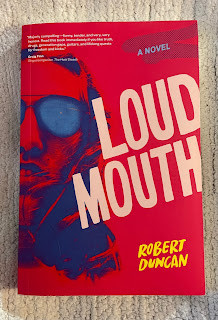
Loudmouth by Robert Duncan

Robert Duncan's Loudmouth was published in October of 2020, and I've had my copy for just over a year. Various things have delayed my reading, and thus this late review, for which I offer Rob an apology. You should know that I consider Rob a friend, more than just of the Facebook variety (although that's been our sole means of communication in recent years) and I'm confident that he returns the favor.

I got to know Rob near the tail end of the 1970s when we were both regulars at the Bells of Hell. We shared a love of rock music, and enjoyed the company of some of the other regulars, two of whom, legendary rock critic Lester Bangs and "The Village Legend" to whom Rob gives the pseudonym Eddie Neil, appear as important characters in Loudmouth. I was invited to Rob's birthday party, held in a Village apartment much spiffier than the Gum Joy Tower flat occupied by Thomas Ransom, protagonist of Loudmouth. When I got there, I saw a long black limo, its engine idling, parked in front. At the party a woman with black hair, wearing a black dress, broke into an upward mezzo soprano glissando. Someone standing next to me said, "That's Liza Minnelli." He then said he understood she and Rob had been in high school together. 

But enough about me; what did I think of the book? First, it's bracketed by rivers. The brief "Chapter 0" at the beginning has the title "Cuyahoga," that being the river that flows through Cleveland and is notorious for having once caught fire. It concerns a tour arranged by Tom Ransom for "Bruce," identified only as such but obviously The Boss, and guided by Charlie, a Cleveland native and friend of Tom's. Charlie shows them a series of dive bars, a record store, and the radio studio where Allen Freed held forth back in the day. At this point I can't resist another personal anecdote. One afternoon in 1970 I was in a law school friend's room when he tried to return a call from his brother, a writer for Cleveland After Dark. When there was no answer at home he called information for Cleveland (remember those days?) and got an operator who, asked for the number of Cleveland After Dark, said something like, "You've got to be kidding." Anyway, at the end of the tour, Charlie takes three 45 caliber bullets, gives one each to Bruce and Tom, then holding his says, "This is how we'll remember."

At the book's end comes "Chapter 00," even shorter than "0," with the title "Hudson." In it, Tom removes the bullet from his Rolodex, in which it's rested for some time. He worries that the gunpowder might be deteriorating in a way that will cause it to discharge spontaneously, with possible fatal consequences. He takes it to a nearby pier and throws it into the Hudson.

Why rivers? One of my teachers, probably my late, beloved twelfth grade English teacher Eleanor Blalock, asserted that rivers, in literature, always signify Life. Loudmouth is a "life," in the sense in which the British use that word where Americans use "biography." Consider W.H. Auden's "A Shilling Life Will Give You All the Facts." in which the poet observes that "all the facts" don't tell the reader what was really important to its subject. Loudmouth is biography. It is a fictional autobiography of Thomas Ransom. Unlike the book mentioned in Auden's "Shilling Life" it lays bare Tom's secret longings, failures, and disappointments, along with his accomplishments.

After I had gotten into Loudmouth, I began to wonder how much of it is fictional. I was led to compare Loudmouth's description of Tom Ransom's life with Rob's, as given in the brief "About the Author" squib at the back of the book. Southern mother; check. Writer for Creem magazine; check. Author of a book about Kiss; check. Singer and songwriter; check. And, as I've mentioned above, hanger out at the Bells; friend of Lester and of The Village Legend. So, is Loudmouth just disguised autobiography? Rob answered that question when he was interviewed by Deborah Kalb:
"Like most debut novels, there's a lot of non- in Loudmouth's fiction. But it's still not an autobiography or memoir. And if only a part of it is fact, all of it is the truth -- perhaps the deeper truth, arrived at by reimagining a life at slightly different times and places, in a slightly different order, with slightly different characters, blurring the physical reality to bring the metaphysical into slightly sharper focus."
I know that when I contemplated writing a novel, I started with my present situation, then tried to imagine how things might be if, at certain junctures, I had - taking a cue from Robert Frost - chosen a different path, or if I were to set off on a different one. Unlike Frost, I took what was, I'm sure, the path more travelled, seeking success in a conventional, bourgeois way. Still, there was that part of me that wanted to be a writer, as well as a corporate lawyer. This had a bad effect on my career in two ways. First, I got into a pattern of missing deadlines because I wanted my memos not only to be legally airtight but also stylistically worthy of consideration for a Pulitzer. Second, as I noted here, the amount of time I was spending in the "Village demimonde," meaning the Bells, and after it closed, the Lion's Head,  contributed to my work woes. The Head had a reputation as a writers' hangout. A woman once came in and said to those assembled at the bar, "I hear this is a place for writers with drinking problems." Village Voice scribe Ace Gillen replied, "No, it's for drinkers with writing problems."

My writing problem was that I never got started, except for a few short pieces in professional journals, at least until I started this blog. Loudmouth gave me a view of what life was like for a music writer in the 1970s. More than that, it gave me a sense of what my life might have been like had I decided to jettison my desire for conventional respectability and indulge that for artistic renown. It wouldn't necessarily have turned out badly; things didn't turn out badly for Rob.

Returning to Rob's interview, Ms. Kalb asked him, "What do you want readers to take away from the novel?" His answer:
"I hope that readers think it's funny, sad, surprising and maybe, in parts, lovely. I hope they enjoy the words, sentences, and paragraphs, the rhythms and music, as much as the characters and scenes. I hope they pick up on what's going on between the lines and among the lines, the wordplay, inside jokes, compulsive allusions to songs, bands and pop culture."

I found it funny, sad, surprising, and, yes, lovely.  I can't say I caught all the inside jokes and allusions, but did get enough to give myself a figurative pat on the back. Then there's this:

"Ultimately, I hope it gives the reader a fresh glimpse of the wonderous/disastrous complexity of life."

That it gave to this reader. I commend Loudmouth without reservation.

Wednesday, December 29, 2021

Rick Danko, Vince Martin, Erik Darling, and Blondie Chaplin: how many names can I drop in one post?

I had the good fortune, during my evenings of hanging out at the Lion's Head in Greenwich Village during the 1980s, to get to know Rick Danko. He had been a member of the Hawks, a Canadian group that became the backup band for Bob Dylan, and later evolved into The Band. Rick died in 1999 at the age of 56.

Rick was unpretentious and welcoming. When I went to hear him and his post-Band group at the Lone Star Cafe, I was invited to join him and the other musicians upstairs during their break. Rather than breaking from singing, Rick picked up an acoustic guitar and sang "Cindy, Oh Cindy", a song that had been popular in 1956, when I was in fifth grade. When Rick finished, I said, "That's a great old Vince Martin song." Vince had done it with the Tarriers, a group that included Erik Darling, whom I had met at a party on the Upper West Side about ten years before, but that's another story. When I mentioned Vince's name, the man next to me turned and said, "Hello; I'm Vince Martin." I told him I loved Tear Down the Walls, a folk album he'd done with Fred Neil. Vince invited me to sing a song from the album with him. Rick handed Vince his guitar and we sang "Dade County Jail", me struggling to try to match Fred's rich baritone.

The clip above has Rick singing and playing bass on "Stage Fright", one of my favorite Band songs. Here he does it with another now deceased musician I admire greatly, but never met, Paul Butterfield. Paul was a veteran of the Chicago blues scene. On this clip he plays harmonica and sings harmony.


This clip features another of my Lion's Head companions, Blondie Chaplin, from the time when he and Rick were playing together, along with Paul Butterfield. On "Semolina" Blondie has the lead vocal and guitar, with Rick and Butter harmonizing and playing bass and harp, respectively. Blondie, a South African, became a member of the Beach Boys in 1972 after Al Jardine and Carl Wilson spotted him performing in London with his band, the Flames. After the time I knew him at the Head, he toured with the Rolling Stones for several years, and more recently has toured with Brian Wilson. He also has a solo album, recorded in 1997, that he plans to have released soon.

Friday, September 10, 2021

Twenty Years

Here's the poem I posted fifteen years ago: 

It’s five years since the turbofan clatter, 
the sudden silence, the loud report, the screams,
the gashed tower, the smoke, then the flame, 
and the realization… 

I like to imagine a time when you, George and I 
take the heavenly PATH to celestial Hoboken, 
where, at the bar of the cosmic Brass Rail, 
we’ll sip ambrosial Berliner weisse.
This time, Brando will join us.

By way of explanation, George was a friend and Yale Law classmate of Charlie's, and a friend of mine. He died of heart failure a few years before 9/11. One afternoon Charlie, George, and I were having beers at the Lion's Head, and Charlie, a great film buff, said he wanted to go to Hoboken and look for the scenes where On The Waterfront was shot. We took the Port Authority Trans-Hudson ("PATH") subway that connects Manhattan to New Jersey. When we got there, we were able to find some places Charlie recognized as having been in the movie. We then found a great old fashioned bar on Washington Street, Hoboken's main drag. The bar was called the Brass Rail and had lots of brass fixtures and wood paneling. As we took our seats we noticed a man sitting near us sipping what looked like iced tea, and asked the bartender what it was. He said it was Berliner weisse mit schuss, Berlin white  (wheat) beer, flavored with a dollop of raspberry syrup, and garnished with a lemon slice. We each had one, and loved it.

I'm adding to my post to mention two others who weren't close friends but who also perished on 9/11. I enjoyed some conversation with Kristin Gould White at the Lion's Head. She was on Flight 93, which crashed in Pennsylvania. The story at the close of her linked tribute of how her daughter learned of her death is heart-rending. I met Joe Lostrangio at a reinsurance related event less than a week before 9/11, and we had a tentative lunch date for the week after. Having read his linked tribute, I wish I'd had the chance to get to know him better. For those of you who didn't know Charlie McCrann, here's his obituary.

Monday, January 18, 2021

Remembrances and appreciations, 2020

I gave 2020 the bum's rush in my last post, but promised to follow up with my annual post offering remembrances of those lost the previous year, along with appreciations of those who have helped or inspired me. Here it is.

The year 2020 saw a grievous loss to the Hamill family, to Brooklyn, to New York City, to literature and journalism, and to the alumni of the Lion's Head, including me, in the deaths, in unseemly quick succession, of the brothers Pete Hamill and the much younger John Hamill. Pete had been in poor health for some years, so his death was not unexpected, but still felt deeply. I first met Pete in 1995, when I went to a midtown Barnes & Noble to buy a copy of his autobiography A Drinking Life and have it signed. As I handed him the book, I told him I'd started drinking at the Lion's Head about a year after he'd quit drinking, and that I knew his brothers John and Denis Hamill. This got a necessarily short conversation going - there were others in line to get their books signed - and Pete wrote in mine, "For Claude, who keeps the flame alive." About nine years later, having had no further personal contact with Pete. I saw that he would be on a panel discussion at Brooklyn Borough Hall, and I went because whatever they were discussing interested me and because Pete would be there. When the discussion ended, I went up to Pete, sure that I would have to re-introduce myself. Before I could say anything Pete held out his hand and said, "Claude, how are you?" I saw him again twice before he died. The first was at a memorial gathering for the late Lion's Head bartender Paul Schiffman, during which we had a longer conversation than we'd had at Barnes & Noble; one that left me laughing appreciatively. The last was at a panel discussion at the Brooklyn Historical Society (now the Center for Brooklyn History) about the Brooklyn Dodgers, roughly ten years ago. After this, he had to be helped off stage and put into a wheelchair. This done, I went to him and mentioned my name. He seemed to remember, and we simply exchanged best wishes. 

I got to know John when he became a bartender at the Lion's Head. Mixology was just one of John's many talents. As his obituary notes, he was a reporter for the New York Daily News, as was brother Pete, who later became its editor. Brother Denis is a Daily News columnist. Like Denis, John was also a screenwriter, co-authoring two Hollywood screenplays. Despite his having opposed the war in Vietnam, John served there as a combat medic, was awarded a Purple Heart and a Bronze Star, and is credited with having saved the lives of at least two fellow soldiers.

John and I quickly became friends when he started his Lion's Head gig. We shared two loves: the Mets and Irish music. We also had similar views on social, political, and economic issues. (At the time I was probably more "conservative," which is to say "liberal" in the classical sense, on the economic stuff.) We lost touch for a while after John moved to California, but re-connected through Facebook, where we became avid readers of, and commenters on, each other's posts. Our last Facebook exchange was a few days before his death from COVID-19, which must have come quite quickly. Before I started writing this, I looked at his Facebook page, which is still lively with reminiscences by family and friends. It was there that I found the image that I put at the head of this post, the Irish toast, "May we be alive at this time next year." It was posted there by his friend Chris Tracy.

Along with the one-two punch of the deaths of the Hamill brothers, there was another death that hit me hard, that of Judy Dyble. Like that of Pete Hamill, hers was not entirely unexpected. In my Remembrances and appreciations, 2018 and '19 I told of how I had fallen in love with her voice in 1970, when I acquired the first Fairport Convention album, how we had met, if only electronically, in 2008, and how this blossomed into a trans-Atlantic Facebook friendship that led to my learning of her lung cancer diagnosis in 2019. We stayed in touch through the first half of 2020, with her delighting me with news of the British music scene, photos of her rescued greyhound Jessie, and zany recipes that usually culminated in a kitchen-destroying explosion. There were few mentions of medical problems; nothing that seemed immediately dire. In early July she posted that Jessie had gone for a visit to her daughter's; this should have been a warning. After a few days silence came the announcement of her death.Above is a video of Judy, with Songs from the Blue House, doing Joni Mitchell's "I Don't Know Where I Stand." This is the song she sang on Fairport's first album that made me fall in love with her voice. Many years later, that voice was still lovely.

In earlier posts I've noted, ruefully, that with advancing age each year brings increasing numbers of losses of family and friends, as well as of people I've admired in various realms, such as art, literature, music, theater, politics, and sports. 2020 unsurprisingly proved no exception to this sad rule. Certainly the most consequential loss was that of Supreme Court Justice Ruth Bader Ginsburg. I consider the loss of singer and songwriter John Prine, for the beauty, incisiveness, and influence of his writing and singing, very significant. Others from the music world I mourn are Bob Shane, the last surviving founding member of the Kingston Trio; Bonnie Pointer of the Pointer Sisters; Rush drummer Neil Peart; Fleetwood Mac guitarist Peter Green; and bluegrass guitar ace Tony Rice. From showbiz, Sir Sean Connery left us shaken, if not stirred; Alex Trebek, game to the end, gave his final answer; and Terry Jones has made his last foray into medieval history. Baseball lost three great pitchers: Whitey Ford, the Yankees' "Chairman of the Board"; Cardinals' fireballer Bob Gibson; and Tom Seaver, "Tom Terrific" or "The Franchise" to long time Mets fans. Oh, yes; the Mets had a lousy season, but more about them in the "appreciations" below. Ailurophiles and existentialists mourned to loss of Henri, le Chat Noir.

In addition to the loss of the two Hamill brothers, the ranks of former Lion's Head regulars continued to be thinned. Those we mourn include jazz critic and "combative cultural gadfly" Stanley Crouch; Pulitzer winning journalist Jim Dwyer, poet Derek Mahon, and raconteurs par excellence Arthur Friedlander and Jerry Schindlinger. I'm sure to have missed a few; my apologies. My thanks to Dermot McEvoy for keeping us informed.

2020 was an unusually violent year. New York City suffered a large increase in homicides, though other serious crimes declined. The deaths of Breonna Taylor and George Floyd led to protests nationwide.

It was a very trying year for friend and fellow Robinson High alum Cheryle Cerezo-Gardiner, who had to witness the ravages of cancer on her oldest son, Martin Jacinto Cerezo, who finally succumbed in January. 

On, now, to the positive side of this long screed. In my remembrances and appreciations for 2019 and 2018 I paid my respects to two women whose courage I had found inspiring: Jennifer Garam and Lauren Jonik. Both are still well and flourishing. As a cancer survivor, Jennifer recently had a check-up to assure the cancer was not recurring. Everything proved OK. I'm sorry to know that, with the onset of the pandemic, she decided to leave Brooklyn. I regret no longer having her as a neighbor, though even before COVID our face-to-face, as opposed to on line, encounters were rare. Perennial optimist that I am, I don't share her outlook for the city's future, though I realize some things will never be the same. In any event, I respect her reasons for leaving.

Lauren, who lives with the ongoing effects of Lyme disease and who survived sexual assault, is continuing her work toward a master's in media management at The New School, and with her writing and photography. 

About those Mets: When Steve Cohen was announced as the new principal owner, I had some trepidation. I worried that, as a successful finance guy, he would assume he knew all he needed to know to get top performance from a baseball team, and would staff the baseball operations with sycophants. I was encouraged when he said he would make my fellow Harvard Law alum Sandy Alderson (we didn't overlap; I was class of 1970, he was of '76, but I got to meet him at an alumni gathering when he was the Mets' General Manager) as the team's President. During his tenure as GM (2010-18), which was cut short by a bout with cancer, many players who are mainstays of the current roster were acquired, and the Mets went to their fourth World Series (2015). I know little about Alderson's choice for GM, Jared Porter, but his record seems encouraging. I can't quibble with retaining Luis Rojas as manager; the Mets recent woes seem not to stem from inept field generalship but rather from uninspired, and sometimes inept, play. The trade that brought Francisco Lindor to the Mets has scribes wondering if this could make them at least divisional title contenders next season. As a long suffering Mets fan who once remarked on the team's "ability to rouse hopes, then smash them like cheap china," I'm leery of being too optimistic. Still, it's new ownership and management, and reason for hope. Update: Hardly had I written this than the news came out that Porter has been fired as GM after confessing to sending an "explicit" photo to a woman reporter several years ago. Trust the Mets to come up with some last minute drama.

There are many others I could praise for the encouragement they have given me along the way, including, as always, my wife, Martha Foley and my daughter, Cordelia Scales. (For those familiar with her as Elizabeth or Liz, she has decided to be known by her middle name. I think it's a fine name - ask Shakespeare - and I approve.)

Tuesday, December 29, 2020

2020, here's your hat. What's your hurry?

On New Year's day 1980, as I recall, someone observed, "Here's to the passing of a real kidney stone of a decade." The seventies had their ups and downs for me, but on balance more up than down. They began with my finishing law school and getting a job in New York. After a year I had to leave temporarily to do two years' Army Reserve active duty. When I returned, I settled into a Greenwich Village that was still an affordable neighborhood for artistic and journalistic sorts, and had bars like the Bells of Hell and the Lion's Head where I could enjoy their company. I had a brief marriage that didn't end traumatically; Joanna and I remained friends until her untimely death in 1993.

I found that the temptations of the Village demimonde didn't mix well with being an associate at what was becoming a high powered corporate law firm, so I left and took an in-house job with a corporate client. When I found even that more than I wanted to handle at the time, I decided to go back to school. My work in regulatory law had sparked an interest in economics, and New York University offered an MBA program with an econ major. With the GI Bill, indulgent parents, and the availability of part-time work, I was able to enjoy a slightly before mid life sabbatical from the demands of full time law practice. I ended the seventies as I had begun them, as a student. They also saw my brief moment of glory as a movie actor, thanks to my friend Charlie McCrann, who would later die in the World Trade Center. There's more about my late seventies adventures here.

Like the seventies, 2020 started for me on a comfortable note. I was still working; my profligacy in my younger days had assured that retirement would be a distant goal. Martha, my wife of over 28 years, was working on interesting projects for clients concerning their archives and genealogy. When COVID-19 hit, I was able to transition to working at home. Martha had already been doing most of her work on her computer here, with occasional visits to her clients to examine archival material. The COVID restrictions had no impact on our ability to continue our gainful employment. 

It did affect our social life, though not in a completely devastating way. About a month after the restrictions were imposed, our favorite place to sit at the bar, have a light supper with cocktails or wine, and socialize with friends or with strangers we met there, along with the bartenders and floor staff, and with Tim, the genial owner who would sometimes join us at the bar, Jack the Horse Tavern (Tim named it for a lake in his native Minnesota), closed permanently. Other places around us managed to keep going, and in good weather we could meet friends for drinks and snacks at outdoor tables, dine on take out, or dine indoors while it was allowed, with strict occupancy limits and spacing. Now that indoor restaurant dining is banned and winter weather is putting a severe crimp on outdoor dining, despite the gas heaters and overhead canopies many restaurants have provided, we fear for the survival of our other neighborhood haunts.

We live in a large building, and have several close friends in the building with whom we've been able to socialize in very small gatherings. We've had Zoom sessions with our more far flung friends and relatives. Our daughter, Liz, and her boyfriend came up from Philadelphia for two days during the week before Thanksgiving. We shared our Thanksgiving meal with one friend, and had Christmas dinner by ourselves.

As I noted here previously, the COVID restrictions imposed in March initially made us give up in person church services. These were replaced by Zoom and live streamed ones. When the infection numbers declined, unfortunately after Easter, we went back to in person services, but with attendance limited - reservations required - and strict social distancing. When infection rates went up, just before the Christmas season, we were required to go back to Zoom and live streaming.

The "New Normal" has, for Martha and me, so far been tolerable, though its long term effects may be less so. We support the requirements intended to limit the spread of the pandemic, such as mask wearing and social distancing. I know that COVID-19 has been disastrous for many other less fortunate people, often fatally. It has also intensified, or at least made more evident, a rift in our social and political fabric. I hope to do whatever I can, in my small way, to mend that rift. I know that those on my side of the rift - one of the few things I celebrate about 2020 is the outcome of the presidential election - have no monopoly on virtue. 

It's been my custom, sometime in January, to look back on the previous year and note those among my friends, relatives, and heroes who have died, along with those who have been helpful to my writing venture or inspirational in a broader sense. I will continue that custom this coming month. As for now, goodbye 2020. Don't let the door hit your backside on the way out. 

Saturday, May 23, 2020

Robert Ward's The Stone Carrier; 1970s New York, Uptown and Downtown

Robert Ward's The Stone Carrier is a book that will grab you and not let you go. I read it because the author and I hung out at the same Greenwich Village bars during the late 1970s, and reviews promised that the novel captured the zeitgeist of New York City at that time. I can vouch for its accuracy about the downtown scene, which was my milieu. (One small quibble: I never knew the Bells of Hell to smell of "moldy bread and dog piss." I took my parents there once. If it had, my mother would have taken one step in, wrinkled her nose, and demanded that we leave.) Two beloved Lion's Head staffers, bartender Tommy and waitress Sha, get fond remembrances; Sha even plays a small part in the action, and there is plenty of that.

Much of that action, including a climactic scene that unfolds over the novel's last few chapters, happens at Elaine's, a bar and restaurant on Second Avenue near 88th Street, that was the favored hangout of New York's glitterati. I never entered Elaine's, though when I arrived late for a party given by my former roommate and his wife, who lived near there, I said I had been walking past Elaine's, looked in, saw Oscar de la Renta and Francoise de Langlade (then New York's top power couple) beckoning to me, and had to join them for a drink. My friends believed me, or more likely pretended to.

Terry Brennan, the central character in The Stone Carrier, is known at Elaine's, and at Studio 54, the disco that drew many of the Elaine's crowd and where more of the novel's action happens. His admission ticket to these places was an article he wrote for Rolling Stone about Thaddeus Bryant, whose first novel, The Debt, was a great success and is being made into a movie. In evident gratitude, Thaddeus introduces Terry to Elaine's and to some of the celebrities he's met there, including Norman Mailer. Terry tells Mailer it was reading his work that inspired him to become a writer. Mailer says, "if that's the truth, then you better be good. 'Cause I don't want to inspire any hacks."

The Stone Carrier (the cryptic title is explained in chapter 32) begins, not at Elaine's, but with a double murder in Central Park at two a.m. The victims are Joey Gardello and his brother Ray. Joey is a boyhood friend of Thaddeus and struggling to make it as a filmmaker. Like he has for Terry, Thaddeus brings Joey into the charmed circle of Elaine's. The murder sets in motion a series of events that lead to Terry's being pursued by both the NYPD and by henchmen of Nicky Baines, a thinly disguised version of Nicky Barnes, the drug kingpin of Harlem. While the plot elicits many surprises, it never strains the reader's - or at least this reader's - willingness to believe. My reaction to plot developments was often "Wow!" but never "WTF?"

Like many, if not most, stories set in New York City, the central theme of The Stone Carrier is ambition; of how small missteps, like allowing a friend to deal coke from your apartment, can threaten it; but mostly about how it can keep you from questioning things that seem to be too good to be true, because they may be.

It's a terrific read.