Wednesday, March 13, 2013

Morning walk over the Brooklyn Bridge, with iPod log.


My Saturday morning walk took a different route than usual: the weather was good and I had some time, so I decided to go over the Brooklyn Bridge. Along with photos, I'm going to include a log of what was playing on my iPod as I walked, with links to video or audio where possible. There were still patches of snow on the Promenade, and not too many people were out enjoying the weather.

Victoria Spivey and Lonnie Johnson, "Idle Hours": a classic woman/man blues duet from long ago. There's no video or audio available, but here's a recording of "There's No Use of Lovin'" from 1926, with a still photo of Ms. Spivey.

Sue Foley, "Careless Love": the iPod stays in a blues mood, but comes to the present time with this Canadian singer's rendition of "a traditional song of obscure origins" (Wikipedia) that has been sung by such diverse artists as Bessie Smith, Johnny Cash, Elvis Presley, and Siouxsie Sioux. Hear it here.

I've long been fond of this bit of art deco ornamentation on the Cranlyn apartment building at Cranberry and Henry streets.

East Village Opera Company,: Au Fond du Temple Saint redux: EVOC do opera arias to rock arrangements and instrumentation, which mightily offends some opera traditionalists. I love EVOC. This is their nail-you-to-the-wall rendition of an aria from Bizet's Les pêcheurs de perles. Hear it here.

Buds in a garden next to the Whitman Close townhouses show early promise of spring.

Billie Holiday, "You Don't Know What Love Is": from the Lady in Satin album. Audio, with still photo.

Patti Smith Group, "Till Victory": the opening cut on her Easter album. Audio, with photo montage.

  While the Promenade had not attracted a crowd, lots of people were walking on the Brooklyn Bridge.

Schubert, String Quartet in D Minor, "Death and the Maiden," D810, Scherzo, allegro molto; Amadeus String Quartet: Here's a video of the Borromeo Quartet performing the same movement.

John Fogerty, "Rock and Roll Girls": from the Centerfield album, which I play a lot at this time of year. Live performance video here.

  Looking down from the east tower of Brooklyn Bridge at Pier 1, Brooklyn Bridge Park, and beyond. Compare with these shots from four years ago.

Martha Reeves & the Vandellas, "Heat Wave": '60s Motown at its sizzling best. Lip-synch video here.

   Looking from the other side of the tower towards the DUMBO shoreline and Manhattan Bridge, with Jane's Carousel at lower left.

Fairport Convention, "Restless": I was hooked by the opening line of this song, "Born between a river and a railroad...", which is sort of true of me. There's no video or audio available, but you can hear a sample of "Rising for the Moon," the title track of the album, and another of my favorites.

  Tourists jammed the middle of the bridge.

Sarah Borges and the Broken Singles, "Ride With Me": I first heard this thanks to fellow Brooklynite Eliot Wagner of Now I've Heard Everything. There's a live performance video here, albeit with lots of chatter at the beginning and sub-par sound quality. Still, I think it's worth watching.

  The Brooklyn Bridge's west tower was completed in 1875. Construction of the Bridge began in 1870; it was not completed until 1883.

Nitty Gritty Dirt Band: "Lost Highway": my version of this Hank Williams cover is from the Dirt Band's magnificent Will the Circle be Unbroken, with contributions by a stellar group of country musicians. Listen here.

An artist sells his works under the west tower.

Tampa Red, "Denver Blues": scarifyingly good slide work by "The Guitar Wizard." Here's a YouTube clip with audio accompanied by an NSFW still photo.

  Frank Gehry's 80 Spruce Street shows off its Bernini drapery; in the background is One World Trade Center (Daniel Liebeskind; David Childs of Skidmore, Owings & Merrill), approaching its ultimate height of 1,776 feet.

Johnny Cash, "I Still Miss Someone": live performance video here.

 The Brooklyn Bridge cactus looked pathetic after a bout with winter weather, but this is a most resilient succulent. After my customary namaste, I turned and headed toward home.

Flying Burrito Brothers, "Close Up the Honky Tonks": the iPod stays country with Chris Hillman's and Gram Parsons' post Byrds group. This YouTube clip, (audio with still photo) was made three years after Gram's fatal night in the Mojave, but it's still good.

Clancy Brothers and Tommy Makem, "Peggy Gordon": I learned this song from Turner & Kirwan of Wexford. Hear the Clancys--Liam on lead vocal--on this audio clip.

 This yellow metal plate marks the center of the Bridge. I always jump over it.

Neil Young, "Cortez the Killer": "Very bad man." Live performance video here.

Aretha Franklin, "I Never Loved a Man (the Way I Love You)": my favorite of her many superb songs. Here's audio with album cover.

  This could be your home for a mere $18 million.

The Chieftains, "O'Keefe's Slide/An Suisín Bán/The Star Above the Garter/The Weavers." Lively Irish dance tunes. Listen here.

Vampire Weekend, "A-Punk": My commentary and VW's video here.

  More harbingers of spring in Cadman Plaza Park.

The Hillmen, "Come All You Fair and Tender Ladies": Chris Hillman's pre-Byrds bluegrass group does a traditional Appalachian ballad, probably with Irish or Scottish roots. There's a lovely version by the Rankin Family; listen here.

Vince Martin and Fred Neil, "Weary Blues": I fell in love with Vince's and Fred's album Tear Down the Walls in 1967 when my college roommate played it for me. Fred's deep voice takes the lead on this track. I met Vince sometime around 1980 in the upstairs room at the old Lone Star Cafe on Fifth Avenue, when Rick Danko played "Cindy Oh Cindy". I said, "That's a great old Vince Martin song," and Vince, who was sitting next to me, introduced himself. We then sang a duet on "Dade County Jail," another song from that album, with me trying to sound like Fred. Hear "Weary Blues" here.

Trees, Cadman Plaza Park.

Jefferson Airplane, "Martha": from the splendiferous After Bathing at Baxter's. YouTube audio clip here with still of album cover. I don't love this song just because it's my wife's name. Honest.

Rolling Stones, "Happy": from Exile on Main Street, contenduh for Best Rock Album of All Time. Live performance video.

Football players were on the Cadman Plaza athletic field, where snow still streaked the artificial turf.

Tinsley Ellis, "Double Eyed Whammy": a white guy from Florida; who'd a thunk it? Live performance video.

Fairport Convention, "Fiddlestix": I first heard this in concert at Carnegie Hall in 1974 with Dave Swarbrick bringing down the house on solo fiddle. On this live video Dave, in white, does a fiddle duet with Ric Sanders, who joined the group in 1985.
Top of the Franklin Trust Company Building (George W. Morse, 1891), a "wonderful Romanesque Revival office building" (Francis Morrone in An Architectural Guidebook to Brooklyn), now expensive condos, at 164 Montague Street, corner of Montague and Clinton streets.

Kitty Wells,  "Making Believe": we lost this country legend just last year. Video (probably from Grand Ole Opry) here.

James Brown, "Hold My Baby's Hand": an early hit for the Ambassador of Soul. Juke box video here.

St. Ann & the Holy Trinity Church (Minard Lefever, 1847), across Montague from the Franklin Trust Building.

Handel, Music for the Royal Fireworks, HWV 351, La Rejouissance, Orpheus Chamber Orchestra: Handel heralds arrival home. Here's a YouTube audio clip with mountain scenery, orchestra unspecified.

Friday, March 08, 2013

Marshall Chapman, "Why Can't I Be Like Other Girls?"

Marshall Chapman is an old friend, and I've long waited for a video of this, which I think of as her signature song. Now, thanks to slussej's channel, I do.

We're in the waning hours of International Women's Day, but I think this song is appropriate for it.

Monday, March 04, 2013

Dashing Dan Lives!

A new job has me reverse commuting from Brooklyn to Hempstead, in Nassau County, which entails my taking the subway two stops to Atlantic Terminal and there boarding a Long Island Railroad train that after about an hour deposits me a five minute walk from my office. Not bad, as I'm going against the tide and therefore always have an uncrowded train and can get some reading done.

Approaching Jamaica Station in Queens, a major junction where outbound trains from Atlantic Terminal, Penn Station in Manhattan, and Long Island City in Queens converge and where trains on some of the LIRR's lines east into Long Island originate, I noticed this diesel powered switch loco (photo above) sitting in the yard just to the east of the station. What first caught my eye is that this engine is painted in a "heritage" color scheme: black with white lettering and orange accents, instead of the contemporary blue and white, or silver (see photo below):
What really caught my eye was the logo that appears below and to the left of the cab of Engine 104 in the photo at the top.  Here's an image of the logo, taken from trainsarefun.com:
The image above differs from that on Engine 104 in that the background is white, not yellow, and the base under the circle is blue, not red. This is the color scheme that was used on passenger cars; the yellow background version was used on locomotives with the black with orange accents color scheme, like 104. This is "Dashing Dan," the image created in 1957 to personify the LIRR's slogan, "The Route of the Dashing Commuter." You  can tell  Dan is from before the presidency of John F. Kennedy by his fedora. JFK, who was justly proud of his head of hair, seldom wore hats, and thereby ended their status as an essential accessory to business attire.

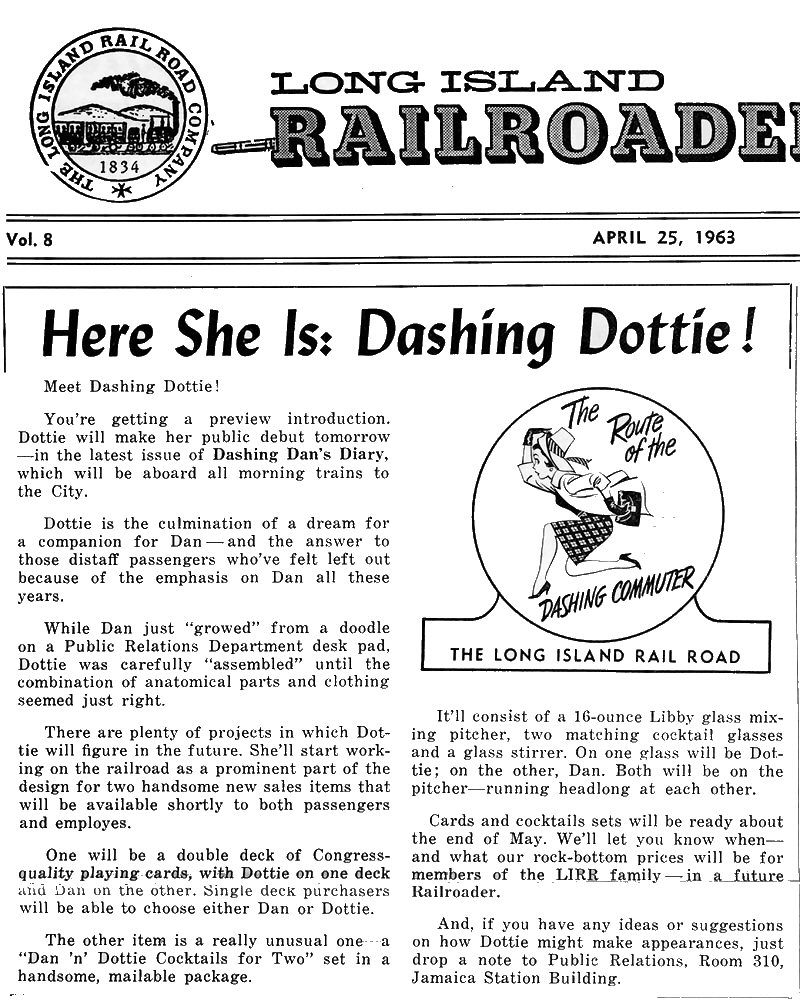
Several years after Dan's debut, someone in the LIRR public relations department noticed that women as  well as men were commuting on the railroad. In 1963, coincidentally the year The Feminine Mystique was published, "Dashing Dottie" appeared.
According to this LIRR employee newsletter (linked in trainsarefun.com):
While Dan just "growed" from a doodle on a Public Relations Department desk pad, Dottie was carefully "assembled" until the combination of anatomical parts and clothing seemed just right.
I'll give Dottie extra athletic and style points for dashing in heels. Unfortunately, she never appeared on any rolling stock, but she was used on printed materials and promotional merchandise, such as  "Dan 'n' Dottie Cocktails for Two," a set with a pitcher, stirrer, and two glasses, one decorated with Dan and the other with Dottie.

Sunday, February 24, 2013

It's February 24, and the Mets have already won one game.

Is this a portent? Hardly; though it's encouraging to see that Zack Wheeler had a good two innings. There's video here. As of this writing (1:56 p.m.) a split squad of the Mets leads the Champions of the West (University of Michigan Wolverines) 3-2 in the top of the fifth, and the other squad leads the Astros 3-1 in the top of the third. I'm trying to contain my enthusiasm.

Update: they're still undefeated, tying the 'Stros 7-7 (after carrying a 7-6 lead into the bottom of the ninth) while the split squad beat the intrepid Wolverines 5-2.

Update-update: the bloom is off the rose. The Mets fall to the Nats in their second encounter in three days, 6-4, as their pitching gets shelled for 17 hits. Meanwhile, the Orioles remain undefeated by trouncing the Yanks 5-1, which makes Peter Wheelwright a happy man.  

Thursday, February 21, 2013

Restoration Rap

I've just finished reading John M. Barry's Roger Williams and the Creation of the American Soul (about which I'll be posting more in the near future), in which I learned that Williams managed the neat trick of finding favor with both the grim Puritan Lord Protector Oliver Cromwell and his successor, the restored Stuart monarch Charles II who, as this Horrible Histories video shows, got Old Blighty back into the party groove.

Tuesday, February 19, 2013

Elvis was Jewish. That's the emmes.

My old Lion's Head drinking buddy Michael Simmons, often a helpful source of ideas for blog posts, sent me a message with the caption "The King of the Jews."  In it, he asked, "Was Elvis a landsmann?" (roughly, the Yiddish equivalent of "homeboy") and gave a link to an article in Tablet magazine, the server of which is now down, perhaps thanks to the folks in Unit 61398. Anyway, according to the article, Elvis was halakhically (i.e. according to Jewish law) a Jew by virtue of being descended from a Jewish great-great grandmother, Nancy Burdine, exclusively through the female line. The article also claims that Elvis' mother, Gladys Love Presley, was aware and proud of her Jewish heritage. As a consequence, Elvis had a Star of David carved onto her gravestone.
By the way, emmes is the Yiddish word for truth. I learned this from my friend Gersh Kuntzman.

Addendum: Blogger Debbie Schlussel posted about Elvis' Jewishness three years ago, assertng that:
He even did what people stereotypically claim Jews do:  Elvis got a nose job (for the record, no-one in my family has had this procedure).
She also quotes from a Jewish Weekly article that traces his descent from his great grandmother, the daughter of Nancy Burdine and Abner Tacket, "the Jewess Martha Tacket." This made me recall an anecdote I read years ago about the late Democratic honcho and prominent lawyer Robert Strauss. When he was a student at the University of Texas, a fellow student remarked about a photo of Strauss' fiancée, "What a pretty Jewess." Strauss replied, "You sumbitch, she's a pretty girl"

Monday, February 18, 2013

Sunday, February 17, 2013

Dave Coles on the Lion's Head, and the Greenwich Village of yesterday.


The video above was first included in this post about a reunion of Lion's Head veterans at the Cornelia Street Cafe last April. The event featured composer, multi-instrumentalist, and all around fine fellow David Amram and a first rate crew of sidemen, along with some excellent guest musicians, as well as Dave Coles, shown in the video reading a passage from his memoir in progress, accompanied by Amram on piano. The story Dave read was of his time as a bartender at the Bells of Hell, which attracted off duty Lion's Head bartenders, just as the Head attracted Bells bartenders like Dave in their off hours. In it, Dave describes how Amram, also a Head regular, would come into the Bells, greeting everyone at and behind the bar, then go into the back room and join whatever musical group was playing that night, deftly putting his French horn into whatever groove it would fit.

Dave is continuing work on his memoir, and recently sent his first chapter to Dermot McEvoy, who then shared it with all of us on his extensive Lion's Head alum mailing list. Here's Dave's description of what it was like to be in the Head on a busy night back in the late 1970s:
These are the grandest nights. Voices of all manner fill the air, from the lofty public school lilts ringing from a crowd of Murdoch's Fleet Street castaways to the nugget-hard demz and doz of a Brooklyn firefighter. On my left, laughter swells over a wagging Irish tongue; from the right a quick, clipped Gallic summing-up coming from beyond the backs of people standing at the bar, "Exeestentshalism ees zee prophylactic of zee mind fuck." The place is jammed and full of sound, conversations rise and fade as I pass, catching a word here, a phrase there, snatches of meaning filling first one ear and then the other--orderly at first, then a jumble: city politics; sixties poetry; left-handed pitchers; tin-eared publishers; music and Marxism; boxing and Boccaccio; women and horse tracks and the price of a pint in Dublin.
This passage corresponds closely to my memory of the Head on a crowded evening; indeed, mine is likely to have been part of the babble of voices Dave heard. Unfortunately, the seeds of this scene's destruction had already sprouted then. The Head survived until 1996, but its last couple of decades were borrowed time. Pete Hamill wrote this in his eulogy for the Head in the New York Times:
The young didn't drink in the same sustained, defiant way, nor did they care much for dark smoky joints full of talk. By the late 1970's newspaper people were finally being paid what they deserved. But nobody ever left the Head at 3 A.M. to drive to the middle-class hamlets of New Jersey. The times had changed; so had we.
Journalists may have been leaving the Village digs a short stagger from the Head, but new folks were moving in. It pains me to confess, but I was part of what caused the death of Bohemia in the Village. I wasn't an aspiring artist or writer (well, I did have occasional fantasies about someday writing a novel) but a well paid law firm associate. People like me, who were seeking authenticity, were able to pay rents that put Village apartments out of the reach of the kind of people who had made the Village what it was, thereby eroding the very qualities that drew us there. The Village was becoming a combination tourist attraction and bedroom community for yuppies.

The artists and writers moved north to Chelsea and Clinton (the renamed Hell's Kitchen), south to Soho, and east to the East Village, a name bestowed by real estate agents on what had been the northern part of the Lower East Side. But the arrival of artists and writers, and the galleries, bookstores, bars, and restaurants that followed them, made these places attractive to the same sort of young professionals and executives who had pushed them out of the Village. So the Bohemians fled across the East River to Williamsburg, DUMBO ("Down Under the Manhattan Bridge Overpass"), and Red Hook in Brooklyn.

The process continued as these neighborhoods gentrified, so the artistic migration continued, to further Brooklyn locations like Greenpoint, Bushwick, and Sunset Park. Some artists left the City entirely, discovering in the decaying industrial towns along the Hudson Valley such as Beacon, New York a supply of affordable loft and studio space in nineteenth century factory buildings.

Dave describes waking around today's Village:
Ancient square-shouldered saloons, neighborhood bars that once roiled with merchant seamen and off-duty cops, with writers and tug boat captains and painters and cab drivers, with know-it-all all-day talkers, old deep-shadowed joints where people drank and sang and fell in love--sometimes into fist fights--have become wine bars with cell-phone chatting young women and their wired young men lounging at sidewalk tables; casual daylight cafes have sprung from weathered storefronts that once housed afterhours clubs and diners, corner newsstands and record shops.
Walking east toward Sixth, I find only interlopers: sushi bars and designer hair salons; sterile boutique windows lit by laser-tight pins of light; card shops touting ribbons and balloons, any kind of trifle; coffee chains and sandwich franchises, the commerce and character of Village streets having become nearly indistinguishable from any in Cleveland or Wilmington or Naperville. 
So, will the tourists from Cleveland continue to come to the Village if what they find is...Cleveland? There are some remnants of the old Village left, but you have to know where to look.

Quoted excerpts from Dave's manuscript are copyright David Coles 2011.

Sunday, February 10, 2013

Your correspondent does a stupid human trick.

Friday morning we were under a blizzard warning, so I chose to wear my L.L. Bean boots to work. Rushing to get underway, I saw a pair of the boots in the hall, and pulled them on, thinking that my wife, who had left a few minutes before, had left them there for me to find easily. I noticed that they seemed a bit snug, but didn't pay it much mind. As I walked to the subway, I felt the boots squeezing my toes, and wondered if my feet had grown since the last time I wore them. On the way home, they felt excruciatingly tight. "Damn!" I thought, "I'll have to spring for a new pair."

I got to our door, slipped the wet boots off in the hall, and felt welcome relief. I padded inside in my stocking feet, reached for my slippers under the bed, and, whoa!, there were my Bean boots where I usually keep them. I'd just spent an entire day wearing my wife's boots. She had decided that morning to wear her tall Hunter boots, and left the Bean boots outside the closet in her hurry. Somehow, I managed not to notice the lighter tan leather uppers on hers (see photo above). I trust I won't make that mistake again.

Sunday, February 03, 2013

Grand Central at 100

Grand Central Terminal (Reed and Stem/Warren and Wetmore, 1913) had its 100th anniversary this past Friday, February 1. The Metropolitan Transportation Authority (MTA), which leases (the owner is an investment group called TDR Midtown Ventures LLC) and operates Grand Central, held a celebration with speakers, entertainers, and exhibits. This was the scene in the main concourse, looking east, just before noon (see the clock atop the information booth, at lower right) on Friday.

Another view inside the main concourse. The passageway beneath the flag leads to Vanderbilt Hall (next photo) and beyond that to the Terminal's main entrance on 42nd Street. The concourse was more crowded than usual at noontime because of the anniversary events.

Vanderbilt Hall, named in honor of the family that founded the New York Central Railroad, Grand Central's builder and former owner, was once the main waiting room, with rows of long wooden benches to accommodate passengers waiting to board intercity trains of the New York Central or the New York, New Haven and Hartford, which shared use of the Terminal. After Amtrak took over all long distance passenger service, its trains continued to use Grand Central as well as Penn Station, Manhattan's other major passenger  train station. However, some years ago Amtrak consolidated all its New York City service at Penn Station, making Grand Central solely a terminal for the commuter trains of the MTA's Metro North Railroad. It is now the nation's busiest commuter station, and is about to become more so when a connection to the Long Island Railroad is completed. Commuters typically rush to and from their trains, so the need for a waiting room ended. Vanderbilt Hall is now used for commercial exhibits, a holiday festival market, and, in honor of Grand Central's centenary, was filled with exhibits concerning the Terminal's design and history.

High tech help was available for the curious.

Before Grand Central Terminal was built, steam powered trains came to Grand Central Station, which previously occupied the site, through an open cut that extended the length of what is now Park Avenue. Electrification meant that trains could go underground for long distances; covering the tracks meant that Park Avenue could be developed as an elegant residential and office boulevard. This greatly increased the value of the land around Grand Central, as well as that occupied by the Terminal itself.

During the 1950s and 60s, there were proposals to demolish or alter Grand Central in order to build a much taller office building on its site. This is the fate that befell Penn Station in 1964; its loss started a movement to preserve historic structures in New York City and the establishment of the City's Landmarks Preservation Commission. Grand Central was designated a landmark by the LPC in 1967. Shortly after that, Penn Central, the railroad resulting from the merger of previous archrivals New York Central and Pennsylvania, disclosed a plan to build a gigantic office tower above Grand Central. While this plan would have preserved the Terminal's interior, it would have destroyed the sculptures, the clock, and other beaux arts decorative elements on the exterior. Because of the landmark designation, Penn Central had to submit the plans to the LPC for approval. People who wanted to preserve Grand Central, prominent among them Jacqueline Kennedy Onassis, opposed the proposal. The LPC twice denied it. Penn Central appealed to the courts, and the case eventually went to the U.S. Supreme Court, which held that the landmark designation and the LPC's decision did not amount to a "taking" of Penn Central's property without compensation, in violation of the Constitution. This proved to be a "landmark" decision in both the sense in which lawyers use that term and in the sense in which historic preservationists use it.

Thursday, January 31, 2013

It's Franz Schubert's birthday.

Someone with a particularly refined aesthetic sensibility once claimed that "music ended with Schubert." Franz Schubert (1797-1838) is reckoned an early romantic, but to me his music seems to partake more of the classical elegance that characterized Mozart (like him, Schubert died in his 30s) than of the romantic sturm und drang of Beethoven and his successors. I love both Schubert's classicism and Beethoven's romanticism.

The video above is of the fourth movement of one of my favorite Schubert compositions, the "Trout Quintet," performed by Julian Rachlin, Mischa Maisky, Mihaela Ursuleasa, Nobuko Imai, and Stacey Watton 

Now, for something very different, here's Johanna Beisteiner playing his "Serenade" on guitar.

No collection of Schubert's music would be complete without a sample of his lieder (songs). Here's one, Am Fenster, by two late and great musicians, the German baritone Dietrich Fischer-Dieskau and the Russian pianist Sviatoslav Richter.

Monday, January 21, 2013

The Helmsley Building

The Helmsley Building (Warren & Wetmore, 1929), formerly the New York Central Building and headquarters of the great railroad nicknamed the "Water Level Route", stands  astride Park Avenue, which passes through the portals on both sides of the building. The NYC's passenger tracks, which extended to Chicago, began and terminated at Grand Central Terminal, just to the south and past the more recently built Met Life Building (Emery Roth & Sons, Pietro Belluschi, and Walter Gropius, 1963), formerly the Pan Am Building--so did two late, great transportation companies surrender their claims to the skyline.

The Helmsley Building is now being lit in festive colors--this evening it was in patriotic ones, in honor of the inauguration--by an energy efficient lighting system.

Sunday, January 20, 2013

Stan Musial and Earl Weaver

Stan Musial, who died yesterday at 92, wasn't a larger than life character like Babe Ruth, Ted Williams, or Mickey Mantle, or a dominant personality like his St. Louis Cardinals teammate Bob Gibson. He was, like Harmon Killebrew, famous simply for being very good at his game. "Very good" is an understatement; he was one of the best of his era, which extended from eight years before I was born until my senior year of high school. A friend of mine said losing him was "a total crusher." There's "nobody left from those golden baseball days of the 40s and 50s but Ralph Kiner." My friend says he now feels "like some kind've World War I vet wearing his medals and ribbons telling some group of semi interested kids about the Battle of the Somme...life in the trenches and such."


Earl Weaver, who also died yesterday, at 82, never played in the majors. He came to fame as manager of the Baltimore Orioles, serving as their skipper for seventeen years, during which the Birds won four American League pennants and one World Series (they lost a series to my Mets, before they were my Mets, in 1969). Unlike me, he wasn't fond of "little ball"; the business of advancing runners with bunts, sacrifice flies, and stolen bases. He loved the long ball, especially with two or more runners on base, as well as pitching and defense. My favorite Weaver quote  is his advice to a player about to go to bat in a close game with one out and a runner on first: "If you even think you might hit into a double play, have the good sense to strike out."

Stan Musial photo: npr.org
Earl Weaver photo: usatoday.com

Birmingham 1963

A year ago I posted an excerpt from Dr. Martin Luther King Jr.'s Letter from Birmingham Jail. This morning The Rev. Stephen Muncie, Rector of Grace Church, read the letter to which Dr. King was responding. It was itself a response to the peaceful demonstrations, seeking an end to segregation and the extension of full civil rights to the descendants of slaves, that were going on in Birmingham, Alabama at the time. The letter counseled the demonstrators to have "patience" and to refrain from further public activities, condemned the influence of "outsiders," and commended the local media and law enforcement authorities for their "calm" response (see photo above). The letter was signed by C.C.J. Carpenter, then Episcopalian Bishop of Alabama, along with his Bishop Coadjutor, a Roman Catholic auxiliary bishop, two Methodist bishops, a Baptist minister, and a rabbi. The text of the letter, followed by Dr. King's letter, is here.

As I listened to Steve's sermon, I had a disquieting thought. If I had been in Bishop Carpenter's position at that time, I would have been tempted to sign that letter. Carpenter, as Steve told it, was no racist troglodyte. He had made statements supporting efforts to end discrimination against African Americans. In doing so, he was risking the displeasure of many, if not most, of the white Episcopalians in Alabama at that time. To have declared himself as supporting the demonstrators would have invited demands for his resignation or replacement. It would also have estranged him from his fellow white denominational leaders and from business and government leaders. My instinct in similar situations has been to try to find a via media, a way if not to please everyone at least to avoid utterly alienating anyone. My besetting sin has been to value tranquility over justice.

Update: for more on this subject, see Diane McWhorter's insightful column in today's New York Times.

Photo: K.C. Johnson, "From Brown to Birmingham"

Saturday, January 19, 2013

More photos from my peregrinations.

Real life has been intruding on my blogging time lately, so right now, despite having a head full of ideas that are driving me insane, I'm taking the easy way out and just posting some more photos I've taken with my new camera on several early morning and weekend walks over the past couple of weeks. Above is a gnarly tree next to the Brooklyn Heights Promenade.
The Chrysler Building (William Van Alen, 1930) was, until completion of the Empire State Building in 1931, the world's tallest building. It is still the world's tallest steel-supported brick building, and one of the most spectacular examples of the art deco style. This photo was taken from Pier 1, Brooklyn Bridge Park, about three miles from the building. I'm very happy with my 20X zoom lens. Note the bird at the upper right of the photo. Probably a seagull, but possibly a red-tailed hawk. I've seen a hawk flying over the Brooklyn Bridge en route from Manhattan to Brooklyn. Why?
Just as these pigeons, and some starlings, are finding plentiful pickings in Brooklyn's Columbus Park, the hawks are finding plentiful prey here.
A frozen-over watercourse on the landward side of Pier 1, Brooklyn Bridge Park.
The tug Weddell Sea, with a barge in tow, heads out of the East River towards the Buttermilk Channel and lower New York Harbor.
A Staten Island ferry, seen from Pier 5, Brooklyn Bridge Park, is docked at its Manhattan terminal. Beyond, at left, is the former Central Railroad of New Jersey station and ferry dock.
Yet another view of the South Street Seaport Museum's fleet, this time in fog.
Statue of Henry Ward Beecher, by John Quincy Adams Ward (1891), at the north end of Columbus Park, Brooklyn. In the background is the Federal Building and Post Office (Mifflin E. Bell, also 1891), an excellent example of the romanesque revival style.
We started with a tree; we'll close with more bare trees along the east side of Cadman Plaza Park, Brooklyn.

Saturday, January 12, 2013

Paul Whiteman and the Rhythm Boys, "That's My Weakness Now."


The Rhythm Boys were Harry Barris, Al Rinker, and the young Bing Crosby. Paul Whiteman was a jazz bandleader whose career began in the 1920s when this recording with the Rhythm Boys was made. This clip by 240252 accompanies the music with a montage of photos of the musicians and period scenes. This song has long been a favorite of mine, since first hearing it on Jim Kweskin and the Jug Band's album Jump For Joy.

Tuesday, January 08, 2013

I might as well have posted, "Roll, Tide!"


It seems my role as a sports Jonah continues. All I had to do to sink Notre Dame's chances in the BCS championship game was to declare that, for the first time ever, I was rooting for the Irish to pull off an upset. Of course, the fact that I'm often rooting for upsets may have something to do with my lousy record.

Also, some credit has to go to Nick Saban and his lads in the red helmets, who thoroughly dominated the game. I arrived at the Chip Shop about halfway through the first quarter, got a pint of IPA, and saw the score was already 7-0 Tide. Not bad, I thought; N.D. has a way of falling behind early and then coming back with a vengeance. But then it quickly went to 14-0, and the Irish offense couldn't seem to get anything going. At halftime I got another pint, this time of Fuller's porter, and hoped for things to get better. They didn't. I topped the evening off with a hot toddy made with Irish whiskey and honey, and left late in the third quarter.

I was backing Notre Dame partly out of respect for the memory of my late friend Pete Demmerle, a hero in the Irish victory over 'Bama in 1973, and partly because Notre Dame is one of the few BCS schools where one may say "scholar athlete" without a knowing smirk.

Sunday, January 06, 2013

New Year's remembrances and thanks.

It's been my custom, early in the New Year, to recognize those who have been helpful to my blogging venture in the past year, and before. This year I'm starting by remembering those whose loss I've felt especially strongly in the previous year. For me, the most significant loss was that of my mother, Marjorie Elizabeth Lane Scales, who died on August 31, just a month and two days shy of her 96th birthday. For the last four years of her life, following a hip fracture the day before her 92nd birthday, she was unable to walk and confined to a skilled nursing facility. The staff there praised her tenacity and sense of humor; these were among her many fine qualities I had known for my sixty plus years.

2012 took a heavy toll of musicians I admired, including Dave Brubeck, Earl "Speedo" Carroll, Levon Helm, Whitney Houston, Earl Scruggs, Donna Summer, Doc Watson, and Kitty Wells.  As a space exploration enthusiast, I mourned the loss of Neil Armstrong and Sally Ride. My second vote in a Presidential election was for George McGovern; I was sorry to see that good man gone.

I've also mourned the death of my law firm alma mater, LeBoeuf, Lamb, which after a mega-merger became Dewey & LeBoeuf. However, I celebrated the revival, in Italy, of my brief movie career that grew out of my time at LeBoeuf.

Now to the happier task of giving thanks. A special hat tip goes to The Reverend Stephen Muncie, Rector of Grace Church, for having shown me an image of Henry Ossawa Tanner's remarkable painting, The Annunciation, which was the basis for what has become the most popular post on this blog. I have a perennial debt of gratitude to Michael Simmons, my old Lion's Head companion who keeps in transcontinental touch and often feeds me material for posts, including this one about Dylan's album Tempest.

On the subject of the Lion's Head, I also must thank Dermot McEvoy for keeping me and other alumni of "Lion's Head University" in contact, with recollections of the past, as well as news, some of it, unfortunately, sad, but some of it welcome, like an invitation to a performance that featured Head alums David Amram and David Coles. Another Head veteran who inspired a post is Lucian K. Truscott IV.

Thanks also to Larry Kirwan of Black 47 for inviting me to a salon of the Irish American Writers & Artists, at which I met Honor Molloy and heard her read "Sixpence the Stars". I couldn't help but think of her delightful piece this morning at Grace Church as we celebrated Epiphany Sunday, recalling how the Dublin "shawlie" in Ms. Molloy's story described the gifts of the Magi as "golden frying pans and more," but said the infant Jesus' favorite was the poor boy's present, "the little oranges."

I'm grateful to Louise Crawford for asking me to review Peter M. Wheelwright's novel As It Is On Earth, and for directing me to the residence and studio of painter Simon Dinnerstein, after I had admired the work of her photographer husband Hugh Crawford, in preparation for what proved to be my "seven artists in two days" post.

On the subject of art, my post on Pierre Bonnard remains a perennial favorite, and for that I owe a continuing debt of gratitude to Mark Crawford (no relation to Hugh and Louise), who inspired my interest in that fascinating painter. I posted about Mark's art just over five years ago. Since then, he's produced many more paintings and his work has taken some new directions, so I will be writing another post about his art in the near future. I'm also working on a new post about Bonnard, based on some interesting material I've recently seen for the first time.

As always, I'm grateful to John Loscalzo and the rest of the Brooklyn Heights Blog staff for giving me an alternate forum on which to post about neighborhood news and issues, and for providing a permalink to this blog which produces much readership.

Thanks also to my faithful readers whom I haven't mentioned by name, but who make this enterprise worthwhile, and to my wife and daughter, who tolerate my obsession.

Friday, January 04, 2013

New Year's Eve day walk, with iPod log

On the morning of New Year's Eve day, I went out with my new camera and my iPod for a stroll through Brooklyn Bridge Park and Brooklyn Heights. Here are photos I took along the way, as well as a log of what I was hearing. The photo above was taken from the Park's newly opened Pier 5. It shows the top of the new One World Trade Center (David Childs, Skidmore, Owings & Merrill), still under construction and already the tallest building (but not the tallest tower) in the Western Hemisphere. In front of it, and appearing almost as tall because it is closer, is 66 story 70 Pine Street (Clinton and Russell, Holton & George, 1932), originally built for oil and utilities giant Cities Service, then acquired by insurance behemoth AIG (which had a near death experience in the financial crisis of 2008), and now owned by a Korean investment company. It typifies the high art deco style of the 1920s and '30s.

The Flying Burrito Brothers, "Christine's Tune": my walk begins with the first cut on The Gilded Palace of Sin, the first album by the group formed by Gram Parsons and Chris Hillman after they left the Byrds. Chris takes the lead vocal on the first verse, Gram on the second. Video here.

Wynonie Harris, "Rotgut": jump blues from the early 1950s by a classic shouter. Hear it here.

John Mayall, "Bernard Jenkins": this blues instrumental features Eric Clapton, who was part of Mayall's  seminal group Bluesbreakers in 1965-66, on lead guitar. Listen here.
The east tower of the Brooklyn Bridge (John A. Roebling, 1883) and the west tower of the Manhattan Bridge (Leon Moisseiff, 1909), also taken from Pier 5.

Billy Grammer, "Gotta Travel On": I remember hearing this on our car radio as my parents and I were moving to Tampa in 1958. Watch a live version here.

Tracy Nelson, "I Need Your Love So Bad": some years ago I was at the bar of the Lion's Head and got into conversation with a woman sitting next to me. She told me she was a blues singer. "What's your name?" I asked. "Tracy Nelson." I think she's amazing. There's no video of her superb cover of this Irma Thomas hit, but here's one of "Walk Away."
The Staten Island ferry John F. Kennedy passes Ellis Island, historic reception place for immigrants, seen from Pier 5.

The Mystics, "Hushabye": in 1959 five young men from Brooklyn had a hit with this uptempo but soft doo-wop song written by the now legendary duo Doc Pomus and Mort Shuman. The Mystics continued to perform together over the years; here they are on WLIW-TV in 2007 doing a faithful rendition of their hit.
South Street Seaport Museum's tall ships Wavertree and Peking, also seen from Pier 5.

Paul Butterfield Blues Band, "Spoonful": "Buttter" put together a racially integrated band that brought the raw sound of Chicago blues to a predominantly white audience of college students, myself included. This is their cover of a song written by Willie Dixon and first recorded by Howlin' Wolf.

Vampire Weekend, "Mansard Roof": And now the tops of buildings I can see them too. You're going to see more of the tops of buildings in this post, as I test the 20X zoom lens on my new camera. Here's a video of the group doing the song. I love these guys.
Seagull on piling; seagull in water. Near south end of Pier 1, Brooklyn Bridge Park.

Tom Russell Band, "Hong Kong Boy": He's got a thousand dollar gold watchband, boots made of watersnake skin/ A diamond cross in his left ear, there's no mistaking him.  No video available, but you can hear a sample here.

The Holy Modal Rounders, "Flop Eared Mule": the original Holy Modal Rounders, Peter Stampfel and Steve Weber, were described by someone as "the originators and sole exponents of the genre known as acid-folk." I was listening to their recording of this from the 1960s, of which there is no video or on-line recording available. Here is a video of a live, very frenetic performance by Stampfel, the surviving original Rounder, with several accompanying musicians.

The ferry Robert Fulton passes the pilings at the south end of Pier 1. The gaps between the rows of pilings show where subway tunnels pass under the East River.

Rolling Stones, "No Expectations": Here's a live performance video from Holland in 2003. Perhaps this should be the new Mets' theme song.

The Boys of the Lough, "The Hound and the Hare": a lovely song, from the Live at Passim album, that ends with the instruments breaking into an eerily accurate imitation of the sound of a pack of hounds in pursuit. I heard the Boys in concert in the late 1970s, and got to meet the great Shetland fiddler Aly Bain because my date was his sister-in-law. There's no video, but you can hear a sample here.
Meagan Ann pulls a barge downstream past Pier 1.

Lou Killen, "Row Bullies Row": a classic by the modern master of the sea chantey, appropriate for watching East River traffic. Listen to a sample here.
Another view of the South Street Seaport's fleet, this time from Pier 1. The Ambrose lightship is at right, and the schooner Pioneer lies astern of the tall ship Peking.

The Angels, "My Boyfriend's Back": mid 1960s girl group R&B par excellence. Video here.
The top of the Municipal Building (William M. Kendall, McKim, Mead and White, 1914) as seen from Pier 1. The gilded statue on top is Adolph Weinman's Civic Fame, showing her back to Brooklyn.

10,000 Maniacs, "Maddox Table": video, and my commentary, here.
McAllister Girls (not to be confused with McAllister Sisters) passes under the Brooklyn Bridge. 

Kingston Trio, "Leave My Woman Alone": the Trio did a wide variety of music, ranging from Hawaiian drinking songs to Appalachian ballads to African hunting songs; here they sing the blues. There's no video of the Trio doing this song, but here's a quartet of Tokyo Trio enthusiasts doing a rousing and, I think, convincing cover.

Cheap Trick, "Surrender": I often woke up to this song when my clock radio was tuned to WNEW-FM during the 1980s. Live performance video here.
.
Hillside Dog Park.

Coro e Orchestra di Teatro Comunale di Fiorenza, Ricardo Muti, cond., "Va, Pensiero, Sull'Ali Dorate": this chorus from Verdi's Nabucco, in which the exiled Israelites long for their homeland, was once described to me as "the unofficial Italian national anthem." Indeed, the first time I heard it, someone in the audience yelled "Viva Italia!" at the end. Video by the chorus and orchestra of the Metropolitan Opera here.
The 1824 vintage Eugene Boisselet House, at the corner of Middagh and Willow streets. Not the oldest house in Brooklyn Heights, but in the words of Francis Morrone, "it is hard to imagine a more perfect specimen of the Federal style frame house." (An Architectural Guidebook to Brooklyn, Gibbs Smith 2001).

Little Brother Montgomery, "Santa Fe": I'm a railfan, so I'm a sucker for songs about trains and railroads, even when the road's name is mispronounced. Stop, look, and listen here

James Brown, "You Don't Have To Go": from the great "Roots of a Revolution" album that includes many of his earliest recordings. Hear a later version here.
Art deco details on the upper stories of the Cranlyn apartment building (H.I. Feldman, 1931), at the corner of Cranberry and Henry streets. Like 70 Pine (first photo) it is a good example of prewar high deco.

The Beatles, "If I Needed Someone": a gem from Rubber Soul; video here.

Iggy Pop, "The Passenger": a favorite of my late friend Charlie McCrann, maker of Bloodeaters aka Toxic Zombies aka Il ritorno degli zombi. Here's a live performance video from the Manchester (England) Apollo in 1977.

Berries, Cadman Plaza.

Charlie Musselwhite, "Leaving Your Town": great harp, great vocal. Listen here.

The Tarbox Ramblers, "Jug Band Music": "It sounds so sweet, yes, it's hard to beat." Listen to a sample here.
The top of the 38 story office building at 16 Court Street (H. Craig Severance, 1927). This building, until recently the second tallest (after the Williamsburgh Savings Bank Tower) in Brooklyn, is identified in old mariners' charts of New York Harbor as the "Flat Top Building."

Lightnin' Hopkins, "I'm Wit' It": a lively little blues guitar number. Hear a sample here.
This gilded statue, "Lady Justice'" stands atop the cupola of Brooklyn Borough Hall (Calvin Pollard/ Gamaliel  King, 1851). The original wooden cupola was destroyed by fire in 1895 and replaced by a new cast iron one (Stoughton & Stoughton/ Vincent Griffith) in 1898. The statue, part of the original design, wasn't placed atop the cupola until 1988.

Tom Rush, "Love's Made a Fool of You": an able Buddy Holly cover by one of my favorites of the folkie generation that came to prominence in the mid to late 1960s. Hear the original, by Buddy and the Crickets, here. Tom is alive, well, and still singing.
Arlington Apartments, 62 Montague Street (Montrose W. Morris, 1887). The tower and turret on this building is one of the first things I see as I walk out of the building in which I live just across the street.

The Flying Burrito Brothers, "Sin City": I began my walk with the first cut from their first album, and ended it with the second cut. Lovely harmonies by Gram Parsons and Chris Hillman, over the dreamy pedal steel of Sneaky Pete Kleinow, he of the pterodactyl Nudie suit.

Saturday, December 29, 2012

Oh, no! Cat photos.

My wife funded my purchase of a new camera for Christmas, and I bought it today. It's a Canon PowerShot  SX 260 HS (no, I haven't a clue what "SX" and "HS" mean), a handy point-and-shoot that will be easy to carry and use on my morning walks. By the time I'd set it up and the lithium ion battery was charged, it was dark and sleeting outside. So my first practice shots were of two handy subjects in our apartment. In the photo above, Hepzibah is snug in her kitty bed. I bent down to try to get a better shot, and, of course, she got up and left.

Here's Attila ("Tilly") curled up on our bed.

Is that a bug on the ceiling?

The weather should be better tomorrow, so I'll try to get some outdoor shots. Anything good I'll post here.