Friday, March 16, 2012

Sinéad O'Connor and the Chieftains, "The Foggy Dew"


As down the glen one Easter morn
To a city fair rode I,
There armed lines of marching men
In squadrons passed me by.
No pipe did hum, no battle drum
Did sound its loud tattoo
But the Angelus bells o'er the Liffey swells
Rang out in the foggy dew.

Right proudly high in Dublin town
Hung they out a flag of war.
'Twas better to die 'neath an Irish sky
Than at Suvla or Sud el Bar.
And from the plains of Royal Meath
Strong men came hurrying through;
While Brittania's sons with their long-range guns
Sailed in through the foggy dew.

The bravest fell, and the requiem bell
Rang mournfully and clear
For those who died that Easter-tide
In the springing of the year.
While the world did gaze with deep amaze
At those fearless men but few
Who bore the fight that freedom's light
Might shine through the foggy dew.
The lyrics are said to be "traditional," hence the author is unknown, though this was written within the last century. The Easter Rising happened in 1916; Suvla and Sud el Bar (Sedd el Bahr) were both disastrous World War I amphibious landings on the shores of Turkey, which was allied with Germany and Austria-Hungary. At Sedd-el-Bahr, a large contingent of Irish troops took heavy casualties; Suvla is remembered in the song, "The Band Played Waltzing Matilda", which tells how Australian soldiers, many of Irish origin or descent, were "butchered like lambs at the slaughter." Here it is by Liam Clancy:


My only visit to Ireland was in the summer of 1988. A friend advised me that there were two things I absolutely must see in Dublin: the Book of Kells in the library of Trinity College, and Kilmainham Jail (or "Gaol"), where the surviving particpants in the 1916 Easter Rising were held and executed.
While walking through the corridors of Kilmainham, I was stunned by this graffito (image courtesy of EAD Living), the words of which are: "Beware the risen people, that have harried and held, ye that have bullied and bribed."
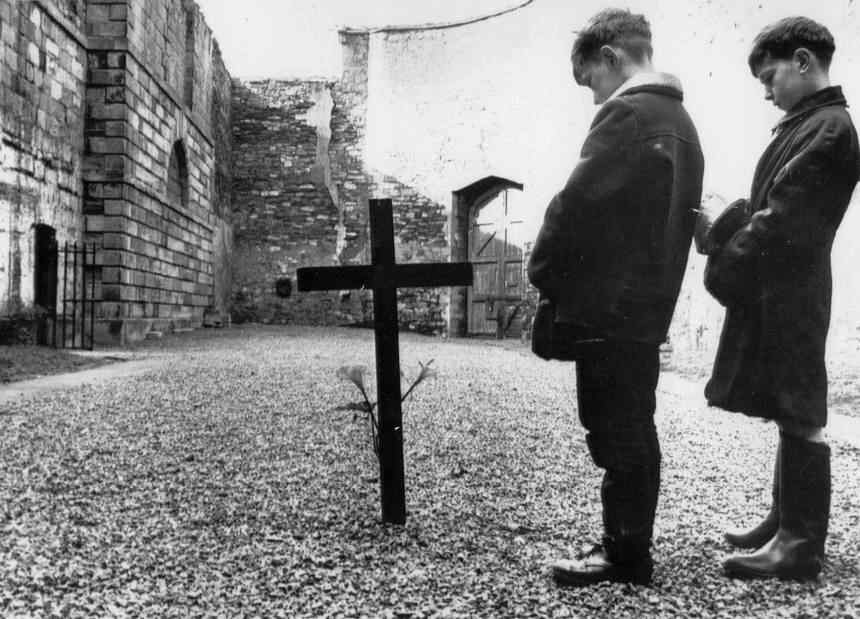
Afterwards, I went to the courtyard and saw the cross marking the spot where the wounded James Connolly was tied to a chair and shot. There were fourteen participants in the Easter Rising executed in the Kilmainham courtyard during May of 1916.

St, Patrick's day is, and should be, a joyous time, even for one like me whose Irish heritage is thin (Update: not so!) and, so far as I know, all on the Protestant side (but remember, Wolfe Tone was a Protestant). Still, it should also be a time to remember what led William Butler Yeats to conclude his poem Easter, 1916 with the words: "A terrible beauty is born."

Monday, March 12, 2012

Tugboats galore.

My "Red Tugboat" post on Brooklyn Heights Blog has drawn enough favorable mention to make me want to post some more of my tug photos. Above is K-Sea's Solomon Sea passing Pier 1 at Brooklyn Bridge Park a few days ago.
Here is Henry Marine Service's trim little Dorothy J. making good speed as she approaches the southern tip of Manhattan at Battery Park in the fall of 2006. This Staten Island Advance story from June 9, 2010 tells of Henry Marine's filing for reorganization under Chapter 11 of the Bankruptcy Act, but also recounts Dorothy J.'s heroic role in the 2003 disaster involving the Staten Island Ferry Andrew J. Barberi.
The very small tug W.O. Decker is part of the South Street Seaport Museum's collection of historic vessels. Here she's seen tied up to the lightship Ambrose, also in the Museum's collection.
Another historic tug that has been preserved is Jupiter, shown here docked at Penn's Landing in Philadelphia.
This tug, spotted from the Brooklyn Heights Promenade, has a low profile, indicating that she probably works on inland waterways where low bridges limit clearance, such as the Erie Canal.
Seen from Pier 6 at Brooklyn Bridge Park, McAllister Towing's powerful McAllister Sisters has made fast to Bouchard Transportation's barge B.No.204.

Thursday, March 08, 2012

Lesley Gore, "You Don't Own Me"


It's International Women's Day, so here's a feminist anthem from 1964, the year I graduated from high school, sung by the daughter of the inventor of Gore-Tex.

Tuesday, March 06, 2012

Paul Whiteman's Rhythm Boys, featuring Bing Crosby: "My Suppressed Desire".

Bing Crosby's rich baritone is one of my early childhood memories. My parents had his Christmas album, from which I especially remember his stirring rendition of Adeste Fideles, sung in Latin and then in English as "O Come All Ye Faithful", and "White Christmas", on which he sounded as if he had a bit of a cold; for a long time I thought it was "Wide Christmas". Dad and Mom, though neither was Irish, also had his album of songs from the auld sod, which included such soulful traditional ballads as "Mac Namara's Band" and " It's The Same Old Shillelagh". One of my earliest cinema memories is The Road to Bali, one of several "Road" movies, made from the early 1940s to the early '60s, starring Bing, Bob Hope, and Dorothy Lamour.

"My Suppressed Desire", for which I thank Mike Pearl for the link, is from much earlier in Bing's career. Bing isn't credited by name on this 1928 record by Paul Whiteman's Rhythm Boys, with whom Bing did his first recordings. On this song, Bing does some scat singing, which I once had the temerity to compare to abstract expressionist painting.

Anyway, I love this song. It's the theme song from a movie titled Gang War, which, coincidentally, was edited by Archie Marshek, who also edited The Road to Bali.

Friday, March 02, 2012

OK, this is a "boomer" blog; here are the inevitable reminiscences of the late '60s.

My friend Michael Simmons wrote this piece for the New York Times "Local" blog about Tuli Kupferberg, the East Village Other, and those special late '60s years when he was in middle school and I was in law school.

I wasn't in the East Village, or Haight-Ashbury during that time, but I was in Cambridge, Massachusetts, which was a scene of sorts. I'll never forget going to J.Press on Mount Auburn Street to buy a suit in the spring of 1970 (still very much part of the '60s in my opinion) the day after a big antiwar riot. When I got there, the windows had all been smashed and replaced by plywood, but a sign taped to the door said "We're open." As I was trying on a jacket, I said to the middle-aged man who was helping me, "It looks like you bore the brunt of the attack yesterday." "Oh, yes sir, " he said. "I was here through the whole thing. These people were the very scum of the earth. You could tell by the way they were dressed."

I also remember balmy spring weekend afternoons on Cambridge Common (see photo, taken in 2010; the place never changes), listening to long forgotten bands like Walk on Water, Clear Light (all the way from L.A., and with an album on Elektra!), and The Ill Wind. Perhaps my quintessential memory from that time was the Sunday morning on the Common when I saw five or six girls of about age nine or ten, probably Harvard faculty brats, dancing in a circle and chanting, "Christ ya know it ain't easy, ya know how hard it can be; the way things are going, they're gonna CRUCIFY me!" (all fall down).

Thursday, March 01, 2012

Controversy, thy name is Mets

Hardly have position players arrived for spring training (though one annoyed the manager by arriving on time) than owner Jeff Wilpon rubbed star third baseman David Wright wrong by passing out shirts emblazoned with the logo of the strength-through-haplessness 1960s comic character Underdog.

Count on the scribes finding lots more contretemps in Port St. Lucie before spring training is over.

Wednesday, February 29, 2012

The Baldwin "Centipede" Diesel

www.toytrains1.com
In the summer of 1954, when I was eight years old and we were visiting my grandmother in Tyrone, Pennsylvania, my father and I went down to the Pennsylvania Railroad station to do some train watching. When we got there, a diesel locomotive heading a passenger train was idling with its front end projecting past the station. It was a kind I'd never seen before. Dad said, "That's a Baldwin." I heard, "That's a bald one," which seemed to make perfect sense, as its low-topped cab, projecting from the front of the high-cowled engine covering, gave it the appearance of having a shaved head. The photo of the model below shows this more clearly:

Tony's Toy Trains
Indeed, the Baldwin DR-12-8-1500/2, as it was officially named, was sometimes nicknamed the "Babyface." It was more commonly called the "Centipede" because of the twelve-axeled phalanx of directional and driving wheels that undergirded each unit's body.

Baldwin Locomotive Works was one of the most successful builders of steam locomotives, but had difficulty making the transition to diesel. The Centipede was its first serious attempt at a road (as opposed to switcher) diesel. The location of Baldwin's plant, at Eddystone, Pennsylvania, made the Pennsylvania Railroad a logical customer, and it was one of only three roads (the others being the Seaboard and the National Railways of Mexico) to buy Centipedes. Unfortunately, they proved too unreliable for regular train service (the one I saw at Tyrone in 1954 must have been near the end of its days pulling trains) and they were relegated to "helper" duty, providing added rear-end power to trains heading west from Altoona, going around the Horseshoe Curve and up through the Gallitzin tunnels to the top of the Allegheny Plateau.

Tuesday, February 21, 2012

"No expectations"? Mets skipper says "No."


This Stones song encapsulates the assessment of the Mets' prospects this season (pitchers and catchers reported today) by most fans and, so far as I know, all pundits. What can be seen peeking over the bottom of the Beggar's Banquet album cover photo shown at the beginning of the clip is where they're expected to be at the end of the season. Manager Terry Collins begs to differ.

For now, I'm keeping my fingers crossed.

Monday, February 20, 2012

iPod Log 7

A few days ago I took a short walk around the neighborhood, tending to errands. On the way, I heard an eclectic concatenation of music that seemed to work together in some odd way. Here it is:


Iggy Pop, "Lust for Life". Thanks to skitzo12 for this live performance video. As commenter MaDdDaWg100 sez: "you got to love iggy cause he is 1 of few who can get skinheads homosexuals hippies punks goths headbangers all into 1 crowd for enjoyment of music peac[e]fully."


Mozart, The Marriage of Figaro Overture, James Levine conducting. My recording has Levine conducting the Metropolitan Opera Orchestra; this clip does not specify the orchestra, though it may well be the Met.

<>
Art Tatum, "Mr. Freddie Blues". Tatum was one of the greatest, to some the greatest, of jazz pianists. Clip courtesy of Art Tatum - Topic


Dave Davies, "Death of a Clown". This was Dave's first solo recording, though he remained part of the Kinks. It was also, as I've mentioned before, a favorite of Turner & Kirwan of Wexford, long time house band at the Bells of Hell. The clip above, by JohnMalloy05, is of a BBC radio show from 1967 which includes the recorded version of the song, along with some chitchat, and accompanied by still photos and the song's lyrics.


The Coasters, "Yakety Yak". I posted another clip of this on my earlier eulogy for Jerry Leiber, but it was, as vwest1life puts it, one of the "inferior modern re-recordings of this song, probably not even with any of the original Coasters singing!" This is the original hit in, as my friend Allen (who will celebrate his 60th on St. Paddy's) likes to say, "screaming mono."


J.S. Bach, Aria from Jauchzet Gott in allen Landen - Cantata BWV51, Orchestra of St. Luke's, Anthony Newman conducting; Kathleen Battle, soprano; Wynton Marsalis, trumpet. Wow. Thanks to grschuur for the clip.


Tom Lehrer, "Fight Fiercely Harvard". I've posted this before, but here it is again. It provided a fitting end to my stroll, as it propelled my charge up the stairs (jock that I am, I disdained the elevator) to my apartment. Though this is a football song, I can't help but wonder what Lehrer thinks of Linsanity.

Thursday, February 16, 2012

Farewell to "The Kid"; Gary Carter dies at 57.


I became a Mets fan in 1985, the year Gary Carter became their starting catcher. My timing was good, as I saw the Mets go all the way to the World Series and the championship the following year, with Carter, called "The Kid" because of his enthusiastic play, an essential part of the team. I watched as he hit two homers over the Green Monster at Fenway in game four of the 1986 Series. This gave him the still standing distinction of being the only player to hit two homers in a single World Series game and in an All Star game (1981, when he was with the Expos). He also had a crucial hit in the bottom of the tenth inning of game six that helped the Mets hold on to win that game (the Red Sox would have won the Series had they prevailed) Carter was elected to the Hall of Fame in 2003. He died today of brain cancer.

Thanks to imBaseball for the clip above, with its montage of photos of Carter during his Mets and Montreal Expos years.

Saturday, February 11, 2012

Goodbye, Whitney Houston

This romantic ballad, written by Dolly Parton, is what I, and many others, will remember you for. Such a loss to die so young.

Sunday, February 05, 2012

Live Blogging Super Bowl XLVI from the Henry Street Ale House


XLVI? I have fond memories of III.

The coin is tossed. Giants get to call, call tails, and lose. Pats elect to kick. Funny, in my experience, it seems the call is almost always heads, and it almost always comes up heads.

First Jint drive stalled by short loss followed by sack. Punt puts Pats deep.

Brady flagged for intentional grounding from end zone. Safety; Jints up by two.

Jints drive for TD, Manning to Cruz, after fumble recovery by Pats nullified by penalty. So far, Pats can't buy a thrill. Down in yardage about 100-0.

Pats offense finally got going, but stalled in red zone, so settled for FG, making it 9-3 Jints. After that, lots of back and forth. Jason Pierre-Paul, who batted down two Brady passes, is from my college alma mater, South Florida.

Pats drive the length of the field for a TD that makes it 10-9 in their favor at half. Pierre-Paul is alternatively hero and goat, as he tackles for a loss on 2nd and goal, but drops into pass coverage on 3rd, giving Brady time to find his receiver.

Halftime. Madonna has antlers. "Springtime for Hitler"? Time for a quick visit to the loo.

Awful halftime show continues. No wardrobe malfunctions. "World peace"? Yes, please.

Chrysler ad looked like it could be an Obama ad.

2nd half kickoff. Pats start on 20; Brady promptly completes two passes, then a long outside run gets them to Jints 35. Drive ends in TD pass. Brady sets record for consecutive pass completions in Super Bowl.

Jints FG makes it 17-12.

Sackarooni! Pats forced to punt from deep; Jints get ball on Pats' side of midfield.

Jints drive stalled; another FG makes it 17-15.

Brady's pass intercepted deep; fumble on next play recovered by Jints. Are the football gods back on NY's side? Maybe. Disputed sideline catch near midfield called in NY's favor.

Lots of stuff at the end; Jints came back with TD to go up 21-17. They hang on with end zone defelection of Brady's Hail Mary pass. So, the Giants' curse on the Patriots continues.

Super Bowl games used to be almost predictably dull. This one was good.

Friday, January 27, 2012

There are three minutes left in Mozart's birthday...


...so I decided to post the first thing I found on YouTube.

Addendum: This is the first movement, molto alllegro, of Symphony No. 40 in G Minor, K. 550, performed in 1998 by the Georgian SIMI Festival Orchestra, Anzor Kinkladze, conducting.

Pierce Turner: "Ball and Chain (Snakes and Ladders)"


Pierce Turner was one half of Turner and Kirwan of Wexford, the house band at the Bells of Hell from sometime in 1977 to 1979. The band was just the two of them: Pierce played Moog; Larry Kirwan played guitar while using a pedal to strike a drum; and both sang. Their repertoire included some original songs ("Absolutely and Completely", "Father Reilly Says Goodbye", "The Girl Next Door"), arrangements of traditional Irish songs ("Free Born Man of the Traveling People"; a version of the rebel song "The Foggy Dew" ending in Moog pyrotechnics), and covers ("Death of a Clown", "Lola"--they were great Kinks fans--and the New Riders' "Panama Red", which, to their chagrin, a certified public accountant named Stu would frequently and loudly request).

Toward the end of their time at the Bells, they were producing more original material. They added a bassist and a full-time drummer, and changed their name to The Major Thinkers. As such, their music evolved into a kind of post-disco electronica with new wave overtones, done very well. (I still have an unscratched Major Thinkers twelve inch disc.) You can hear them here.

Today, Larry fronts Black 47, and Pierce is a solo artist. His latest is in the clip above (thanks to odriscl for the clip and to Bells/Lion's Head friend Cheryl Floyd for the link) and, in my opinion, shows him still at the top of his game.

Update: Pierce leaves a comment (see link below) on this post which includes the following information:
I will be performing at Joe's Pub on March 3rd at 7pm-I have a new album pending-I'm mixing right now-and I think fondly of those Bells of Hell days.
I hope to see lots of my New York friends there.


Meanwhile, I've found a video clip of "Wicklow Hills", a song that's on Pierce's first solo album, and which I heard him perform live back in 1983. About a month after attending his concert, I was walking along Hicks Street in Brooklyn Heights, my then new home, late at night, when a drunken man came by singing, "Tell everybody I'm going away for ten years; I'm gonna wander, among...those...hills." I bit my tongue to keep from shouting out, "Wicklow!"

Sunday, January 22, 2012

Goodbye, Joe Paterno

Miamiherald.com
I don't think Joe Paterno, who died today at 85, will have the fate Shakespeare's Antony described in Juluis Caesar, Act 3, scene ii: "The evil that men do lives after them; The good is oft interred with their bones". The evil of which Paterno was accused so near the end of his life was a sin of omission, but one that may have had very bad consequences. Fellow blogger Mark Koltko-Rivera, writing at the time the scandal had just broken and before Paterno was fired as Penn State's football coach, made a case, on both consequentialist and deontological (if, indeed, there is a real difference between the two) grounds, for firing Paterno immediately, thereby denying him a "last hurrah" at the Nittany Lions' then forthcoming end-of-season game.

Joe Paterno was a native of my now beloved adopted home, Brooklyn. He coached at a university near where my mother was born and raised and where I was born, whose teams I rooted for whenever they weren't playing against Florida or Florida State. I believed, and still believe, in his reputation as a good coach, not only in the sense of being a winning coach, but one who inspired respect and love from his players while instilling or reinforcing in them ideals of good conduct and devotion to learning, as well as to football. I don't think this reputation will "be interred with [his] bones", nor should it. The "evil" will also be remembered, and should serve to caution others who find themselves in a situation similar to that in which Paterno found himself when confronted with the information he was given.

Thursday, January 19, 2012

Louis Prima, "Just a Gigolo"


This was a favorite of Nick Tosches. I remember his repeatedly, and unsuccessfully, cajoling Delbert McClinton to do it at the Lone Star Cafe. The sound and video quality on this vintage clip, courtesy of Glauco Malagoli, isn't the greatest, but Louis Prima's talent shines through. Keely Smith sings and acts wonderfully. Nick also gets a credit on the clip.

Monday, January 16, 2012

Lion's Head lament: Liam Clancy singing "Dirty Old Town"; Lucian Truscott on looking back.


In the continuing e-mail discussion of the history of the Lion's Head hosted by Dermot McEvoy, who is writing a book about it, Lucian K. Truscott IV made this observation:
I’ve been thinking about this, and I guess every generation goes through this same sort of geezer stage, when there are fewer and fewer people around who remember the good old…or bad old…days. It’s the natural order of things.

I remember one Saturday years and years ago, back in the late 80’s, after I had moved out of New York. I was back for a couple of days staying with a friend in the Village, and I was walking down Bedford Street, or one of those nice little streets over there west of 7th Avenue, and I saw this young woman walking down the street toward me. She was in her early 20’s, and dressed real cool, and she was gorgeous, and she was going somewhere important to do something important, almost bent forward with the energy of youth and Great Expectations. It came to me that she was exactly like the young women I lusted after when I was her age. We were all gorgeous and dressed real cool and headed someplace fast to see someone important or do something important, filled with Great Expectations that would come true, damn it, or we would die tryin’. All of a sudden I realized that we had been replaced. That the little studio apartments all around me were no longer filled with my friends and acquaintances, but hers. The street was hers now. The energy was hers. The important people she was going to see were her important people, not mine, and the important things she was going to do were different than our important things. The only things that remained pretty much the same were the street and her gorgeousness and Great Expectations.
Dermot replied that this made him think of the song "Dirty Old Town", as done by another, now deceased, Head regular, Liam Clancy, and gave a link to the YouTube clip above. This song was a favorite of another now departed Head stalwart, Dennis Duggan.

Dermot is quoted in this New York Observer article about the changes that have been wrought on Greenwich Village and New York City at large.

Sunday, January 15, 2012

From the "Letter from Birmingham Jail."


The Rev. John Patrick McGinty quoted portions of this paragraph of Dr. Martin Luther King, Jr.'s Letter in his homily this morning at Grace Church, Brooklyn:
We have waited for more than 340 years for our constitutional and God given rights. The nations of Asia and Africa are moving with jetlike speed toward gaining political independence, but we still creep at horse and buggy pace toward gaining a cup of coffee at a lunch counter. Perhaps it is easy for those who have never felt the stinging darts of segregation to say, "Wait." But when you have seen vicious mobs lynch your mothers and fathers at will and drown your sisters and brothers at whim; when you have seen hate filled policemen curse, kick and even kill your black brothers and sisters; when you see the vast majority of your twenty million Negro brothers smothering in an airtight cage of poverty in the midst of an affluent society; when you suddenly find your tongue twisted and your speech stammering as you seek to explain to your six year old daughter why she can't go to the public amusement park that has just been advertised on television, and see tears welling up in her eyes when she is told that Funtown is closed to colored children, and see ominous clouds of inferiority beginning to form in her little mental sky, and see her beginning to distort her personality by developing an unconscious bitterness toward white people; when you have to concoct an answer for a five year old son who is asking: "Daddy, why do white people treat colored people so mean?"; when you take a cross county drive and find it necessary to sleep night after night in the uncomfortable corners of your automobile because no motel will accept you; when you are humiliated day in and day out by nagging signs reading "white" and "colored"; when your first name becomes "nigger," your middle name becomes "boy" (however old you are) and your last name becomes "John," and your wife and mother are never given the respected title "Mrs."; when you are harried by day and haunted by night by the fact that you are a Negro, living constantly at tiptoe stance, never quite knowing what to expect next, and are plagued with inner fears and outer resentments; when you are forever fighting a degenerating sense of "nobodiness"--then you will understand why we find it difficult to wait. There comes a time when the cup of endurance runs over, and men are no longer willing to be plunged into the abyss of despair. I hope, sirs, you can understand our legitimate and unavoidable impatience. You express a great deal of anxiety over our willingness to break laws. This is certainly a legitimate concern. Since we so diligently urge people to obey the Supreme Court's decision of 1954 outlawing segregation in the public schools, at first glance it may seem rather paradoxical for us consciously to break laws. One may well ask: "How can you advocate breaking some laws and obeying others?" The answer lies in the fact that there are two types of laws: just and unjust. I would be the first to advocate obeying just laws. One has not only a legal but a moral responsibility to obey just laws. Conversely, one has a moral responsibility to disobey unjust laws. I would agree with St. Augustine that "an unjust law is no law at all."
You may reasonably ask, may everyone decide what laws are just and which unjust? Everyone will, but we can hope that, as was the case with those who opposed the Jim Crow laws, those whose decisions are right will in the end prevail.

Saturday, January 14, 2012

Austin Lounge Lizards, "Gingrich the Newt"

Arthur Boehm's posting of this Gingrich campaign ad made me remember the Austin Lounge Lizards' song from the 1990s, performed a cappella (I wonder if Newt also objects to Italian?) in the clip above. The video is a bit, uh, psychedelic, but the sound is comme il doit Ăªtre.

Wednesday, January 11, 2012

Downtown Manhattan: a financial triangle.

The building with the curvilinear facade at the left is 200 West Street, the headquarters of Goldman Sachs (Pei Cobb Freed & Partners, 2009). The two buildings to the right, of similar design, are Three and Four World Financial Center, the headquarters of American Express and Merrill Lynch (now a subsidiary of Bank of America), respectively (both by César Pelli & Associates; both completed 1986). In the background, the new One World Trade Center (Skidmore, Owings & Merrill LLP; completion anticipated 2013) is rising.

This photo of one of the principal nerve centers of finance capitalism was taken from the Irish Hunger Memorial.

Thursday, January 05, 2012

Be Good Tanyas

In response to my Country and Northern post, Sheryl Robinson, better known to Fray veterans as Dawn Coyote, asked why I hadn't mentioned the Be Good Tanyas. My first thought was that I don't think of them as "country", but, as I noted at the close of my post, it's a thin line between "country" and "folk". I do like this Vancouver based group of three women, shown in the clip above--the only one I can find that shows them in live performance--doing "Scattered Leaves", a song I hadn't heard before, with bass and drum backing. I like them despite Frazey Ford's singing, as a critic once wrote of Natalie Merchant, "in English as if she'd grown up speaking some Polynesian language."

Here they do "Oh, Susannah", probably as classic a "country" song as there is.

For a more contemporary country sound, here they do Townes van Zandt's "Waitin' Around to Die."

They do blues, too. Here's their cover of Josh White's (or is it their cover of Dylan's cover) of "In My Time of Dying."

Tuesday, January 03, 2012

New Year's shout-outs.

Skaket Beach, Cape Cod Bay, morning, January 2, 2012
Last year, Blogger started telling me what are my most popular posts. Leading the pack is Grace Slick at seventy; so, leading my shout-out list is Michael Simmons, who sent me the lovely pic of septuagenarian Grace that led to the post. Second on my hit parade has been Pierre Bonnard, "Late Interiors", at the Metropolitan Museum of Art; so, a salute to Mark Crawford for inspiring me to take an interest in that painter's work, and to the Met for mounting a great show. Other posts that have drawn lots of visits include Jazz and the visual arts, featuring a painting by Mike Sorgatz, and Gabriel Fauré, Le Jardin de Dolly, another post that attempts to draw a parallel between painting and music, for which I can thank WQXR, New York's classical music station.

I'll give special mention to John "Homer Fink" Loscalzo, publisher of Brooklyn Bugle, which re-publishes many of my posts, and Brooklyn Heights Blog, which is my alternative forum for writing about matters of local interest. One of my most popular posts is Do you curate? If so, you rate?, which was inspired by my BHB colleague Heather Quinlan. I also tip my hat to Eliot Wagner for introducing me to new musicians and groups about which I've posted.

Finally, as always, thanks to my loyal readers--you know who you are--and to my wife and daughter.

Sunday, January 01, 2012

New Year's Greetings from Cape Cod

I'd been to Cape Cod once before. In 1988, I was asked to speak at the fall meeting of the Insurance Accounting and Statistical Association in Hyannis in November. It was held in a Holiday Inn that was undergoing off-season renovations, and new carpet was being put down in the hall outside my room, so I was inhaling carpet glue fumes as I put the finishing touches on my speech. My company's CFO and I decided to venture out for dinner one evening, and got caught in the season's first snowstorm. So, when friends invited my wife, daughter, and me to join them for New Year's at their house in Orleans (see photo above), I was skeptical. The drive up was through fog and rain, which inensified my doubts. However, New Year's Day dawned bright and clear, and after breakfast we drove to Nauset Beach, on the Atlantic Ocean side of the Cape Cod Peninsula.

We weren't the only people out enjoying the beach.

Some were enjoying it with gusto.

There were seals with their heads out of water, but too distant to get a good photo.

Here is a very gnarly piece of driftwood.

These are dunes above the beach.

The dunes are a nesting place for threatened seabirds.

Behind the dunes is the Orleans Town Inlet.

On the shore of the Inlet, I found this water dwelling snail and its track. These snails prey on oysters, drilling through their shells to eat them.

A gull paddles across the surface of the Inlet.

High-flying cirrus clouds betoken another change in the weather.

I'm delaying posting my usual New Year's shout-outs until we return home. Happy New Year!

Friday, December 23, 2011

Sting, "There is no Rose of Such Virtue"

One of the songs associated with the Advent season and Christmas that I've come to appreciate later in life is "There is no Rose of Such Virtue", also known by the title Rosa Mystica. Here it is sung by Sting, also playing oud, and with choral and orchestral accompaniment, at Durham Cathedral, England, in September 2009. Clip thanks to Aliceclypsis.

Tuesday, December 20, 2011

Sunday, December 18, 2011

Country & Northern

A few days ago a friend, whose judgment I respect, posted this on Facebook:
I am more than a little bit tired of Canadian pop stars because they are seriously wack. When was the last time Canada sent us a decent musical artist???? Think back. WAY back. It was Corey Hart or maybe early Bryan Adams. Everything since then? WACK.
I could've responded with Arcade Fire as a counter-example, but instead chose Kathleen Edwards doing her hockey song, "You Get the Glory, I Make the Dough." My friend's response was:
And Claude Scales, in the time that I've known you I've found that you have SUPERB taste in music, but this Kathleen Edwards? She lost me at the "I'm a Ford Tempo, you're a Ma[s]erati..." No. Just, no. I'm a purist; I like my country music sung by folks below the Mason Dixon line.
Well, being an Air Force brat, I spent much of my childhood and youth below the Mason Dixon line, but my earliest memories of country music were from the radio at my grandmother's in Pennsylvania, or on the road across Ohio on the way to my father's family home in Indiana.

And, yes, as I learned later in life, there was country music north of the border as well. One of the most admired country music stars of the 1950s and '60s, Hank Snow, was born and raised in Liverpool, Nova Scotia. Geologically speaking Nova Scotia is part of Appalachia; it would seem to be culturally as well.

The clip above, thanks to Charlie Dahan, shows Hank, with Chubby Wise on fiddle, Eddie Noack on rhythm guitar, and I'm not sure who on bass or on steel, doing "I'm Moving On."

I can't give up on Ottawa's favorite daughter, Kathleen Edwards, either. Here she is (courtesy of building55), doing what I think is a first-rate country-rock song, "Change the Sheets," at Stephen Talkhouse, Amagansett, Long Island, July 17, 2010.

k.d. lang (she spells her name in all lowercase) is from the high plains of eastern Alberta, and her songs sound as expansive as that wide-open country. Listen to "Big, Big Love," courtesy of TheLangChannel.

I could go on, but I'll close with "Early Morning Rain," a song that touches on many country music themes: getting drunk, riding freight trains, longing for an absent lover. It's performed here by Ian Tyson and Sylvia Fricker, who begin with some talk about the breakup of their long marriage and musical partnership, which hasn't affected their friendship or ability to sing together. They're joined on the last verse by the song's author, Gordon Lightfoot (forgive me, Lester Bangs). Ian and Sylvia, and Lightfoot, are usually classified as "folk" musicians, but, heck, it's a fine line.
I walked down there and ended up
In one of them coffee-houses on the block
Got on the stage to sing and play
Man there said, “Come back some other day
You sound like a hillbilly
We want folk singers here”
--Bob Dylan, "Talkin' New York"

Tuesday, December 13, 2011

More morning walk photos: focus on maritime heritage.

This photo is from a walk a couple of weeks ago. It shows the small tanker Commencement taking on bunkers from the barge Double Skin 32, brought to her side by the tug Oyster Creek. Commencement is docked at Port Authority Brooklyn Pier 7, near the foot of Atlantic Avenue. In recent years, it received ships carrying bagged cocoa beans, but it is now leased by a beer distributor which doesn't, to my knowledge, take cargo from ships there. It does serve as an occasional dock for ships, like Commencement, taking on fuel or perhaps just needing a parking space between charters. I took the photo from Pier 6, which is now part of Brooklyn Bridge Park.

This photo, and the rest on this post, is from my walk this past Saturday. This was taken at the Atlantic Avenue entrance to Pier 6, Brooklyn Bridge Park.

After walking the edges of Pier 6, I took the path northward that leads to Pier 1. On the landward side of the path, near Pier 5, which is being made into athletic fields, I saw these bollards, forlorn reminders of when the pier was an active dock.

This is the ruin of Pier 4, which once received barges carrying freight cars from the railroad terminals in New Jersey.

The skeleton of the cargo shed on Pier 2 remains. It will be re-covered to house indoor athletic facilities.

The East River is actually a tidal strait that connects two arms of the Atlantic Ocean: New York Harbor and Long Island Sound. The tide was low during my Saturday walk. I believe that the greenish strip of rocks in the middle of this photo marks the normal high to low tide variance, while the grayish strip to its right marks the extent of two recent unusually high tides: one during Hurricane Irene, and the other a more recent "king tide", when the moon's and sun's gravitational pulls were combined.

The tops of these pilings were barely above water during Hurricane Irene and the "king tide." While most of Pier 1 was made into parkland, the deck of the southernmost portion was stripped off to expose the pilings, which provide a habitat for marine life and resting places for sea birds. The buff masts and spars towering over the white high speed ferry on the Manhattan side of the East River belong to the bark Peking, part of the South Street Seaport Museum's collection of historic ships and boats.

Saturday was the date for SantaCon NYC, and a crowd of hipsters in Santa garb thronged South Street Seaport's Pier 17.

Sunday, December 11, 2011

Lionel Train display at New York City Transit Museum Annex, Grand Central Terminal


The first Christmas I can remember--I think I was three--was when I was given a Lionel train set. It's still at my parents' house in Tampa, packed away. My daughter, now eighteen, wants it someday. She'll get it.

Every year the Transit Museum's Gallery Annex and Store at Grand Central Terminal has an elaborate Lionel layout on display during the holiday season. The clip above, which I made this past Thursday, shows this year's version. It features a mock downtown Manhattan, complete with Brooklyn Bridge, as well as some rural, mountainous territory.
There are also static displays of historic Lionel trains along the walls of the gallery. The steam (top) and electric (bottom) trains shown in the photo above probably were made in the 1920s or '30s.

Tuesday, December 06, 2011

iPod Log 6

I haven't done one of these for a couple of years. These are the pieces of music I heard on my morning walk from my apartment to Pier 1, Brooklyn Bridge Park, and back, yesterday morning. I've included photos of what I was seeing while listening to each piece. Where I've been able to find them, I've included links to video clips in the text.
Jimmy Cliff, "The Harder They Come." The title song from Cliff's 1972 movie makes a teriffic starter for my morning jaunt, and sustains me through 35 push-ups.
Siegel-Schwall Band, "Leavin'." Siegel-Schwall was one of the many electric blues bands formed in the late 1960s. There's no video of "Leavin'", but here's Corky Siegel doing solo harp and vocal at the Ladder House, Sturgeon Bay, Wisconsin, on February 20, 2009.
Tom Rush, "Statesboro Blues." Tom Rush is one of my favorites of the generation of folkies that came to prominence in the middle 1960s. On one of his early albums he does an excellent cover of Blind Willie McTell's "Statesboro Blues". There's no video of Rush doing this song, but there is of him singing his own "No Regrets".
Bessie Smith, "Gimme a Pigfoot."
At the break of day,
You can hear old Hannah say,
Gimme a pigfoot, and a bottle of beer...
Bessie Smith is regarded perhaps second only to Robert Johnson as an influence on the development of the blues as a musical style. There's no video of "Gimme a Pigfoot," but here she is doing "Nobody Knows You When You're Down and Out."
Scott Joplin, "Sunflower Slow Drag", by the New England Conservatory Ragtime Ensemble, Gunther Schuller, conductor. My iPod reaches back further in the history of American popular music for an orchestral arrangement of a Scott Joplin rag. Here's a piano roll version of the same tune.
George Gershwin, "Piano Concerto in F, Movement III", by Gary Burton and Makoto Ozone. This comes from the album Virtuosi (Concord 2105-2), on which Burton (vibes) and Ozone (piano) do pieces ranging from Domenico Scarlatti (1685-1757) to Johannes Brahms (1833-1897) to Gershwin (1898-1937) to Jorge Cardoso (b. 1945), and an original piece by Ozone. There's no video of them doing Gershwin, but here's their take on Scarlatti's Sonata in E (K20). Here's the Gershwin with full orchestra and piano (NHK Symphony, Marek Janowski conducting; Peter Jablonski, piano).
The Dovells, "You Can't Sit Down." You may have noticed that my iPod has, so far, followed a more or less sensible progression, from reggae to late '60s electric blues to mid-60s acoustic folkie blues to 1920s jazzy blues to ragtime to jazz influenced classical music. Now we have an abrupt shift to mid-'60s Philly R&B. I first heard this song when I was with the Robinson High debate team at a tournament at Florida State University in Tallahassee. Some of my teammates and I were having burgers and milkshakes at the student union cafe, which had a jukebox and dance floor, when the song came on. A couple who looked like they stepped out of a Norman Rockwell illustration of typical American youth--he with a perfectly coiffed ducktail and pegged khakis, she with a tartan skirt and saddle Oxfords with bobby sox--took the floor and danced very energetically, twirling vigorously, and he once lifting her by the waist and swinging her overhead. This song is notable for its perhaps earliest uses of "hippie" and "hip hop" in american pop culture parlance.
Terry Allen, "Truckload of Art."
Yes, an important art work was thrown burning to the ground,
Tragically landing in the weeds,
And the smoke could be seen for miles around,
But nobody knows what it means.
From '60s Philly R&B we go to 1979 Texas tongue-in-cheek country. Hear it here. Apologies to Kei Andersen, Mark Crawford, Mike Sorgatz, and any other artist friends who may be offended by this.
Fleetwood Mac, "One Together." This is a cut (of which, unfortunately, there's no video) from Kiln House, one of my favorite albums despite its less than enthusiastic critical reception. One Rolling Stone writer characterized it as "Buddy Holly obsessed"; in my opinion, to paraphrase Yellowman, Buddy Holly is a nice obsession.

Monday, December 05, 2011

Reyes to Marlins

Huffington Post
I can't say I was surprised. Like so many things concerning the Mets, I have mixed feelings about this. He's a great player when he's not on the DL, though sometimes inclined to surprising lapses in judgment, both on defense and on the basepaths. Since he's staying in the NL East, I'll get lots of chances to test the curse of the ex-Met theory.