Saturday, June 17, 2006

Another New York harbor scene.


On May 31, I took a walk along the promenade at Battery Park City and got this view of the Manhattan Sailing Club's J-24 fleet arrayed in front of the Statue of Liberty.

Friday, June 16, 2006

A Bloomsday survey.

Choose your answer; give your reason:

James Joyce has had a (A) good (B) bad (C) indifferent effect on the course of literature.

My mind is open on this subject. Best response wins my frayed, dog-eared paperback copy of Portrait of the Artist that I read for Humanities 101 at the University of South Florida in 1965 (if I can find it).

Beware the agenbite of inwit.

Friday, June 02, 2006

Rove chums, Hevesi bites?

Coverage of the Homeland Security funding flap focuses on allegations of intent to give GOP incumbents in tight races some pork to brag about. There's a more subtle, and to me troubling, interpretation that seems sneakily Rovian. Perhaps the real intent was to cause coastal elites to go berserk, thereby confirming to heartlanders our overwrought sense of entitlement. In other words, to energize the base, not by gratitude but by the much more effective means of resentment.

If so, it seems to be working. Someone was reading choice bits from the tabs on NY1 this morning, and I heard something about ear-to-ear grins in "Podunk America"; and, of course, New York State Comptroller Alan Hevesi's howler, in front of a college graduating class, no less, about Chuck Schumer wanting to put a bullet in an unfortunate place, couldn't have been scripted better by Ol' Karl himself.

Tuesday, May 30, 2006

An aging beauty comes to town.

Last September, I posted about ship watching from the Brooklyn Heights Promenade, and concluded my essay with a photo of a very pretty and shipshape vessel heading up the Hudson towards the midtown cruise ship terminal. You can find it here. On Sunday, while crossing the Brooklyn Bridge in a cab, I was delighted to see that same ship docked at the Brooklyn cruise terminal. Monday being a holiday, I was free to take my camera to Red Hook to get a closer shot of her, and to try to ascertain her identity.

Here she is, looking fine, despite the addition of two unsightly domes that, no doubt, protect electronic devices of considerable value in enhancing the safety of her passengers and crew. Note the Brooklyn Bridge in the distance.

The gantry next to her bow obscured her name, though I could make out that it started with an "S". When I got home, it took a few minutes on Google to identify her as Saga Ruby, of Saga Holidays, U.K. She began her career as Vistafjord, of Norwegian-American Lines, having been completed in 1973 (her classic lines fooled me in my earlier post into thinking she was ten of fifteen years older) at the great Wallsend shipyard of Swan Hunter.

In her early years at NAL, she may have been among the last ships to maintain a transatlantic liner service, at least during the summer months. She was later acquired by Cunard, which operated her under her original name for several years before renaming her Caronia, after an earlier ship that had the distinction of being the first Cunarder to be purpose-built for cruising. During my first months in New York, in the summer of 1970, I spent many hours studying for the bar exam on the Morton Street Pier, which extends into the Hudson from Greenwich Village. When I looked to the south, I could see the older Caronia (actually the second Cunarder to bear that name) anchored in Upper New York Bay just a couple of miles away. She had left Cunard ownership some time before, and instead of having her original sea-green hull with white superstructure and Cunard's red and black funnel, she was a solid dull white with blue funnel. After a month or so of riding at anchor, she was towed up the Hudson to an unoccupied pier and docked; when her bankrupt owners couldn't pay the fee to keep her there, she suffered the ignominy of being given a parking ticket. In 1974, she was stripped of her fittings, some of which later became decorations at a bar near the Village apartment where I lived in the late '70's. She was then sold to Taiwanese breakers, but ended her days enroute to the blowtorch when she struck a seawall off Guam and broke up in heavy weather.

Saga Ruby, along with her near sister Saga Rose (formerly Sagafjord), has the distinction of being one of the last of the survivors of the liner era still in service. Long may she sail!

Wednesday, May 24, 2006

Julio for El Duque?

It seems an all so typical Mets trade: an up-and-comer for a veteran with a glittering past, but lately on the skids. Julio, of course, is not Kazmir. Indeed, he was one of those vets-on-the-skids when the Mets acquired him. Lately, though, he'd turned things around, and was becoming a reliable reliever.

Much is made of Hernandez's late season success. Let's hope it continues, and that the Mets prove to be in a position to benefit by it.

Monday, May 15, 2006

Bye, bye Flutie

One of the highlights of college football in 1984 was the victory of Boston College, with quarterback Doug Flutie, over Miami in a regular season game. Today, almost 22 years later, Flutie announced his retirement from professional football at the age of 43.

He will not go down in any NFL record books, or even be remembered as one of that League's heroes. His comparatively short stature and proclivity towards a wide-open, scrambling game made him better suited for Canadian football, and a large, and by far the most active, part of his pro career was spent in the CFL. He spent his last season back at home with the New England Patriots and, on his last play, used a drop kick for a TD conversion. This hadn't been done in the NFL since 1941.

I'll look forward to his next career as a college football analyst and commentator.

Sunday, April 30, 2006

In honor of her 75th birthday ...

... here is Shreve, Lamb & Harmon's masterpiece catching the rays of the setting sun.

Ken, I hardly knew ye.

John Kenneth Galbraith died yesterday, at the age of 97. I saw him once, during my law school sojourn in Cambridge, walking across Harvard Yard. There was no doubt; the six foot eight inch frame and angular face were unmistakeable. I read only one book of his cover-to-cover. It wasn't his best-selling critique of post-World War 2 American capitalism, The Affluent Society. Nor was I one of the fifty or so people (in his estimation, according to his obituary in today's New York Times) who read his one book-length attempt (successful, again in his estimation, as well as that of the Times writers) at technical economic analysis, A Theory of Price Control.

The book I did read was The Scotch, a memoir of his coming of age among the farmers of Southern Ontario, of whom his parents were exemplary. I suspect this little book is typical of Galbraith's ostensibly non-economic writings (he has also written three novels and was co-author of a study of Indian art) in that it is laden with implications concerning what used to be called (and what Galbraith might most accurately be described as having taught and written about) "political economy". The one that sticks with me from The Scotch is that a requisite of a liberal political and economic dispensation - using "liberal" in the contemporary American sense of "generous" as well as in the classic European sense of "characterized by individual liberty" - is the ascendancy of people of "substance". By "substance" he didn't mean wealth (though the Calvinist beliefs of these descendants of Scottish Presbyterian emigrants made them see worldly success as indicative of divine grace), but personal integrity.

The Scotch included an anecdote Galbraith told on himself that was illustrative of the local character. He was, he recalled, sitting on a rail fence beside his family's cow pasture. Next to him was "a compact, honey-haired girl" on whom he had a high school crush. As they watched, OAC Pride, a prize bull his father had bought from the Ontario Agricultural College, gave his attention to one of the cows. "I'd like to try that sometime," said young Ken wistfully. "Well," the girl answered," it's your cow."

Monday, April 24, 2006

Marshall Chapman can't be like other girls.

That, as a certain other blonde would say, is a Good Thing.

Yes, Marshall Chapman is a she. Alone among the spate of Marshalls in pop music - Marshall Crenshaw, Eminem and the Marshall Tucker Band come quickly to mind - Ms. Chapman is emphatically female. Emphatically, but not typically - thus the title of what has evolved from over thirty years of music making as her signature song, "Why Can't I Be Like Other Girls?"

She grew up in Spartanburg, South Carolina, where, as the song goes, by second grade she could read and write, but "learnin' to be white was nothin' that I needed to know." A tomboy who loved boys, she learned to sing and play guitar. After high school, she went to Nashville, initially as a student at Vanderbilt University, but where she later joined the many aspirants to stardom in Music City. I'm pretty sure I've been to the "Doubleknit Bar" and probably met the same lout who called out to her, "Hey, little miss, sing one by Kris/ I'll help you make it through the night." A break came when some of her songs began to be recorded by established Nashville artists. Later, she was noticed by the A&R folks for a major record company, who "took me up to New York City," where they "wined me, dined me, signed me and put me on hold."

By the time I first saw her, she was off hold. As best I recall (we're going back almost thirty years here), I was out one weekend night at a local Greenwich Village saloon and ran into my friend Nick Tosches, a brilliant writer - then primarily about country and rock music, but now also an accomplished novelist - in the company of a buxom and pretty woman I hadn't seen before, whom he introduced as Joy Wahl, from Nashville. We had a drink together, and they invited me to come along to see their friend Marshall Chapman at Trax (or was it Traxx?), a trendy music venue on the Upper West Side. Marshall was doing a show featuring songs from her recently released second album, Jaded Virgin. She wore a white jump suit and played a white guitar; her backing band consisted of guys in black playing black instruments. The music was kick-ass, out-of-sight mah-vel-ous.

During a break in the show, Joy described the cover of Jaded Virgin, and said she'd designed a t-shirt based on it. I decided I had to have one, and asked if she'd send it to me. She said she would. As the evening progressed - we hit a couple of spots for drinks after the concert - I got really obnoxious about it, several times begging Joy not to forget to send me the shirt. About a year later, Nick and I were at his apartment for a nightcap after hitting several bars. He decided he wanted to call Joy, but didn't feel up to dialing her number, so he gave it to me and asked me to place the call. When she answered, I said, "Hi, Joy, this is Claude Scales. I'm at Nick's place and he asked me to call you." "Claude," she said, "I promise I'll send you that shirt." A couple of years later, I was in Nashville and, while having a beer at Ruby Tuesday's, looked up Joy in the phone book, called and found her at home. She induced a cringe when her second sentence to me was, "I haven't forgotten about the shirt." So, anyway, I never did get the goddamned shirt. I still love you, Joy.

During that same phone conversation, Joy told me Marshall would be playing the following night at a place called Cantrell's, a converted drive-in restaurant not far from the Vanderbilt campus. As soon as I walked in, I spotted Marshall at the bar - an easy thing, as she stands about six feet tall wearing flats. I walked up to her and introduced myself, telling her I was a friend of Nick's. She greeted me warmly, asked about Nick, and said she hoped I would enjoy the show. I found a seat in the back room, not too far from the stage, and took in a performance that was perhaps even better than the one at Trax. She was doing material from her third album, including such memorable pieces as "Rock 'n' Roll Clothes" and "Runnin' Out in the Night." (No, Marshall, I won't speculate as to what that one's about. I just like the song a lot.) I had to bite my tongue to resist the temptation to make a complete fool of myself by requesting a bouncy, reggae-flavored piece from that same album, called "Don't Make Me Pregnant." (No need to speculate about that one.)

I next saw Marshall about ten years later, when she appeared at the late, lamented Bottom Line in Greenwich Village, where she was part of a group of five or six singer-songwriters who discussed their craft and each sang a song or two. (If I recall correctly, Marshall Crenshaw was also part of this group.) I had since married, and my wife was with me. She enjoyed the show, and I hoped to introduce her to Marshall afterward, but she and the other singers were quickly whisked Elvis-like from the building. After that, work and fatherhood cut into my hanging out in bars and going to rock performances, and I lost track of Marshall for a few years.

A few years ago, I began earnestly replacing my vinyl record collection with CDs. I found one by Marshall that I hadn't heard before, a superb live performance at the Tennessee Women's Prison called It's About Time, but couldn't find any of her earlier albums. A few months back, I entered her name in Google, and was directed to her official website, www.tallgirl.com. Through it, I was able to order CDs of her early albums, as well as another new live album, this one of a performance at the Bitter End on Bleecker Street that I was sorry to have missed because I never knew it was happening.

Checking the website a couple of weeks ago, I saw that Marshall would be visiting New York last weekend, and would be appearing Saturday night at a place called O'Flaherty's on West 46th Street. My wife was taking our daughter and a friend to the New York City Opera's performance of Carmen that night, so I would have to go alone. I got there a little after ten - Marshall was scheduled to go on at eleven - and had a look around. At first I wondered if I could be in the right place, as there seemed not to be any space for a musician to perform. The only open area was a small, sunken room in the back, with some tables and chairs lined up next to one wall, and most of the floor taken up by a pool table that was in lively use.

I had hoped that, in addition to seeing Marshall, I might also encounter Nick, and perhaps Joy, and maybe some other of my old rock critic drinking buddies. But, in circumnavigating the bar, a rectangular island taking up most of the front room, I didn't see a familiar face. I found an empty seat, got an India Pale Ale and waited. About the time I finished my first IPA, I looked to my right and saw, from the rear, a tall, lanky figure crowned with straw-colored hair. I got up and did a second circle of the bar, so that I would approach her from the front. Apart from some subtle smile creases around her eyes and mouth, she looked just as I remembered her. I caught her eye and said, "Hello, Marshall. Do you remember me?" Not surprisingly, since our only face-to-face encounter had been about 25 years ago, she shook her head no. I told her my name, mentioned that encounter, and again invoked my connection to Nick. Her jaw dropped slightly, she smiled, extended her hand and said, "Good to see you!" A short, balding man who had been talking with her when I walked up turned to me and said, "You're Nick Tosches?" "No, just a friend," I replied, but he still gripped my hand eagerly. Seeing that Marshall had business to discuss before her show, I went back to the bar and got another ale.

At eleven, I picked up my glass and went from the bar to the stairway leading down to the sunken pool room, just as Marshall walked in carrying her guitar. She set up her amp and plugged her guitar in while dodging pool cues. I wondered if the game would continue during her performance, but, as she started to tune up, one of the players said, "Let's stop here," and they all put their cues up on the rack. The short bald man, who evidently was the owner or manager of the place, went to the mike and introduced Marshall. Then she began her set.

Hearing her playing solo in this fairly intimate setting was a new and pleasant experience. She was able to impart as much energy and excitement to some of her old, familiar pieces as if she had a band backing her. She also did some songs from her new album, Mellowicious, including one called "Call the Lamas" that grew out of watching three little girls kissing a Buddha-like baby boy while waiting in a supermarket checkout line. She said she got stuck on the last line while writing the song, and woke her husband up, asking him for a four-syllable word to describe the kind of kiss the little fellow imparted. "Transcendental," he replied, then fell back asleep.

After the show, as Marshall was packing up her gear, I went over to her again. "I just wanted to let you know," I said, "that Jaded Virgin is one of my twelve year old daughter's favorite albums." "Well," Marshall said, "she's likely to have an interesting life."

Update: When I wrote this post, there was nothing available on YouTube of Marshall in performance. Here she is with Tim Krekel at the CD launch party for his album Soul Season at Third & Lindsley in Nashville (thanks to almoreschi for the clip):


For another clip of Tim and Marshall doing the same song in a different venue (Louisville's Vernon Club), and more text, see here.

Sunday, April 23, 2006

The walk home through Red Hook

This is a postscript to my post on the Queen Mary 2. I mentioned there that her new berth in New York is located in a Brooklyn neighborhood called Red Hook. For many years, the economic focal point of Red Hook was the Erie Basin, an artificial inlet formed by piers and seawalls. My photos of the departing QM2 were taken facing west, toward the Buttermilk Channel. Had I turned around to the east, I would have been facing the piers that form the southern edge of the Erie Basin.

Why Erie? During the nineteenth century, this became the final transshipment point for grain bound overseas; grain from the West that had been shipped across the Great Lakes to Buffalo, loaded onto horse or mule drawn barges and taken via the Erie Canal and Mohawk River to the Hudson at Albany, then transferred to Hudson sailing vessels that brought it to Brooklyn. Here it was unloaded from the Hudson sloops and schooners into elevators that later deposited it into oceangoing square-riggers bound for Europe or other destinations. What made this trade possible was the opening of the Erie Canal.

Red Hook has thus been a busy place for many years. While the canal and riverine grain trade ended long ago, it has remained an active commercial waterfront. For a time, sugar replaced grain as the bulk commodity handled there, this time as an import rather than export. It was also the site of a ship repair facility operated by Todd Shipyards, and a smaller service dock for tugs and barges remains. Below is a photo of part of the Erie Basin as it appears today, taken from the website of the Bridge and Tunnel Club (www.bridgeandtunnelclub.com). The large metal structure is a now derelict sugar silo, and next to the ruined pier in the foreground are the masts of a sunken lightship.

A small container port has operated at the northern edge of Red Hook and along the Columbia Street waterfront for some years, despite the lack of a landside rail connection. A year ago, I got this shot of two small container ships, Maersk Nassau and Industrial Century, docked there.

The continued existence of this cargo operation is threatened by the increase in value of the land it occupies for possible residential development. Nevertheless, Red Hook's continued use as a port seems assured by the addition of the passenger ship terminal at which QM2 now docks.

The inland sections of Red Hook have become an intruiguing variety of building types and uses. Its history is proclaimed by nineteenth century warehouses,

as well as by streets bearing haunting names.

Other interesting nomenclature may reflect a more contemporary mindset:


Buildings along Columbia Street, Red Hook's main commercial thoroughfare, are an odd patchwork. Consider this trio, which likely were identical when built:

The plaster chef holding the list of the day's specials was doing his job well, as the cafe behind me was transacting a lively business.

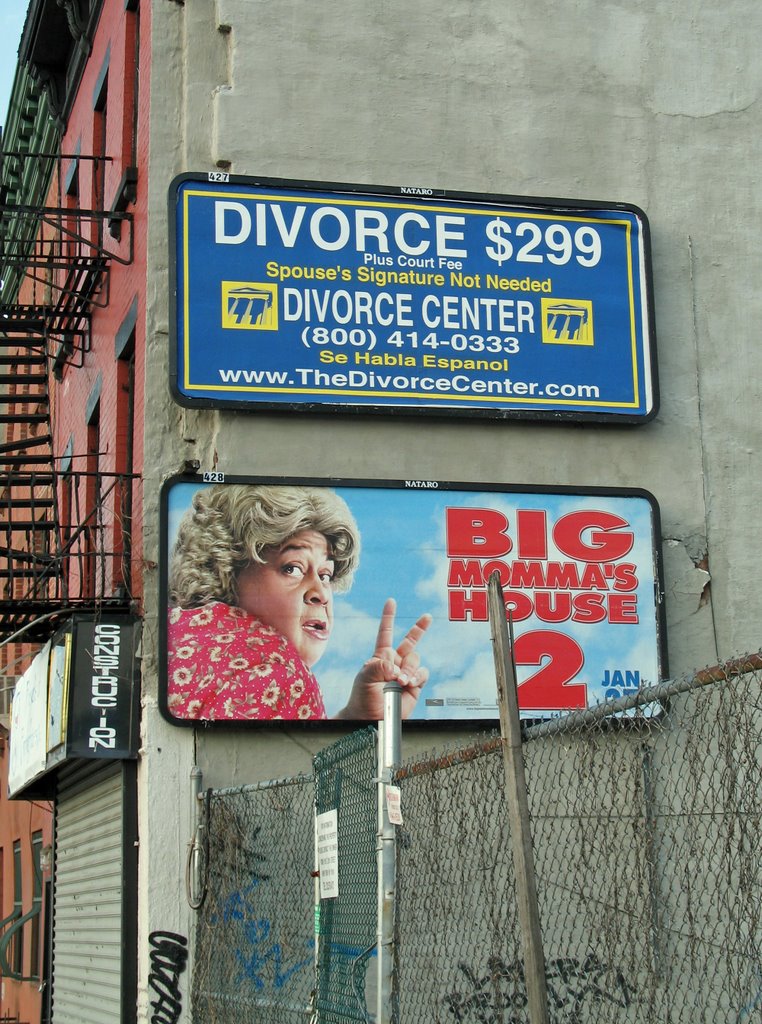
Walking north out of Red Hook on Columbia, I encountered two very contemporary signs attached to the south wall of a nineteenth century row house. The upper one had reassuring words for those contemplating splitsville.

Returning to my own neighborhood, Brooklyn Heights, I passed Our Lady of Lebanon, a Maronite Catholic cathedral at the corner of Henry and Remsen Streets (see photo at left). I've been told that these ornate metal doors were salvaged from the Normandie, the great French liner that burned and capsized at a Manhattan pier during the early part of World War 2 (see below for a photo, taken from www.ocean-liners.com, of Normandie leaving New York during her brief career as one of the queens of the North Atlantic.)

Thursday, April 20, 2006

Scott Crossfield, 1921-2006

Before today, it's safe to say I hadn't seen or heard the name Scott Crossfield, or thought of him, in at least forty five years. But when I was about the age my daughter is now (she's in sixth grade), Crossfield was one of my heroes. He was a test pilot for the National Advisory Committee on Aeronautics, or NACA (the forerunner of NASA, before anyone was bold enough to put "space" in the name), who, in 1953, had flown a beautiful swept-wing rocket-propelled plane, the D-558-2, at Mach 2, twice the speed of sound. Later, he flew the same craft to a new altitude record. Later still, flying a more advanced plane, the X-15, he became the first to exceed Mach 3.

Yesterday his body was found in the wreckage of his single-engine prop-driven Cessna, the same sort of plane I learned to fly in the summer between my junior and senior years of high school. At 84, he was still flying solo. As with so many airmen, a sudden encounter with bad weather was his nemesis.

Monday, April 17, 2006

Queen Mary 2 visits Brooklyn


Early Saturday morning, we heard the throaty blasts of a great ship's horns coming through a thick fog. It had to be Queen Mary 2, all 150,000 something gross tons of her, coming to dock for the first time at her new berth in Brooklyn. Yes, Brooklyn will now be her terminus on the western side of the Atlantic, from which, during the summer, she will maintain a regular service to Southampton, just as her Cunard Line predecessors did years ago, and in the fall and winter she will set off on cruises to the tropics. I had seen her before, sailing into and out of the Hudson, getting the photograph above of her departing at dusk. I had also seen her tied to the pier at the foot of West 55th Street, almost exactly where, at the age of five and from the observation deck of the Empire State Building, I had seen the old Queen Elizabeth docked during my first visit to New York in 1951. When I saw QM2 docked last year, she was longer than the pier, her stern jutting well into the river - no doubt a dicey situation because of the strain the Hudson's tidal currents put on her mooring lines. So a new place had to be found for her, and the other huge ships being put into cruise service, to tie up in New York. (Some had, to the horror of New Yorkers who care about such things, begun using an extra-long former military pier in Bayonne, New Jersey.) Brooklyn came to the rescue with Pier 12, a disused former breakbulk cargo berth lying at the seaward end and parallel to the Buttermilk Channel, a strait separating Brooklyn from Governor's Island. A new passenger handling facility was built there, and when I read that this would be where QM2 would dock, I realized I was about to realize a childhood dream: to live within sight of where great Cunarders berth.

When the fog cleared, I went across the street to the Brooklyn Heights Promenade and looked to the south. I was pleasantly surprised by how close the great ship's berth seemed to be. Knowing QM2 was to sail at 5:00 P.M. , I resolved to walk down to Red Hook, the neighborhood where she docked, in time to photograph her at her berth and as she sailed. That afternoon, I walked and walked, realizing that the ship's enormous bulk had fooled me into thinking she was closer than she really was. After hiking about two and a half miles, I got to the corner of Prince and Conover Streets, where I saw this juxtaposition of QM2's severely raked bow and the distant Statue of Liberty.

The closest view of the ship at dock was from the foot of Wolcott Street. Unfortunately, a high chain-link fence impeded photography, but by extending my zoom lens and slipping it between the links, I was able to get this shot of her magnificent superstructure and funnel:


I realized, however, that this site would not afford a good view of the ship's departure, as buildings behind me obscured the view of the channel to seaward. So, I walked back to Conover Street and headed south. At the foot of Conover, where the land curved around eastwards, I found just what I had hoped for: a public pier - the "Valentino Pier" according to the New York City Parks Department sign - jutting out into the harbor. There was a sizeable crowd already gathered to watch QM2's departure, but I was able to find a vantage point near the end of the pier. Just to my left was a police boat, part of a heavy presence of gendarmarie for this high-profle event.
After a few minutes' waiting, I was rewarded by three blasts of QM2's horns. A short while later, her bow emerged from behind warehouses and a rocky promontory.


As she sailed past, a fireboat in the harbor began to salute her with red, white and blue plumes of water.


As she headed toward the Narrows and the sea, I took one last shot of her stern. Note the crowds gathered by her railings:

Monday, April 03, 2006

Is Florida the new Kentucky?

Hard to think of the Gators as a basketball power. I figured them to blow by George Mason, then wilt in the glare of national championship spotlights. Besides, UCLA has trad-di-SHON, and that, as any sports pundit worth the NaCl will tell you, is what counts in the crunch.

But not this time.

Mets won their opener, too. Of course, I take this as a bad sign. I believe (correct me if I'm wrong, please -- I'm too tired to look it up) that they lost their opening games in '79 and '86.

Wednesday, March 15, 2006

The Brit villain was right.

An occasional ornament of cowboy movies was the evil Englishman. He had some underhanded scheme to acquire a huge tract of land which, of course, he planned to fence, maybe even graze sheep. Or, perhaps, it was to get his hands on a small tract on which he knew there was gold. He spoke in flowery phrases with a clipped, upper-class accent, and made no effort to conceal his disdain for Yank yokels. At the climactic moment, when the cowboy hero confronted him, pistol drawn, to thwart his crooked designs, the Brit always uttered some comment on his superior intellect or breeding, hoping to so overwhelm the rube as to make him re-holster his gun. It never worked.

One declaration of this ilk sticks in my memory: "The blood of Plantagenet kings flows in my veins." Well, turns out that, if our hero knew about human genetics, he could have answered, "Yup, me too."

Tuesday, March 14, 2006

Promises, promises ...

Yes, I said the blog was back, then went and neglected it again. I've got my excuses: heavy work schedule, a bout with some nasty virus, and, not least, a certain wistfulness brought on by my impending 60th birthday.

More to come soon. I'm rested (if not tanned) and more or less ready. Stay tuned.

Monday, February 20, 2006

A pre-season contest.

How will the Mets blow it this year?

Martinez's toe? Reyes's hamstring? Delgado succumbing to no-hit-itis while Beltran fails to recover? Clubhouse acrimony?

Your suggestions, please ...


3/3/06 update: Twiff, as I might have guessed, offers "All of the above." Spring training results so far (opener a 12-7 win over the Cards with Delgado looking great and Nady going 4 for 4 with a grand slam; Cards ahead 11-7 tonight in the top of the 9th, with no details available) indicate lots of offensive fireworks. Pitching, as might be expected, is shaky at this point (but a good inning from Wagner last night is encouraging).

Martinez emerges as the big question. Even with the new shoe, he's reporting some pain. I'm anticipating an early season exit and surgery.

Mature at last!

The Trivial Life - Why Jay McInerney should embrace frivolity. By Blake Bailey.

According to Blake Bailey, "Mature at last!" was F. Scott Fitzgerald's cri de couer after each crisis, and might well be McInerney's. As one who admires both The Great Gatsby and Bright Lights, Big City, despite having little in common with Nick Carraway (apart from "being inclined to reserve all judgements") and with "you" (except for the occasional sense that an attractive woman I pass on the sidewalk is regarding me "as if I just crawled out of the Hudson, trailing slime"), I'm similarly inclined. This despite being a bit shy of a month from my sixtieth birthday. (I've told my wife that I mean to have buttons made that say "60 is the new 40". She doesn't approve.)

So I promise this blog is back, and will at last live down to its intendedly ironic name. Keep checking.

Monday, January 02, 2006

Transit strike postscript.

I took some more photos on my walk to work during the third and final day of the strike. The next few days were full of holiday events; between those and work I haven't had time to post them until now.

As I've mentioned in my earlier posts, the strike made me walk through some places where I hadn't walked in some time. This made me renew some old architectural acquaintences, as well as introducing me to some new ones.


Crossing the Brooklyn Bridge, I noticed the frenetic activity on the water below. The ferry services were doing very good business.

I also noticed how banal the East River waterfront has become, palisaded as it is by undistinguished buildings of 1960s, '70s and '80s vintage, dominated by the monstrous, bulky 55 Water Street.

The one architectural gem in this view is the newly-completed Staten Island ferry terminal. It's the slope-roofed building just to the right of the orange Staten Island ferry vessel sitting at its berth.

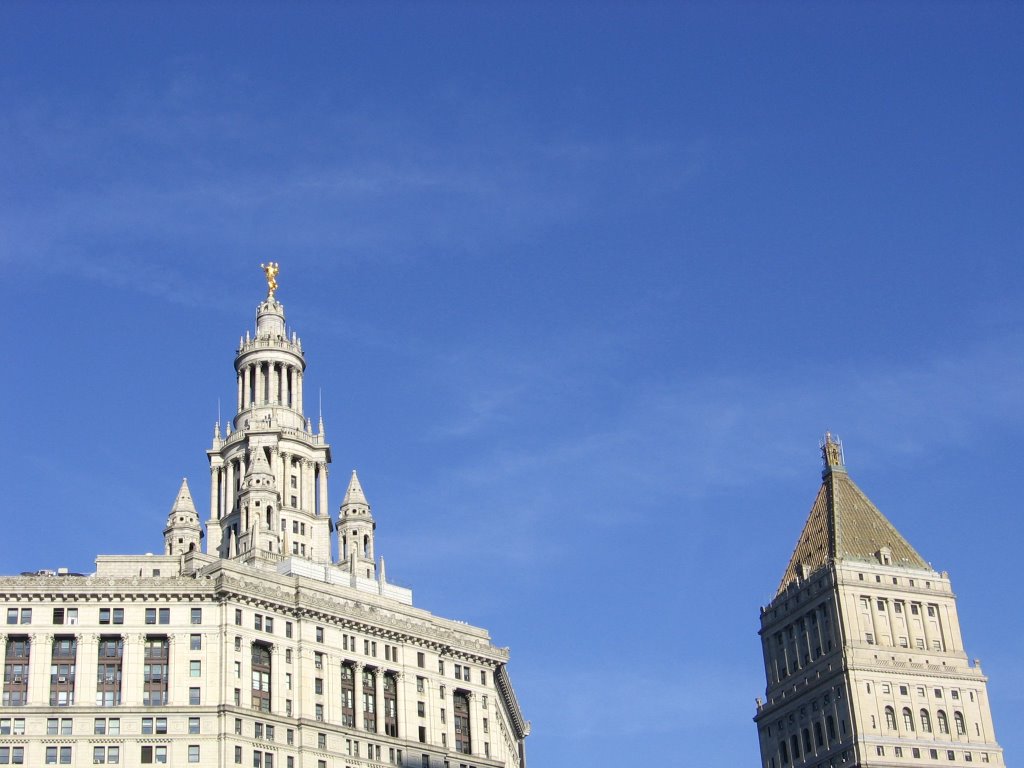
Continuing across the Bridge, I got another good view of "Civic Fame," this time of her back. This daylight view of the Municipal Building also explains the "Stalinist Gothic" quip in my earlier post.

The building to the right, topped by a golden pyramid, is the old Federal Court House, facing on Foley Square. It houses the Court of Appeals for the Second Circuit and the District Court for the Southern District of New York. The latter has become so busy that additional courtrooms and judges' chambers have been added in the adjacent (but not visible here) new Daniel P. Moynihan Courthouse.
Vernacular architecture in New York runs the gamut. Here's the pagoda at Canal and Centre, in the heart of Chinatown:

The ground floor used to house a bank, but now hosts a Starbucks. Can anything be divined from this change?

Small, often overlooked buildings can be surprisingly lovely. Consider these neighbors on Lafayette Street, one Romanesque, the other Gothic:
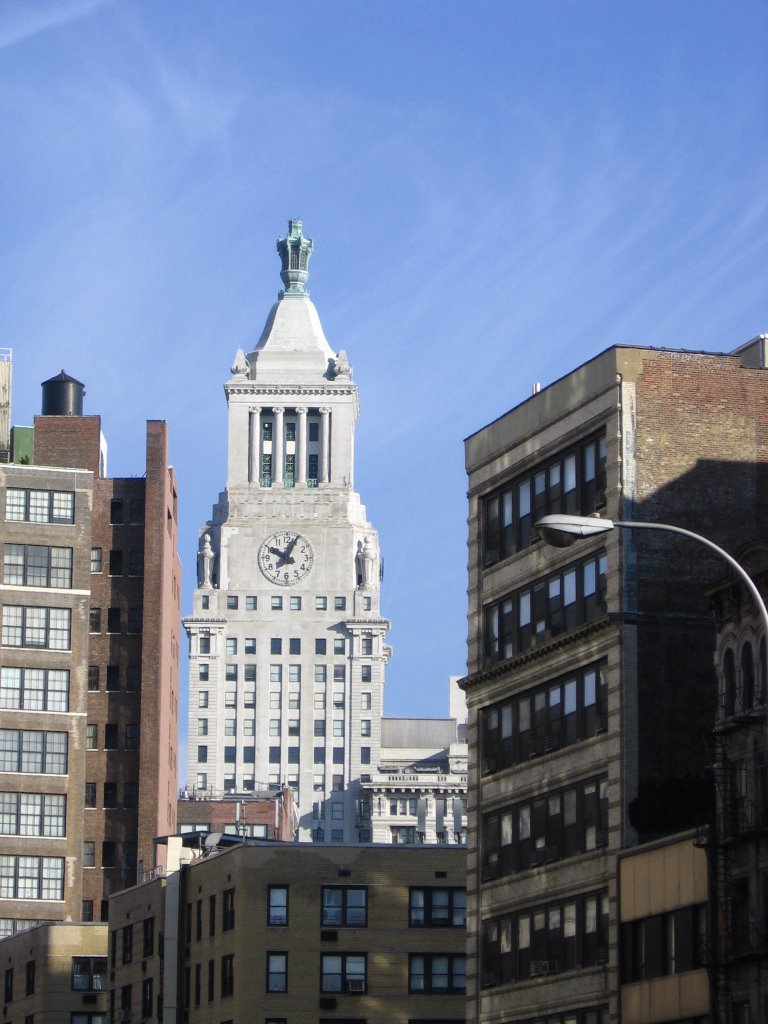
Reaching the north end of Lafayette at Astor Square, I looked at the clock on the Electric Kremlin (Con Ed headquarters, so called both for its appearance and for the alleged management style of the mighty utility company). Once again, I saw that I was later than I'd hoped.


Continuing my walk up Park Avenue, I noticed something new.

It proved to be "Scandinavia House." As you would expect of a building bearing that name, it is (1) modern, and (2) exquisitely tasteful. Its tatefulness may be accentuated by comparison to its less than comely neighbor to the right.

The art deco style is like the little girl with the little curl in the middle of her forehead. When it is good, it is very good:


But, when it is bad, it is very, very bad:


Consideration of deco brings to mind Rockefeller Center, and, at this time of year, Rockefeller Center brings to mind the Tree.

Happy New Year to all!

Gators survive!

About two minutes into the fourth quarter, I was convinced they were going to show their talent for snatching defeat from the jaws of victory. An offsides call on an onside kick probably saved them going to overtime. Somewhere, Hipparchia is celebrating, as is my neighbor who spread a "Florida Gators" mat in front of his door a day before the game. He just recently passed the New York bar exam, and he and his longtime girlfriend have announced their engagement. DAH! Da-da-da-da-duh!

My USF Bulls were not completely humiliated in their first bowl appearance, even though they were shut out for the first time ever. At least they showed they have a decent defense, except for the second quarter, when they allowed N.C. State two quick TDs.

Wednesday, December 21, 2005

Transit Strike Journal - 2


As promised, I'm continuing my story of day one of the strike with an account of my walk home. I got an early start, so it was still quite light when I left 52nd and 5th. By the time I crossed 14th Street at Union Square, it was twilight. Walking down Lafayette Street just above Bleecker, I noticed some delicate looking pink clouds over the buildings to the southeast.

The big glass of Stella painted on the side of the building looked inviting, but I resisted the temptation to rest my legs while perching on the nearest available barstool.

When I got to Canal Street, the sky was quite dark. Just below Canal, I faced another temptation.
Is "healthy dessert" an oxymoron? I hadn't eaten dinner yet, and could have used a sugar rush (if a healthy dessert can indeed deliver one). Nevertheless, I pressed on.
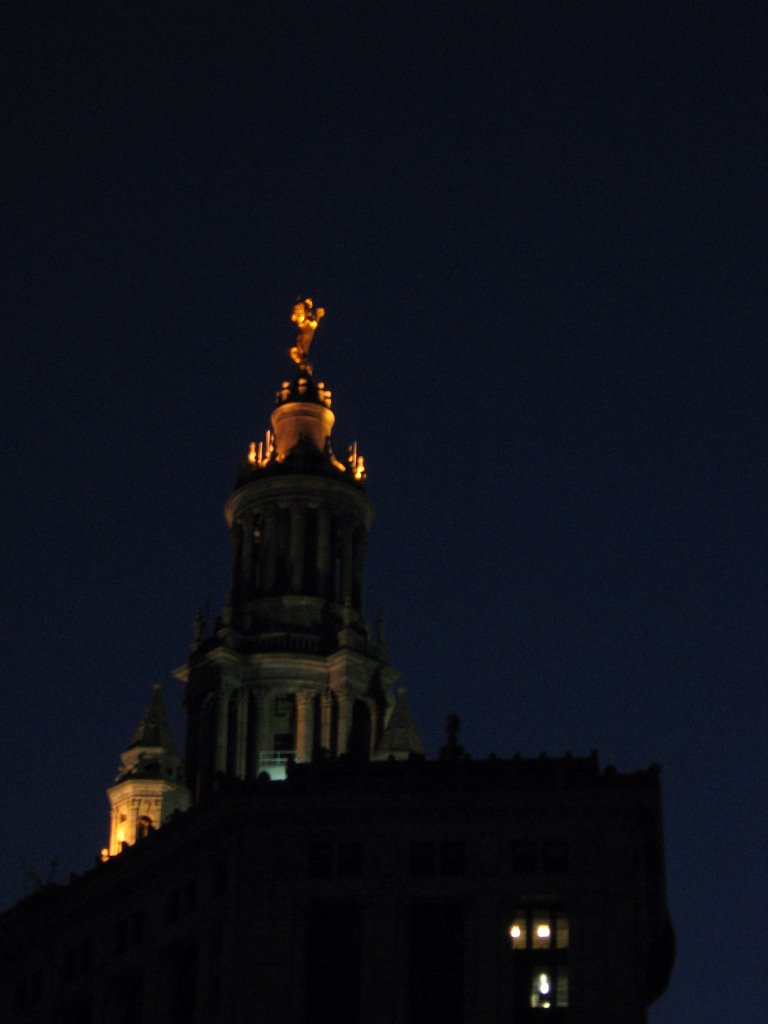
Approaching Foley Square on Centre Street, I had a good view of "Civic Fame," the gilded statue atop McKim, Mead & White's ponderous Municipal Building, described as "the finest example of Stalinist Gothic architecture in America."

She seemed an angel from another age, standing guard over a city that had undergone enormous change since she assumed her perch. Her eyes would have looked right at the World Trade Center towers as they were built over several years, stood for nearly thirty, then were brought down in one terrible hour.
Perhaps now she was looking down at the swarm of pedestrians heading onto the Brooklyn Bridge walkway, wondering what madness had possessed her polis.

Approaching the bridge, I was drawn into a surge of bodies being funneled onto the narrow walkway. Looking down, I could see a swarm of traffic clogging Water Street below.

On reaching the far side of the Bridge, I found our ebullient Borough President, Marty Markowitz, greeting returning Brooklynites.
In a fit of either historical amnesia or secessionist defiance, he was shouting, "Welcome to the City of Brooklyn!"

Tuesday, December 20, 2005

Transit Strike Journal

News junkie that I am, I stayed up until midnight to see if there was going to be a transit strike. There was no point in turning the TV on before then; the kabuki of public employee labor negotiations in New York is such that nothing can ever be resolved until the last possible minute. The first word I got was that TWU President Roger Toussaint had rejected the MTA's "final" offer (its second such, or perhaps third) at 11:30 p.m., and left the negotiations to meet with the Union's board. The trains and buses were still running, pending the board's decision. I watched for a while as Gene Russianoff of the Straphangers' Campaign and others speculated on the likely outcome and its conse quences. When no decision had been announced by 12:45, I decided that I'd better get to bed, as I almost surely had a long walk ahead of me in the morning. This theory was confirmed at 6:00 a.m. by the WQXR newscaster. I rolled over to get a bit more sleep, and wasn't able to rouse myself before 7:30. I figured it would take about an hour and a half to get from where I live, Brooklyn Heights, to midtown Manhattan, where I work. I didn't feel any pressure to be in early, so I had a leisurely shower and breakfast, and kissed my wife and daughter goodbye at 8:45. It was a great day for walking, cold, but with little wind, and perfectly clear. I felt cheerful, with a spring in my step as I walked across Montague Street and down Henry towards the pedestrian entrance to the Brooklyn Bridge. As I crossed Cadman Plaza, I looked over at the bridge approach to see how crowded the walkway was. People were going by at a good clip, and it wasn't packed:

I climbed the stairs to the walkway, and headed toward Manhattan, feeling the exhiliration I hadn't felt for the few years since I'd last crossed the Brooklyn Bridge on foot.


When I got to the Manhattan side, I headed north past the courthouses on Foley Square and just beyond on Centre Street. As I went past the huge Art Deco Criminal Court building, I noticed a new (to me, who hadn't walked here in some years) addition just to its north. I relaized this was the new jail that replaced the ancient and storied "Tombs." Then, from the corner of my eye, I noticed a brightly colored sign affixed to the elevated walkway connecting the jail to the courthouse:


Given recent revelations, I'm surprised this sign is still there. At least it's fun to speculate as to what behaviors might be symptomatic of a "Bernard B. Kerik Complex."

Going up Lafayette Street, I walked past a bicycle store, noticing a beautiful, chrome yellow bike in the window. Then I saw several men inside, all positioned near the door, willing me in with their eyes. They seemed hopeful of doing a lot of business because of the strike. For a moment, I thought how nice it would be to go in, buy a bike, and ride it the rest of the way. But then, there was the question of what to do with it once I got there. New York doesn't have lots of public bike racks, and surely the staff of the building where I work wouldn't allow one to be brought inside.

When I got to Lafayette and Houston, the light was against me, so I went left towards Broadway. I decide to cross at Crosby, however, because it afforded a view of the exquisite Bayard-Condict Building, the only New York example of the art of Chicago's great Louis Sullivan:


Heading up Broadway, I heard the bells of Grace Chuch (not to be confused with my own beloved Grace Church, Brooklyn Heights) chime ten times. I knew I was taking more time than I should, but I was still enjoying the walk. I went past Union Square onto Park Avenue South, and, by 23rd Street, was feeling the effects of age and lack of serious exercise. A little further, and Grand Central beckoned:


The clock on the Terminal's facade said 10:30, and I still had about twelve blocks to go. I plunged into the Terminal, hoping the ceiling laser show would be going so I could photograph it, but it wasn't. I went across 43rd to Madison, then headed up to 52nd Street. At 51st, I paused to take this shot of St. Patrick's Cathedral from the rear, with Rockefeller Center beyond, and Olympic Tower, site of my office, the brownish International style slab to its right:


When I entered the office of the firm where I work, the first thing I noticed was a bike standing near the door of the senior partner's office. He got up to greet me, dressed in an outfit not unlike that worn by Tour de France contestants.

I have more tales and photos from my journey home, but will save them for tomorrow.

Sunday, November 06, 2005

I did say to look out for Vandy, didn't I?

I'm beginning to think I could make money calling Gator games. What was the spread? Had to be at least seven.

Saturday, October 29, 2005

Spillage at World's Largest Outdoor Cocktail Party.

Gators 14, Dawgs 10.

Georgia used to have Florida's number in the worst kind of way. Seems like it's the other way around, now.

Meyer can breathe a little easier. A win over Georgia washes away many sins.

Next weekend, though, his team faces Vandy. A lark, you say? If you're a Gator fan, you'd better hope the team doesn't think that way.

Thursday, October 27, 2005

Wot, no curse?

White Sox win, for the first time since 1917. This, despite my favor (see my "I give the kiss of death" post below). So, the teams that hadn't won since the administration of Woodrow Wilson have both done it in the administration of the single W. Can the team that hasn't done it since the administration of William Howard Taft (yes, Joe Queenan, I stole that from you) be next?

Actually, I hope the 2006 champ will be a team that last won it during the second Reagan administration, just in time for the twentieth anniversary of their last World Series triumph.

Saturday, October 22, 2005

Gators and Seminoles

Fray friend Hipparchia responded to my last post by recalling a party she gave for the Florida-Florida State game, to which she invited an equal number of fans for each team, and divided them by duct tape on the floor. She says her team won, but is coy about which team that was. She probably told me when I met her at the New York Fray gathering a few weeks ago, but I've forgotten. I'll be bold enough to guess it's FSU, because (1) Hipparchia lives in Pensacola, which is a lot closer to Tallahassee than to Gainesville, and (2) the 'Noles have beaten the Gators more often than not in recent years.

"[I]n recent years": therein hangs a tale I promised to tell in my last post.

First, a bit of history. Until 1947, what is now Florida State University was the Florida State College for Women. In that year, both it and the University of Florida (formerly exclusively male) were made coeducational. Sometime after that Florida State began fielding a football team. (Personal sidebar: The first time I ever saw a college football team on the field was in 1957, when I saw the FSU freshmen team play the Eglin Air Force Base, where my father was then stationed, Eagles. The Eagles won handily, largely on the strength of their running back - old Baltimore Colts fans take note - Lenny Moore.) Anyway, as the story goes, FSU longed to play the Florida Gators, but the Gators, then in what later became known ironically as their "golden era", and fearing embarrassment, refused to schedule them. Finally, the Florida Legislature passed an act, signed by the governor, that compelled the two teams to play each other each season.

For a number of years, despite the fears that kept them from scheduling them, the Gators routinely beat the 'Noles, while Florida fans taunted the FSU contingent by yelling "Girls' school!". If you've read my earlier posts about the Brooklyn Dodgers, you know that I favor underdogs. So, though I rooted for the Gators in every other game, through many years I rooted for FSU to beat them. It finally happened in 1964 (they managed a 3-3 tie in 1961) when I was in college at South Florida (which didn't have a football team in those days). Then, it was back to frustration, particularly in 1966, when a disputed call ('Noles receiver Lane Fenner was called out of bounds on a catch that would have won the game) decided things. So I was still backing State in '67, when I was in law school in Cambridge, Massachusetts, and despairing of getting any news of the game on local radio, when, to my amazement, the WRKO Boston late evening DJ said, "I've got to hand it to my old Florida State team. They beat Florida today, 21-16."

But a funny thing happened. FSU got a coach named Bobby Bowden who turned the 'Noles into uberhunden. So, now, when they play each other, I usually root for the Gators, unless the 'Noles have a shot at the national championship and the Gators don't, which, of course, is when the Gators usually beat them. Appropriately, the Gators' only national championship came when their only regular season loss was to FSU, then they turned around and beat the 'Noles in the Sugar Bowl.

Monday, October 17, 2005

Perhaps my last college football rant.

This weekend, like the one just past, usually comes about mid-season. I mean the one when absolutely every game I care about goes the wrong way. The one where all my favorites - the Gators, the Seminoles (yeah, love 'em both - there's a story I'll tell some other time), Penn State (my mom grew up near State College, and I was born in Altoona, where PSU has a branch that hosts a summer fling for railroad buffs that I attend whenever I can) - get eliminated from national title consideration. The one where my alma mater loses one it could have, and needed to, win. The one where the Big Upset I wanted doesn't happen - yeah, I was rooting for Notre Dame over USC, and the only satisfaction I get is that the Irish got dealt the same fate they visited upon my beloved 'Noles and Gators, i.e. seeing a fourth quarter lead erased in the final seconds.

So, who's left to pin my hopes on? Could I learn to love the Horned Frogs?

Friday, October 14, 2005

Thank you, Mickey!

Blogspot should pay the prevailing wage, as determined by DOL, don't you think?

-Kausfiles, October 13, 2005

Of course, if it's hourly, I wouldn't be making much lately.

Monday, October 10, 2005

I give the kiss of death; or, why I want the White Sox to win the championship.

In an earlier post, I told how I became a Brooklyn Dodger fan at age nine, so you know I have a thing for underdogs. Now that the Red Sox are out of it, the bonds of spousal loyalty have been cut, and now that the Braves are gone, only one team that I loathe (the one I loathe maximally) is still in the chase. (As I write this, the Angels cling to a two run lead over said loathed team in the bottom of the seventh, having survived an onslaught by the cream of said team's order in the top of the inning, yielding only a solo homer to Jeter. So there's hope.)

Assuming the Angels succeed in driving a stake through the Steinbrennerian heart tonight, that leaves Angels vs. White Sox, Astros vs. Cards. I was glad when the Angels got it a couple of years ago. They were classic underdogs. But since their ridiculous name change - why couldn't they just call themselves Los Angeles de Anaheim? - I can no longer take them seriously. Normally, I would root for the National League team in any event, out of loyalty to my Mets and disdain for the AL game. (What's good about the designated hitter rule? Oh, yeah. It extends the careers of great old warhorses like Rafael Palmiero.) And the Cards, everyone's favorite to win the NLCS, happen to be the team I admire most on purely aesthetic grounds.

But the Chisox haven't won it since 1917, and there would be something nice about their winning it the year after the team that hadn't since 1918. That, and getting over the Black Sox thing, just like getting past the Curse. And Chicago's a great town.

Sorry, guys. Teams I root for have about the same success ratio as politicians I back. But, go Sox!