It only took them fifty seasons, but the Mets finally got a no-hitter. They got it off the arm of their ace, Johan Santana, who has had a rocky start this season coming off shoulder surgery. The eight runs scored by Santana's teammates called into question the notion that he doesn't get run support. That he and the team got it against the Cardinals, a strong contender in the NL Central, makes it doubly impressive.
Typically for the Mets, it wasn't without drama. Santana came within inches of losing it in the sixth, when a long drive down the left field line was, in what I'm sure in the eyes of most Cards fans was an example of "home cooking", called foul. That the drive came off the bat of Carlos Beltran, who subsequently grounded out, casts doubt on the "curse of the ex-Met" theory.
Photo: Wikipedia.
As anyone following the story knows by now, Dewey & LeBoeuf LLP filed for bankruptcy early today. The New York Times story notes that the merger of the former Dewey Ballantine with LeBoeuf, Lamb, Greene & MacRae LLP happened just before the financial collapse of 2008. Before the merger, LeBoeuf, under Steve Davis's leadership, had been aggressive in recruiting partners laterally from other firms, and Dewey had taken on debt. According to the Times:
Even as [post-merger] Dewey’s performance flagged, the firm doled out lavish multiyear, multimillion-dollar guarantees to its top partners and star recruits. The guarantees — there were about 100, with several over $5 million a year — created compensation obligations that the firm could not meet.
That what should have been evidently risky behavior continued after financial market turmoil, along with other, more gradual changes in the market for legal services, such as the tendency of corporations to take more legal work in-house to save costs, reduced the firm's revenue, points to a parallel between Dewey and J.P Morgan Chase. In both instances, there seems to have been a tendency to "double down" rather than to accept what may have been a manageable loss. I'll be writing more about the J.P. Morgan debacle soon.
This is not the promised second installment of my reminiscences about the LeBoeuf that was. That we be along soon; I hope by this coming weekend. Please stay tuned.
I hated disco when it dominated the party scene and the airwaves in the mid to late 1970s. Now that it's wrapped in the warm blanket of nostalgia, my feelings have mellowed. And I always made an exception for this lady with the powerful voice. Thanks to Rael1964 for this live performance clip.
"You're part of the legend." That's what another lawyer I had just met, who had formerly been a partner in the firm LeBoeuf, Lamb, Greene & MacRae LLP, arriving there long after I'd left, said. I didn't ask what the legend was. From the perspective of a 21st century megafirm, the firm with which I started my career in 1970, then called LeBoeuf, Lamb, Leiby & MacRae, must have seemed a legend, though perhaps more like Fiddler's Green than Camelot.
My first contact with LeBoeuf was an interview in Cambridge during the fall of 1969. After I introduced myself to the partner and associate conducting the interview, the partner's first question was if I knew a woman in my class who had done a summer clerkship at the firm that year.
"Know her? I've only been hopelessly infatuated with her for the past two years. Why else would I have signed up to interview with a little known firm in a city I haven't seriously considered as a destination?", I thought.
"Yes," I said. As I gave my flat affirmation, my eyes and the partner's made meaningful contact. Knowing we shared an affection, we became simpatico. The rest of the interview was pro forma. By such ephemera are the course of a life shaped. A few days later, I got a letter inviting me to further interviews in New York.
(The woman in question later spurned LeBoeuf's offer of a permanent position, choosing instead the charms of San Francisco.)
The New York interview went well, by my estimation, until lunch. The two partners who accompanied me to the Broad Street Club were: Peter, tall, of patrician manner, and bearing the name of one of New York's grand old Dutch families; and Joe, short, balding, bespectacled, and Jewish. For most of the lunch I felt like a spectator at an intellectual ping pong match, as Joe and Peter engaged in what to them seemed most enjoyable repartee. Then I made what I later learned was a classic mistake: "If they take you to lunch, don't order dessert." I ordered a creme de menthe parfait. When it arrived, Joe said, "That's instant alcohol!", and Peter said, "Oh, no. We'll have to carry him back." On our return to One Chase Manhattan Plaza (see photo, courtesy of en.wikipedia.org) where the firm had its offices, I managed to get into the same revolving door compartment as Joe, and trod on his heels. When we arrived at the firm's reception area and I thanked them for the lunch, I got Joe's surname wrong. "Oh, well," I thought, "so much for that."
When I got the letter offering me a job as an associate, at the then stratospheric starting salary of $15,000, I celebrated by buying Jefferson Airplane's Volunteers, a bottle of vodka, and a bottle of Kahlua, then went home, fixed a Black Russian, turned up the volume, and grooved to Grace Slick singing
We are all outlaws in the eyes of America,
In order to survive we steal, cheat, lie, forge, fuck, hide, and deal,
We are obscene, lawless, hideous, dangerous, dirty, VIOLENT,
And young....
When I started work at LeBoeuf in June of 1970, I was given a desk in an office next door to Joe's that I shared with two other associates, Judy (the firm was ahead of its time in having two women lawyers; the other, Sheila, had started as a secretary, went to law school at night, was made an associate, then became the firm's first female partner after twelve years, as contrasted with the usual six or seven) and another Pete. Working on my first assignment, I came to a citation I didn't understand. I asked Judy if she could explain it, and she said, "Why don't you ask Joe?" With trepidation, I knocked on his office door. He looked up, blinked, and said, "Oh, so we did make an offer."
I later discovered, because of my occasional urge to push the sartorial envelope, that Joe was a self-appointed dress code enforcer (he personified the saying, "Think Yiddish, dress British"). One day I showed up in a perfectly acceptable Brooks Brothers tan poplin summer suit, but under it wore a fire engine red dress shirt and a dark blue tie with a diagonal chain link figure that matched the red of the shirt. As I passed Joe's office, I heard, "Hey, Claude, ya gonna shoot 'em up?" I looked at him quizzically, and he said, "You look like you're dressed for the Saint Valentine's Day Massacre."
The desk I was given in the three-associate office had belonged to a lawyer who left the firm shortly before I arrived. In what has now proved to be a bit of historical irony, that lawyer was John Martin Dewey, the younger of Thomas E. Dewey's two sons. Dewey père was the former Governor of New York and Republican candidate for President in 1948, famously and erroneously declared the victor over Harry Truman by the Chicago Tribune. After that he became the lead partner in a large, prestigious firm then called Dewey, Ballantine, Bushby, Palmer & Wood.
Past Joe's office was Jim's, and a few doors down from Jim was Jack. Both were listed on the letterhead as partners. Jim had closely cropped white hair, a round, florid face, and glinty Irish eyes. Jack had sharp features, slightly protuberant eyes, and slate grey hair brushed back and pomaded into place. Both would arrive every morning ten-ish, and close their office doors. Both took long lunches from which they would return with more color in their faces than before. They would close their office doors again, and soon the odor of cigar smoke would waft from under them. No associates were ever called to their offices for assignments. From bits and pieces of lore I could glean from older associates, Jack and Jim had been very productive partners for many years. They had done financing work for public utilities, the traditional centerpiece of the firm's practice. Someone told me that Jack billed forty hours a week to a large upstate electric and gas utility, which was glad to pay the bill, knowing he would occasionally look over a bond indenture with his keen eye and institutional memory.
One of my first big assignments was to assist Taylor, a senior litigation partner, with a matter for a client in Jamestown, a small city located near the far western end of New York State. Our first trip out to visit the client was in October, and it was a clear, crisp fall day as we boarded an Allegheny Airlines (a predecessor of USAir, often called "Agony Air") twin turboprop Convair at Newark Airport. Our flight was a puddle jumper that went from Newark to Bradford, Pennsylvania, then to Jamestown, then on to its final destination, Pittsburgh. As we flew westward, we were soon over a thick cloud bank. On our descent into Bradford, I casually mentioned to Taylor that this was where Allegheny had put two planes into the trees the previous winter. We made it into and out of Bradford without incident. Descending into Jamestown, which was still under heavy clouds, we had just broken through so that I could see brilliant autumn foliage below when the pilot gunned the engines and we began climbing. He got on the intercom and said we'd missed our approach, that he would circle and try again, but that if we missed a second time we would have to skip Jamestown and go on to Pittsburgh. We made it on the second try. (Photo:AirlinersGallery.com)
I can't resist mentioning here that Jamestown later became the birthplace of one of my favorite rock groups, 10,000 Maniacs, which, in turn, became famous for launching the solo career of Natalie Merchant. The clip above is of their song "Maddox Table", named for one of Jamestown's biggest employers (the city was a furniture manufacturing center) and a customer of our client. The music is accompanied by video scenes of Jamestown life in 1948; "Maddox Table" is a paean to the band's parents' generation.
After a day conferring with the client's managers, we were taken to dinner at Jamestown's club for local V.I.P.s. Taylor and I had tickets to return to Newark on an Allegheny flight that took the same route as the one we took out in reverse, leaving at 7:30. As it got to be 6:30 and we were finishing dessert, I glanced nervously at my watch. Taylor asked if Cognac was available. It was. Cigars? To be sure. Our cab got us to the airport just as the plane was taking off. "Darn!", Taylor said. "We'll just have to rent a car, drive to Buffalo, and see if we can get a flight from there. If there's nothing tonight, my sainted parents will put us up." At the Buffalo airport, we were able to get on an American Airlines 707 nonstop to Newark--no flirting with the treetops in Bradford.
Taylor later became the messenger delivering some very welcome news. I was cavalier in my preparation for the New York bar exam; as a consequence, I failed on my first attempt. The day after the results came out, three partners (not including Taylor) came to my desk at different times, each to confide that they, too, had flunked the exam on the first go-round, and not to worry. After that, I had to leave the firm temporarily to fulfill my Army Reserve active duty commitment, and found that Fort Polk, Louisiana was an ideal study environment. I took leave to go back and take the exam, and a month or so later got a phone call from my parents, who had received a telegram: "You passed bar exam. Congratulations, Taylor."
Ike Davis, who's had his (as sportswriters love to put it) struggles at the plate, hit a three run homer at Citizens Bank Park tonight to help the Mets complete a three game sweep of their division rivals and often nemeses the Phillies on their home ground. Having taken two of three from the Phils at Citi Field in April, the season record is now 5-1 Mets. The Amazins are now in third place in the Real Baseball League East, but a mere half game behind the division leading Nats and Braves. Third is as well as I'd hoped they would finish the season, even in my wildest dreams, but they're flirting with better.
I can't help but wonder if I'm sharing the fate of Tantalus.
Tonight's supermoon, or, as we here in Brooklyn Heights call it, Cosmo's moon, was obscured by clouds. Last night, walking home from Jack the Horse Tavern, I did get this fuzzy photo (using my BlackBerry) of a 99% supermoon looming over Hicks Street.
On this Cinco de Mayo, the day that Mexico celebrates its independence, I'm thinking about an incident in the long and fraught relationship between that country and ours, back when that relationship was at its most fraught, 1846-48, when we were at war with each other. It also involves Ireland, a country for which, through some ancestry, many friendships and now through marriage, I hold great affection.
The San Patricios, or St. Patrick's Batallion, were mostly Irish immigrants who defected from the U.S. Army either, like their leader Jon Riley, shortly before war was declared, or during the course of the war, to join and fight with the Mexican army. Along with Irish, the battalion also included immigrants from other European countries, almost all of them Catholics, a few native Mexicans who had enlisted in the U.S. Army, and some escaped African slaves. Few were U.S. citizens.
The song in the clip above, by David Rovics, of necessity gives a simplified account of the San Patricio story. The original 200 or so who defected with Riley are said to have been motivated by the discrimination they felt from officers and fellow soldiers because of their being Irish and Catholic (Irish immigrants were objects of considerable prejudice at the time) and by being denied the ability to practice their religion (no Catholic chaplains or masses) which the Mexicans, as co-religionists, could offer them. However, the Mexicans also offered higher pay to soldiers who would defect and serve in their army, and made promises of land to those who fought and survived. Immigrants to the U.S. may also have been offered land upon completion of army service.
They are said to have fought bravely and effectively. Many were killed in action. Those who were forced to surrender near the conclusion of the war were dealt with harshly. The ones who defected before hostilities were declared, including Riley, were given fifty lashes and had their faces branded with the letter "D" for deserter. Those who deserted after the war started were executed; a few by firing squad but most by hanging.
The Chieftains, in collaboration with Ry Cooder and many Mexican musicians, recorded an album, San Patricio, based on the battalion's history.
Listening to Jimmy's song made me think about waterbeds. I've never owned one, and never hope to. I'm sure that, in my cooperative apartment proprietary lease, somewhere in the fine print I read years ago and mostly forgot, there's a clause prohibiting them. The weight can put strain on structural elements, and a leak on a higher floor could send water cascading down. Maybe this is why I haven't heard of waterbeds in years: I live in a city of apartment dwellers. Perhaps I have suburban acquaintances who are frolicking on waterbeds but somehow failing to mention this to me. Out of curiosity, I did a web search for "waterbeds New York" and found one dealer in suburban Farmingdale.
An Arkansas boy, Levon Helm joined up with fellow Razorback Ronnie Hawkins and followed him to Canada where, with the addition of some Canadian musicians, they became Ronnie Hawkins and the Hawks, and spread the gospel of rock 'n' roll in the Great Frozen North. Later, sans Hawkins, they became Dylan's backup band. Then they became The Band, makers of so much sublime music. The clip above, thanks to PBS, shows Levon drumming and singing with a group called the Midnight Ramblers on the classic Band song "The Weight" sometime not too long ago.
Levon died today at 71, from "complications of cancer."
This sort of thing isn't supposed to be happening. I was delighted by their season opening sweep of the Braves, but I recalled a similar occurrence some seasons ago, after which the Mets quickly demonstrated what statisticians call regression toward the mean. I thought that was happening when the Mets lost their second two to the Nats, including the vaunted Santana-Strasburg match-up. I couldn't watch the game, as I was working. After seeing the 4-0 score, I asked Kristin, charming Chip Shop bartender and fellow Mets fan, if Santana had re-injured his shoulder. "No," she said, "he's all right. They just never hit for him."
I'll confess to being puzzled by this "run support" thing. The implication is that the batters dislike a pitcher, so, in games when he's pitching, they (subconsciously, we hope) don't see the ball as well, or take a little off their swings. But if it's the ace pitcher who typically doesn't get support (as with Santana), then a more straightforward explanation is that schedules often produce ace-to-ace match-ups, so the batters will facing the opposing team's best pitcher, as the Mets may have been with Strasburg.
In another few weeks, I may look back on this post with embarrassment. For now, I'm enjoying the ride.
I'd had a taste of Brooklyn Brewery's Sorachi Ace beer at Borough President Marty Markowitz's presser for Dine in Brooklyn (indeed, several tastings, as the Brooklyn Brewery folks were kind about refilling my little cup as I went around tasting food), and I wanted to try it again. This afternoon I spotted it at Lassen & Hennigs, and decided it would be an interesting accompaniment to my temporary bachelor (my wife is at an archivists' meeting in Cape May, New Jersey) dinner of Trader Joe's barbecued pulled pork on a bun accompanied by a mixed green salad with tomatoes and mushrooms topped with T.J.'s sesame soy ginger vinaigrette dressing. Above is a photo of the impressive 25.4 fluid ounce bottle, with its Champagne-style cork.
Here is a closer photo of the label. "Sorachi Ace" is the kind of hops used in making the beer.
When I pulled the cork, there was a nice little "pop." I made the mistake of pouring a bit too fast, which resulted in a huge head. After allowing it to collapse enough to pour more beer, I settled down to drink and eat. Here are my tasting notes:
Color: deep amber.
Head: big, creamy, long-lasting.
Aroma: citrusy, hoppy, with floral overtones.
Taste: rich, not overly bitter, toasty, suggestion of apricots in the finish. After I wrote those tasting notes, I did a web search for "sorachi ace hops" and got this. While the article stresses a lemony quality of the hops, the comment by Ben (scroll down) refers to " a really creamy, cloying, buttery element" that seems to agree with my "rich" and "toasty."
Bottom line: an interesting, well made beer that stands up to flavorful food like BBQ pork. It would also be good to savor on its own.
Almost three years ago I posted a video clip and some text about Marshall Chapman performing with her friend Tim Krekel and his band at an event called Bobbie Watson's Dance or Die, at the Vernon Club in Louisville. As I noted in an addendum to that post, not long after that event Tim died; I've since learned it was from a fast-acting cancer.
The clip above, thanks to Music Fog, is of Marshall singing a lament for Tim, in which she recalls singing with him that last time in Louisville.
If the AP wire says so it must be true. I never dreamed they would go undefeated this deep into the season.
So far, everything seems to be clicking: Sanatana back in old form, Dickey, Niese and the bullpen pitching well, Francisco (is it now a rule that Mets closers must have "Francisco" as part of their name, and will we someday have one named Francisco Franco?) rings up three saves, Wright is hitting, Lucas Duda looks to be a force at the plate, and, dare I say, Ruben Tejada is filling in nicely for that guy who went to the Marlins (now if only he proves less fragile).
The Easter Hymn from Pietro Mascagni's opera Cavalleria Rusticana is here performed by the chorus of the Geneva (Switzerland) Amateur Operatic Society. A bit rough in spots, but what it lacks in precision it makes up for in brio. Thanks to briantho for the clip.
Composer, conductor, multi-instrumentalist, and raconteur par excellence David Amram put on a show at the Greenwich Village venue Cornelia Street Cafe (there was a round of applause when it was announced that the Cafe's lease, despite contemporary Village real estate madness, has been extended for five years; it has been in its location since 1977) on Monday evening, April 2. The event was arranged by Lion's Head veteran Jack Deacy, who spread the word with help from Dermot McEvoy, who maintains a e-mail list of over 100 alumni of "Lion's Head University." The Cafe's narrow performance space was packed, leaving quite a few, like your correspondent, who didn't know he needed no steenking reservation, seated on bar stools or standing in back.
By Jack's count, in addition to him, Dermot and me, these were the Lion's Head folks present: Sheila McKenna, Mary Elizabeth Pendl, Barry Murphy, Jeanine Johnson Flaherty, Tim Lee and Joann Horovitz, Mary Breasted and daughter, Peter Myers, Dave Coles, Neil Hickey, Billy Powers, Patsy Denk, Jill Freedman, and Myron Rushetzky. Also present were husband and wife actors Kier Dullea and Mia Dillon who treated us to readings from the works of Jack Kerouac, as did Canadian actor Michael Sean Collins. Frank Messina, poet laureate of the Mets (a title once earned, though never officially bestowed, on late Head regular Joel Oppenheimer), read two of his poems. Singer-songwriters Beatie Wolfe and Morley Kamen sang.
The video clip above shows David singing a segment from "Pull My Daisy", a song he composed, with lyrics from a Kerouac poem, for the film by the same title. He is joined by Cuban jazz great Paquito D'Rivera, who plays a solo on clarinet. David's excellent sidemen on this and other pieces are, from left to right: Cameron Brown on bass, Elliot Pepper on bongos, Kevin Twigg on drums (and, in a later piece, glockenspiel), and David's son Adam Amram on congas.
Here David plays a shennai, a reed instrument of Indian, or possibly Persian, origin. During the course of the evening, in addition to piano and shennai, he played French horn, a Chinese instrument the name of which I don't recall (though it may have been a huluhu), a drumlike instrument the name and origin of which I don't recall, and two tin whistles, one from each side of his mouth. He also demonstrated proper technique for playing the tambourine (it's not just shake and slap).
Those of us who were, for its too brief existence, also devotees of a bar called the Bells of Hell (it was always a moveable feast between the Bells and the Head) remember David Coles as Denver Dave, resplendent with almost shoulder length blond hair, tending bar there many nights. His western drawl and low key manner couldn't hide his keen intelligence and depth of knowledge which, as the saying goes, he wore lightly. Bells regular Zizi Roberts wrote and sang a lovely song about Dave and his "cowboy dream." After the Bells closed, Dave went to Washington, became part of the team at PBS's NewsHour, and lost his long blond mane. He's now writing a memoir, and, with piano accompaniment by David Amram, read a part of it about Amram's visits to the Bells, a portion of which is shown in the clip above. Dave's reference to "Irish acid rock" is to Turner and Kirwan of Wexford.
Closing time at the Head often called for a parting song, and "Wild Mountain Thyme" became the customary choice. I earler posted a clip of David and another former Head regular, folksinger Tom Paxton, singing "Wild Mountain Thyme" at the Philadelphia Folk Festival. On Monday night, David started it off slowly and mournfully, as it should be, on flute. After a few bars, the Head veterans started to sing, their voices swelling to the end.
Is this a bad sign? My wife, a Red Sox fan, is convinced that a good start always betokens a later collapse. She should take heart: the Sox lost their opener to the Tigers. I'll savor the moment, be encouraged by seeing Santana and the bullpen hold old archrivals the Braves (though the title of Mets' nemesis seems, in recent seasons, to have shifted to the Phillies) scoreless, and Wright drive in the sole, and thus winning, run. There was an injury--hey, these are the Mets--to starting center fielder Torres, though not one that is likely to sideline him for long.
I have no illusions about a quick turn-around. Harvey Araton quotes Mookie Wilson:
The New York Times: Wilson...said he believed the Mets could regain their standing and someday even turn New York back into a National League city if they could develop and stick to an organizational blueprint.
When his Mets were on top, “the Yankees were trying to buy pennants and it didn’t work,” he said. “I think they learned their lessons over the years: you have to build a strong foundation of core players. And then you can figure out what you need most, that piece or two, in order to win the World Series.”
I was thinking I should find an appropriate post for Palm Sunday; checking Facebook, I found it, courtesy of another Grace Church, this one in Massapequa, New York. Clip by drwestbury.
I took this photo of an Austin-Healey Sprite Mark II, III or IV--the three models' exteriors are, to me, visually indistinguishable-- in August of 2008, in the Glen Park section of San Francisco. A 1961 Mark II Sprite was my first car. It served me from my sophomore year of high school (I got a Florida driver's license at 16) into my first year of university. I loved it, but traded it for a somewhat larger Sunbeam Alpine because, after an accident caused by someone turning left out of the right-hand lane in front of me, my mother was convinced that the Sprite's smallness made it invisible to other drivers.
The iconic (I once swore off that over-used word, but it is appropriate here) Sprite was the Mark I (so designated only after the Mark II hit the market), sometimes called the "bugeye" or "frogeye":
The first Sprite I saw was on Virginia's Skyline Drive, as my parents and I were returning to Florida after a visit to my mother's relatives in Pennsylvania. We were traveling the constantly curving highway behind a bugeye Sprite with British right hand drive piloted by a man in a tweed Sherlock Holmes hat. The Drive has many parking spaces, or "scenic overlooks", where one may stop and look at vistas of the Shenandoah Valley and mountains beyond. The Sprite driver disdained these, but eventually pulled over to the shoulder of the road and got out, camera in hand. My mother asked why he hadn't stopped at one of the overlooks, and my father answered, "He couldn't waste his time on that, because it had already been seen."
As I earlier noted here, Brooklyn Pier 7, which lies next to Brooklyn Bridge Park's Pier 6, sometimes serves as a temporary berth for ships between charters. For the past week or so, it has hosted a larger than usual vessel, Torm Thames, a Norwegian flagged chemical tanker with an overall length of 604 feet and a cargo capacity of 47,036 deadweight tons. I took the photo above from Pier 6 while on a morning walk the day after Torm Thames arrived.
Here is a better view of Torm Thames' superstructure, taken the following, foggy, morning from the Brooklyn Heights Promenade.
Continuing northward on my walk, as I passed the northern edge of Pier 6, I caught a glimpse (and was able to get a quick shot just as she began to disappear behind the pier) of the small harbor tanker Patrick Sky heading south into the Buttermilk Channel.
Here, thanks to FL92002, is a video of Patrick Sky heading south on the East River after passing under the Queensboro--excuse me, the Edward I. Koch--Bridge (also known as the 59th Street Bridge). There's also a photo of Patrick Sky with a snow-covered main deck, taken after the storm of January, 2011, on Will Van Dorp's Tugster: a Waterblog.
March 25 is the traditional day to celebrate the Feast of the Annunciation, though on this year's Episcopal Liturgical Calendar it has been "transferred" to Monday, March 26, because it would otherwise fall on a Sunday in Lent. The Feast commemorates the appearance of the Angel Gabriel to Mary, announcing that she will be the mother of Jesus (see Luke 1, 26-38). It is also called Lady Day (apologies to Billie Holiday fans, of which I'm one).
The painting above, The Annunciation (1898), is by Henry Ossawa Tanner (1859-1937), the first internationally recognized African American painter. A native of Pittsburgh, Tanner studied at the Pennsylvania Academy of the Fine Arts in Philadelphia, where one of his instructors was Thomas Eakins. He later emigrated to Paris, and continued his studies there. In the 1890s his work became known to the French artistic establishment, and he had a painting accepted into the Salon in 1896.
The Annunciation (click on the image above to enlarge) is interesting for, among other things, its depictions of Gabriel and of Mary. Earlier paintings of the same subject were quite different. Consider this Annunciation (circa 1644) by Philippe de Champaigne:
In this painting, Gabriel is rendered, as angels were in medieval, renaissance, baroque, and neoclassical art, as an anthropomorphic figure with wings added. Mary is shown in full dress, arrayed as a well-to-do European woman of the Renaissance era might be, in a red gown and blue cape. She has been studying a book, an anachronism, but presumably what she is reading is Isaiah 7, 10-14, anticipating the birth of Immanuel. While her hands register surprise, her facial expression is one of quiet ecstasy: note the slight smile and the keen eyes (for an enlarged image, see here.) She also has a subtle halo.
In Tanner's painting, by contrast, Gabriel is shown as a shimmering (the on-line image doesn't do the painting full justice) shaft of light. This may reflect a modern theological understanding of angels as disembodied entities. (I recall the late Roman Catholic Bishop--later an archbishop; now a Servant of God--Fulton J. Sheen, on his television show in the early 1960s, saying that an angel's theme song might be "I Ain't Got No Body.") Tanner's interest in religious matters--many of his works were on Biblical themes--may result from his father's having been a clergyman who became a bishop in the African Methodist Episcopal Church.
More radical than his portrayal of Gabriel, in my view, is Tanner's depiction of Mary as a young woman huddlrd in her bedclothes, with a facial expression not of joy, or of fear, but of acceptance with a hint of wistfulness (for an enlarged image, see here). There is no halo. Tanner, trained by Eakins in the realist tradition, leaves little doubt that this is a real woman.
I'll close this with Sting's live rendition (also see here), of the traditional song "Gabriel's Message", a studio version of which is included in his album If on a Winter's Night....
Spring officially began yesterday, but in New York City, trees don't often blossom before early April. This year it's different, as this view looking across Park Avenue towards the Colgate-Palmolive building shows.
This was the New York Post's take on the settlement, which limits the liability of Mets owner Fred Wilpon to the trustee in charge of winding up the affairs of, and paying claims against, the bankrupt investment enterprise of convicted Ponzi schemer Bernie Madoff. Many fans were rooting for Wilpon to lose, on the theory that it would force him to sell the team to a more deep-pocketed, and perhaps more competent, owner. Harvey Araton, in the Times, has a perhaps predictably less hysterical view of the situation.
While I've sometimes fantasized about going to a Mets game and, with a little help from my friends, unfurling a banner over the upper deck railing emblazoned with "Why can't we fire the Wilpons?", contemplating a change of ownership has, for me, always posed the devil-you-know versus the devil-you-don't quandary. My modest hope at present is that the Wilpons, Père et Fils, will let Sandy Alderson and Terry Collins manage with the resources they have. I'm glad to stick with the team (indeed, David Brooks suggests I might lack character if I didn't) through a period of re-building, if it's done right.
On my almost daily walk to Brooklyn Bridge Park and back yesterday, I saw a car of a kind I hadn't seen in years: a Sunbeam Alpine. An Alpine, in light blue, was my second car. I had it from 1965, during my first year of university, until 1971 when, in what retrospectively seems an act of insanity, I traded it in for a Chevy Vega.
Sunbeam was a marque of the English Rootes Group, which also made cars under the Hillman, Humber, and Talbot names. The Alpine shared its chassis with the Hillman Husky, a small station wagon or, in British parlance, an estate. This made it quite sturdy but, by sports car enthusiast standards, the chassis was a bit hefty for the Alpine's four cylinder engine. I found mine peppy enough.
As down the glen one Easter morn
To a city fair rode I,
There armed lines of marching men
In squadrons passed me by.
No pipe did hum, no battle drum
Did sound its loud tattoo
But the Angelus bells o'er the Liffey swells
Rang out in the foggy dew.
Right proudly high in Dublin town
Hung they out a flag of war.
'Twas better to die 'neath an Irish sky
Than at Suvla or Sud el Bar.
And from the plains of Royal Meath
Strong men came hurrying through;
While Brittania's sons with their long-range guns
Sailed in through the foggy dew.
The bravest fell, and the requiem bell
Rang mournfully and clear
For those who died that Easter-tide
In the springing of the year.
While the world did gaze with deep amaze
At those fearless men but few
Who bore the fight that freedom's light
Might shine through the foggy dew.
The lyrics are said to be "traditional," hence the author is unknown, though this was written within the last century. The Easter Rising happened in 1916; Suvla and Sud el Bar (Sedd el Bahr) were both disastrous World War I amphibious landings on the shores of Turkey, which was allied with Germany and Austria-Hungary. At Sedd-el-Bahr, a large contingent of Irish troops took heavy casualties; Suvla is remembered in the song, "The Band Played Waltzing Matilda", which tells how Australian soldiers, many of Irish origin or descent, were "butchered like lambs at the slaughter." Here it is by Liam Clancy:
My only visit to Ireland was in the summer of 1988. A friend advised me that there were two things I absolutely must see in Dublin: the Book of Kells in the library of Trinity College, and Kilmainham Jail (or "Gaol"), where the surviving particpants in the 1916 Easter Rising were held and executed.
While walking through the corridors of Kilmainham, I was stunned by this graffito (image courtesy of EAD Living), the words of which are: "Beware the risen people, that have harried and held, ye that have bullied and bribed."
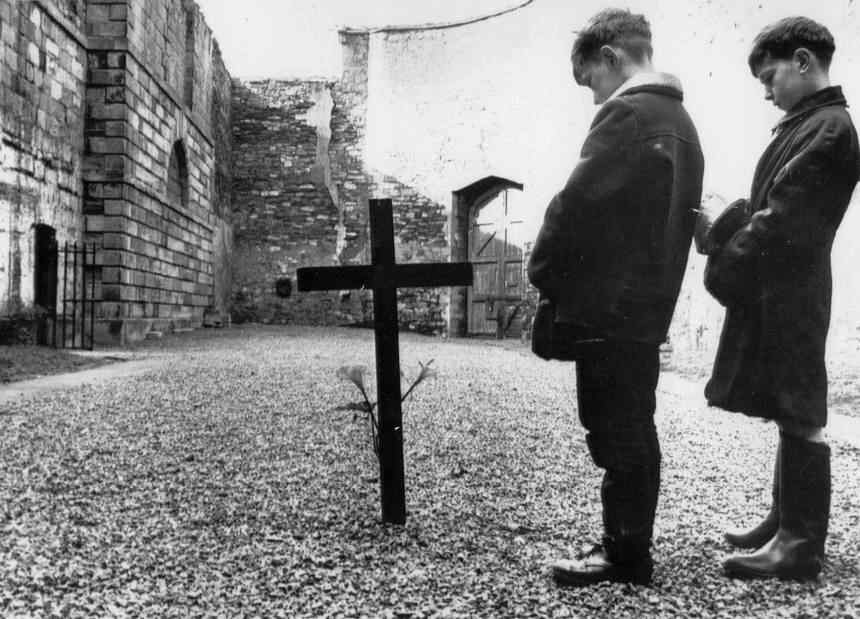
Afterwards, I went to the courtyard and saw the cross marking the spot where the wounded James Connolly was tied to a chair and shot. There were fourteen participants in the Easter Rising executed in the Kilmainham courtyard during May of 1916.
St, Patrick's day is, and should be, a joyous time, even for one like me whose Irish heritage is thin (Update:not so!) and, so far as I know, all on the Protestant side (but remember, Wolfe Tone was a Protestant). Still, it should also be a time to remember what led William Butler Yeats to conclude his poem Easter, 1916 with the words: "A terrible beauty is born."
Here is Henry Marine Service's trim little Dorothy J. making good speed as she approaches the southern tip of Manhattan at Battery Park in the fall of 2006. This Staten Island Advance story from June 9, 2010 tells of Henry Marine's filing for reorganization under Chapter 11 of the Bankruptcy Act, but also recounts Dorothy J.'s heroic role in the 2003 disaster involving the Staten Island Ferry Andrew J. Barberi.
The very small tug W.O. Decker is part of the South Street Seaport Museum's collection of historic vessels. Here she's seen tied up to the lightship Ambrose, also in the Museum's collection.
Another historic tug that has been preserved is Jupiter, shown here docked at Penn's Landing in Philadelphia.
This tug, spotted from the Brooklyn Heights Promenade, has a low profile, indicating that she probably works on inland waterways where low bridges limit clearance, such as the Erie Canal.
It's International Women's Day, so here's a feminist anthem from 1964, the year I graduated from high school, sung by the daughter of the inventor of Gore-Tex.
Bing Crosby's rich baritone is one of my early childhood memories. My parents had his Christmas album, from which I especially remember his stirring rendition of Adeste Fideles, sung in Latin and then in English as "O Come All Ye Faithful", and "White Christmas", on which he sounded as if he had a bit of a cold; for a long time I thought it was "Wide Christmas". Dad and Mom, though neither was Irish, also had his album of songs from the auld sod, which included such soulful traditional ballads as "Mac Namara's Band" and " It's The Same Old Shillelagh". One of my earliest cinema memories is The Road to Bali, one of several "Road" movies, made from the early 1940s to the early '60s, starring Bing, Bob Hope, and Dorothy Lamour.
"My Suppressed Desire", for which I thank Mike Pearl for the link, is from much earlier in Bing's career. Bing isn't credited by name on this 1928 record by Paul Whiteman's Rhythm Boys, with whom Bing did his first recordings. On this song, Bing does some scat singing, which I once had the temerity to compare to abstract expressionist painting.
Anyway, I love this song. It's the theme song from a movie titled Gang War, which, coincidentally, was edited by Archie Marshek, who also edited The Road to Bali.